I am thinkin about getting one of these guys. Any one got any pics or info???
Reptile & Amphibian Forums
Welcome to kingsnake.com's message board system. Here you may share and discuss information with others about your favorite reptile and amphibian related topics such as care and feeding, caging requirements, permits and licenses, and more. Launched in 1997, the kingsnake.com message board system is one of the oldest and largest systems on the internet.


Black Racers
snakemaster24
May 28, 2008 02:48 PM
Replies (4)
batrachos
May 28, 2008 04:23 PM
They're handsome devils. I've never tried keeping an adult in captivity; the juvenile I had would only take skinks, and I never could switch it to pinkies; it eventually escaped.
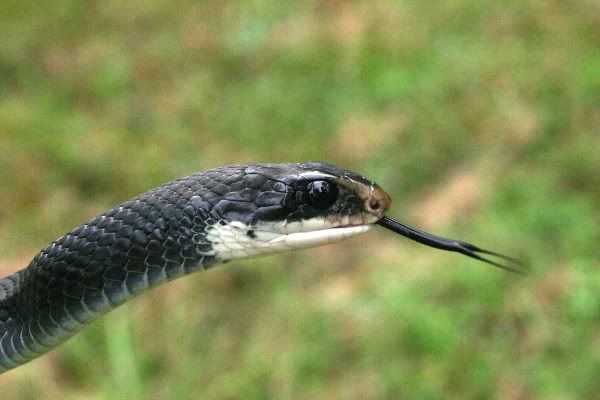
Here's a wild adult, presumably a southern black (Coluber constrictor priapus) in Stewart County, TN.
53kw
May 29, 2008 08:58 PM
Last year I conditioned a pair of Blue Racers for an associate who will use them in education demonstrations and also acclimated ten hatchling Southern Black Racers right out of their eggs.
I find that racers usually accept mice as food, some snakes preferring live but most accepting dead mice. Not all snakes will eat defrosted dead mice so it may still be necessary to have fresh-killed mice to offer. Hatchling racers may need to be offered small frogs or baby snakes to eat before switching to mice. Some of mine switched when I scented defrosted pink mice with chicken. WC racers are likely to need a sense of security and may need to have paper or something else covering the front and sides of their cage so they can't see out. It should not be long before even a wc racer accepts activity outside the cage, as racers are quite intelligent and will realize that they are safe inside their enclosures.
I use a dry bedding like cypress mulch or all-natual forest mulch (not dyed mulch). These are heavier than aspen shavings and give the snakes better purchase when they move. Each cage has a piece of bark to hide under and a water dish. I keep it uncomplicated for easy cleaning since racers have high metabolisms and will produce waste more frequently than some other snakes. All my racers and coachwhips have full-spectrum light that includes one or more Lumichrome bulbs with a temperature of 6700K and a CRI of 98, and also one ZooMed 10.0 UV bulb. Each cage has a basking light at one end that yields a basking temp of around 95. The racers body surface temps are usually around 95-98. They live like mammals and eat like them at these temps, typically more than once per week, although they occasionally go through periods when they will not eat for several weeks. It makes me crazy but they are OK and will eat when they are ready.
Keep the substrate dry except for a bit of soaking when the snakes are opaque before shedding. Racers get small blisters under their scales if too moist and it happens fast. Usually not a problem unless the infection spreads but I don't like to court trouble so my animals are kept on dry bedding until shedding time and even then substrate moisture is kept low.
Use large cages to allow the racers room to feel like they can run if they want. Don't crowd them with live food as it can intimidate them. Experienced hunting racers will wait for their best shot, usually a bite from the side to the neck and back of the head so they can drive their teeth into the spinal nerve and maybe the heart for a fast kill. This means they may have to wait for a live mouse to turn just right before striking and a cage too small unnerves the snake by putting a jumpy live mouse right in its face. Best cages are longer than the racer. If using live food respect the racer's limits and offer food small enough for it to kill with minimal risk of injury to the snake. Mice that will fit in the racer's mouth or that it can get its mouth around the chest area are better than larger mice. If a snake rejects one mouse, try a smaller mouse--the snakes know their limits and will accept a mouse they know they can kill safely but may refuse a feeding strike to a mouse they perceive as too large. Keep trying until you learn your snake's preferences.
All my cages have forced venting from axial fans mounted under the heat bulb to pull warm air out of the cage and replace it with cooler room air from the vent on the far end. This prevents heat creep from overheating the whole cage and leaving the snake no where to escape the heat. My snakes bask under warm bulbs and capture radiant heat just like in the wild rather than living in warm air.
Expect to see an intelligent, spirited snake--one that demands and deserves a genuine commitment to care if it is to thrive, but one of the most rewarding relationships a keeper can have with captive wildlife. Just don't expect the racer to like you any time soon. Many racers and coachwhips tame with handling and even seem to appreciate it but it's a longer process than with a Ball Python and it's likely that, as in the Oscar-winning film, there will be blood.
KevColubrid
May 29, 2008 10:50 PM
"Many racers and coachwhips tame with handling and even seem to appreciate it but it's a longer process than with a Ball Python and it's likely that, as in the Oscar-winning film, there will be blood."
Well said! I've kept numerous yellow bellied racers, adults and juvies both, and I think the same can be said for both of them. They don't like being watched while they eat. I had a young blue racer that I kept for over a year. I knew he was eating, because I'd throw two or three pinkies into his cage, and come back later to find them gone, and him fatter. But never once did I ever see him eat, and if I was present, he wouldn't eat. The same went for the juvenilles I kept, I could get them to eat pinkies without much of a problem just so long as they were small enough. But they were very sensitive to being watched.
The same cannot be said for the coachwhips that I keep. It's like a shark frenzy 
Kevin
53kw
May 30, 2008 07:17 PM
I agree that racers are twitchy about being watched while eating, like Grandma at the family reunion--"Don't take my picture while I have food in my mouth!" My racers will occasionally feed while I watch but I have to remain motionless. The exceptions were two Blue Racers I conditioned last year for an associate who runs a nature center. They arrived from a dealer and were on the thin side. A few live fuzzy mice convinced them to eat everything in sight and the female, who was more agressive, actually came out of the cage in pursuit of a defrosted mouse held in forceps, dropped into a bucket, tolerated having the lid of the bucket put on and still ate her mouse while the male was being fed. Beast. After they gained enough weight to send on their way, I heard from their new caretaker that they are still shameless feeders, although he does offer baby quail, and who could resist that?
My coachwhips fit the description you offered, too. One dislikes the forceps and will sometimes reach around the defrosted mouse and strike the forceps. If I drop the mouse the snake goes right to it and eats it. I wonder if he knows the forceps are holding the mouse and he hits them to make them drop it. He occasionally shakes a mouse like a dog with a rag toy--once threw a mouse several feet out of his cage before I got the door closed (he just lost his grip--fumble! He ate it when I offered it again. Butterfangs) The other male Western just pounds food as soon as the door so much as cracks open. Looking into those coachwhip eyes, I believe he's certain he can get my head into his mouth if I just give him the chance. I think I will not give him the chance. I do have kind of a pin head--what if he's right?
