Reptile & Amphibian Forums

Welcome to kingsnake.com's message board system. Here you may share and discuss information with others about your favorite reptile and amphibian related topics such as care and feeding, caging requirements, permits and licenses, and more. Launched in 1997, the kingsnake.com message board system is one of the oldest and largest systems on the internet.

Click for 65% off Shipping with Reptiles 2 You
Southwestern Center for Herpetological Research
Click here for Dragon Serpents

Rubber Boa and Rosy Boa

CKing May 28, 2008 06:49 PM

Hi, Richard, if you are still visiting this forum, here is something that I just thought of. Rodriguez-Robles et al.'s mtDNA data looks to be in good shape, however there is one anomaly in their tree (actually more than one). That anomaly is the relationship between the rubber and rosy boas. In their tree, the rosy boa is shown to share a more recent common ancestor with the Calabar boa than with the rubber boa. Biogeographically, such a tree makes no sense.

The rosy and rubber boas are obviously close relatives morphologically, and it is very likely that the rosy boa directly descended from the rubber boa. The disjunct distribution of the small morph rubber boa can be explained by a change in the climate and habitat of what is now the Mojave Desert. The rubber boa's distribution was once continuous between the San Bernardino Mt. and Kern County localities, but when the Mojave Desert formed, the Kern County population became isolated from the Southern California populations because of extinction of the rubber boa in this area. Apparently not all of the boas became extinct. Some of them evolved into a new species, namely the Rosy boa, which is better adapted to arid conditions than the small morph rubber boa. The Rosy boa was then able to disperse into arid environments in Arizona and southern California. It is the Rosy boa which is apparently responsible for the spotty distribution of the small morph rubber boa (i.e. umbratica) in Southern California. If someone were to analyze the mtDNA of both the rubber boa and rosy boa, then it may well be shown that the rosy boa is in fact a descendant of the rubber boa.

This anomaly may be responsible for the relatively poor statistical support for the Sierra Nevada subclade (the node with the number 72 next to it). If the rosy boa is in fact a descendant of the rubber boa, then Rodriguez-Robles erred in choosing the rosy boa as an outgroup in constructing their tree. The choice of outgroup is important in phylogenetic analysis and it often meant the difference between a successful one and an unsuccessful one. If a member of the ingroup is chosen as the outgroup, then the tree can be anomalous. That is because similarities are used to construct a tree. A similarity that is due to recent common ancestry but which is mistaken as an shared ancestral character can result in an anomalous tree. You may want to raise that possibility with Rodriguez-Robles or with the scientists who are analyzing mtDNA of the rubber boa.

Regards.

Replies (34)

RichardFHoyer May 29, 2008 10:11 AM

CK,
Late last night I scanned the forums but at the present time, I have other tasks to which I need to attend. Will return later to the forum.

RF Hoyer

RichardFHoyer May 30, 2008 11:37 AM

CK,
Have you seen the following paper?

RF Hoyer
=================================================================

Molecular Ecology (2008) 17, 1918–1929 doi: 10.1111/j.1365-294X.2008.03725.x
© 2008 The Author
Journal compilation © 2008 Blackwell Publishing Ltd
Blackwell Publishing Ltd Good species despite massive hybridization: genetic
research on the contact zone between the water snakes
Nerodia sipedon and N. fasciata in the Carolinas, USA
K. MEBERT
Department of Biological Sciences, Old Dominion University, Norfolk, VA 23529, USA
Abstract
Genomic markers generated with the amplified fragment length polymorphism method
revealed extensive, panmictic-like hybridization along the narrow contact zone between
the water snakes Nerodia sipedon and Nerodia fasciata in the Carolinas, USA. However,
asymmetric distributions of diagnostic markers between both species and low frequencies
of backcrossed hybrids with a high value of interspecific mixture infer selection against
certain genotypes. This is consistent with a pronounced genetic and morphological preponderance
of N. fasciata characters in the hybrid zone. Despite massive hybridization within
the contact zone, the existence of nearly fixed genetic markers and the potential inferiority of
certain hybrid genotypes support the species status of the two taxa and corroborate known,
but nondiagnostic differences in morphology and ecology. This study stretches the
applicability of species concepts to cases, where the genetic compatibility between two
closely related species is very high, yet, they still evolve and persist as independent entities.
Keywords: AFLP, hybridization, incomplete speciation, Nerodia fasciata, Nerodia sipedon, snake
Received 11 March 2007; revision received 8 January 2008; accepted 24 January 2008

CKing May 30, 2008 12:59 PM

>>CK,
>>Have you seen the following paper?
>>
>>RF Hoyer
>>=================================================================
>>
>>Molecular Ecology (2008) 17, 1918–1929 doi: 10.1111/j.1365-294X.2008.03725.x
>>© 2008 The Author
>>Journal compilation © 2008 Blackwell Publishing Ltd
>>Blackwell Publishing Ltd Good species despite massive hybridization: genetic
>>research on the contact zone between the water snakes
>>Nerodia sipedon and N. fasciata in the Carolinas, USA
>>K. MEBERT
>>Department of Biological Sciences, Old Dominion University, Norfolk, VA 23529, USA
>>Abstract
>>Genomic markers generated with the amplified fragment length polymorphism method
>>revealed extensive, panmictic-like hybridization along the narrow contact zone between
>>the water snakes Nerodia sipedon and Nerodia fasciata in the Carolinas, USA. However,
>>asymmetric distributions of diagnostic markers between both species and low frequencies
>>of backcrossed hybrids with a high value of interspecific mixture infer selection against
>>certain genotypes. This is consistent with a pronounced genetic and morphological preponderance
>>of N. fasciata characters in the hybrid zone. Despite massive hybridization within
>>the contact zone, the existence of nearly fixed genetic markers and the potential inferiority of
>>certain hybrid genotypes support the species status of the two taxa and corroborate known,
>>but nondiagnostic differences in morphology and ecology. This study stretches the
>>applicability of species concepts to cases, where the genetic compatibility between two
>>closely related species is very high, yet, they still evolve and persist as independent entities.
>>Keywords: AFLP, hybridization, incomplete speciation, Nerodia fasciata, Nerodia sipedon, snake
>>Received 11 March 2007; revision received 8 January 2008; accepted 24 January 2008

Hi, Richard, I have not seen this paper. Apparently what it describes is not unknown. Interspecific hybrids do occur in nature, as DNA studies have revealed what morphological studies cannot. The wolf, for example, is known to interbreed with the coyote based on DNA studies. From the abstract, it seems that two closely related species have come into secondary contact and there is hybridization. And since the hybrids with features that are intermediate between the two parental species are maladaptive, there is strong selection against them. This is what is predicted by the Biological Species Concept. The BSC further suggests that since the hybrids are maladaptive, natural selection would favor the evolution of premating isolation mechanisms. Once these isolation mechanisms have evolved, then the incidence of interspecific hybridization will be much rarer. Apparently some researchers are not very familiar with the BSC, so many of the phenomena that are consistent with the BSC appear as new revelations to them.

RichardFHoyer Jun 09, 2008 01:07 AM

CK,
The current researcher mentioned something to the effect that the relationship between the Rosy, Calabar, and Rubber Boa are different from what Javier portrayed them in his mtDNA paper.

Also, what information tells you that it was the Rosy Boa that evolved from the Rubber Boa and not the reverse? And isn't there the possibility that both species arose from some common ancestor?

Correct me if I am mistaken but I believe you have mentioned that mtDNA results provide a clue to the age of various lineages. So if that is correct, taking in account the explanation
for Fig. 4 in the Rodriguez-Robles paper along with the relative lengths of the arms of his ML tree, can it be inferred:
1) That the Southern Clade is older than the Northern Clade and that the latter arose from the former? (You have already stated this before.)
2) That the Northwestern subclade is older than the Sierra Nevada subclade?
3) That samples 15, 17, 18, 19, and 26 are older than all other tested samples of the Sierra Nevada subclade?
4) That sample 26 is the oldest member of the Sierra Nevada subclade?

Richard F. Hoyer

CKing Jun 11, 2008 10:46 AM

>>CK,
>>The current researcher mentioned something to the effect that the relationship between the Rosy, Calabar, and Rubber Boa are different from what Javier portrayed them in his mtDNA paper.>>

Rodriguez-Robles et al. did treat the Rosy boa as an outgroup a priori. They never considered the possibility of budding evolution, i.e. that the Rosy boa evolved from one population of the rubber boa, while the rubber boa remained a distinct species that is relatively unchanged.

>>Also, what information tells you that it was the Rosy Boa that evolved from the Rubber Boa and not the reverse? And isn't there the possibility that both species arose from some common ancestor?>>

One basic assumption that cladists such as Rodriguez-Robles make is that speciation occurs exclusively via the process of splitting. Splitting occurs when one ancestral species give rise to 2 daughter species. Budding, however, occurs when one species continues to live relatively unchanged, while one or more new species budded off the ancestral species. The cladists, when pressed, often admit that they don't really believe in splitting, and even Hennig (the father of cladism) himself admits that their assumption of splitting is only a "convention." Cladists sometimes call budding "asymmetric splitting" (meaning that one sibling species evolved far more than the other sibling species and also meaning that cladists are unable to divorce themselves from their own dogma). Cladists justify their intolerance of paraphyletic groups in their classification by asserting that splitting is the predominant means of how new species are formed (even though they then admit that splitting is only a convention). Darwinians, however, maintain that most species are formed by peripatric speciation, in which a small isolated population evolved rapidly into another species while the larger parental population remain relatively unchanged. The old species continues to live and it is paraphyletic. Similarly, higher taxa evolved the same way. A new higher taxon evolves via budding from an exiting higher taxon, thus rendering the parental taxon paraphyletic. Hence paraphyletic taxa are the natural consequence of the process of evolution and they should not be eliminated, despite the cladists' dogmatic intolerance.

Most evolutionary biologists would agree that most new species probably evolved via peripatric speciation or budding, although quite recently it has been demonstrated that sympatric speciation is also quite common. What the cladists assume is that speciation occurs mostly via allopatric speciation, in which two geographically isolated populations evolve into two different species gradually over time and neither species is the same as the parental species.

What leads me to believe that the rosy boa evolved from the rubber boa but not vice versa? One reason is the Mojave Desert. The rosy boa inhabits the Mojave Desert and it is superbly adapted to the desert. The Mojave Desert at one point in time did not exist. This is obvious if we look at the distribution of the rubber boa, because the Kern County rubber boas and the southern rubber boa were once part of the same population. mtDNA divergence between the northern and southern subclades have shown that they have been isolated from each other for approximately 5-12 million years according to Rodriguez-Robles et al. Morphologically they have remained relatively unchanged, making the rubber boa a good candidate as the parental species from which the Rosy boa budded off. The morphological similarities between the Kern County and Southern Rubber boas also argue against splitting, because when splitting occurs, both sibling species are very different from the ancestral species. Since the rubber boa remained largely unchanged, it is difficult to argue that splitting is the speciation mechanism between the rubber and rosy boas. Further, if the rosy boa is ancestral, then the rubber boas from Kern County northward and the southern rubber boa evolved convergently and independently from a desert adapted species into 2 morphologically similar inhabitants of moist woods. It is of course possible, but very unlikely.

Yet another clue that the Mojave Desert is younger than the rubber boa is the distribution of Lampropeltis zonata. The range of L. zonata is interrupted by the Mojave Desert, and yet there are L. zonata found both north and south of this desert, suggesting that the range of L. zonata was also continuous before the formation of the Mojave Desert.

>>Correct me if I am mistaken but I believe you have mentioned that mtDNA results provide a clue to the age of various lineages. So if that is correct, taking in account the explanation
>>for Fig. 4 in the Rodriguez-Robles paper along with the relative lengths of the arms of his ML tree, can it be inferred:
>> 1) That the Southern Clade is older than the Northern Clade and that the latter arose from the former? (You have already stated this before.)

Yes and no. The southern subclade consists of a number of genetically similar populations that appear to have only diverged from one another very recently. Yet, the southern subclade as a lineage is quite old, and the mtDNA marker that the southern and northern subclades share is an ancient one. So, even though the northern subclade is derived from a population that lived in the south, the northern subclade is not descended directly from one of the living populations in the South. However, the morphological similarities between the southern rubber boa and the Kern County small morph boas suggest that neither have diverged morphologically from their common ancestor. So we can safely say that the northern subclade evolved from the southern rubber boa and that the southern rubber boa is closest to the ancestral morphotype of the species.

>> 2) That the Northwestern subclade is older than the Sierra Nevada subclade?

No. That is not the case. Both subclades evolved from a common ancestor subsequent to the split between northern and southern rubber boa subclades. This ancestor is almost certainly a small morph snake. However, what I have maintained is that the Northwestern subclade, which is large morph, evolved the large morph genotype much earlier than the large morph snakes evolved within the Sierra Nevada subclade. Currently the Sierra Nevada subclade includes a mixture of both older small morph populations and younger large morph boas. I have suggested that the small morph snakes within the Sierra Nevada subclade be classified with umbratica in the same subspecies, and the large morph Sierra Nevada boas be classified in its own subspecies, while the Northwestern subclade will be the third subspecies in a 3 subspecies arrangement.

>> 3) That samples 15, 17, 18, 19, and 26 are older than all other tested samples of the Sierra Nevada subclade?

No, that is not exactly what the mtDNA data shows. The mtDNA data shows that these snakes form a lineage, and this lineage is older than the lineage that is comprised of the Kern County small morph boas and the Central Sierra Nevada large morph boas (south of samples 17,18,19 but north of Kern County. However, mtDNA shows that these samples also diverged from one another quite recently. So it appears this old lineage may have arrived relatively in its present location relatively recently. That of course means the possibility of a trans-Valley leak cannot be ignored.

>> 4) That sample 26 is the oldest member of the Sierra Nevada subclade?
>>
>>Richard F. Hoyer

No, Richard. The sample 26, according to the ML tree, is slightly younger than the lineage that gave rise to the Plumas, Butte and Nevada County boas, which are in turn older (as a lineage) than the other Sierra Nevada subclade boas. That is the main reason I think the ancestor of the Butte, Nevada and Plumas County snakes may have been small morph. In fact, one can include sample 26 and the Plumas, Butte and Nevada County boas as part of a paraphyletic northwestern subclade separate from the Sierra Nevada subclade. You raised some very interesting questions that I did not even consider.

emoneill Jun 12, 2008 10:35 PM

I have a suggestion for you, Cking. Download the data from genbank reanalyze it with a more distant outgroup, then publish your results.

CKing Jun 13, 2008 01:17 AM

>>I have a suggestion for you, Cking. Download the data from genbank reanalyze it with a more distant outgroup, then publish your results.>>

Do you have a good suggestion for an outgroup?

batrachos Jun 13, 2008 11:04 AM

You'd probably have to delve into the old world sand boas, I imagine.

CKing Jun 13, 2008 12:39 PM

>>You'd probably have to delve into the old world sand boas, I imagine.>>

I saved several of the papers dealing with snake phylogeny, I think I need to dig them out to see which species is probably a good candidate as outgroup to both the rubber and rosy boas. Eryx reinhardtii may not be a good candidate. It may only be convergently similar to the rubber and rosy boas, or else their similarities are plesiomorphic.

CKing Jun 15, 2008 03:33 PM

>>You'd probably have to delve into the old world sand boas, I imagine.>>

I browsed through several recent papers, and they all show that Exiliboa seems to be the next closest relative of the Charina bottae/Lichanura trivirgata species pair. It makes sense biogeographically and morphologically to have a Mexican species of dwarf boa being ancestral to Charina bottae, in which the dwarf morph is also the ancestral condition. The Calabar boa (transferred to Charina by Kluge) appears to be only convergently similar to Charina bottae.

RichardFHoyer Jun 17, 2008 05:48 PM

CK,
Your using the terms 'subclade' made it a little difficult to follow your post but I believe I got the gist after reading a couple of times. I can see that respect to relative ages, I undoubtedly have misinterpreted the information contained in Javier's graphs. Oh well, back to the drawing board.

Back in the mid 1990s and before I was on the internet, I wrote Glenn Stewart with my 'guess' that the Rubber Boa likely originated in Mexico. From there, over time it then dispersed northward as access to suitable habitat became available. I also mentioned in those letters that I felt the large morph evolved from the dwarf morph and gave a hypothesis as to what selective factors were involved that led to the large morph.

To be able to intelligently speculate as to when, where, and why species evolve, it helps greatly to have a solid background in past geological and meteorological history. I am totally lacking in such background. Of course, that hasn't stopped me from guessing. With Javier's results of two major clades and the two subclades, that seems to have complicated matters considerably.

But from the current known distribution of the two major clades, it might seem that the Northern Clade arose from (budded off) from the Southern Clade south of the current distribution of the latter clade ----- perhaps even in Baja Calif. On the other hand, is it possible that the Southern Clade is younger and budded off the Northern Clade or that the two clades split off of some extinct parent type?

In either case, the Northern Clade dispersed up the coastal mountains of Calif. north and then west of San Diego and the Southern Clade up the interior Mts. northeast of San Diego. The species appears to have completely disappeared south of its current known southerly distributions, the Northern Clade in Ventura county and the Southern Clade in Riverside county.

As mentioned, I have a hypothesis only for 'why' the large morph evolved but little hints as to where and no clue as to when. However, it would seem reasonable that the large morph likely arose north of the current distribution of the dwarf form Taking into account the current distribution of the two subclades in turns suggests that the large morph evolved twice, once from the Sierra Nevada subclade somewhere in the Sierra Nevada Mts. and once from the Northwestern subclade somewhere in the coastal mts. possibly from Baja
Baja Calif. or San Diego county to Monterey county.

To switch gears, a couple of years ago, I exchanged messages with Robert Hansen and questioned the results reported by Kluge. Robert then informed me that recent information suggested that Charina and Calabaria were not all that closely related. Below is part of a recent e-mail from my youngest son Ryan in Utah. Perhaps it was the Noonan paper to which Robert Hansen was referring.
------------------------------------------------------------------------------------------
Bryce Noonan evaluated all boas relationships in a recent paper. See: http://bnoonan.org/Papers/Noonan_Chippindale_06a.pdf In this paper, he presents a phylogeny tree that shows Charina, Lichanura, and Exiliboa on the same branching. Bryce got the rubber boa for that study from me when he was at BYU a few years back doing post doctorate work.
----------------------------------------------------------------------------------------

Richard F. Hoyer

CKing Jun 17, 2008 09:55 PM

>>CK,
>>Your using the terms 'subclade' made it a little difficult to follow your post but I believe I got the gist after reading a couple of times. I can see that respect to relative ages, I undoubtedly have misinterpreted the information contained in Javier's graphs. Oh well, back to the drawing board. >>

Every clade is really a subclade of a more inclusive clade, which is in turn a subclade of an even more inclusive clade. About the only clade that is not a subclade of something else is the clade that includes all life on earth.

>>Back in the mid 1990s and before I was on the internet, I wrote Glenn Stewart with my 'guess' that the Rubber Boa likely originated in Mexico. From there, over time it then dispersed northward as access to suitable habitat became available. I also mentioned in those letters that I felt the large morph evolved from the dwarf morph and gave a hypothesis as to what selective factors were involved that led to the large morph.>>

Very good guess. Without mtDNA data, it is next to impossible to guess where a species may have originated. For example, I thought that Elaphe guttata originated in the east and spread west, but mtDNA data shows the opposite. It originated somewhere in Texas and spread east to Florida.

>>To be able to intelligently speculate as to when, where, and why species evolve, it helps greatly to have a solid background in past geological and meteorological history. I am totally lacking in such background. Of course, that hasn't stopped me from guessing. With Javier's results of two major clades and the two subclades, that seems to have complicated matters considerably. >>

Rodriguez-Robles' two clades can be treated as two subclades, since C. bottae is a clade.

>>But from the current known distribution of the two major clades, it might seem that the Northern Clade arose from (budded off) from the Southern Clade south of the current distribution of the latter clade ----- perhaps even in Baja Calif. On the other hand, is it possible that the Southern Clade is younger and budded off the Northern Clade or that the two clades split off of some extinct parent type?>>

It is certainly possible that the rubber boa may have originated in Baja California, but there is no evidence of its presence there (could be due to lack of collecting). In the area where L. z. agalma now lives, there may well be rubber boas. As to the southern subclade having budded off from the northern subclade, that is not ruled out by the mtDNA data. However, the mtDNA data shows that the northern and southern subclades became separated from one another long before the northwestern and Sierra Nevada subclades evolved. The many populations found in Southern California are all relatively recently derived, but as a lineage it is an old one.

>>In either case, the Northern Clade dispersed up the coastal mountains of Calif. north and then west of San Diego and the Southern Clade up the interior Mts. northeast of San Diego. The species appears to have completely disappeared south of its current known southerly distributions, the Northern Clade in Ventura county and the Southern Clade in Riverside county.>>

I believe the expansion of the Mojave Desert in the past may have wiped the San Gabriel Mt. and Santa Monica Mountain area clean of rubber boas. And the appearance of Lichanura prevented the recolonization of these areas by C. bottae.

>>As mentioned, I have a hypothesis only for 'why' the large morph evolved but little hints as to where and no clue as to when. However, it would seem reasonable that the large morph likely arose north of the current distribution of the dwarf form Taking into account the current distribution of the two subclades in turns suggests that the large morph evolved twice, once from the Sierra Nevada subclade somewhere in the Sierra Nevada Mts. and once from the Northwestern subclade somewhere in the coastal mts. possibly from Baja
>>Baja Calif. or San Diego county to Monterey county.

Parmley, Dennis and Don Walker 2003. Snakes of the Pliocene Taunton Local Fauna of Adams County, Washington with the Description of a New Colubrid. Journal of Herpetology 37(2):235-244

The Northwestern subclade must have evolved more than 3 million years ago because of a fossil rubber boa found in Washington state, described in the paper above.

>>To switch gears, a couple of years ago, I exchanged messages with Robert Hansen and questioned the results reported by Kluge. Robert then informed me that recent information suggested that Charina and Calabaria were not all that closely related. Below is part of a recent e-mail from my youngest son Ryan in Utah. Perhaps it was the Noonan paper to which Robert Hansen was referring.
>>------------------------------------------------------------------------------------------
>>Bryce Noonan evaluated all boas relationships in a recent paper. See: http://bnoonan.org/Papers/Noonan_Chippindale_06a.pdf In this paper, he presents a phylogeny tree that shows Charina, Lichanura, and Exiliboa on the same branching. Bryce got the rubber boa for that study from me when he was at BYU a few years back doing post doctorate work.
>>----------------------------------------------------------------------------------------
>>
>>Richard F. Hoyer

I have seen quite a few papers that suggest Boa constrictor is actually more closely related to the rubber boa than either one of them is to the Calabar boa.

CKing Jun 17, 2008 10:36 PM

>>CK,

>>To switch gears, a couple of years ago, I exchanged messages with Robert Hansen and questioned the results reported by Kluge. Robert then informed me that recent information suggested that Charina and Calabaria were not all that closely related. Below is part of a recent e-mail from my youngest son Ryan in Utah. Perhaps it was the Noonan paper to which Robert Hansen was referring.
>>------------------------------------------------------------------------------------------
>>Bryce Noonan evaluated all boas relationships in a recent paper. See: http://bnoonan.org/Papers/Noonan_Chippindale_06a.pdf In this paper, he presents a phylogeny tree that shows Charina, Lichanura, and Exiliboa on the same branching. Bryce got the rubber boa for that study from me when he was at BYU a few years back doing post doctorate work.
>>----------------------------------------------------------------------------------------
>>
>>Richard F. Hoyer

There are other papers that show similar relationships, contradicting Kluge's morphological analysis. Such as this one below:

http://evo.bio.psu.edu/hedgeslab/Publications/PDF-files/141.pdf

Nicolas Vidal, S. Blair Hedges 2002. Higher-level relationships of snakes inferred from four nuclear and mitochondrial genes. C. R. Biologies 325 (2002) 977–985

CKing Jun 18, 2008 12:22 AM

>>CK,

>>But from the current known distribution of the two major clades, it might seem that the Northern Clade arose from (budded off) from the Southern Clade south of the current distribution of the latter clade ----- perhaps even in Baja Calif. On the other hand, is it possible that the Southern Clade is younger and budded off the Northern Clade or that the two clades split off of some extinct parent type?>>

Hi, Richard. I apologize for rewriting my response to this one point, but I would like to address it in greater detail than I did originally. The following paper claims that Baja California was connected to mainland Western Mexico 4-5 million years ago.

http://www.pnas.org/cgi/reprint/97/26/14017

As I pointed out in another response, fossil C. bottae is known from Washington State about 3 million years ago. Depending on how long it took Baja California to arrive at its present location, there may not be enough time for the rubber boa to have originated in Baja and then for Baja to reach its present position, while leaving enough time for it to reach Washington State. 4-5 million years also appeared to be much younger than Rodriguez-Robles' estimate of the age of the Rubber Boa as a species.

Of course the southern and northern subclades once shared a common ancestor, therefore making both subclades the same age. However, this common ancestor is almost certainly a small morph snake, since the small morph phenotype is found in both lineages. To assert that the large morph is ancestral would require a reversal in evolution: i.e. large morph ancestor -> small morph intermediate -> large morph Northwestern subclade. Of course reversals are possible, but most systematists prefer not to assume that it has happened unless there is specific evidence to support it. Since there does not appear to be any good reason to believe there was a reversal, the likely common ancestor of all rubber boas would appear to be the dwarf morph. As such it is assignable to umbratica, since this lineage appeared to have changed very little since it evolved. Hence I believe budding, in which the northern subclade budded off a small isolated population of the southern subclade, seems more likely than splitting, in which two populations of about the same size diverged from each other and from a common ancestor that is unlike either subclade but is now extinct. Budding of course would create a paraphyletic umbratica. Since cladists dislike paraphyletic taxa, they would much prefer to believe that splitting was the process which had created "C. bottae" and "C. umbratica." Nevertheless, it would be difficult to fathom a common ancestor of the northern and southern subclades that is anything other than a small morph population that is virtually indistinguishable for either the Kern County small morph boas or umbratica in Southern California. That means it would appear to be fitting evidence into cladistic dogma to claim that the SRB and the norther populations evolved through splitting instead of budding.

PS I posted several different messages that mysteriously disappeared a few hours later. One of these concern the distribution of C. bottae near Lassen National Park. The Calif. Acad. of Sci. has conducted some recent surveys in this area, and it appeared that there are boas both north and south of the park, with the distance between the northern locality and the southern locality separated from each other by a mere 15 miles or so.

RichardFHoyer Jun 23, 2008 12:54 AM

CK,
Need to be educated. What precisely in the definition of 'paraphyletic taxa' and what is or are the alternatives that the cladists embrace?

Secondly, you sort of lost me when you begin my mentioning that the southern and northern subclades are the same age. But then later indicate that the northern subclade likely budded off of the southern subclade which in turn would indicate that the northern subclade is younger than the parent southern subclade.

I thought I mentioned the following once before. I took a couple of side trips to view the habitat in all directions of Mt. Lassen and to make some searches. I confirmed that there is no break in suitable boa habitat anywhere in that region. Secondly, I collected two specimens northwest of Mt. Lassen in Shasta county near the junction of highways 89 and 299 near Burney, one specimen northeast of Mt. Lassen in western Lassen county along hwy 44, and two specimens southeast of Mt. Lassen near Deer Creek along hwy 36 in extreme northeastern Tehama county. Shortly thereafter, in my communication with Chris Feldman, I learned that he and another grad student at Utah St. U. had collected a number of other boas in the vicinity of Mt. Lassen in Plumas and Lassen counties and perhaps also in Shasta Co. that were for the CAS collection.

Thus about 2 years ago, I urged the current researcher to have all of those samples tested which he has done. It is from those specimens plus some others that were deposited at CAS from yet a forth county that have produced results that conflict with Javier's hypothesis that a break occurs in the distribution of the species and that the Northwestern and Sierra Nevada subclades are thus allopatric in distribution. As I have mentioned some time ago, biologically such a scenario makes no sense given the fact that suitable boa habitat occurs throughout that region.

Richard F. Hoyer

CKing Jun 23, 2008 12:48 PM

>>CK,
>>Need to be educated. What precisely in the definition of 'paraphyletic taxa' and what is or are the alternatives that the cladists embrace?>>

A paraphyletic group is a monophyletic taxon (as traditionally defined) which does not include all the derived ex-groups. ---Mayr and Ashlock 1991

Hi, Richard. The term paraphyletic is an important one because a vast majority of the taxonomic proposals above the species rank we are seeing nowadays are based on the rejection of paraphyletic taxa by the German scientist Willi Hennig and his many followers, who are often known as cladists or “phylogenetic systematists.” There are other schools of systematists, namely the pheneticists (who claim that the order of descent is unknowable), and the Darwinians or traditional systematists. Pheneticism is on the decline because very few people still maintain that branching order or evolutionary history is unknowable. MtDNA and other molecular techniques, not to mention traditional morphological and paleontological (stratigraphic) evidence show that historical branching order can be estimated and in many cases with a great degree of certainty.

Today, we have basically two major schools of taxonomy: the Darwinians and the cladists. Perhaps the main difference between these 2 schools is their treatment of paraphyletic taxa. Darwinians accept paraphyletic taxa as valid but the cladists in general do not. There are a few cladists that do tolerate paraphyletic taxa but they are regarded with suspicion by the more orthodox cladists. Basically cladists will only recognize taxa that consist of a single ancestor and all of the descendant species of this ancestor. For example, cladists would not recognize the chimps, gorillas, orangutan, and gibbons as members of the family Pongidae, because this groupd excludes all of the bipedal primates including the australopithecines and the genus Homo. Some cladists have proposed including the chimps and gorillas in the family Hominidae, while other, even more radical cladistic proposals lump the chimps, gorillas and humans into the genus Homo.

What precisely are paraphyletic taxa? Ever since Darwin, biologists have accepted evolution as a basic fact and Darwin’s idea that all life on earth shares a single common ancestor. Thus all life on earth is monophyletic. “Monophyletic…was a term that was coined by Haeckel in 1866 in support of Darwin’s theory of common descent….Haeckel applied the term monophyletic to all the taxa recognized in his time—for instance, Reptilia, Aves, and Mammalia—each of which he thought consisted of descendants of a nearest common ancestor” (Mayr and Ashlock 1991, Principles of Systematic Zoology).

Then, in 1950, the German scientist Willi Hennig redefined the term “monophyletic.” “For him, a taxon is monophyletic only when it consists of the totality of the descendants of the ancestral stem species” (Mayr and Ashlock 1991). According to Hennig, a taxon like Reptilia, which consists of a group of species descended from a single ancestral species but not all of the descendants of that ancestral species, is not monophyletic. To Hennig and the cladists, Reptilia is “paraphyletic” because this taxon does not include birds and mammals, which are also descended from the ancestor of the Reptilia. Another taxon that is considered paraphyletic is Prokaryota. The classic distinction between Eukaryota and Prokaryota makes Prokaryota a paraphyletic taxon, because the eukaryotes are descended from a prokaryote, but the eukaryotes are excluded from Prokaryota. Hennig’s redefinition of monophyletic was largely ignored because his book was written in German and his ideas were unknown to most biologists around the world. Later, in 1966, his book was translated into English. His ideas gained popularity in the 1970’s and these ideas became more widely accepted in the 1980’s and 1990’s.

Arnold Kluge is a famous cladist who wrote many articles in the journal Cladistics concerning cladistic theory and practice. Practically all of Kluge’s taxonomic proposals (for example his proposal to classify Chondropython viridis as a member of Morelia) are based on the cladistic principle that paraphyletic taxa ought not be recognized. Since Morelia, according to his data, would become paraphyletic if Chondropython is recognized, he transferred C. viridis to Morelia. It does not matter to him or a vast majority of cladists whether C. viridis is morphologically disparate from Morelia. They are only concerned with eliminating paraphyletic taxa. Reptilia, as mentioned earlier, is paraphyletic. In an attempt to make Reptilia “monophyletic” sensu cladism, some cladists redefine Reptilia as all amniotes except the mammals and the therapsid and synapsid reptiles which are basal to the mammalian branch of the tree. The cladistic Reptilia also includes birds; Aves is therefore a part of cladistic Reptilia. Most scientists and laymen continue to recognize Reptilia as valid and monophyletic, and they continue to recognize Aves as a taxon equal in taxonomic rank to Reptlia. In fact, the cladists' taxonomic practice has largely been ignored by the rest of the scientific community. Even some cladists said they dislike the cladistic redefinition of Reptilia, but they nevertheless have to accept it because it adheres to the cladistic principle of intolerance of paraphyletic taxa and because disobedience to this principle can have undesirable consequences.

Cladists often find vociferous and widespread opposition to their incessant taxonomic proposals to lump and split taxa on the basis of their intolerance of paraphyletic taxa. Hence, even in their own writings, many of them have wisely chosen not to use the term paraphyletic. They instead use the more ambiguous term “non-monophyletic” or “not monopyletic.” Of course such a practice is dishonest because “not monophyletic”, to most people including the cladists, may also mean polyphyletic. In fact, to many Darwinians, the term paraphyletic makes no sense, because they consider paraphyletic taxa monophyletic. Therefore, many people who are not familiar with the cladists’ intolerance of paraphyletic taxa often do not know that a new taxonomic proposal is made by a cladist (because cladists often do not brand themselves as cladists in their own scientific papers). By avoiding the use of the term paraphyletic, many cladists also attempt to conceal the fact that they are splitting or lumping taxa on the basis of cladistic intolerance of paraphyletic taxa. Many scientists and laymen are instead misled into thinking that the “non-monophyletic” or “not monophyletic” taxa being disqualified by the cladists may be polyphyletic, because to them, that is what "not monophyletic" means. To most biologists, the term "not monophyletic" means polyphyletic. Therefore the cladists are using dishonest practices in order to gain wider acceptance to their taxonomic proposals.

>>Secondly, you sort of lost me when you begin my mentioning that the southern and northern subclades are the same age. But then later indicate that the northern subclade likely budded off of the southern subclade which in turn would indicate that the northern subclade is younger than the parent southern subclade. >>

The northern and southern subclades of the rubber boa are both descended from their common ancestor. Therefore they are the same age. However, I also pointed out that this common ancestor is almost certainly a dwarf morph boa that is morphologically indistinguishable from the southern subclade. Therefore one can consider the southern subclade to in fact be the lineage that dates all the way back to the founding population of the species Charina bottae. Hence, it is with this broader definition of the southern subclade that I claimed that the northern subclade had budded off the southern subclade. I would also include the Kern county dwarf boas as part of the southern subclade since they appeared to be morphologically indistinguishable from the common ancestor of the southern California boas and their common ancestor and their lineage is also basal to the large morphs (both northwestern and Sierra Nevada large morphs). Perhaps I should have made that more clear. My definition of the Sierra Nevada subclade would therefore exclude the Kern County dwarf morph boas and the southern Rubber boa would be a paraphyletic group. I was switching between my own definitions of subclades and Rodriguez-Robles et al.’s definitions without making it more clear. That may have confused you and I apologize.

>>I thought I mentioned the following once before. I took a couple of side trips to view the habitat in all directions of Mt. Lassen and to make some searches. I confirmed that there is no break in suitable boa habitat anywhere in that region. Secondly, I collected two specimens northwest of Mt. Lassen in Shasta county near the junction of highways 89 and 299 near Burney, one specimen northeast of Mt. Lassen in western Lassen county along hwy 44, and two specimens southeast of Mt. Lassen near Deer Creek along hwy 36 in extreme northeastern Tehama county. Shortly thereafter, in my communication with Chris Feldman, I learned that he and another grad student at Utah St. U. had collected a number of other boas in the vicinity of Mt. Lassen in Plumas and Lassen counties and perhaps also in Shasta Co. that were for the CAS collection. >>

Perhaps I wasn’t paying close enough attention to what you wrote. I apologize if that is the case.

>>Thus about 2 years ago, I urged the current researcher to have all of those samples tested which he has done. It is from those specimens plus some others that were deposited at CAS from yet a forth county that have produced results that conflict with Javier's hypothesis that a break occurs in the distribution of the species and that the Northwestern and Sierra Nevada subclades are thus allopatric in distribution. As I have mentioned some time ago, biologically such a scenario makes no sense given the fact that suitable boa habitat occurs throughout that region.
>>
>>Richard F. Hoyer

At the time of Rodriguez-Robles et al.’s paper, there was indeed a break in the distribution of the rubber boa in the vicinity of Lassen National Park. Depending on the mtDNA haplotypes of these additional specimens, Rodriguez-Robles et al.’s claim of allopatry may or may not be disproven. I am curious as to the phylogenetic affinity of these boas, but I will await publication of the results.


RichardFHoyer Jun 27, 2008 03:52 PM

CK,
Thanks for the explanation but due to my lack of background, it is still not all that clear.

There is one large disconnect in our thinking regarding C. bottle distribution when you mention, "At the time of Rodriguez-Robles et al.’s paper, there was indeed a break in the distribution of the rubber boa in the vicinity of Lassen National Park."

The notion that a break existed in the distribution of the species in the Mt. Lassen region at the time of Javier' study is not rational but was due to a lack of available finer scale sampling. In other words, the authors reached an erroneous conclusion simply because tissue was only available from boas that occurred at considerable distance from one another. If the only tissue available had been from vouchers near Mt Hood in Oregon and Lake Tahoe, it would be just as irrational to claim that a break in the distribution of the species exists from near Mt. Hood to Lake Tahoe.

So as they do not repeat the same error, I have already mentioned to Glenn and Rick that they need to exercise caution when making interpretations where large gaps exist between related haplotypes because the tendency is conclude that such a gaps are real. An equal or even more likely explanation is that such gaps are due to short comings in sampling as was the case in Javier's study.

I recently received a copy of the MP consensus tree for the new mtDNA study. On a large scale, the result duplicate and confirm Javier's results of three major groupings or subclades. On a finer scale, there occurs some new results that conflict with conclusions reached by Javier. But that is to be expect in research and it will be of interest how these new results are interpreted.

Richard F. Hoyer

CKing Jun 28, 2008 12:38 AM

>>CK,
>>Thanks for the explanation but due to my lack of background, it is still not all that clear.>>

I presume you mean my explanation of paraphyletic taxa. It is, as I said, an important concept since a vast majority of the taxonomic proposals are based on the cladists’ intolerance of paraphyletic taxa. For example, such recent changes as the transfer of Hyla regilla to Pseudacris, the splitting of Clemmys into several different genera, the resurrection of Pantherophis for N. American species of Elaphe, and the recently proposed lumping of N. American species of Elaphe with Pituophis are all examples of the cladists’ intolerance of paraphyletic taxa.

Basically a paraphyletic taxon is one in which some of the descendants of the common ancestor of that taxon have been excluded. For example, Reptilia (as traditionally defined) is paraphyletic (according to the cladists) because the common ancestor of Reptilia also gave rise to mammals and birds, which are traditionally classified in Mammalia and Aves respectively. The taxon Aves, however, is not considered paraphyletic by the cladists because as far as we know, no species that has evolved from the common ancestor of the birds has been excluded from Aves. Darwinians make no distinction between paraphyletic and monophyletic taxa, but the cladists do. This is why there is often big controversies when there are new taxonomic proposals made on the basis of the cladistic intolerance of paraphyletic taxa (e.g. the proposed split of Iguanidae into several different families a little over a decade ago).

>>There is one large disconnect in our thinking regarding C. bottle distribution when you mention, "At the time of Rodriguez-Robles et al.’s paper, there was indeed a break in the distribution of the rubber boa in the vicinity of Lassen National Park.">>

According to scientific data available at the time of Rodriguez-Robles’s paper, there was a break in the distribution of C. bottae. As you know very well, scientists can only base their conclusion on the available data, although you also know very well that this is not always the case. When there is new data, revisions to the existing theory should be made if necessary, although you also know very well that it is not always done.

>>The notion that a break existed in the distribution of the species in the Mt. Lassen region at the time of Javier' study is not rational but was due to a lack of available finer scale sampling. In other words, the authors reached an erroneous conclusion simply because tissue was only available from boas that occurred at considerable distance from one another. If the only tissue available had been from vouchers near Mt Hood in Oregon and Lake Tahoe, it would be just as irrational to claim that a break in the distribution of the species exists from near Mt. Hood to Lake Tahoe.>>

With hindsight, it is clear that Rodriguez-Robles et al. reached an incorrect conclusion concerning the existence of the break in distribution. However, they did follow scientific procedure in basing their conclusion only on the available data.

>>So as they do not repeat the same error, I have already mentioned to Glenn and Rick that they need to exercise caution when making interpretations where large gaps exist between related haplotypes because the tendency is conclude that such a gaps are real. An equal or even more likely explanation is that such gaps are due to short comings in sampling as was the case in Javier's study.>>

To your credit, your prediction that the break is due to lack of collection is correct. However, as you pointed out in one of your papers, rubber boas are extremely difficult to find, even for experts. Therefore, it is understandable how there can be no samples from the area surrounding Lassen National Park until the recent past.

>>I recently received a copy of the MP consensus tree for the new mtDNA study. On a large scale, the result duplicate and confirm Javier's results of three major groupings or subclades. On a finer scale, there occurs some new results that conflict with conclusions reached by Javier. But that is to be expect in research and it will be of interest how these new results are interpreted.
>>
>>Richard F. Hoyer

Thanks. As far as I can tell, Rodriguez-Robles’ several mtDNA based studies are quite reliable. Overall he did a very good job of sampling. Since you are apparently unable to reveal more of the results, I will await its publication and see if I agree with the new interpretation. BTW, I notice that recently there has been a publication of mtDNA data of the rosy boa. I have good reason to believe that the rosy boa probably budded from a small population of the rubber boa. Osteologically the two species are nearly indistinguishable (according to the paleontologists who compared their vertebra), and these two species have complementary but non-overlapping ranges. This is almost a classic case of budding, in which environmental changes isolated two populations of the same species, with subsequent divergent evolution of one of these populations while the parental population remains relatively unchanged.

It would be interesting if the mtDNA of both species are combined in a single phylogenetic analysis. It may indeed show that the rosy boa budded from the rubber boa. If so, then the rubber boa would be paraphyletic, because all of the descendants of the last common ancestor of rubber boa would not be included in C. bottae, since some of the descendants are now in L. trivirgata. Of course that would drive the cladists nuts, and they may splinter C. bottae into several different species, just as Shaffer et al. had separated Ambystoma tigrinum californiense from A. trigrinum primarily on the basis of an intolerance of paraphyletic taxa.

apeltes Sep 30, 2008 11:14 AM

You say the reptilia is a taxon that consists of all descendents of a common reptilian ancestor, minus the birds and mammals.

What use does the group serve, then, if it's not complete? In other words, what does "reptile" mean, if it does not refer to a group of organisms more closely related to members of the group than to members of other groups?

CKing Jun 29, 2008 11:16 AM

>>CK,
>>I recently received a copy of the MP consensus tree for the new mtDNA study. On a large scale, the result duplicate and confirm Javier's results of three major groupings or subclades.>>
>>Richard F. Hoyer

The terms clade and subclade are the favorite jargon of the cladists. Cladists are so named because they are obsessed with "discovering" clades, or groups that consist of a single common ancestor and ALL of the descendant species of this common ancestor. The term "all" is emphasized because if some of the descendant species of this group are excluded, the cladists no longer consider the group a clade, or a monophyletic group. The term clade has a different meaning for traditional, or Darwinian taxonomists. The traditional or Darwinian taxonomists consider Reptilia, for example, a clade because all species within Reptilia share a recent common ancestor, even though not all descendant species of this recent common ancestor are included. Cladists call such groups paraphyletic, and they will seek to either splinter or lump without regard to morphological differences until there are no more paraphyletic groups in their taxonomy.

The "clades" and "subclades" delimited by mtDNA data differ from the morphotypes within the rubber boa. For example, if the 2 large morph boa subclades are given subspecies recognition and the small morph boas of Kern County are classified as umbratica in a 3 subspecies arrangement that I favor, the small morph boas (umbratica) would become a paraphyletic taxon. The cladists would almost certainly not accept such an arrangement, because they despise paraphyletic groups, even though such a taxonomic arrangement would inform us that the small morph represents the ancestral condition and that the large morph populations were derived independently (budded) from the small morph snakes.

The current 2 subspecies or 2 species taxonomic arrangement of umbratica and bottae is unsatisfactory because bottae contain a mixture of 2 lineages of independently derived large morph snakes and also a population of small morph Kern County snakes which have changed very little (if at all) since becoming geographically isolated from the Southern California (umbratica) populations. The 2 taxa arrangement also tells us nothing of the existence of the large morphs within the northern subclade, and it tells us nothing about the separate evolutionary origins of the 2 large morph populations. Instead, it misinforms us into believing that the Kern County boas are different from the dwarf form found in Southern California and that they more closely resemble the large morph snakes in the Pacific Northwest and Sierra Nevada Mountains.

Nevertheless, the cladists would favor the 2 taxon arrangement because such an enlargement allow them to recognize taxa that consist of a single common ancestor and all of its descendant species. In other words, such an arrangement allows them to avoid recognizing taxa that are paraphyletic.

CKing Jun 26, 2008 01:53 AM

>>CK,
>>The current researcher mentioned something to the effect that the relationship between the Rosy, Calabar, and Rubber Boa are different from what Javier portrayed them in his mtDNA paper.
>>
>>Also, what information tells you that it was the Rosy Boa that evolved from the Rubber Boa and not the reverse? And isn't there the possibility that both species arose from some common ancestor?>>

Here is additional information that would suggest the Rosy Boa evolved (or budded) from the rubber boa. I found the following paper regarding a mtDNA analysis of the Rosy Boa

http://www.cnah.org/pdf_files/929.pdf

A quote: "The average sequence divergence (uncorrected) between all L. trivirgata haplotypes is 3.3%, (ranging from 0.09% to 6.3%). Sequence divergence estimates between L. trivirgata and its nearest relative (C. bottae) range from 14.4% to 16.7%."

mtDNA data therefore shows that there is less divergence within L. trivirgata than there is between L. trivirgata and C. bottae. It means L. trivirgata is considerably younger as a species than the common ancestor of L. trivirgata and C. bottae. If C. bottae had budded from (or evolved from an isolated population of) L. trivirgata, we would expect the many populations of L. trivirgata to have greater sequence divergence than the common ancestor of L. trivirgata and C. bottae. L. trivirgata is relatively young as a species, therefore it could not have been ancestral to C. bottae.

A similar situation exists in the y chromosome sequences of human beings. There is much greater sequence divergence among the human populations in Africa than there are sequence divergences among all of the world's non-African human populations. It means all of the World's non-African populations share a more recent common ancestor with each other than the many populations of Africans do with each other and that the non-African populations originated in Africa.

emoneill Jul 20, 2008 02:21 PM

"That anomaly is the relationship between the rubber and rosy boas. In their tree, the rosy boa is shown to share a more recent common ancestor with the Calabar boa than with the rubber boa."

I think you should look carefully at the tree and think about what sharing a common ancestor means. You might notice that in the phylogeny, Charina forms a monophyletic group. Therefore all Charina share a recent common ancestor, not shared by Eryx. For your statement above to be true, Charina would have to be paraphyletic, which is not what is shown in the tree.

CKing Jul 20, 2008 11:46 PM

>>I think you should look carefully at the tree and think about what sharing a common ancestor means. You might notice that in the phylogeny, Charina forms a monophyletic group. Therefore all Charina share a recent common ancestor, not shared by Eryx. For your statement above to be true, Charina would have to be paraphyletic, which is not what is shown in the tree.>>

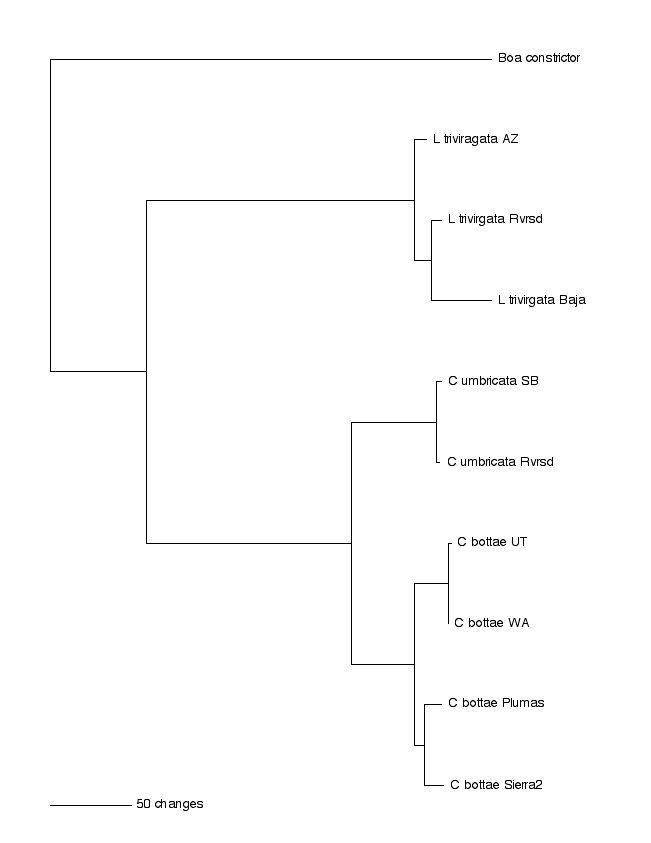
What a tree can show often depends on how many samples are included in constructing that tree. So far no one has included multiple samples of both C. bottae and L. trivirgata in a single analysis of their mtDNA. When that is done, it will probably be shown that L. trivirgata is nested within C. bottae.

emoneill Jul 21, 2008 11:16 AM

As a preliminary test of this you could rerun the analysis with only Eryx as the outgroup, assuming you have access to software (e.g. Paup).

emoneill Jul 21, 2008 11:21 PM

Sorry I thought Eryx was the calabar boa. I did not realize Charina Reinhardtii was the one you were talking about. Now I see your point. I am not as familiar with the taxa as I am with phylogenetics.

CKing Jul 22, 2008 12:11 AM

>>Sorry I thought Eryx was the calabar boa. I did not realize Charina Reinhardtii was the one you were talking about. Now I see your point. I am not as familiar with the taxa as I am with phylogenetics.>>

"Charina reinhardtii" is now Calabaria reinhardtii. As I predicted in the past, Kluge's morphological analaysis was in error, as evidenced by mtDNA data. As mtDNA and other molecular data become more widely available, most of the taxonomic proposals made using morphology based cladistic analyses will likely be overturned.

Only where DNA data is unavailable, e.g. in paleontology, can cladists be dogmatic about the results of their analyses. One of the most dogmatic groups of cladists are the paleontologists, who continue to insist that birds are descended from theropod dinosaurs, even in the face of a large volume of opposing developmental, stratigraphic, biophysical and comparative anatomical data.

DHL Aug 11, 2008 05:40 PM


An analysis of the available mtDNA data shows that Lichanura is NOT nested within Charina.

CKing Aug 12, 2008 03:37 PM

>>
>>An analysis of the available mtDNA data shows that Lichanura is NOT nested within Charina.>>

What is the source of your "available data?"

DHL Aug 12, 2008 04:05 PM

Genbank. Sequences were sub-sampled from both studies.

DHL Aug 12, 2008 04:28 PM

And by both studies I mean to say Rodriguez-Robles et al. 2001 and Wood et al. 2008. The data set consists of the ND1 and ND4 gene regions. Analysis was maximum-parsimony, transversions weighed 2X transitions.

emoneill Aug 12, 2008 09:43 PM

Nice work DHL. Thank you for posting that.

CKing Aug 13, 2008 10:14 AM

>>Genbank. Sequences were sub-sampled from both studies.>>

LOL. You don't know what you are talking about.

DHL Aug 13, 2008 10:25 AM

Care to explain?

emoneill Aug 19, 2008 07:00 PM

Nice job scooping that jerk CKing! I suggested he download the data, but he was too busy jabbering on about his pet hypothesis to actually test it. Classic!

Site Tools