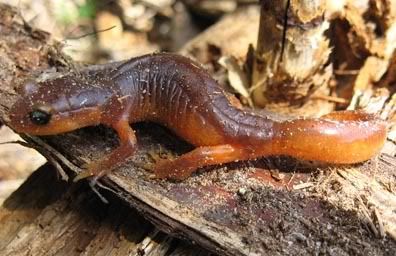
Hi, I found this picture tonight. I took it several years ago at my Caliveras County ranch, about the 2500' elevation. This individual was hiding under a half bark round at the edge of the chicken coup. I am posting it for your enjoyment and hoping to get an I.D. at the same time.

Foot Hill Reptiles
Reptile & Amphibian Forums
Welcome to kingsnake.com's message board system. Here you may share and discuss information with others about your favorite reptile and amphibian related topics such as care and feeding, caging requirements, permits and licenses, and more. Launched in 1997, the kingsnake.com message board system is one of the oldest and largest systems on the internet.



An I.D. Please?
JasonW
Jul 06, 2008 02:20 AM
Replies (6)
batrachos
Jul 06, 2008 08:22 PM
Nice shot! That's definitely a Pacific newt (Taricha species); I'm not sure which one you have in your area.
CKing
Jul 07, 2008 10:30 PM
>>Hi, I found this picture tonight. I took it several years ago at my Caliveras County ranch, about the 2500' elevation. This individual was hiding under a half bark round at the edge of the chicken coup. I am posting it for your enjoyment and hoping to get an I.D. at the same time.
>>
>>Foot Hill Reptiles
That looks like an Ensatina, a sort of lungless salamander. This individual is interesting because it has a regenerating tail. Must have survived an encounter with a (mammalian?) predator and lost its tail. Many salamanders use their tails to draw attention away from their bodies. A predator will bite on the tail, which is often waved around by the salamander and/or held up high. When the salamander is bitten, the tail will release a lot of poison, making the tail very distasteful in the mouth of the predator. The predator then moves on, leaving the salamander to live another day.
Many people think that the Ensatina is a mimic of the California newt, but I doubt it. The Ensatina, just like the tiger salamander, can survive on its own defense strategy without mimicking newts. BTW, some newts also have stump tails, proving that even newts will use the same defense strategy as many less toxic salamanders.
Note the costal grooves found on this salmander, which are not found in newts.
zippybomb
Feb 02, 2009 08:45 PM
ensatinas don't swim. that one has webbed feet and ensatinas are brownish. the juvenilles are black and blue spotted.
tspuckler
Jul 08, 2008 07:42 AM
It's an Ensatina, one of the more commom woodland salamanders in California. They are highly variable in color and sometimes have blotched patterns. On occasion, they get decent-sized. I've mostly found yellow and orange types - that's a sweet looking red one!
Tim
Here's one I found in Santa Cruz in April:
Third Eye
batrachos
Jul 08, 2008 11:23 AM
You guys are right, I was too hasty in my ID. Sorry for any confusion!
CKing
Jul 08, 2008 03:56 PM
>>You guys are right, I was too hasty in my ID. Sorry for any confusion!>>
LOL. Your "confusion" lends support to the hypothesis that Ensatina is a "mimic" of the newts in the genus Taricha.
http://www.biol.lu.se/zooekologi/epb/people-en/es-en/Shawn/pdf%20downloads/2008%20Kuchta%20et%20al%20Evolution.pdf
OTOH, here is a photo of what an owl did to a "coral-snake mimic." Being a "mimic" is of questionable value. 

