Reptile & Amphibian Forums

Welcome to kingsnake.com's message board system. Here you may share and discuss information with others about your favorite reptile and amphibian related topics such as care and feeding, caging requirements, permits and licenses, and more. Launched in 1997, the kingsnake.com message board system is one of the oldest and largest systems on the internet.

Click here to visit Classifieds
aghiowa Jul 18, 2008 06:57 PM

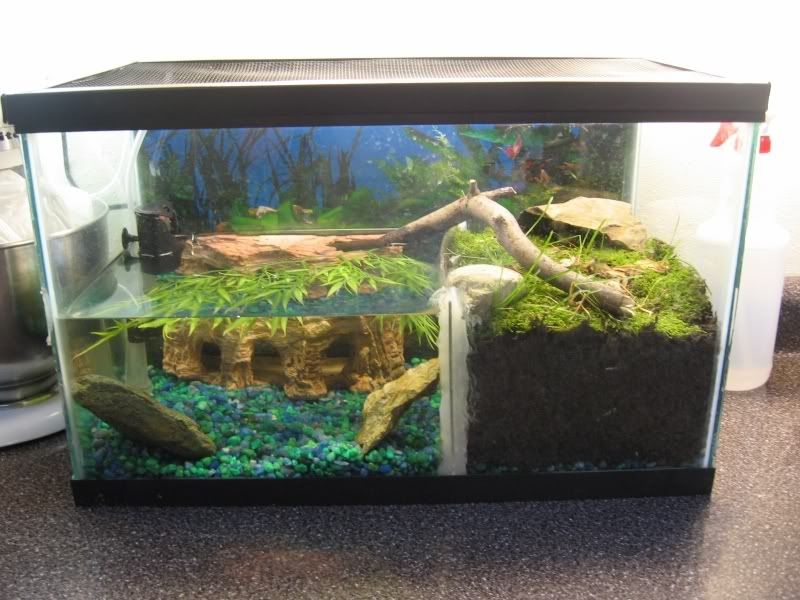
Hi everyone! We just got a new fire belly newt yesterday. He/she is smaller than I thought - body length of probably 1 1/2-2" (more with tail). I have set up a semi-aquatic 10 gallon aquarium with room temp water, a filter, rocks, a land area with compost and moss, etc. So far all it does is hide under its rock on land.

Is this normal behavior, or is something wrong with it? Also, it doesn't seem to know how to swim. It once slipped into the water and thrashed about until it got to dry land.

It's just frustrating. I did a lot of research and set up to try to get the perfect environment for the little guy and I don't think it's acting like everything is OK.

Any ideas?

Thanks in advance,
Angela

Replies (6)

aghiowa Jul 18, 2008 07:22 PM

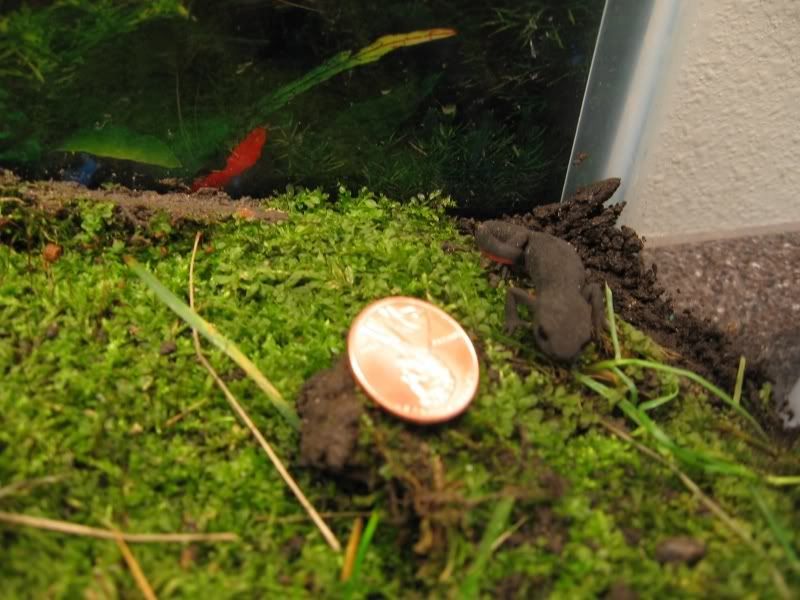
I forgot to add pictures. I attached one of his/her tank, and one of him/her. Looking at the pic, he/she looks very skinny, but I have never seen one before so maybe not?
Image

aghiowa Jul 18, 2008 07:23 PM

Here it is...
Image

CKing Jul 19, 2008 02:20 PM

>>Hi everyone! We just got a new fire belly newt yesterday. He/she is smaller than I thought - body length of probably 1 1/2-2" (more with tail). I have set up a semi-aquatic 10 gallon aquarium with room temp water, a filter, rocks, a land area with compost and moss, etc. So far all it does is hide under its rock on land.
>>
>>Is this normal behavior, or is something wrong with it? Also, it doesn't seem to know how to swim. It once slipped into the water and thrashed about until it got to dry land.
>>
>>It's just frustrating. I did a lot of research and set up to try to get the perfect environment for the little guy and I don't think it's acting like everything is OK.
>>
>>Any ideas?
>>
>>Thanks in advance,
>>Angela

Most newts live on land at least part of the time, especially for the juveniles of some species (e.g. the eft stage of eastern newts of the genus Notophthalmus and the juveniles of most western newts of the genus Taricha). So, it is normal for some newts, even highly aquatic ones, to hide on land and to thrash about when put in the water. You can sometimes "convert" a newt to its aquatic phase by putting it in shallow water for prolonged periods of time, water so shallow that it can keep its belly on the bottom and still keep its head above the water to breathe. In time, the newt may be able undergo changes to allow it to live and feed in deeper water. You can also try feeding it brine shrimp while keeping it in shallow water. If it doesn't feed in the water, you can try feeding it on land, using tiny earthworms or crickets or other live prey of suitable size. Sometimes a newt that is newly purchased has not fed for a while and sometimes it is a bit dehydrated. Both conditions will make it look a bit skinny.

Newts that are in the aquatic phase will have labial flaps on the upper lip: a flap of skin that extends from the posterior end of the upper jaw downward and obscuring the margin of the lower jaw. The labial flaps are also present in larval salamanders of all kinds. These labial flaps probably function to restrict the size of the opening of the mouth, allowing the newt to draw water into its mouth in higher velocity than if the opening was larger and perhaps also to keep water from escaping through the rear when the mouth is opened to suck in water. Newts in the terrestrial phase and larval salamanders that are about to metamorphose both lack the labial flaps. As a result they are not very efficient in suction feeding, so they would be unable to catch small prey while under water. If your newt does not have the labial flaps, it is not in its aquatic phase and would need to be kept on land to keep it from drowning and/or starving.


CKing Jul 19, 2008 08:26 PM

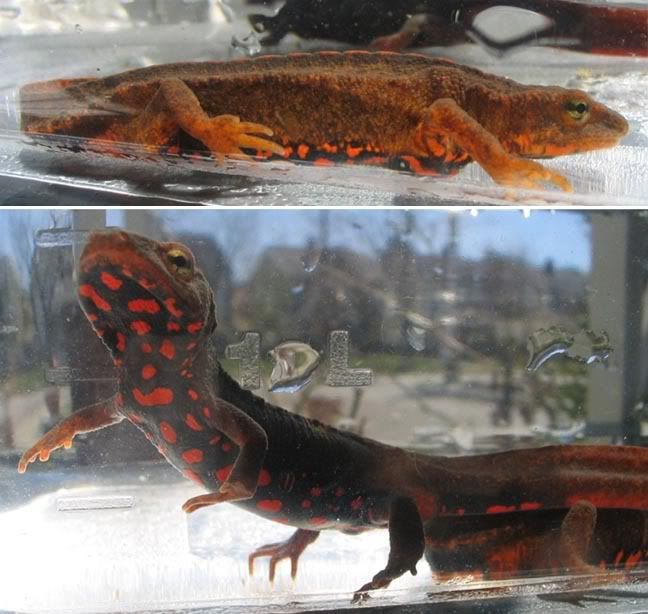
Here is a photo of a western newt with the labial flap, a flap of skin on the upper jaw of the aquatic phase of newts and larval salamanders that extend beyond the outline of the lower jaw. This flap of skin probably helps the newts and larval salamanders to suction feed because newts and metamorphosing larval salamanders that lack this flap are often unable to catch small aquatic prey by suction. The flap is encircled in the photo by the dark colored line. Newts that have the labial flap sometimes look somewhat like the muzzle of bulldogs.

tspuckler Jul 20, 2008 08:57 AM

Angela,

It's pretty common for newts to stay on dry land when they're introduced to a new setup. It's also common for them to thrash around in the water if they're dropped into deep water. If they go in on their own accord, they tend not to thrash. A month ago I changed the setup for the newts that I've have for more than 3 years, giving them a larger land area. One is still staying on the land almost all the time, one started going in the water immediately and one took about two weeks before it started making regular water visits. So I think your newt probably just needs some time to adjust.

Tim
Third Eye
Third Eye

tmac1rebok Aug 12, 2008 12:08 PM

So if a nezt is not acclimated to aquatic life with the use of shallow water, then it will stay on land be satisfied?

Could I just keep a terrestrial newt (eft) in a soley land enviroment?

Site Tools