A. prasina

B.cyanea

H.nasicus

Rhamphiophis rubropuctatus

Telescopus semiannulatus

Does anybody know, if there is a sexual dimorphism at Rhamphiophis rubropunctatus? What is the difference of caudals by probing?
Welcome to kingsnake.com's message board system. Here you may share and discuss information with others about your favorite reptile and amphibian related topics such as care and feeding, caging requirements, permits and licenses, and more. Launched in 1997, the kingsnake.com message board system is one of the oldest and largest systems on the internet.



A. prasina
B.cyanea
H.nasicus
Rhamphiophis rubropuctatus
Telescopus semiannulatus
Does anybody know, if there is a sexual dimorphism at Rhamphiophis rubropunctatus? What is the difference of caudals by probing?
Those are great shots! Sorry I do not know anything about Rhamphiophis dimorphism.
I like your pictures. The Telescopus, Ahaetulla and Boiga cyanea are species I have always wanted to keep but have never got around to for some reason. I think I kept a Telescopus short term at one point but I can't say for sure.
Does anybody know, if there is a sexual dimorphism at Rhamphiophis rubropunctatus? What is the difference of caudals by probing?
I have heard from more than one source that they are basically impossible to probe. I have even heard of a Rhamphiophis rostratus that probed out as a male that later layed eggs. And the guy who probed the snake was very experienced.
I read on an African Herp forum that you can compare tail lengths by counting subcaudals on sheds. I have one specimen right now and do have a shed saved but have not yet counted the subcaudals. Hopefully enough of us keeping this species can start doing counts and making comparisons to get an idea of what sort of variation exists.
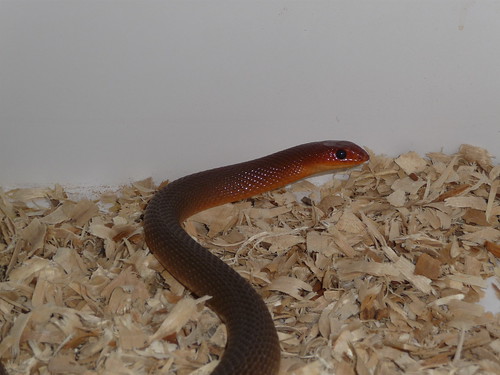
What sort of substrate is it that you're keeping your Rhamphiophis on?
I have mine on aspen right now but eventually plan to move it to natural soil or something similar.
-----
Currently keeping:
6.10 Gonyosoma oxycephalum (Javan, mixed colors)
0.0.4 Rhynchophis boulengeri
1.1 Philodryas baroni
1.1 Lampropeltis triangulum multistriata
0.0.1 Rhamphiophis rubropunctatus
0.0.2 Morelia viridis (Aru & Merauke locale types)
1.0 Rhodesian Ridgeback
My ground is quite similar to aspen, but looks more like sand. It is a little bit smaller then yours...
It works fine and I will not change it.
I have read the same informations like you, about sexing them.
On a forum there is a post that the differnce by probing is only 2 to 3 caudals.
I have also read about counting the length in percent? Males have a longer tale?
Maybe I start here a Thread where I POST MY iNFORMATIONS about my two snakes.
I have bought them as 1.1.
RGDS Fabian
-----
www.rear-fanged.com
On a forum there is a post that the differnce by probing is only 2 to 3 caudals.
I have not read this. From what I have heard the probe either stops right away or goes very deep into the tail area. And one of these snakes that probed very deep turned out to be a female so I would not trust it.
I have also read about counting the length in percent? Males have a longer tale?
I think I read this same post. I believe the males had tails that had 10% to 20% more subcaudals.
Maybe I start here a Thread where I POST MY iNFORMATIONS about my two snakes.
Please do. I'll do the same.
-----
Currently keeping:
6.10 Gonyosoma oxycephalum (Javan, mixed colors)
0.0.4 Rhynchophis boulengeri
1.1 Philodryas baroni
1.1 Lampropeltis triangulum multistriata
0.0.1 Rhamphiophis rubropunctatus
0.0.2 Morelia viridis (Aru & Merauke locale types)
1.0 Rhodesian Ridgeback
Help, tips & resources quick links
Manage your user and advertising accounts
Advertising and services purchase quick links
