Reptile & Amphibian Forums

Welcome to kingsnake.com's message board system. Here you may share and discuss information with others about your favorite reptile and amphibian related topics such as care and feeding, caging requirements, permits and licenses, and more. Launched in 1997, the kingsnake.com message board system is one of the oldest and largest systems on the internet.

Click for 65% off Shipping with Reptiles 2 You
Click for ZooMed
Click here for Dragon Serpents

Diet, Housing, Lighting..My Experience!

lizzettebarcel Jun 17, 2009 06:52 PM

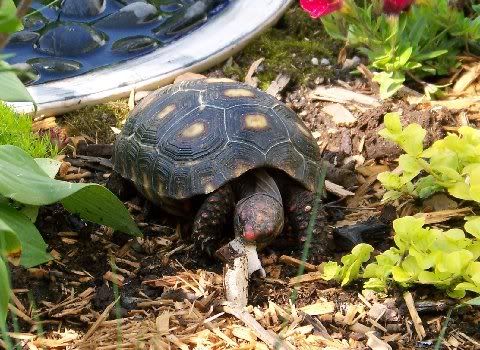
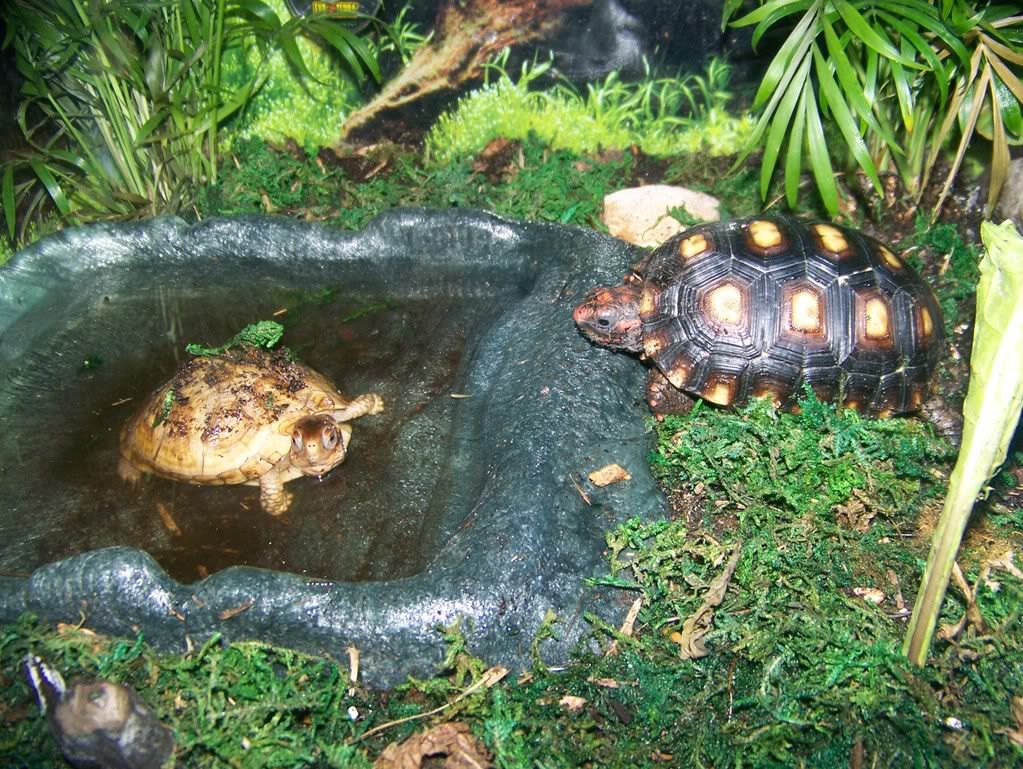
Well, I have had my red footed tortie for almost 5 years now. I bought her from Mike Greathouse. I took a good look at my animal today, and felt an impulse to write about so many things I read before everywhere on the Internet, and what I have done.

Well, first of course, she has passed checkups from her vet, a reptilian specialist. He recommended to me when she was a 15g baby, to feed her kale. I have read opposition to this, and cabbage, and broccoli all over. Today, my animal is active, healthy, and her shell is not deformed at all!

I do not sprinkle calcium on her food, ever! Kale and dandelion greens are very high in calcium already. Dandelion flowers are a delicacy. During the season, all she eats is fresh picked from my garden. Today she had lettuce, kale, fresh strawberries, spinach and parsley. I will feed her some broccoli sprouts and kohlrabi leaves tomorrow. other days I give her asparagus florets. It is always different, every day. I do not even measure her food or feed her "just twice a week." She eats all she wants, everyday! I pick fresh greens and berries for her daily and she eats until there's leftovers that I have to toss out.

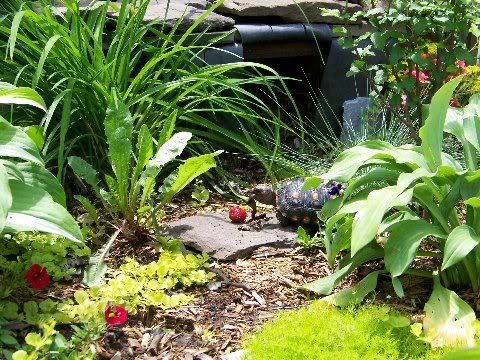
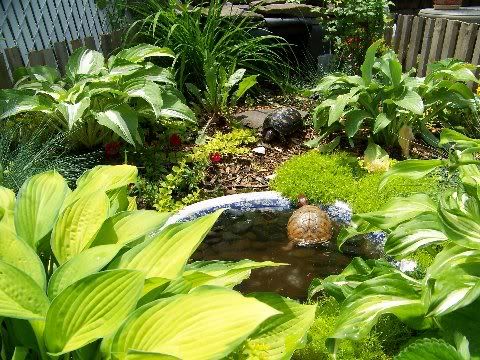
She is indoors, but has a pen in my backyard where she spends all day long during sunny days. She has a hide and she gets her moisture from fresh berries and fruits. My turtle is not lazy at all! She is always moving and foraging within her pen. It is a simple and humble 3x3 square with the bottom and top chicken wired for her protection, but all native weeds grow right through. She loves earthworms and the occasional slug she finds. And that's about all the bugs she eats! Every once in a while, a cabbage moth lands nearby and she may luck out. She loves Japanese beetles too.

I do take time to brush her shell with a toothbrush and Betadyne with Dove mild handsoap everyday when she comes in for the night, just to wash off any maggots or algae that landed on her shell. I soak her daily, to encourage pooping as often as she needs to.

In her indoor tank, she has water. She has NO lightbulbs at all. She gets natural sunlight right until the winter keeps her indoors. She gets a ray or two of the light from the bearded dragon's tank above hers, but nothing more than a heat mat in her tank warms her up.

She is a puppy in a shell that taps on her tank door when she sees me walk into the livingroom. She has me trained and demands attention like a queen... She is spoiled rotten.

What's my point? Well, maybe some owners are working too hard but do not realize that ample space for exercise, sunlight and fresh, natural moisture and feed are the best! Mine has never even needed a vitamin shot! She is growing perfectly.

So, focus on trying to make the environment as natural as possible. Avoid opening cans, jars or bags of anything as much as you can and draw on teh power of that sunlight to raise a healthy animal. Just advice from experience...

Wanda

Replies (34)

tortlemon Jun 18, 2009 06:02 AM

Wanda,
That's the way to do it! I've raised redfoots since 1996 and quit the reptile lights long ago. I toss in lots of varied food every day(if possible) and in the long NY winter they only recieve light from regular bulbs. Lots of garden kale(red russian) and dandelion greens all summer. Some edible weeds too.
My herd of 2.6(was much larger) produce tons of fertile eggs every year.
I think many people try too hard.
Just keep those babies WARM.

lizzettebarcel Jun 18, 2009 03:30 PM

Thank you for your support. I am in Connecticut, by the way, so we share the harsh winters.

Your babies look adorable! I can tell you adore those animals.

My personal advise for anyone not being able to provide a freer, much more natural environment and diet for these animals is to please select another pet. Keeping a red footed tortie under artificial lights, eating cat food, and other unnatural conditions is more detrimental than they can handle and deserve. If your tortie is not spunky, active, with a smooth shell and bright eyes, the care provided is inadequate.

I'll post a pic of my Suki as soon as I can!

Wanda

Terryo Jun 21, 2009 08:52 PM

I'm with you too Wanda. I have had my Cherry head only two years, but try to keep her enclosure a natural as possible, and now for the summer he is outside. I feed just about the same as you do, except I always throw in a cuttle bone inside and outside. Mine is also smooth and healthy so far.

maxmommy Jun 22, 2009 10:04 AM

WOW! That's great to hear...and very reassuring!
I just bought a 4-year-old Red Foot from PetSmart...they had marked him down from $199.99 to $99.00...I couldn't resist!
I named him "Baby"...I believe he is a male from the inverted carapice (sp?). I have him outdoors in a 3 x 2 wire cage w/ a heat lamp over him for the evenings (California has not been a typical summer yet...nighttime temps are still down in the upper 50's to lower 60's). I take him out twice a day for an hour or so and let him roam the backyard. The neighbors have a messy Mulberry tree that drops hundreds of berries into my yard; "Baby" is trying to consume as many as possible, but just can't keep up with 'em : )
I have turnips, lettuce and chard growing in my garden, and "Baby" gets to help me maintain the area!
My only concern is the humidity; when I bring Baby in for the winter, I will have a humidifier over his aquarium. But what do I do about humidifying an outdoor cage??

lizzettebarcel Jun 22, 2009 04:04 PM

Oh let him pig out on the mulberries!
These are the things mine adores (straight from my backyard):

dandelion flowers
dandelion leaves
fresh, four-leaf clovers (both leaves and flowers)

Now, these are things I grow in my garden that she loves:
squash flowers (both summer and winter)
kale
parsley
cilantro
strawberries
blackberries
lettuce (LOVES red)
spinach
kohlrabi
brussel sprouts

You can grow fresh parsley and cilantro in a pot by a sunny windowsill! Or those who can't have that, please visit your local farmers market and pick up some fresh goodies. For gawd's sake, leave the cat food for the cats! Feed only fresh stuff to your turtle and keep them away from those hideous lightbulbs in favor of natural sunlight and exercise room. If you can't provide it for your pet, you're abusing that animal and neglecting his care. Please have him adopted by someone who can take care of him and select a more suitable pet before this one dies of an illness brought on by unsuitable care...

I am thrilled to see so many owners who do strive to provide good care for their torties!

Wanda

Maxmommy Jun 22, 2009 04:38 PM

Oh, good for YOU! One thing that truly APPALLS me are people who take on a new pet for their children's sake, or just because it's "cool". A person I know took her two pre-teens on a vacation to AZ last year. They found a pair of snapping turtles and brought them home. They had fun with them during the summer heat in a small wading pool, but when WINTER CAME they just couldn't understand WHY they both died! Very sad and tragic...
PLEASE, everybody, study your pet before you bring him home, learn about his needs and habitat, and, by all means, NEVER take an animal out of his natural habitat! Chances are, he won't make it....

KevinM Jun 23, 2009 07:57 PM

Maxmommy, your redfoot should be OK outside as long as the temps stay above 55-60 degrees at night, and warms up in the day. Too hot is not too good either, and these guys love shady areas and wet mud holes to wallow in during the hottest part of the summer days. Even though I live in Louisiana, its been VERY hot (100 degrees plus at mid day with heat index) and relatively dry the past few weeks with no rain. I give my torts a soak in the evening with a the hose. Just spray them and a section of the outdoor pen down to give them some relief. Maybe make a mud hole in a corner for them too. Make sure they have a nice big shallow pan to go for a soak if needed and shaded areas/hides to get out of the bright sun. I dont think red or yellow foots are big "baskers" and live mainly in fringe areas around rainforest habitats where the sun is probably dappled and not too direct. Natural is the best way to go and my babies and subadult really put growth on during the spring, summer, and early fall months they are housed outdoors.

Maxmommy Jun 24, 2009 12:04 PM

Thank you, Mike! I let Baby out into the garden after my dogs are let out (they are dachshunds and I don't want them to be with Baby without my supervision). Baby doesn't bask, as you said. I found her in the late afternoon burrowed halfway in the mud under a garden fence. They sure like to be private, don't they?
Speaking of dogs, is there anyway my dogs will get used to the tortoise? I would NEVER leave them alone together, but it would be nice if they stopped that continuous barking.

KevinM Jun 24, 2009 02:24 PM

Well, depending on how large your tort is (or how small your dogs are LOL) will dictate if they will harm the tortoise or not. My little terrier mix snoops around their pens, but doesnt mess with mine. My babies are going on two years old and are big enough to not get carried off by cats that may come in the yard. Mine have never been threatened by anything. However, I would suggest not leaving unsupervised since your dogs get excited around your tort. Think about putting a simple wood and screen cover over your pen. My two babies are housed in an eight x four foot pen, and my 5 year old female is housed by herself in a six by six foot pen. Plenty of areas to hide. Their pens are close to and beneath a water oak tree in my yard, so basically out of the full sun.

Maxmommy Jun 24, 2009 02:43 PM

Good to know. My tort is 4 years old and too big for the cats to carry away. But dachshunds are hounds and will hunt instinctively. I will put up a semi-permanent fence around "Baby" for the warm weather, and I just purchased an acrylic aquarium (terrarium) for him to winter in.
I just checked on him and he's sleeping peacefully in the small burrow he made yesterday : )
Now, where do I find info on how to set up the terrarium come winter?

lizzettebarcel Jun 24, 2009 04:00 PM

I have chicken wire on the bottom of the pen, and the top. I never put the tortoise out unless I am in the house. Years ago, I learned the hard way when a boxie climbed over the red footed and went over the boundary of the pen. I never saw her again.

Wanda

KevinM Jun 24, 2009 04:14 PM

Well, I would not recommend housing a N.A. box turtle with a S.A. tortoise. I would be paranoid of disease or parasite tranfer. All my pens have a lip installed around the tops to prevent escapes from climbouts and I dont put anything near the edges for them to climb up onto and possibly over.

As far as a winter terrarium, I would find the biggest and lightest plastic tub you can find. A four by two footer is usually 20 bucks or so. You can put a uvb/heat bulb on one end with a clamp lamp. I use cypress mulch for my red and yellow foots when housed indoors with a decent sized plant saucer thats shallow enough for them to climb in and out of easily. I consider the inside enclosures temporary as my tortoises stay outside more in general, usually late March/early April until October or even early November pending night temps. As long as the night temps are above 55-60 degrees, they stay outside.

Maxmommy Jun 24, 2009 07:44 PM

Wow, I wish I would have waited to hear from you guys first. I just bought a 4 ft. long aquarium made of plexiglass. Is that dangerous, to house a tortoise in hard plastics/glass?

KevinM Jun 24, 2009 09:33 PM

Nothing wrong with the plexi tank at all as long as roomy enough. Also more appealing if set up nicely. The tubs work for me along with a big metal cattle trough when I house my torts indoors for winter. Its no frills, but gets the job done. I have a baby red and yellow foot, a subadult redfoot, and a pair of russian torts that need to come in in winter LOL!!

Off topic, but while tending the torts this evening (finally got some rain this afternoon HOORAY), I found a baby Gulf coast box turtle in the big redfoot pen that previously housed a pair of Gulf coast box turtles I had last summer!!! Quite a shock!!

Maxmommy Jun 25, 2009 10:01 AM

Well, Kevin, I've never been listed on Forbes Richest People In the World List... had I known I could have saved a hundred dollars by using a plastic tub instead, well, I would have gone down to Walmart right away. Oh, well, live and learn..
BTW, I called you "Mike" in an earlier post; my apologies...got you mixed up with a Mike mentioned by Liz.
One of you mentioned that turtles/tortoises don't need a tall tank; I have my two R.E. Sliders in a tall tank. Being that they are swimmers, is this okay (or should I post this in a different forum?)

lizzettebarcel Jun 25, 2009 03:06 PM

Land tortoises do not need tall tanks, but wide ones. Mine exercises a lot in that Vision tank but I don't like their quality. A heat lamp can melt the vynil.

I have one for the dragon and another for the tortie. They're long enough for them, so they're comfy...

Wanda

lizzettebarcel Jun 25, 2009 04:59 AM

The danger is only in not being able to control the temperature, and making the animal overheat. If you do not have this issue in the winter, it should not be a problem.

I've raised mine in one of those vision, plastic tanks. Longer than taller because the turtle does not need height. She's there in the winter. Has been for 5 years and there's no reason why she can't stay there for five more...

The only heat source there in the winter is a mat. She gets some rays from a light for a bearded dragon livin above. And she is fine. The sun she gets most of the year is plentiful to keep her healthy, obviously.

So it depends on where you live and how much heat the animal's room needs

lizzettebarcel Jun 25, 2009 04:52 AM

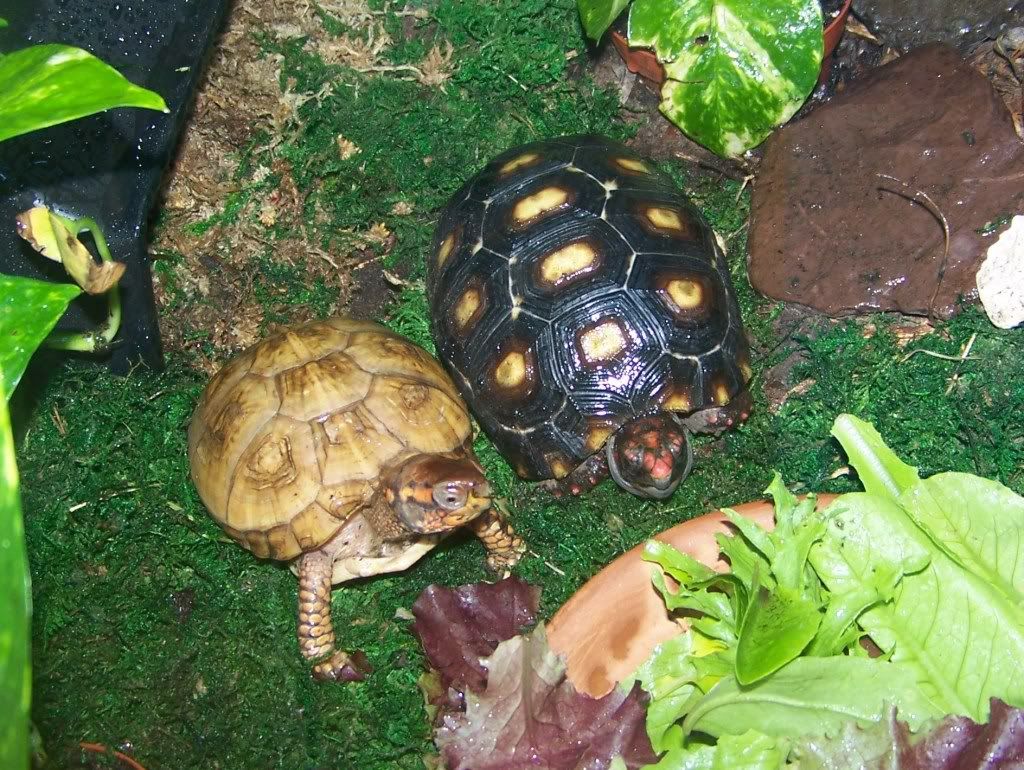
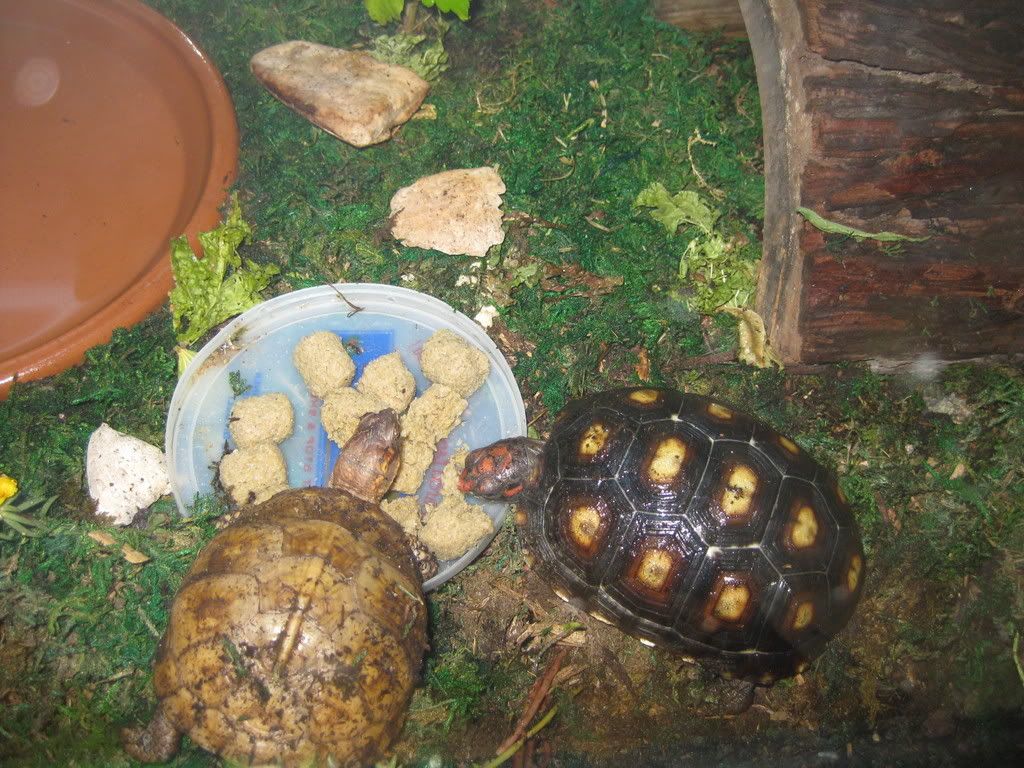
Kevin, it could have been two turtles of the same species housed together and one still climbed over another. Recall, dear, in the wild several species coexist together. The issue about separating them in tanks is promoted by some breeders only. Professional caretakers, aquariums, zoos, etc., already house various species of animals together without problems. What they don't have in common with opposers of this natural practice is a veterinarian who regularly checks the animals...

Recommending lightbulbs over natural sunlight to people is more of a display of ignorance than anything else.
Leave the cat food for the cats. If it comes in a bag or a can, you should not feed it to your tortoise. After all, it is the typical, sound advice I am sure *your* reptilian specialist has shared with you!

Wanda

KevinM Jun 25, 2009 09:27 AM

I agree that artificial light is no sub for natural sunlight. However, for a winter enclosure the UVB can't hurt for the few months they can't go outside for various reasons. For the very few months mine do have to stay indoors, I don't provide UVB to the adult russians and subadult redfoot. With seven or so months of natural sun when housed outside, plus a couple of days here and there in the winter months when weather permits, I dont think they need the uvb in their winter quarters. This is the first year the baby red and yellowfoot are being housed outdoors 24/7, but because of their ages they may still get uvb in their winter cage.

I also agree that catfood is unacceptable and never mentioned it was at any time in my posts. I do sporadically feed Mazuri tortoise chow. But mine mostly get mixed greens, veggies, and occassionally fruit. Plus whatever weeds and grasses they forage in their pens or edible flowers growing in my yard when available.

As far as mixing species, I admit I house a yellow and red foot together. However, these are two S.A. species and are captive hatched.

lizzettebarcel Jun 25, 2009 03:03 PM

Both the boxie and the red footed were captive bred. The boxie was spunkier than the red footed and climbed over her. That was how she escaped their pen outside.

In fact, I'd never have a boxie again or recommend it as a pet after that experience. It is an art to bring them back from hybernation and mine needed mega shots of calcium and vitamin B to stop her anorexia. I nursed her as she recovered from a renal condition that caused shellrot, shortly after I bought her from teh breeder. She recovered completely. I don't think she survived in the wild though, and that is what saddens me the most.

The red footed has the personality of a puppy. The boxie was more aloof and shy. Didn't like to interact too much with people. The red footed is a conceited flirt.

Wanda

KevinM Jun 25, 2009 03:40 PM

Box turtles are definitely a bit more of a challenge than torts IMO too. They are complete omnivores that need protein and plant matter, and the torts are strict vegetarians for the most part (although many claim redfoots will unhesitantly eat any small animal that enters their pen). Sorry to hear about your boxie, but you never know how it did once it escaped to the wilds and it may just have survived and be cruising around now!!

In contrast to your comment about your boxie, my redfoots and the yellowfoot are reserved. Not shy necessarily, but not too animated. The yellowfoot is a bit shy. The box turtles I kept last summer were big Gulf Coast boxies, and they acted like they were pets all their life the way they scrambled and begged for food when I approached their pen. Man, those guys could eat!!! I rescued them from a job site we were clearing and excavating and donated them to a local swamp exhibit educational center last summer.

lizzettebarcel Jun 25, 2009 04:41 PM

Are you kidding me? Your boxie had more personality? Wow! I'm impressed.

My red footed taps on her tank so I take her out to scratch her head. When it is time to come in for the night, I don't have to reach out for her in the pen. I just call her. She knows her name. She lifts her head, spots me and starts walking towards me. By the time she reaches me, I have already picked up the dragon and am ready to bring them both in. Not even the bearded dragon has a personality like the red footed tortie! I put her on the floor in the living room and she chases me. Then she "cuddles up" next to my skin. She really is a puppy in a shell. I thought all red footed were like that

I definitely do not recommend boxies or hybernating turtles to people who are considering them as pets. It costed me a fortune to keep her alive and get her to gain weight after hybernation. Thank you for your comfort but being it a fact that she was captive bred and then lost in my yard, I can only hope she has made it. I keep telling the dog to make herself useful and sniff her out. But two winters have passed and Tulip never came back. I live in an urban community. And like you say, I can only hope she made it....

terryo Jun 27, 2009 07:13 PM

I have housed my Three Toed and my Cherry Head in a planted vivarium since they were both 3 weeks old. They are two years old now and are outside for the summer together also. In the fall they will both come in again into the same vivarium. The both need the same requirements...same heat...same humidity. After being told on another forum, that they shouldn't be together, I separated them. The boxie couldn't care less. My Redfoot stopped eating and was clearly stressed...circled the viv almost all day until he was exhausted. This went on for 4 days and finally he went into his hide and didn't come out for another two days. Finally I gave in and put the boxie back into the viv. He went back to his old self and everything was fine. He actually follows her around like a puppy, and will go into the same hide even though they have two in their enclosure. When I do eventually put the boxie outside for good in another year I will have to get another cherry head for him. As for personalities, the boxie is more outgoing, and has much more personality. The tortoise is shyer but sweet just the same.

terryo Jun 27, 2009 07:17 PM

outside together

lizzettebarcel Jun 28, 2009 08:06 AM

THERE IS ABSOLUTELY NOTHING wrong with housing different species together. I have been a reptile owner for over a decade and came in and out of boards where this topic becomes a flaming subject.

What I have always noticed is that the ones who oppose housing different species together are often very unkowledgeable, to the point they can't explain how in nature so many species coexist sharing the "housing" accomodations and how in zoos and aquariums species are housed together for display.

They claim that diseases can be spread, this and that. I guess I was assuming their reptilian specialist had previously checked their animals out for parasites and cleared them!

The trick is the same: have your animals checked, use common sense (don't house your corn snake with your frogs), add plentiful hideouts and feed. And create your little natural ecosystem at home. Mother Nature, who always knows best, had been doing it for billions of years already before some reptile owners on the Internet opposed it.

I have a dog and two cats sharing my couch as I type. There are loose crickets jumping around. We're all different species and we all coexist!

Wanda

Maxmommy Jun 28, 2009 10:32 AM

LOL!! I LOVE it!!! I thought I was the only one with loose crickets in the house...actually, their chirping brings the sound of nature to the indoors..too funny.

KevinM Jun 28, 2009 05:53 PM

Lizette, to each his own, and if you are comfortable doing it and taking the necessary precautions to insure your captives are disease and parasite free then all the better. HOWEVER, many folks have lost animals from housing different species together. That is just a fact. ALL animals potentially harbor parasites and pathogens that are absolutely non-harmful to them, yet deadly to other species from other areas that get exposed to them. I have housed a rescued sulcatta with my redfoot. I assumed the sulcatta was captive bred and mistreated. I took it in because it was so malformed and grotesque in the shell that I felt sorry for it and just wanted to give it a good home for the rest of its days. We named it Quasimodo it was so darn ugly. The two did great together, were housed in the same pen in the warm weather, and inside in the same pen during cold weather. One day for unexplained reasons I found the sulcatta dead outside in their pen. I was mortified and it scared the heck out of me thinking I may have transferred something to my redfoot. Luckily I believe it died of its malformities that were probably internal as well as external. Still, it gave me a scare for sure. Right now I have my yearling red foot and my yearling yellow foot together in the same pen. They are both CB and from similar areas in South America. However, I would not knowingly house animals from two different countries together out of fear one may spread something to the other, vet checked or not. Once again, not flaming you for doing it, and applauding you for taking the neccessary vet precautions to ensure all is OK. Still, others dont and I dont think they need to be flamed for their opinions on the matter.

lizzettebarcel Jun 29, 2009 05:32 AM

First of all, if their animals had any parasites I blame it on the owner for poor husbandry and care practices. Most of those opponents (if not all) have no reptilian specialist to clear their animals of infections.

Like I said before, this is always a favorite topic of arguments on boards. I always remember the one many took as a commandment that crickets spread pinworms. All it took was the person who started that rumor to confirm with a reptilian specialist that such infections are not common, and the belief was founded on internet chatter. To this same day, if anyone still has questions, all he needs to do is ask an entomologist or reptilian specialist rather than preserve illiteracy.

So, if anyone lost animals to parasites it was NOT for housing different species together, but for his/her own inadequacy and refusal to have those animals checked and treated to kill all parasited, exposing them to a slow and agonizing death just to save a buck.

lizzettebarcel Jul 06, 2009 08:48 AM

Here is a newly discovered one, fresh from this morning: Rosde petals!

I offered some fresh pulled, rose petals to my tortie and she went BANZAI!!! We all know the properties of rose hips tea, and that you can even eat rose petals in salads.

Offer them to your tortie for a fresh, nutritious snack! Make sure of course the bush wasn't sprayed with pesticides beforehand, blah blah blah...

Your tortie may perk up with rose petals for a snack or a meal..

Maxmommy Jul 06, 2009 10:06 AM

Thanks! I'll try it today...

lizzettebarcel Jul 06, 2009 11:08 AM

And I just found out roses are related to strawberries, so why should anyone be surprised?

My shrub came from Walmart for about $4, years ago...
My tortie could not believe her eyes!

Wanda

Maxmommy Jul 06, 2009 11:47 AM

I did not know that strawberries and roses were related : )I have plenty of roses out here in Northern California; I HAVE had rosehip jam before...excellent source of vitamin C.
I don't use pesticides, but I DO use a rose food. Can you find out if there is any harm in the tortie eating rose petals that were fertilized? Thanks!

lizzettebarcel Jul 06, 2009 02:15 PM

I fertilize mine too, with bone meal, blood meal and epsom salt. Fertilizing them just adds nitrogen, potassium and phosphorus to the plant. Neither is a pesticide.

Plants that are fertilized (w/organic or inorganic feed) are not harmful to either animals or humans and are approved for consumption, so feel free to offer their petals to your tortie...

The concerns about organic farming is always about the use of pesticides, not plant feed. All the plant feed affects is the quality and amount of the product. Like, too much nitrogen produces too many leaves in blooming plants, too much phosphorus stunts the plants growth, etc.

Wanda

meeslither Jul 15, 2009 10:41 AM

i think its so awesome that private pet owners have taken it upon themselves to refine the captive care and husbandry of this species when every piece of literature you read contradicts what we know and every zoo specimen is pyramided and unhealthy. heres to you wanda, and all those like you!
Jason

Site Tools