


Reptile & Amphibian Forums

Welcome to kingsnake.com's message board system. Here you may share and discuss information with others about your favorite reptile and amphibian related topics such as care and feeding, caging requirements, permits and licenses, and more. Launched in 1997, the kingsnake.com message board system is one of the oldest and largest systems on the internet.

Click here to visit Classifieds
Click for ZooMed
Click here to visit Classifieds

A couple of Texas indigo questions

Bryant_King Aug 14, 2009 09:41 PM

A while back I picked up a great little pair of Texas indigos- last years babies. It was a great price and I am thrilled with the animals. I grew up catching Eastern indigos here in southwest Florida. I had owned a baby black tailed cribo years ago. I've kept a lot of boas and pythons and am no novice, but these are my first Texas indigos. I thought you guys might help me get these guys dialed in a little faster than I could figure it out on my own.

I've got them in 28qt Sterilite shelves in my garage, which ranges from low to upper 80's F this time of year. Their cages are prone to some condensation forming, especially if any of the water spills, in other words, fairly high humidity.

My first question is in comparison to my previous black tail cribo experience. My black tail cribo was an absolute chow hound. I could hold it by mid body and lower its head down into a tray of pinkies and it would eat them one after the other. These Texas indigos, in comparison, are shy feeders. They will not eat immediately when a mouse is placed in their cage. A dead mouse left overnight will be gone in the morning, but they refuse to eat in my sight. Is this normal? Is this an age related thing?

They are experiencing rapid shed cycles. If they were boa constrictors, I would suspect mites (likewise with the appetite reduction). I see no evidence of mites, and like every snake that enters my collection regardless of source, I prophylactically treated the cage with permethrin when they arrived. I see no obvious skin irritations or defects and there is no supplemental heat source to burn them. I considered a sensitivity to the permethrin, but I am skeptical about that. No retained shed anywhere.

I am wondering if the humidity or temperatures are too high for this subspecies. I've got blood pythons, boa constrictors, and mussuranas in identical set up and they are all thriving.

Any thoughts from more experienced keepers of Texas indigos?

I will eventually figure it out, but you guys may have the answers right now.

Thanks,

Bryant King
Replies (9)

steve fuller Aug 15, 2009 06:10 AM

Temperatures are too high. Shoot for 70's at night and maybe 80 during the day. I've found that most young indigos will feed best if food is left overnight. They generally become anytime feeders as young adults. I have one two-year old female that will still only eat when left alone overnight. Good luck with them.

DanielsDen Aug 15, 2009 10:20 AM

I agree with Steve...temperatures are way to high. Also, your humidity might be a little to high as well. Like most drymarchons...once they get settled in they will become verocious feeders. A hide box will be benefical as well. I would keep the cage on the dry side with a large water bowl always available for soaking and drinking. Remember though, indigos love deficating in there water bowls!!

Bryant_King Aug 15, 2009 12:19 PM

Thank you both for the advice. I can easily lower the humidity with greater ventilation, but the temps will require me convincing my wife that these are "inside" as opposed to garage snakes. It is easy to make a cage warmer, but making one cooler is a bit trickier. While I am convincing my wife, I may make something up about the Chondros to get them in the living room in display tanks too.

I had noticed that they liked to defecate in their water bowl. Indeed, I check their cages more often than my other charges, but they are worth it. I had already incorporated hide boxes after neglecting them at first, and you are right, they utilize them.

Thanks again both of you. An aquarium with a screen lid and an under tank heater in my air conditioned living room worked well on my cribo years ago, I may go back to such a basic set up with these. I expected these to resemble the Easterns that I use to catch, and they do in some ways, but they also remind me of cobras probably due to their brownish coloration.

Thanks again,

Bryant King

BradleySturgeon Aug 15, 2009 11:33 PM

Hi, its very interesting that you asked this. I have had similar experiences this summer, only reversed. I have an 09 Black Tail male that refuses to eat or show interest in live or frozen pinkies. The only thing he will do is eat a leg of a chick left overnight. It has to be KFC Crispy Dark meat. ha ha, Joking. Now I also recently purchased a pair of Texas Indigos, 07 female, and an 08 male. She is very aggressive with anything when she is hungry, however he will eat in the comfort of his hide box on the first one and then if I offer more very slowly he will take them off the tongs, out in the open. So I think to answer your question, yes it is age related behavior. However these animals are very sensitive to heat over 80 degrees, besides in a basking spot. So I agree with the other guys before me, please get them OUT of the garage. These precious animals deserve better than that for sure. I would hate to hear of them dying from the high temps, they are harmless so just reassure your wife of this and give them the comfort they deserve... The rapid sheds really do concern me, that is not normal to my knowledge and experience thus far. So I hope this helps and do you or anyone else have any tips for my problem feeder B T Cribo? Thanks, Bradley.

tokaysrnice Aug 16, 2009 10:32 AM

be it scent from a tuna can or small chunks of actual fish. Both my Cribo's were also finicky to feed until they hit 3' then it was on, anything and everything whenever.

I would also do everything in your power to get their ambient temps in the mid seventies.

Nate

alanB Aug 16, 2009 12:22 PM

Nice picture Mr. Nate ! To throw my two cents in I have one Texas female in my group of adults who eats like a champ only when kept in the mid 80's. Perhaps each specimen has his / her own comfort zone ?
I also find the Rubidus can tolerate much higher temps then the other subs.

ALAN B

Bryant_King Aug 16, 2009 08:44 PM

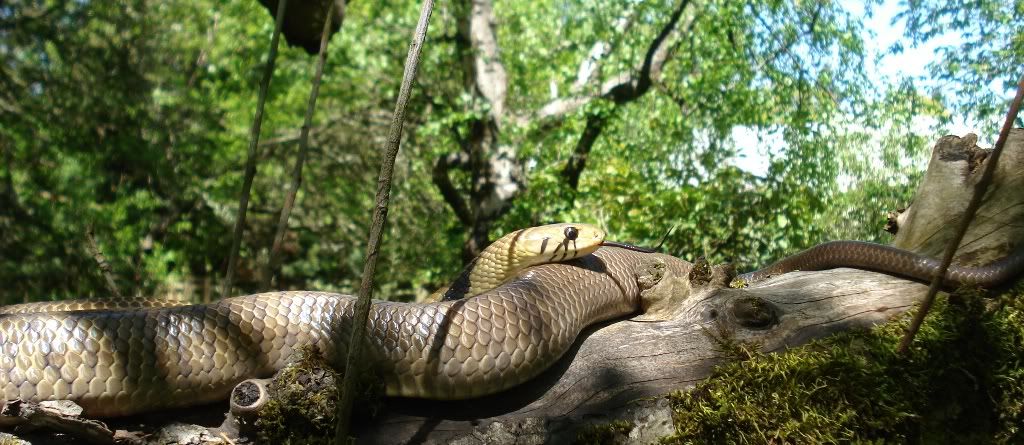
Nice picture! Now that one reminds me of the Easterns that I use to catch!

Some of this I am probably going to have to chalk up to individual variation, although I now regret even more trading that outgoing, gluttonous black tail cribo that I owned years ago. I just assumed that was normal for them. I have force fed an Australian olive python for a year which will just now take brained mice left overnight, so these are still easy in comparison, and now I will worry less. I also bought them from a very reputable guy but in a cooler climate. They may just be "adapting" slowly to their new latitude and they may tolerate the mid 80's you mentioned later in life.

Bryant King

skiploder Aug 16, 2009 07:57 PM

Unless I'm missing something, I didn't see your definition of a rapid shed.

All of my drys shed every 4 to 6 weeks - like clockwork.

My largest BT's sheds from July of last year:

July 19
August 27
September 26
October 31
December 4
January 9

My female Indigo's shed cycle during the same period:

August 3
September 11
October19
November 27
December 30
February 1

Compared to my other colubrids (with the exception of western and mexican hognoses), pythons, etc,. my drys shed more regularly and more frequently.

As to the BT not eating, I've had the odd squirt that won't eat. I've had success with feeding trout pieces.

Once hooked on the trout, I will marinate an appropriately sized rodent in the trout by sticking it in the body cavity of the fish.

Bryant_King Aug 16, 2009 08:26 PM

Okay, that is about right. I have not been keeping detailed records, but I was amazed at how frequently I would go to feed them and see them in shed, which would mean they were less likely to eat. They are shedding clean, just more often than I see in my boids or even my mussuranas. I'll quit worrying about that. Thank you!

As to the temps, I am going to try to have them in the air conditioning by the end of the week. While we are on the subject, how cool will you let them get in the winter? Almost all of my supplemental heat sources are off for all of my animals right now. Once we start getting temps in the low 70's overnight, I will have to plug some of them back in (I am in southwest Florida). I was planning on keeping the mussuranas and indigos in the same rack. With the mussuranas, it seems that I can do no wrong (except getting anywhere near their mouth if I smell like rodent or other snake), although I don't turn on the under tank heaters for their cages until much further into winter than the boids and I set the thermostats in the lower to mid 80's for the warm spot.

Thanks to everyone for the advice and help. It is appreciated. What I am hearing is that high humidity is fine, as well as frequent sheds, but I should try cooler temperatures. Everyone has already saved me some time and concern.

Bryant King

Site Tools
