Reptile & Amphibian Forums

Welcome to kingsnake.com's message board system. Here you may share and discuss information with others about your favorite reptile and amphibian related topics such as care and feeding, caging requirements, permits and licenses, and more. Launched in 1997, the kingsnake.com message board system is one of the oldest and largest systems on the internet.

Click here to visit Classifieds
Click for 65% off Shipping with Reptiles 2 You

Causes of full term, dead in the egg???

zach_whitman Apr 19, 2010 09:43 PM

OK. I have been breeding anthill pythons for several years. The first year I incubated all clutches artificially(2 clutches). One clutch of 6 hatched perfectly and one clutch had 2 dead in the egg and 5 live. The second year I incubated 2 clutches and let the females maternally incubate 2 more. The maternally incubated clutches both hatched beautifully. Again out of two incubated clutches, one was perfect, and the other was half healthy hatchlings and half dead in egg. So the past two years I have been using maternal incubation but have had to incubate one clutch when the female layed it in a bad spot. This clutch just hatched out 2 healthy hatchlings and the entire rest of the clutch (7 eggs) were completely perfect looking, fully pigmented, but very dead babies.

I incubate eggs at 89-90F, in a large rubbermaid container half full with damp spag. This is the same temp and the same substrates that my females use if given free choice. I place a small piece of styrofoam down to stop the eggs from laying on the substrate and maybe getting too wet. I place the eggs on the foam and cover it with a lid with a few small hole in it. I open the incubator (a large styrofoam box) every few days and occasionally open the containers briefly to let in some fresh air. I have tried several variations including straight perlite.

Does anyone have any insight into what causes this phenomenon? I have bred colubrids and geckos for many years and this is a very unusual occurance with them. I have never seen perfectly good egs just die like this.

I thought it might be pipping issues if the shells were somehow too thick/dehydrated/whatever. So with this last clutch I slit each egg as soon as I saw the first heads poking out. No luck, they were already gone.

Replies (33)

BradleySturgeon Apr 19, 2010 09:52 PM

Hi, no answers here sorry. Just curious if you still have the babies? I could feed them to my snake eaters! Thanks, Bradley

BuzzardBall Apr 20, 2010 07:14 AM

I too first thought over-calcification! But that wouldn't explain the maternally incubated clutches hatching, assuming the mothers are fed the same diet! I say, get rid of the styro under the clutch! Think, "in the wild"! Nobody puts styro under the clutch in the wild! Move them to vermiculite!

Jaykis Apr 20, 2010 11:00 AM

Actually, it's not uncommon for perfectly good looking eggs to not hatch. It means that there was something in the final development that went wrong, and they would not have survived, or that they were not possibly strong enough as an embryo to hatch.

zach_whitman Apr 20, 2010 10:19 PM

I am thinking that since it only happens in the clutches that I incubate, its more that just a random event. There is very little development that takes place so late in the incubation, mostly its just growth at that point. Also, I doubt an unexplainable birth defect would mysteriously take out 25% of a normal healthy population. This is happening across numerous females in a variety of incubation conditions. I am pretty confident there is an underlying reason.

When you say "quite common" what do you mean? With your pythons? How common?

zach_whitman Apr 20, 2010 10:10 PM

I have found that these eggs are extremely susceptible to taking on too much water. There seems to be a very fine line with my anthill python eggs between too moist or too dry. So I have been going for dry with 100% humidity.

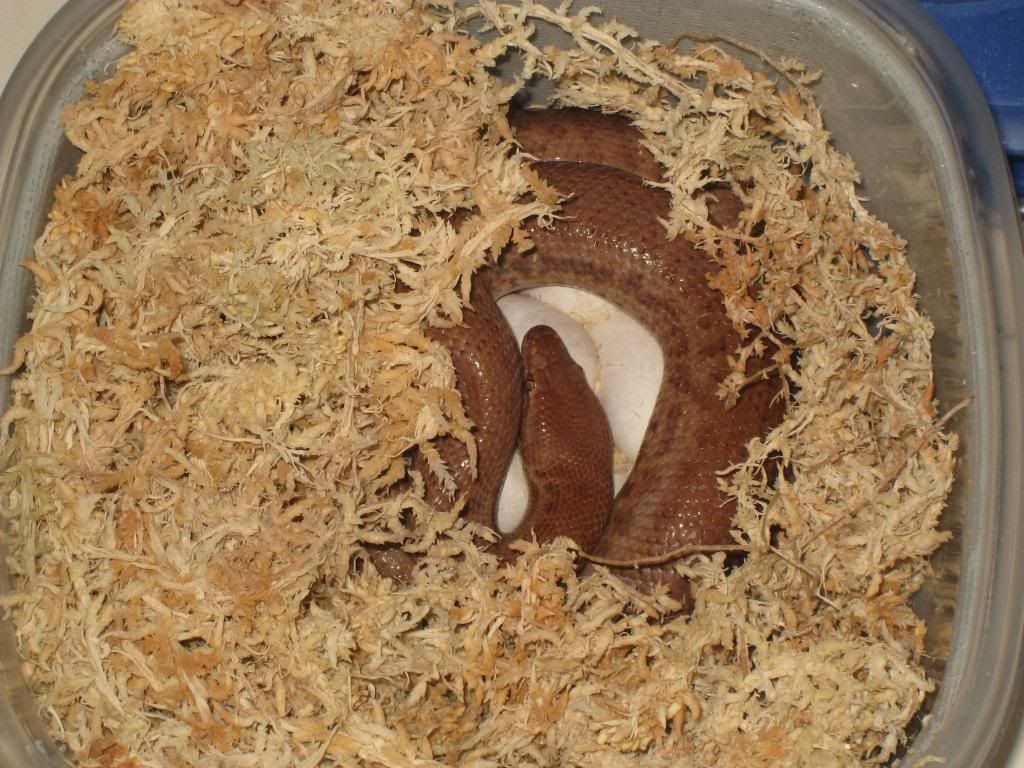
Basically I looked at what the females were doing. If she is large enough to completely encircle the clutch than she will, and even the bottom eggs will rarely touch substrate. If she is not big enough she would clear away the substrate (barely moist sphagnum) and then rest the eggs on the smooth plastic while she covers the top of the clutch. Any time I have put anthill eggs directly into the substrate (sphagnum, vermiculite, or perlite) I have had them take on too much water. Hence... styrofoam barrier.

This pic is one of the first clutches I ever had. I now give them a much bigger laying tub to give them a big choice of temps. Also holds humidity better and provides more thermal mass against temperature fluctuations. But you get the idea...

zach_whitman Apr 20, 2010 10:29 PM

As I said before, there is very little in the way of development that is going on so late in the incubation. And I do not believe it is genetic since I can see no patterns and all females have had full healthy clutches. Which leaves me to keep coming back to the shell as the problem. Two possible options, an infectious culprit or a husbandry error, either one of which does something to change the shell. Most likely something fungal that maybe somehow changes the properties of the shell?

The other thing that I was thinking is that the eggs are naturally surrounded by the mother and maybe the clingy contact of her skin prevents the shells from becoming as dry and thick as the shells in the incubator which are exposed to a small amount of air moving around them. If I ever have to incubate another clutch I have thought about taking some plastic wrap and poking a ton of tiny holes in it and wrapping it very loosely over the eggs? Thoughts? Is this a bad experiment with a very expensive clutch of eggs???

BuzzardBall Apr 21, 2010 09:13 AM

Zach,

I don't know if that's a good idea! The plastic will still collect condensation, making it worse!

derekroddy Apr 21, 2010 09:56 AM

It has been proven in Poultry that....when fed a high diet of fats and proteins......that the embryos die full term in the eggs.
The respiratory system is one of the last things to develop and because of the types of nutrition intake...causes the respiratory system to fail at the last stages of it's development.
Reptiles and birds are very similar in make up.

What species do we see this happening with the most in captivity? Mostly reptile eaters...such as BHPs, Womas...(and lizard eaters... such as the Anthills).

Change the diet of the adults (off of the rodents)....get better hatch rates.
It worked for me....with my BHPs.

Ironically....the only animals I have any problems hatching....are the ones from adults... that will only eat rodents.

Cheers,
D.

derekroddy Apr 21, 2010 11:40 AM

And..of course, environmental issues can be a problem as well.
I can see that you might have gotten better hatch rates with the MI....as I believe the air would have been better suited for desert species (drier) eggs in this manor.

I have stopped using water in my incubation medium all together for the BHP and Woma eggs.
I simply run my incubator at 80% and let the eggs get the humidity they need.... from outside the container.

Couple this with the diet...and, This is what I believe is leaving fully formed hatchlings... dead in the eggs.

D.

Kelly_Haller Apr 21, 2010 06:47 PM

Studies I have seen in the past have pointed to eggs of this genus being more hydrophilic than the eggs of other python species, most likely due to the drier environments inhabited by these species. This adaptation toward a higher capacity for water absorption makes these eggs more prone to super-saturation in an artificial incubation environment where typical humidity levels are 90 to 95%. In their natural environment, the female is obviously able to control this situation through spatially selecting the laying site for optimum relative humidity, and also by the degree to which she allows air flow around the egg mass by use of body coil configuration. It appears optimum humidity for the most successful egg incubation is around 80 to 85% with Antaresia in general.

Another issue is incubation temperature. Antaresia is known for slightly lower incubation temps than most other tropical zone pythons and is usually most successful at 86 to 88 F. When you get up around 90, I believe you are approaching the upper safe limit and if your temp measurement device reading is off by a degree low, you could actually be into the 90’s and producing developmental problems and hatch rate issues.

My thoughts on Zach’s full-term neonate loss issue are that there is a possibility that the temps and humidity were both just slightly high in the artificial setup. I bred A. maculosa and A. childreni in the 1980’s and used both maternal and artificial incubation with excellent results using both methods. Ambient humidity was around 80% maternally and in the upper 80% range artificially, and I used an artificial incubation temp of 86 to 87 F. While I would occasional see an infertile egg or two, I never lost any neonates in the egg with either method.

I understand the concerns with a rodent diet expressed by Derek, but with Antaresia I don’t think that is an issue. The maternally incubated group didn't show the same issues while on the same diet. Also, I believe Antaresia have a lower percentage of lizard species in their diets than Aspidites sp., and are better able to tolerate a higher percentage of mammalian prey. I definitely never noticed any health issues in any of the Antaresia in my colony, which were fed on rodents exclusively from birth.

Kelly

zach_whitman Apr 21, 2010 11:47 PM

Thanks for the advice Kelly. I think that you are on the right track about humidity/moisture being the problem.

As far as temps...

The laying tubs are a tupper ware container, spray painted black on the outside, and filled with moist spag. My first year with pythons I used small tubs because I was planning on artificial incubation (just what I was used to). But since then the tubs I have used are almost the full length of the females tub. They have the option to lay from about 82 - 92 degrees inside the box. Every single female, every single time, without fail, has laid her clutch and maintained it within 1 degree of 90. So I think I am going to stick with doing the same. I once pushed a tub too far into the rack by mistake which changed where the heat was in relation to the laying tub. Overnight the female was actually able to move herself and the clutch about 3 inches through fairly dense moss to keep it at the temp she wanted. I thought it was pretty neat too see.

Also, I do have an expensive and accurate thermostat and a digital thermometer on each incubator. And I also check temps several times a week with the temp gun.

What really gets me is that there is only one difference between the clutches using MI and the clutches in the incubator, and that is mom. I set up my incubation tubs in much the same way as I set up the laying tubs for my females. Hmmm... I guess they know something I don't.

markg Apr 22, 2010 09:55 PM

>>Studies I have seen in the past have pointed to eggs of this genus being more hydrophilic than the eggs of other python species, most likely due to the drier environments inhabited by these species. This adaptation toward a higher capacity for water absorption makes these eggs more prone to super-saturation in an artificial incubation environment where typical humidity levels are 90 to 95%. In their natural environment, the female is obviously able to control this situation through spatially selecting the laying site for optimum relative humidity, and also by the degree to which she allows air flow around the egg mass by use of body coil configuration. It appears optimum humidity for the most successful egg incubation is around 80 to 85% with Antaresia in general.
>>
>>Another issue is incubation temperature. Antaresia is known for slightly lower incubation temps than most other tropical zone pythons and is usually most successful at 86 to 88 F. When you get up around 90, I believe you are approaching the upper safe limit and if your temp measurement device reading is off by a degree low, you could actually be into the 90’s and producing developmental problems and hatch rate issues.
>>
>>My thoughts on Zach’s full-term neonate loss issue are that there is a possibility that the temps and humidity were both just slightly high in the artificial setup. I bred A. maculosa and A. childreni in the 1980’s and used both maternal and artificial incubation with excellent results using both methods. Ambient humidity was around 80% maternally and in the upper 80% range artificially, and I used an artificial incubation temp of 86 to 87 F. While I would occasional see an infertile egg or two, I never lost any neonates in the egg with either method.
>>
>>I understand the concerns with a rodent diet expressed by Derek, but with Antaresia I don’t think that is an issue. The maternally incubated group didn't show the same issues while on the same diet. Also, I believe Antaresia have a lower percentage of lizard species in their diets than Aspidites sp., and are better able to tolerate a higher percentage of mammalian prey. I definitely never noticed any health issues in any of the Antaresia in my colony, which were fed on rodents exclusively from birth.
>>
>>Kelly
-----
Mark

zach_whitman Apr 22, 2010 12:17 AM

Thanks Derek

I actually don't only feed mice, I also feed young quail to the anthills. I would say probably about 75% mice and 25% quail. Probably neither are as lean as lizards, and I have often thought about breeding or buying feeder lizards (although I have to admit more for getting babies feeding than for my breeders).

So what do you feed your adult BHPs? What do you start your juvis on? And how do you deal with parasites feeding herps to other herps?

As far as nutrition in relation to my problem...

Where did you here that about chicken eggs? I have never heard anything like that and I can't find any research on it either.???

In mammals one of the last things to fully develop is the lungs. Or really the surfactant, a chemical that allows the lungs to stay open and pliable, is not produced until late in development. But while reptiles and birds are fairly similar they have VERY different lungs. I don't know of any studies looking at the respiratory development in herps but a snakes lung is a very simple sacular organ and to my knowledge they don't use surfactant. Also, I have necropsied several of them looking for a cause and the lungs appeared physically and histologically normal. I am not saying you are wrong, I just don't think that the picture is that simple.

As far as nutrition in general...
I have been very very torn about feeding herps laboratory mice when they are evolved to eat other herps. Especially in terms of getting these anthills to feed. It seems like I bend over backwards to get them to finally give in and recognize a mouse as a food item, when what i should be doing is what they are trying to tell me, and feed them lizards. I have seen several nutritional analysis done on whole prey animals and the differences between a captive mouse, a wild mouse, and a lizard are not as enormous as you would think. Don't get me wrong, they are different (especially in terms of % body fat), I am just not sure its different enough to make a difference.

I would love to hear more about how you feed. Are you saying that you had this dead in the egg problem and it went away completely when you stopped feeding rodents? Did you change anything else?

Cheers

BuzzardBall Apr 22, 2010 08:38 AM

Zach,

Couple of things:

1) I think your on the right track w/temp/humidity! I don't think it's nutritional! I've done different types of Anteresia while feeding strictly rodents and never had a problem!

2) Since your babies were found dead in an "unpipped" egg, the lungs were never used to begin with!

3) Were the dead eggs on the top or bottom of clutch?

derekroddy Apr 22, 2010 09:30 AM

Most people have a way only seeing something as black and white and, the world is full of color.

When I mention Diet or Humidity......it's neither one or the other but, a combination of several things.

Anteresia as a whole may handle rodents just fine but, could any of you please tell me..... what rodent species a 48cm python is going to eat throughout it's life in the wild? (especially, coming from the area they do..... where there aren't many rodents to begin with.)
I know a dude that has cut open 100's of road kills there and most of them had lizards in their gut...suggesting a diet of mostly lizards for this particular species of Anteresia.

Zach wrote...."It seems like I bend over backwards to get them to finally give in and recognize a mouse as a food item, when what i should be doing is what they are trying to tell me, and feed them lizards."

And, that would be correct Zach.

Zach wrote...."Where did you here that about chicken eggs? I have never heard anything like that and I can't find any research on it either.???"

I'll find the exact title for you....it was in one of my wife's Biology books from College...I'll look for it later for ya.

Zach wrote..."I just don't think that the picture is that simple."

Nobody said it was....it is a suggestion for better reproductive rates... when done in combination with other modifications....such as using drier air with-in the container.

Changing the diet may help 15%...changing the moisture may help another 15%....still doesn't get it to 100%.

Zach wrote..." Don't get me wrong, they are different (especially in terms of % body fat), I am just not sure its different enough to make a difference.
Are you saying that you had this dead in the egg problem and it went away completely when you stopped feeding rodents? Did you change anything else?"

Fat is THE key to the dietary health of reptile eaters.
Yes, mostly my problem with dying full term stopped. I had tried the lower moisture thing and it did give me better results but, I really started seeing a difference when I changed their diet up.
I still give them rodents....just not as much. I'd say 40% of their diet would be rodents....undersized rodents as well....just more of them.
And honestly...I also think that live or fresh killed rodents....are better for them than frozen rodents.

Now a days...they only animals that give me problems....are the BHPs I have that will only eat rodents.
For instance, this year I had a female that eats only rodents lay a clutch and... a female that eats mostly chicken and fish lay......the girl who only eats rodents....her eggs are barely hanging on with over half of them lost.
The girl who eats chicken/fish....eggs are fine. No issues.
Same incubator...same container set up.

Again, I'm sure with the combination of drying the air...and feeding more lizards...you'll see this problem go away.

A few clutches done MI and AI ......I don't think is enough to say whether the female did a better job or not. Until you have multiple clutches done each way.....would I come to that conclusion. To many variables to consider.

Zach wrote...."What do you start your juvis on? And how do you deal with parasites feeding herps to other herps?"

I start them on whatever they'll eat.(Very few will eat mice....but, most want Beardies or skinks...maybe Quail eggs.
I feed frozen to lower the risk of parasites.

I was in Aussie a few years ago and a friend had some wild baby BHPs hatchlings....only a day or 2 old. They didn't have that gross extended belly that you see on captive bred hatchies.
They looked like normal little snakes....not gross... bloated belly fat asses. Haha
When I changed the diet of the adults....my babies also started to hatch without those gross yolk filled guts.....that tells me something right there.
Again, I'm still in the early stages of this but, I do see a difference in results thus far.

I'd pick a female Anthill....feed it 60% lizards this year....and see if you notice a difference.
It won't hurt anything and you might actually find it may help.....(where as the ways of old or not accepting a new theory will keep you asking questions). Ask the questions...but, also try to solve the problem by trying solutions.

People that break new ground on subjects like these are the guys who try non conventional things.....not by following what has been written before.
If you're following what is written and the results aren't cut and dry success.....then the books are most likely wrong.

Cheers,
D.

Jaykis Apr 22, 2010 10:00 AM

When I had 26 eggs from my Female Carpondro 2 years ago, the clutch size gradually went down in viable eggs. Some of that may have been due to the fact that they were hybrids, but not weird ones like some of the ball python crosses w/bloods and womas, but I was finally left with about nine good eggs. 3 ended up going full term but not hatching (one pipped, then died). I had 6 babies, but one had neuro problems and one got loose. 4 remain viable to this day. One had regurge problems, and that seemed to resolve itself as it got older. I suspected a digestive issue, or stricture of some kind.
With the 2 that never hatched, the eggs started to lose their structure and simply died full-term, but unable to hatch. Eggs only have a certain time before they die, anyway.

zach_whitman Apr 22, 2010 01:02 PM

Thanks for all the info. It makes a lot of sense. I think that the first thing I am going to try to do is decrease the moisture a bit. I may look into finding a regular supply of anoles or something as well.

I am more than a little curious about the fish. I don't really understand how feeding fish and birds to a lizard eater is that much better than mice? Also, what kind of fish do you use?

derekroddy Apr 22, 2010 01:30 PM

Zach wrote..."I am more than a little curious about the fish. I don't really understand how feeding fish and birds to a lizard eater is that much better than mice? Also, what kind of fish do you use?"

I would have never tried it but, a friend in Australia has been feeding fish for many years after seeing some wild BHPs "hunt" for yabbies (Crayfish, freshwater shrimp, whatever you want to call em')and small fish....in shallow creek beds. (I often have wondered what the hell my BHPs were looking for in their water bowls!Haha)

Keep in mind it's the types of nutrients with-in the prey item. We're feeding farm bred rats....that are raised quickly for commercial market. I would think that if you're raising your own rodents....with a natural diet....this wouldn't be as much of an issue.
These rats we are feeding are packed full of proteins and fat that...even if these animals were eating tons of rodents in the wild....they would not be getting the same types of nutrients as those that are eating farm bred...I believe.

So it's not so much the item itself....as it would be what's IN the food items.

What about... what's left in the prey items gut in the bush.....compared too what's in the gut of a commerical bred rodent?

Over time...they have to be getting something that they don't get in captivity.

If it wasn't the diet causing some of these problems....then why is it that... animals that do eat high percentages of rodents (like Carpets, Retics, etc)....eggs hatch fine, with no mysteries attached?...and, animals that eat mostly reptiles (who are fed mostly rodents in captivity).....we have more problems with?

It could be argued that most reptile eaters live in the desert...requiring a drier climate....but, Centrals are in the desert, Balls, many other species that are rodent eaters....live in the desert...their eggs hatch fine...without any of the associated problems that we see in reptile eaters.

D.

derekroddy Apr 22, 2010 01:41 PM

Another source of problems in diet I believe... are calcium related.

you would think they'd get more calcium from reptiles they eat than the farm bred rodents....or rodents in general.
Calcium is very important for egg production and if it was a calcium issue...would make sense that the eggs would be very susceptible to moisture, temps, etc...

Couple all these issues together....and, you maybe on your way to getting better hatch rates with this species.

I've heard all types of theories from "the egg shells are too think" to..."maybe they didn't have an egg tooth"
.
All the ones I've seen... have the egg tooth, the shells are no different in thickness or consistency...and, that doesn't explain why a normal looking hatchling will craw out of the egg and die....which happens a good deal with BHPs...and other reptile eaters.

Combination of many things.

D.

Jaykis Apr 22, 2010 07:43 PM

I've seen pics of carpets eating fish.

derekroddy Apr 22, 2010 07:58 PM

Yes, my Carpets will eat fish too.
I'd think a lot of snakes... would eat fish.

D.

Jaykis Apr 22, 2010 09:58 PM

But only on Friday.

zach_whitman Apr 23, 2010 11:47 PM

I have NEVER seen a hatchling crawl out of an egg and then just die. Not in any species. How often does this happen with black heads?

derekroddy Apr 24, 2010 09:17 AM

It's the only species I've had that happen with Zach....as far as I can remember.
In fact...out of the hundreds of Carpets I've bred over the years....I don't think I've ever had that happen...(or have I seen dead baby Carpets in the eggs.)
I've had some deformed ones that didn't make it out but, never perfect ones...dead.

Only species I've personally ever seen any of these types of problems is... with the BHPs.

Now, Not saying other people haven't.

I've had... (out of 8 clutches lets say)....maybe 5 or 6 hatchlings crawl out and die.... for no visual reason.
I've had....maybe a total of 5 or 6 (out of those same clutches) to be perfect babies...dead in the egg. (number getting lower each year)

Cheers,
D

BradleySturgeon Apr 23, 2010 03:04 PM

DEREK RODDY IS A GOD OF THIS SPECIES. LISTEN TO HIM LOL : )

Tom Keogan Apr 23, 2010 08:46 PM

Kelly, Very nice response!

Zach,
I agree with Kelly!

My thoughts on the cause of this problem are moisture, temperature, air circulation, moisture, oxygen and maybe moisture.
My thoughts are the eggs sweat and need to loose moisture toward the end of incubation. The development causes an increase in heat in the final stages and if they are kept at too high of a humidity and temperature in a small controlled environment the eggs can't loose the necessary moisture / heat causing death.
Could be 1000 different things but that is my thought!

I try to you use larger incubators and egg containers, have very good air circulation and watch my temps and humidity. I have hatched several drier area species like anthills, spotteds, childreni, blackheads and womas with pretty good results over the years. I feed my reptiles rodents!

Derek, I feel the type of diet may play a small role in the blackheaded python life cycle but I feel it is more on the amount of food compared to what type of food.

masticophisman,
Your God doesn't and to my knowledge has never kept anthills! He does have some young spotteds now though! LOL

derekroddy Apr 24, 2010 08:45 AM

Haha..Thanks Bradley but, I don't keep Anthills! Haha.

derekroddy Apr 24, 2010 08:57 AM

Did any of you see the movie....30 days?
It's a story of a man who only ate McDonalds value meals for a solid 30 days?

Well, that diet DID have a MAJOR effect on the dude.
Why would any other animal in the animal kingdom...be any different?

Hamburgers aren't really that unhealthy...but, eat them 3 times a day and see what happens...Especially ones that are loaded with fat, etc....from Mickey dee's. LoL.

You are what you eat.... and if you guys don't believe that diet plays an important part of... how and why.... these animals do....what they do...then I don't know what to say. Haha.

It's not so much the rats but, the fat content contained in those rats.
I don't think feeding rats is unhealthy at all......if fed appropriately.
That's the key....appropriately.
Just like you can't eat at McDonalds everyday...and expect not to have a heart attack!!!

D.

Jaykis Apr 25, 2010 03:15 PM

On the other hand, it's wiser to pick normal or thin rats rather than obese ones. Fat rats are kind of the McDonalds of the rat world.

derekroddy Apr 24, 2010 10:45 AM

Zach...here's something I found quickly on-line.
http://animalscience.ucdavis.edu/Avian/pfs33.htm
(Scroll down to the blue section)

Most of the info I've seen suggest...nutrition (as well as all the other items we have identified..such as moisture, etc)...To be just as likely a cause for the types of problems we see.

Oh yeah, the book in which the study was done in regards to fat content and hatch failure was...
Vertebrates (second edition) Kenneth V. Kardong

I'm searching for that section but....at 760 pages...might take me a minute.

Cheers,
D.

zach_whitman Apr 24, 2010 12:24 PM

Yeah it is interesting. Although humidity problems are also on there for having the same effect...

Ryan Young Apr 24, 2010 08:13 PM

I think antaresia are very easy to hatch. I mix the vermiculite like I would for anything else (dry side). I have had well over 100 childrens, 75 or so spotteds 50 or so stimsoni and I just hatched the 4 good perthensis eggs I had (first time). I incubate at 88.5F and I bet I have only had 3-5 that failed to hatch in the 10 years I have worked with the genus.

Ryan Young

zach_whitman Apr 24, 2010 09:35 PM

When I used to work for another guy we had about 6 childrens clutches do just fine. Never saw this until I started with the anthills.

Site Tools