Haha...
Cheers,
D.
Reptile & Amphibian Forums
Welcome to kingsnake.com's message board system. Here you may share and discuss information with others about your favorite reptile and amphibian related topics such as care and feeding, caging requirements, permits and licenses, and more. Launched in 1997, the kingsnake.com message board system is one of the oldest and largest systems on the internet.


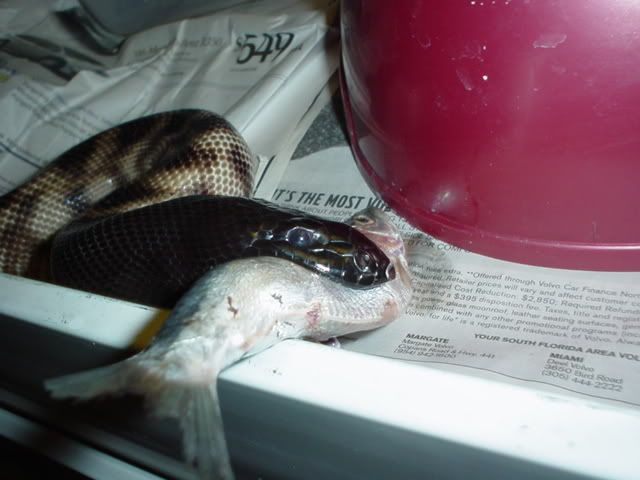
while we're on the subject of diet...
derekroddy
Apr 22, 2010 07:13 PM
Replies (21)
bhmorrill
Apr 22, 2010 11:07 PM
WOW, wasn't expecting that!!! How did that turn out? Never even crossed my mind to ever try offering fish. Have you done that much?
-----
Ben
www.australianaddiction.com
derekroddy
Apr 23, 2010 07:55 AM
Hey Ben....I got this idea after hearing a friend in Australia tell me.... he had seen BHPs "hunting" for small fish and Yabbies in a shallow creek bed.... in Queensland...several years ago.
I've been feeding fish to my BHPs about once or twice a month...for the last year...at least.
In fact, All my snakes will eat the fish. The Carpets LOVE them.
To large (or simply too many) Rodents can be a death sentence for a BHP...especially females....as they don't eat a lot of rodents in the wild.
I feel they should be fed a varied diet of things like fish, chicken, other reptiles, etc.....after all.....that's what they eat.
Cheers,
D.
Jaykis
Apr 23, 2010 03:25 PM
Considering how hard some hatchling bhps are to get to feed....goldfish??
derekroddy
Apr 23, 2010 10:58 PM
I'll let you know.
Haha.
Maybe sardines! The adults love em'.
D.
DanW
Apr 24, 2010 06:57 AM
Derek,
What do you feed Womas? Do you experience the same problems with too many rodents and too large rodents in womas?
Thanks,
Dan
derekroddy
Apr 24, 2010 07:45 AM
Hey there Dan....
Well, Woma eggs are "kingsnake eggs" compared to BHPs....at least in my experience. Haha.
I've never had issues with Woma eggs but...that said....
These days, I give all my snakes a varied diet.
I still feed rats....but much smaller (and more often) than most keepers and, I follow it with Turkey necks, fish, chicken parts, etc...
After all....they wouldn't be eating the exact same thing... everyday in the bush.
I just figure...it can't be bad for em'...why not?
Cheers,
D.
zach_whitman
Apr 24, 2010 12:56 PM
I will start by saying that I agree with the diet you are feeding. But I'd like to throw some ideas out there...
The question is not weather or not an appropriate diet effects vitality and fertility. It absolutely does. The question is, are rodents and appropriate diet?
I should know the effects of a good diet better than anyone. I have chrons disease and I follow a diet called the paleo diet to keep my intestinal disease under control. The premise of the paleo diet is exactly what you are trying to do with your snakes... feed people what they are actually meant to be eating. In a nut shell I eat meats, fruits, vegetables, nuts, and a little dairy. Basically stuff you could find outside. I eat no carbs, refined sugars, corn products, or preservatives of any kind, and it has a dramatic and measurable effect on my health. Getting off topic...
Like I said, the question is not whether or not a good diet is important, the real question is whether or not rodents make a good diet?
I do believe that variety is a good thing. I have no doubt that the vitamins, minerals, and maybe most importantly the types of fats in the varied species are beneficial in some way.
While many wild carnivores prey on a variety of species, many others are specialists in hunting specific species as well. I don't think any of us know where our individual reptiles fall on this continuum. So is a rodent diet really why my anthill eggs and your BHP eggs aren't hatching? I am not so confident. At least with anthills many people before me have fed only mice and not had this problem. I also feed about 25% quail. And while all of my animals eat the same diet only specific clutches are affected. If this happened at low levels to all clutches I would be more tempted to think diet played a bigger role.
Since we were talking about fats below, I would also question what the diet you are feeding actually changes. If you look at the study that I found in the post below, you will see that chickens actually have about the same if not much more fat than rodents depending on the age. Also, the fat content of fish is highly variable depending on species, reproductive statuts, and time of year. It can range from .5% (much lower than rodents) all the way up to 30% (higher than most rodents). I do not know what type of fish you feed nor what their specific body fat percentage is, but on a crude fat level, I doubt that your diet is any lower in fat than a diet of all rodents, The types of lipids may be different and the variety may be good for other reasons but its probably not a low fat diet.
Unfortunately I have been searching all morning for a study that has looked at the total body fat of whole lizards and I have not been able to find anything concrete. I will keep looking. After performing necropsy on many lizards (mostly iguanas, beardies, and leopards) I doubt that their body fat percentage is much different just based on visible fat stores... but I could be wrong and maybe a true lizard diet is markedly different in this regard.
On a different note, I have been thinking about using guppies to get juvi anthill pythons started and I think I am going to try that on a few this year.
Kelly_Haller
Apr 24, 2010 04:26 PM
There is one thing that is just as important as what food item you are using, and that is what that food item has been eating before it is eaten. I worked at a zoo many years ago, and one thing study after study showed us was carnivore diets in captivity usually fail when the diet of the species being eaten lacks, or has an excess, of some essential constituents. These are dietary constituents of these prey species that they are obviously acquiring in their natural diet that is not being supplied in the proper amounts in their captive diets before being used as a food source. Laboratory diets come close to these criteria, but it must be remembered that these diets are not necessarily geared toward the use of these animals as prey species for other animals in captivity. However, these types of diets are a good starting point. Rodent diets are probably the most thoroughly researched and closer to complete than any, and therefore rodents are most likely the best choice when attempting to supply snakes with their required macro and micronutrients. The commercial diets for insects, fish, and especially birds are fairly researched, but don’t typically approach the research that has gone into the formulation of a high quality laboratory rodent diet.
However, there is an issue even with commercial rodent diets. Except for ultra specialized formulations, most commercial rodent diets are usually geared toward high volume reproduction, and usually contain levels of protein and fat not acquired in the diets of their wild counterparts. Most commercial mouse and rat diets have an average of around 20% protein with 10% fat for mice and 5 to 8% fat in rat diets. Wild rats and mice typically consume diets with about two-thirds of that level. Some rodent breeders even cause more problems by using cheaper diets (sometimes dog food, etc.) that have even higher levels of fat and protein causing further dietary imbalances and obesity in these feeder animals. I have been raising my own feeder rats and mice since the late 1970’s and have never used anything raised outside my colony. I have a specific dietary formulation that is a mix of a commercial diet and natural grains that provides all essential constituents that I am aware of and provides about 14% protein and 3 to 4 % fat. The rodents in this colony are lean but not thin, and have very low body fat but yet are of a solid build. They also produce large healthy litters of young, although not quite commercial breeder numbers, but close.
I guess my point is I believe most snakes in captivity can do well on a rodent diet regardless of their natural diet, provided those prey animals are fed a high quality feed and of reasonable protein and fat concentrations. The fat content of prey species is probably one of the most critical components in the diets of captive snakes, and this has been proven by many other reptile keepers as well. Low fat content feeder animals are especially critical when using rodents to feed snakes that typically consume high percentages of lizard prey in their natural environment.
Kelly
zach_whitman
Apr 24, 2010 09:55 PM
All good points Kelly. Gut loading is not just for crickets!
It seems to be considered common knowledge that lizards are so much lower in fat. Does anyone actually know this for a fact?
derekroddy
Apr 25, 2010 07:24 AM
Kelly wrote..."There is one thing that is just as important as what food item you are using, and that is what that food item has been eating before it is eaten."
And...."I guess my point is I believe most snakes in captivity can do well on a rodent diet regardless of their natural diet, provided those prey animals are fed a high quality feed and of reasonable protein and fat concentrations.
The fat content of prey species is probably one of the most critical components in the diets of captive snakes, and this has been proven by many other reptile keepers as well.
Low fat content feeder animals are especially critical when using rodents to feed snakes that typically consume high percentages of lizard prey in their natural environment."
Exactly what I was saying.....
Thanks for the post Kelly.
Cheers,
D.
TOM_CRUTCHFIELD
Apr 25, 2010 01:37 PM
Kelly, just to add to your statements a little on the subject of proper diet for snakes is the fact that snakes that are genetically programmed to eat ectothermic prey for part or all of their life don't do as well, I think, on endothermic prey. A classic example are West Indian Boas and King Cobras. Most folks upon receipt of a King immediately try to switch to rats. The result is usually an obese flaccid Ophiophagus instead of the sleek muscular steel like bodies of snake eaters. I'm fully aware of the theories and motives behind this but I personally never try to switch them and one I kept for over 10 years and finally gave it to George Van Horn lived for years afterward. Usually I feed pre-killed f\t snakes and my Kings retain that unique regal steely appearance of a healthy wild one. I know in crocodilians diet has everything to do with fertile egg production. With Cuban Crocodiles for instance They require whole mammalian prey to acieve maximum fertility and egg viability. I'd bet that snakes are perhaps not as sensitive as crocs but still would likely benefit if fed their natural diet...thanks
-----
Tom Crutchfield
www.tomcrutchfield.com
Kelly_Haller
Apr 25, 2010 03:29 PM
species that as you stated - feed almost exclusively on ectothermic prey. I think these species are the most prone to the effects of excess fat, and are able to counter that caloric differential in the wild by eating ectotherms. Most ectotherms have on average a higher percent protein content by weight, and a caloric density that is as high or higher than most mammalian prey.
Kelly
derekroddy
Apr 25, 2010 08:12 AM
Zach worte..."Like I said, the question is not whether or not a good diet is important, the real question is whether or not rodents make a good diet?"
Of course, they make a good diet.....especially for animals that eat them all the time.....I'd have to argue whether a 100% diet was "good" for animals that don't though.
I guess if you are making sure that the fat's aren't too high.....you'll be just fine. (And of course, you would have to know what food source is being fed from the commercial breeders before making that call...unless you're breeding your own)
Problem is...at least with BHPs....is that.... most keepers don't know what is an exceptable fat diet.
That's been proven to me time and time again when BHP keepers call and ask why their 7 foot 6 year old female is dead with fat babies loading down the internal organs.
Nobody is questioning whether rodents are an acceptable food item....it's whether they are acceptable as a 100% food item to animals....that don't eat them.
Obviously, if you know what the fat content of the animals you feed is....and, it's a low fat diet....then you should be cool.
Just be aware of it....was all I was ever saying to begin with.
Zach wrote..." So is a rodent diet really why my anthill eggs and your BHP eggs aren't hatching?"
Never said it was....I threw out a suggestion for improving hatch rate..... by changing diet.
In your particular case... I would say it was keeper error on the incubation method.
I think if I was raising my own rodents...and, knew what those rodents were getting....I wouldn't be so worried about it.
I know at least 10 BHP keepers who have had animals die on them from being overfed (Fat bodies in or on the internal organs)...so.... It DOES make a difference...at least in BHPs.
I don't see overfeeding to be as much of a problem with rodent eaters....yeah, they may get fat....but, to just roll over and die?...Haven't heard about it...(not saying it couldn't happen but)....never heard anybody mention killing a carpet or retic from over feeding rodents.Haha.
But, people often overlook what they are feeding their animals in order to....
"Get them to breeding size"
"Get larger clutches"
"The female needs to be up to weight"
etc....
What I'm getting at is.....there are a million and one reasons why a keeper would want to over feed their animals. This is why I say the things I do about diet because... I feel most keepers over feed their animals. (Just like a lot of people want to over eat....then get larger and have complications from it.)
That said....I believe that mice have about 10% less body fat than rats...If I remember correctly.
Cheers,
D.
Jaykis
Apr 25, 2010 09:42 AM
I know fat snakes are not healthy snakes, but is that more of a result of the type of prey item, or the volume? Sedentary snakes don't eat a lot. I don't think BHPs are that sedentary, unlike overweight Blood pythons or Burms. Some snakes never seem to get fat, tho. At least as adults.
Snakesunlimited1
Apr 25, 2010 12:47 PM
Every snake in captivity can be overweight as adults. In fact I rarely see captive collections that are not mostly overweight. If you don't think that I would think you do not see enough wild snakes. I was at a guys place recently and he was complaining about another keeper's collection being fat. I looked around his animals and mentioned they were all fat too and he thought I was joking. I try to keep my animals pretty lean and I miss a breeding season here and there because of it. When I cared more about production I did keep my animals heavier but now I go lean.
Jason
zach_whitman
Apr 25, 2010 10:48 AM
All of that seems to make logical sense, except for one thing. I don't think that the diet you feed is any lower in fat than a diet of all rodents! I have seen nothing conclusive that would indicate a diet of fish, chicken, and rodent, is lower in fat than a all rodent diet. As far as rats vs. mice, it depends on the age of each.
Snakesunlimited1
Apr 25, 2010 01:02 PM
Quote from above "Unfortunately I have been searching all morning for a study that has looked at the total body fat of whole lizards and I have not been able to find anything concrete. I will keep looking. After performing necropsy on many lizards (mostly iguanas, beardies, and leopards) I doubt that their body fat percentage is much different just based on visible fat stores... but I could be wrong and maybe a true lizard diet is markedly different in this regard."
HAHA I don't think that you can open up captive lizards and compare that to what a BHP would be eating in the wild. Captive beardies are way overweight compared to wild beardies. Same with everything else in captivity. Looking at the wild iggies in Florida would be a fair comparison in a way but that is about it.
One big thing being left out is famine and hunting activity. BHP are seek and destroy type predators more than ambush. They get a lot of activity in the wild and besides Derek taking his out for a walk I am not aware of anybody else that really lets them cruise like they should. I would highly recommend (though I can't currently provide it myself) large enclosures that also provides height and climbing opportunities.
Jason
Jaykis
Apr 25, 2010 03:08 PM
My male only cruises when hungry, just like any other hunting snake.
Kelly_Haller
Apr 25, 2010 03:15 PM
I did a little search in my library and online and found some scattered info on fat composition in lizards. In Dr. Eric Pianka’s book, Ecology and Natural History of Desert Lizards - 1986, he makes reference to studies showing that desert lizards typically have slightly larger fat reserves on average than moist climate lizards. This evolved as a survival adaptation to counter times of food scarcity in highly variable desert environments. Another study conducted in Florida supplied physiological data gathered on an established wild population of Nile monitors. Fat content of these animals averaged about 5% of total body weight. However, prey composition studies in almost all cases show nutrient composition of prey animals as percent dry weight. As such, that would put the dry matter fat percentage of these monitors at around 12 % to 15% on average. My guess would be that the diets of these Niles was considerable better than that of their African counterparts. Another study looked at a wild population of Cordylus in a dry region of Africa. These arid climate lizards would probably be very indicative of desert species in general. They gave dry matter actual weight figures only and no percentages, so I had to do some calculations, but they appeared to be in roughly the 10% range on dry matter basis. Comparing those fat content figures to some listed for anolis, that 10% figure looks even more reliable. While lab raised rats and mice on higher fat diets have easily twice this fat content, data on wild rats and mice show fat contents that are not that much higher than wild ranging lizards. Another case for the monitoring and/or revising of the diets fed to captive rodents that are to be used as feeders for captive snakes.
Another excellent point that Tom brought up on April 23rd in another thread below, was the issue of not only what to feed, but how much. Even when using nutritionally balanced and appropriate prey items, you can still run into health problems and overfeed even when using low body fat prey items.
Kelly
derekroddy
Apr 26, 2010 11:46 AM
And, keep in mind that....maybe a high rodent diet (for reptile eaters) may not effect every animal.....just like high sugar intakes effects diabetics.....and, not every human.
Of course over feeding anytype of food item could be bad....whether it's rodents, fish, or hamburers! Haha.
D.
JackAsp
Apr 25, 2010 11:28 PM
In humans, fish fats are more beneficial to the body than mammalian fats. I wonder if there've been any studies on whether or not that's relevant in herps...
-----
0.1 2006 Western Hognose (Bebe)
0.1 age unknown Cane Toad (Hengo)
0.1 2005 White-Banded Sheen Skink (Minerva)
1.0 2006 Northern Diamondback Terrapin (Queequeg)
1.0 2006 Madagascan Speckled "Hognose" (Sigmund)
1.0 2008 Bullsnake (Winkle)
1.2 2008 Eastern Collared Lizards (Pancho, Lupe, and Chica)
2.0 2009 Eastern Collared Lizards (Cesar and Nino)
