


Reptile & Amphibian Forums

Welcome to kingsnake.com's message board system. Here you may share and discuss information with others about your favorite reptile and amphibian related topics such as care and feeding, caging requirements, permits and licenses, and more. Launched in 1997, the kingsnake.com message board system is one of the oldest and largest systems on the internet.

Click here to visit Classifieds
Click for 65% off Shipping with Reptiles 2 You

Persistent RI symptoms?

Whyte_Rabbit Apr 25, 2010 06:33 PM

I'll apologize in advance for the long story, but I'm trying to include as much detail as I can.

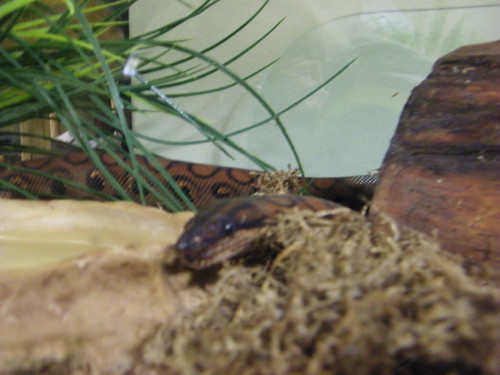
I have a rescued 3yr old female BRB that I've been nursing since I picked her up mid-March. She was extremely dehydrated and underweight on first meeting, retained eyecaps and shed on her head. We thought we lost her on the way home in the car... was sleeping with her mouth agape, and making rasping noises on inhale. No mucos, discharge or cough. Just that persistent "snarfling" inhale... when she does it she looks almost like a toad croaking, the pouch of skin under her jaw puffing up as she breathes occasionally. Her tank setup: temps and ambient humidity fluctuate between 75-80, waterbowl for soaking, damp hide and dry hide on 3" of cypress mulch. Her symptoms subsided a bit once she settled in, but still there. Got her to a vet a few days later (delay due to blizzard), we found some redness deep in her throat, more like broken blood vessels. The decision was made to treat her for RI regardless. Shots every 3 days for 12 doses (blanking on the name of the medicine, I know it was a broad spectrum.) Finally got a good shed and a fecal; still "snarfling" occasionally, but marked improvement. She's gained 100g in 8 weeks, almost to 500g now. Still tiny for a 3 yr old. One adult mouse weekly, no powerfeeding here. Fecal came back with hookworms, so now on a Panacur regimen for 8 weeks. Have a call into my vet again regarding the symptoms returning.

Has anyone had experience with these RI symptoms? I'm pretty sure the vet's going to want to get a culture of whatever's brewing in there. This lil gal has been a trooper through it all, great disposition and even getting some spunk back! Hoping we can get to the bottom of this all. Any input is appreciated!

Thanks!

Tonya & Cassie
Image

Replies (4)

Whyte_Rabbit Apr 25, 2010 07:30 PM

Small correction in time table.. picked her up 2/27 @ Berks show.

Kelly_Haller Apr 26, 2010 12:51 AM

With no mucous discharge or attempts to expel anything, and the fact that she is feeding well, my guess is that the problems stem from the severe dehydration. The lung and throat tissue could just be irritated from the severe dehydration making it difficult to breath. It is also possible there is a tissue infection in the throat as well, but I would think that an infection in the throat of much degree would keep her from feeding. Weight gain is obviously a good sign, and I would keep the humidity in the 75 to 80% range, but definitely raise the temps and make sure your substrate temps and air temps are at least 85 F. Temps in the 70's will inhibit the effectiveness of her immune system. I would be curious if your vet feels further antibiotic treatment is necessary, and I would also be interested to hear Ian’s thoughts as well. Please keep us posted.

Kelly

Whyte_Rabbit Apr 27, 2010 01:51 AM

Update: Thread relocated to "Rainbow Boa" Forum. Thank you.
-----
Desiderata Baby!

1.0 '08 BRB "Orion"
0.1 '07? BRB "Cassiopea"
0.1 '09 Cal King. "Pandora"
0.1 '09 Apricot Hondo "Speckles"
1.0 '08 Tang. Hondo "Bates"
0.0.1 '09 Eastern Garter winter refugee "Jumper"
2.1 '08 Domestic Ferrets "Hobbs, Meenu & Stash"
0.2 '95 & '99 Homo Sapiens, feline recessive

joeysgreen Apr 29, 2010 04:56 PM

I guess I missed the boat on this one, being gone for a few days. Good advice Kelly, the only additional thing that really popped to mind was the presence of hookworms. Now my parasite life cycles are a little rusty, but I do know that immature hookworms are migrators. Many migrating species aim to reach the back of the mouth/larynx area, in which they are swallowed into the digestive tract where breeding commenses. I have little first hand experience on this, but I would guess that this little snake would have to be loaded to get a very noticeable reddness in the mouth as seen by the vet. Still, a tissue reaction, and high parasite numbers, could explain all the symptoms. Keeping the enclosure sparkling clean and removing feces immediately (before eggs can hatch and reinfect... perhaps only a few hours at snake keeping temperatures), will prevent reinfection. I do think hookworms have a direct lifecycle. Antiparasitic med's should be limited to local GIT treatments. Systemic drugs will kill all of the migrants, and with potentially hundreds of dead worms throughout the snakes body, anaphylaxis, toxicosis and septicemia are all concerns.

Here's the real question: Where would this boa get hookworms from? Are BRB's still commonly wild caught in the USA? What about the substrate used; could it contain the hookworms found in local herps?

I should also say that I went off on a tangent and this isn't necessarily the problem, but a possibility. Unless unnecessarily invasive, further diagnostics are always a good idea in my book.

Ian

Site Tools
