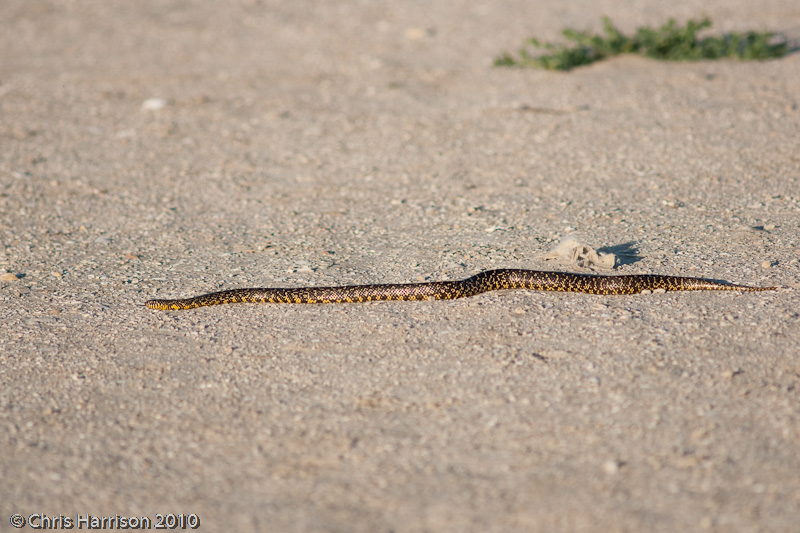
What is it, and where was I?
-----
Chris Harrison
San Antonio, Texas
Welcome to kingsnake.com's message board system. Here you may share and discuss information with others about your favorite reptile and amphibian related topics such as care and feeding, caging requirements, permits and licenses, and more. Launched in 1997, the kingsnake.com message board system is one of the oldest and largest systems on the internet.



What is it, and where was I?
-----
Chris Harrison
San Antonio, Texas
idk, desert king, central TX?
-----
2 tham radix
1 Chicago Tham s. semifasciatus
2 elaphe vulpina
1 gray tiger salamander
4 Aphonopelma hentzi
1 G rosea
1 Haplo minax
1 Brachy angustum
1 Brachy sabulosum
1 Brachy vagans
1 Cent. hentzi scorp
Well, without knowing the size(and how old it is), it is tough, but I will go with it being a speck from a probable splendida intergrade zone. Maybe central Texas, or into Oklahoma.
But as you know, this can cover a HUGE area of several states.
BTW, I am totally surprised(as you probably are) that there haven't been more posts here with snakes that have been showing up, being as it is late April now. 
~Doug
-----
"a snake in the grass is a GOOD thing" 
my website -serpentinespecialties.webs.com
Darn,
I forgot my automatic signature!
I was hoping to trick someone into calling it a FL King.
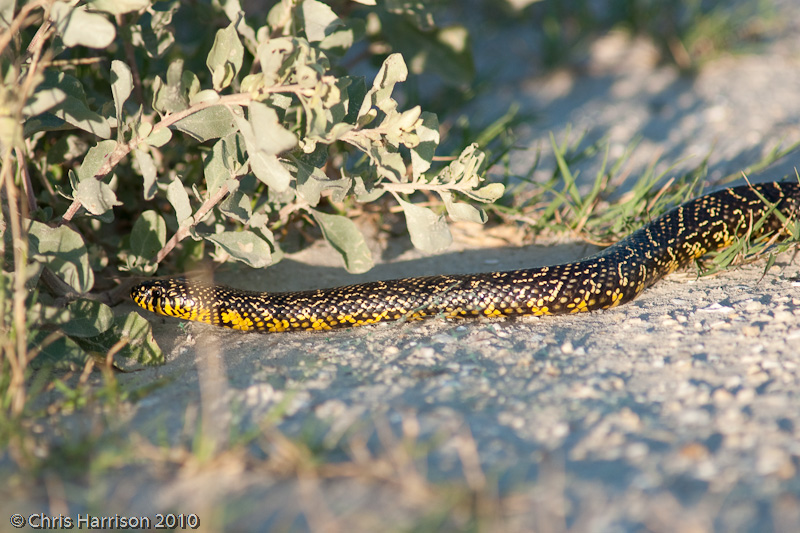
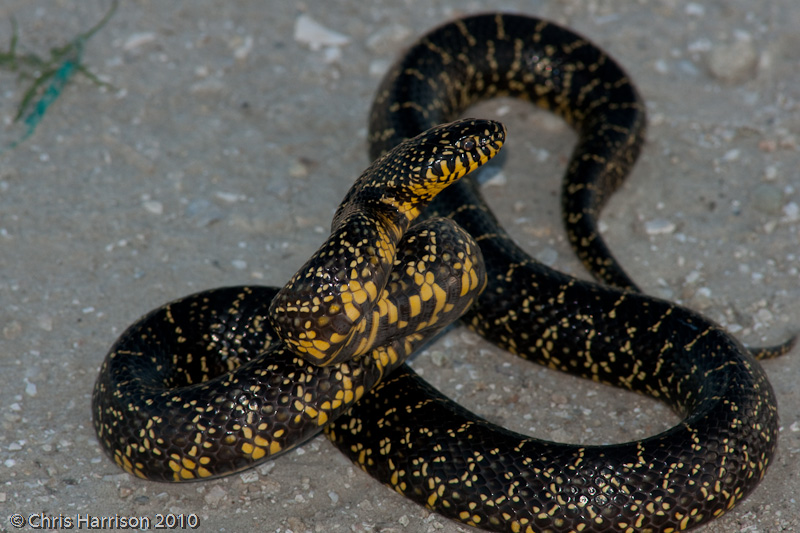
I found it out crawling in Port Aransas, Texas last weekend. I saw it from a distance in binoculars and my first (ridiculous) thought was that it looked like a Florida King.
It is, of course, an ugly intergrade Speckled x Desert King.
Oh well, can't trick you guys and gals!
Chris
-----
Chris Harrison
San Antonio, Texas
Yeah, but it's not really so ugly in my opinion either. It sure has the strong yellows goin on there!
Yep,..right at the extreme southern point of the intergrade zone!
Now I can't STAND when people produce man-made intergrades and hybrids that dilute genuine gene pools in the hobby, but a naturally occurring locality intergrade is certainly all fine and good with me in that case. as long as it is kept that way of course, and not bred to a genuinely pure ssp. and sold as such..LOL!
Thanks for sharing those nice pics. Some of the guys I know on the king forum would love that dude!
~Doug
-----
"a snake in the grass is a GOOD thing"
my website -serpentinespecialties.webs.com
Doug, you are correct, ME LIKEY!! Hey, its a natural integrade and thats cool. I also agree that those yellows are a LOT more vibrant than I see in specks!!
So, heres a question. If you captured an animal like that, would you have an issue breeding it either into a holbrooki line or a splendida line? Since it could go either way, would you do that, or only breed it to a similar integrade animal captured in the same general locality? (OK, thats really two questions!).
KevinM
To be honest, personally I wouldn't breed it to anything other than another intergrade just like it from that same locality.
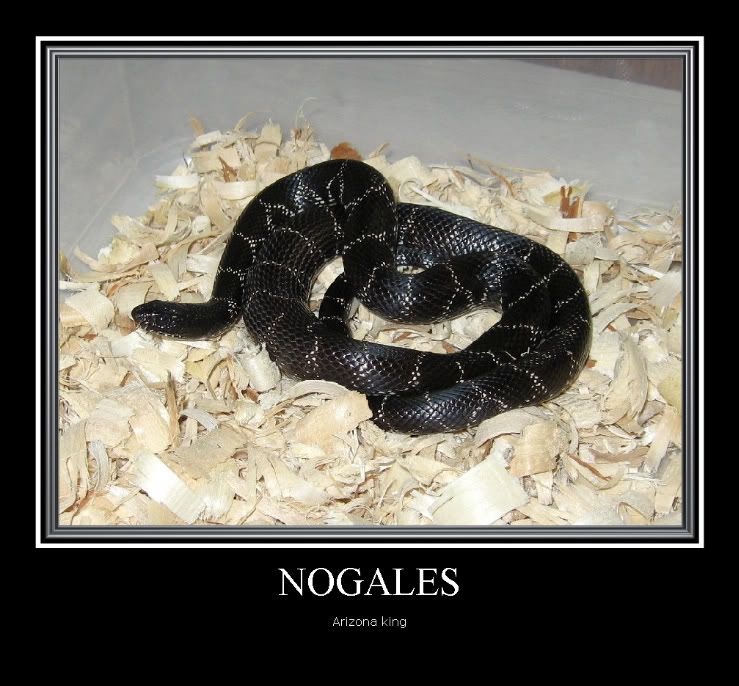
I have the very same dilemma with that "Nogales" locality king I have. If I cannot locate another one from that same bloodline later on that came from that founding "Nogales",Arizona lineage, I will not breed it. I won't breed it to a pure splendida, or "Yuma" intergrade kingsnake, or whatever the case may be.
Truth is, I do not know what percentage of exactly what it TRULY is anyway, and nobody else does either. All three ssp.forms meet right together in that one area, and can look like any combination of all three, or more like either individual ssp. of the three, or any two, or whatever..LOL!.
I know it has strong splendida influence, but nigrita, and some californiae are also very likely in there, just know way to tell what percentage of what..LOL!
Heck, nigrita is very likely a mere melanistic form of splendida anyway, so when one looks at the locality charts in Hubbs' book, it can be a freakin coin-toss in THAT respect too. The thing is a real unexplainable puzzle right there in extreme southeastern Arizona man, that is a fact! 
~Doug
-----
"a snake in the grass is a GOOD thing"
my website -serpentinespecialties.webs.com
>>Heck, nigrita is very likely a mere melanistic form of >splendida anyway,
And holbrooki is just a slightly more speckled splendida. What deserves subspecific designation then?
I used to be really into south AZ kings. I spent a lot of time down there looking for them and kept a few. My general rule for breeding them was I bred animals that looked like each other, regardless of their particular locality. I was looking for a particular phenotype, not a locality bloodline. I wanted clean narrow yellow banded snakes with no speckling on the sides like a "classic" Yuma king. The whiter the bands, the better.
I stopped breeding them a long time ago when I found out everyone else thought they were just ugly cal kings.
Chris
-----
Chris Harrison
San Antonio, Texas
Yep!,...I can totally relate to every bit of that Chris.
yumensis.... "ugly Cal. kings" indeed..LOL!
similar to a genuine polyzona being looked at as just an "ugly" hondurensis!
Trouble is, not enough people know enough about any natural history or morphology of any of these snakes,.....just flashy colors and flashy names.
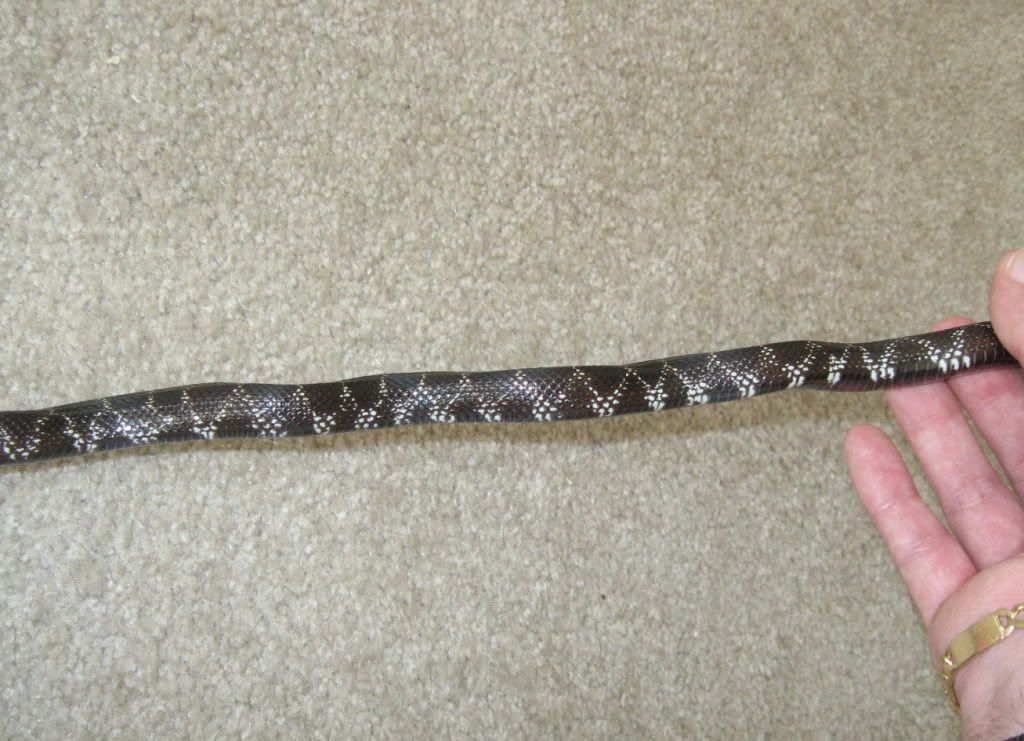
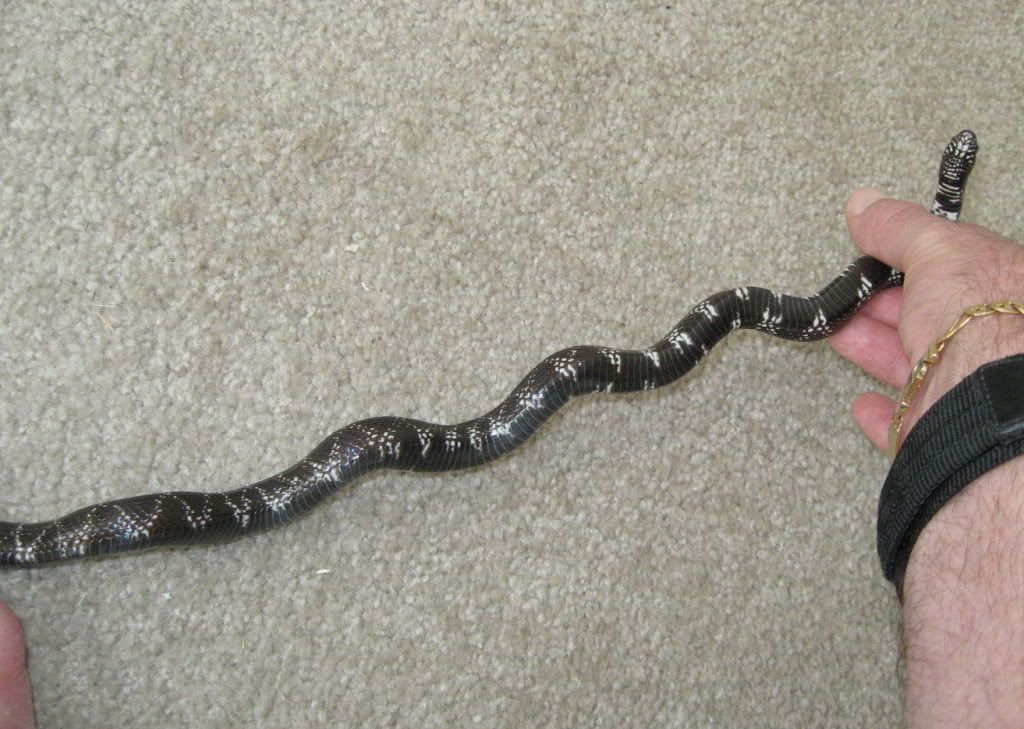
BTW, yes, a guy emailed me with a picture of a king he captured less than a mile from the Mexican Nogales border in Santa Cruz County Arizona that looked EXTEMELY similar to the one I have, but he no longer has it..LOL!. That thing would have been a perfect match.....oh well!..LOL!
I might have some luck at the Repticon show in Orlando this coming month where I was vending and picked this snake up, as two people I know there know more details about the W/C parents and several other pertinent details that might make it possible to get another animal from this same "Nogales" bloodline.
I have seen TONS of photos of splendida, and splendida intergrades from different places, but have only seen one or two that are almost identical to this one, only they were a tad darker is all. The Nogales king that guy emailed to me after seeing it posted on the "king" forum months ago was that extremely similar snake. This is why I have little doubt that this is EXACTLY where this snakes parent lineage originated. His Nogales animal was indeed a dead ringer for this one I have, only just SLIGHTLY more melanistic is all.
-----
"a snake in the grass is a GOOD thing"
my website -serpentinespecialties.webs.com
Desert animals always ring my bell.That is one nice snake Doug and I hope you get to breed it put me on a offspring list for sure.It reminds me of one I saw that came from the santaritas.The desert hold some very nice and hardy snakes.
-----
Archie Bottoms
Thanks Archie!,.....
Yes, I totally agree with that. Some VERY unique snakes in those desert areas for sure!
I will keep you in mind if I get an appropriate mate for him and they breed successfully.
~Doug
-----
"a snake in the grass is a GOOD thing"
my website -serpentinespecialties.webs.com
I really like those B&W splendida looking things. Really underappreciated snakes, only because you can't put a label on them. I think that snake is 10X better looking than the pure "anerythristic" splendida people sell.
similar to a genuine polyzona being looked at as just an "ugly" hondurensis!
I've seen more than a few polyzona. Unfortunately every one I have seen was seen by another car or truck before me. They aren't ugly in any way.
This animal from southern Veracruz was over 4 feet long. I've seen a few wild caught hondurans who dream of being this nice looking.

I think the origin of the "ugly" polyzona is that people ended up with ugly, black stippled hondurans (= low $$) and simply upped the price and sold them as polyzona (= high $$). Same thing happened with Sinalons/Nelsoni.
Am I implying that herpers would lie about the "correct" subspecific origin of a snake to make it more saleable? SHOCK!!
-----
Chris Harrison
San Antonio, Texas
God forbid any one would ever lie.To me every snake holds its own beauty as what it is .I think that money has long got in the way of good science .When a snake became just money was a long time ago.I keep snakes that no one else wants because I like them.My collection has little value as far as cash goes.I do not mind tho.One of my favorite snakes is a bothrops atrox no value at all or my cotton mouth.I keep snake that interest me as what they are not what they can do for me.I keep great plains rats as well and some locality atrox.They interest me .Or the norther form of new mexico milk.Just for me.I even keep albino cal kings as a pet.


-----
Archie Bottoms
Thanks Chris!,...
I really like the very unique look this guy has too.
Yeah, the anerythristic/axanthic splendida don't really do a whole lot for me either, ......but to each his own I guess.
Nice Veracruze animal there!. Being that it is from the southern area of Veracruze, would you not also say it seems to have a good amount of stuarti influnce?. The high RBR count at 22, and the very thin "V" shaped snout band are pretty indicative of this as well.
Just as you mentioned, with several of the other Latin forms that are in todays mix of so-called hondurensis now, it can be tough to distinguish exactly what is what anymore, even when they key-out well as a certain ssp.
And yeah, most people don't know the real differences between sinaloae and nelsoni anyway, let alone no a great looking specimen if they saw it.
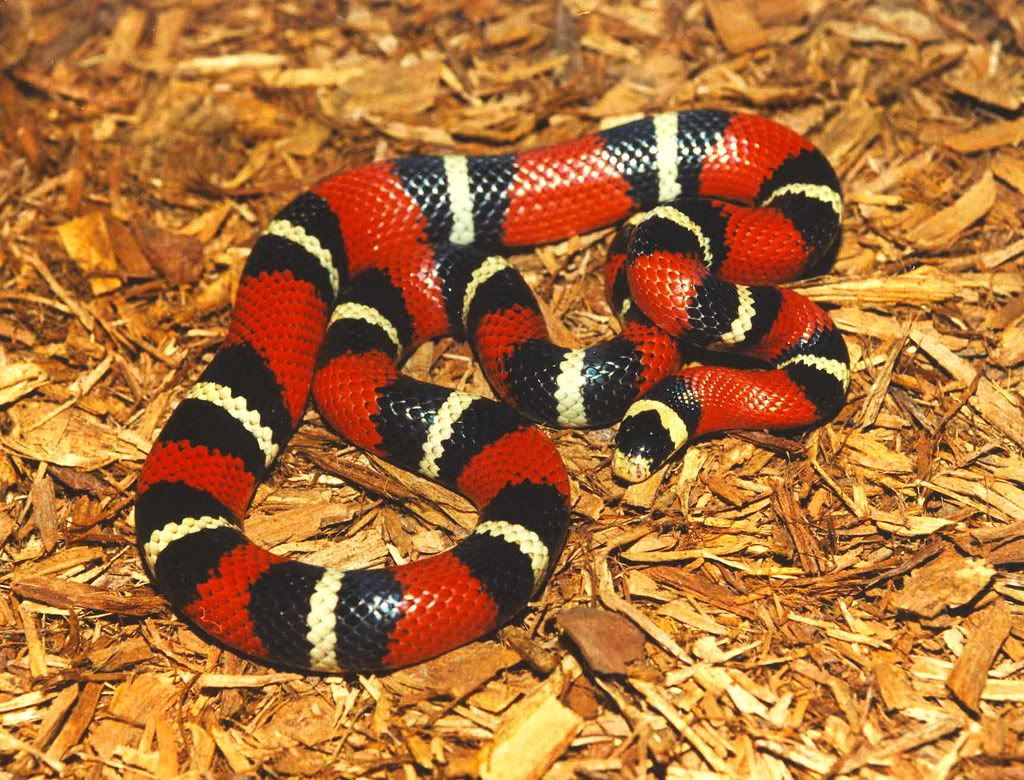
Scott Ballard, Shannon Brown, and many other milk-head "guru's" were blown away at this nelsoni specimen I had many years ago. When is the last time you went to a show and saw one like this that wasn't all "watered-down" with sinaloe influence?..LOL!
This guy sported a very incomplete black neck ring "notch" under the throat, as well as had the very obvious high RBR count with very thick, flaired out dorsal black rings.
Boy!, do I wish I still had him!
~Doug
-----
"a snake in the grass is a GOOD thing"
my website -serpentinespecialties.webs.com
can't believe I freakin misspelled "Veracruz" TWICE there!!....geez!
~Doug
-----
"a snake in the grass is a GOOD thing"
my website -serpentinespecialties.webs.com
Nice Veracruze animal there!. Being that it is from the southern area of Veracruze, would you not also say it seems to have a good amount of stuarti influnce?. The high RBR count at 22, and the very thin "V" shaped snout band are pretty indicative of this as well.
This snake is from southern veracruz closer to the Tabasco border. Paste these coordinates into Google Maps if you want to see the exact locality:
18.167546,-94.166222
If it would show any influence of other ssp, they would be blanchardi (a hundred miles to the west) or oligozona - 50 miles south across the isthmus of Tehuantepec. I don't know that snakes cross the isthmus from north to south though? It seems like there could be intergrades in the lower areas across the isthmus, but milksnakes are lowland snakes in this part of Mexico.
Considering how bogus most central american milksnakes ssp. are, I don't think I put any weight in band counts, patterns, or whatever.
-----
Chris Harrison
San Antonio, Texas
Yes, that really would be more polyzona territory as you mentioned.
I also agree on some of the "bogusness" on some of the variables of RBR counts as well.
~Doug

-----
"a snake in the grass is a GOOD thing"
my website -serpentinespecialties.webs.com
Did the babies resemble the adults -just curious
Actually they were variable, just like nigrita babies.
Some hatched looking almost like the adults (narrow banded cal kings) although they were brighter and usually had a tiny bit of "splendida" type speckling.
Others looked like baby splendida, but would darken as they aged.
-----
Chris Harrison
San Antonio, Texas
Help, tips & resources quick links
Manage your user and advertising accounts
Advertising and services purchase quick links
