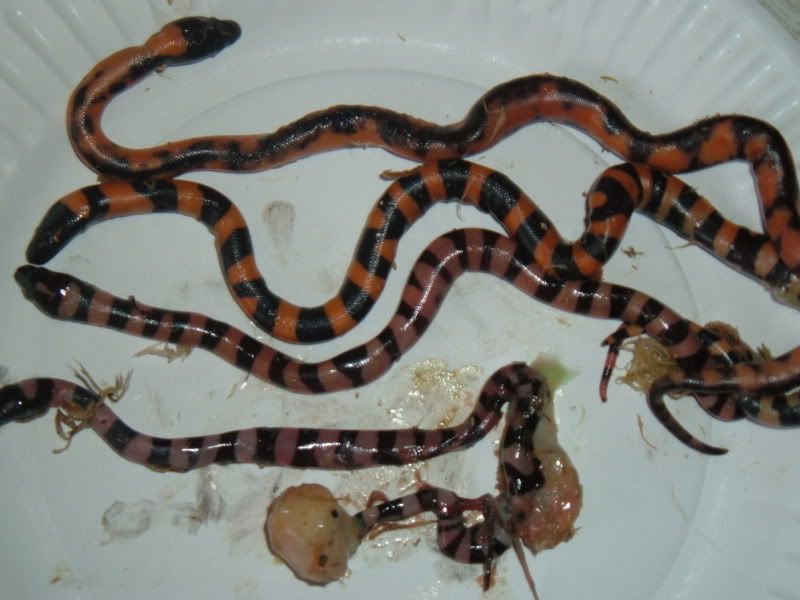
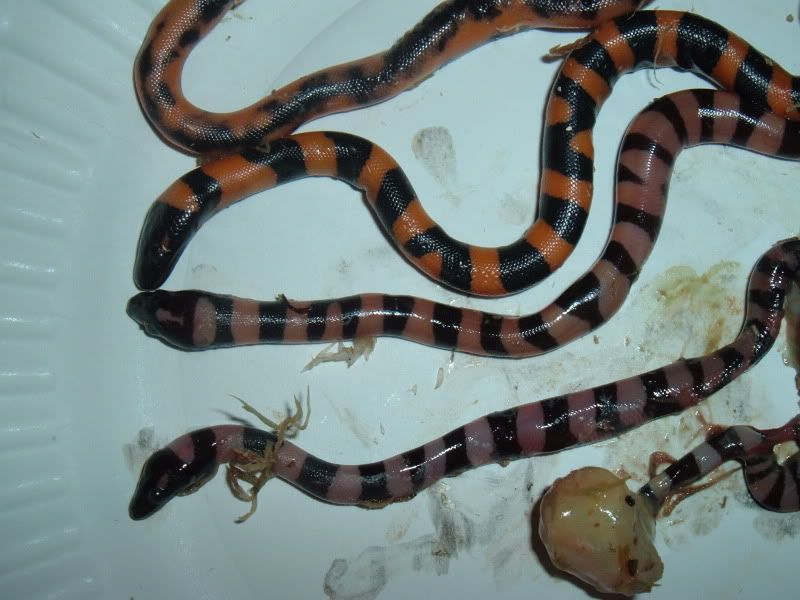
Once again,this year we had a 100% failure with the Bismarck eggs!
Just about had enough!, feel like `giving up!`
Reptile & Amphibian Forums
Welcome to kingsnake.com's message board system. Here you may share and discuss information with others about your favorite reptile and amphibian related topics such as care and feeding, caging requirements, permits and licenses, and more. Launched in 1997, the kingsnake.com message board system is one of the oldest and largest systems on the internet.


another Bismarck disaster
oakbank
May 18, 2010 02:31 PM
Replies (20)
Jaykis
May 18, 2010 03:48 PM
Talk to Tom Keogan. He's bred tons of them. He'll see your post soon.
Tom Keogan
May 19, 2010 08:15 PM
Sorry to hear that but all I have is ?'s, how, why, where, how many, age of adults, incubation?
Again Sorry!
oakbank
May 20, 2010 01:49 PM
Hi Tom
"It,s Heather,(Oakbank), from `Sunny Scotland`,i think that you should still have our e.mail addy somewhere (lol)
i,ll try and give you as much details as poss.
1. Adults cooled, as you suggested in one of your last emails.
2.16.3.10 13 eggs laid, 23.3 2 eggs removed, and then on 31.3 another egg removed (all duds!)
3.the eggs were kept in incubator with temps. 31oC they were placed on moist vermiculite,with moss lightly place around
and were sprayed when required,maybe every 7/10 days with same temp. water
4.about two weeks ago some of the eggs started to (deflate),and when i opened then, found partially form youngsters.
5. on 18 may(day 63) 3 eggs seemed to pip,but after a day they were found to be dead.i cut the four pipped egg open,and this too was dead!
6. at present there is still one `good looking egg!`
7. the female is 01 and the male 03
i have little expierence with python eggs,(as i mainly keep and breed boas), but have bred. Western Hoggies for years,so have had some dealings of eggs.
"Any Advice Tom, most welcome"
Kind Regards
Heather/Carey
from `Sunny Scotland` (lol)
Jaykis
May 20, 2010 03:49 PM
I think the 31C is a little too low.
Jaykis
May 20, 2010 04:06 PM
Also, many python eggs deflate a week or so before hatching. It's normal, from my experience.
oakbank
May 20, 2010 05:15 PM
hi J.
The eggs were actually leaking out fluid, the exact same as western hoggy eggs do when they are pipped,only difference is the wee hoggies heads soon start to poke out
Jaykis
May 20, 2010 10:33 PM
Eggs have a finite life. If they are incubated at too low a temp, the eggs can decay.
Tom Keogan
May 21, 2010 06:22 AM
Heather/Carey, I would like to ask you for some more info if you can like the size of incubator, size of egg container, how it was heated, air circulation in the incubator? Also what you consider moist vermiculite? Pictures would be great. Sounds like they may have been too wet, but there could be lots of reasons! I would not mist the eggs. Slightly drier is always better then too wet. They should get moisture from the air from high humidity and should be able to dimple/deflate in the last few weeks and lose some water. If the egg container is too wet they cannot lose the necessary moisture.
If they were leaking fluid they were probably too wet.
Were the partially formed babies alive, what made you cut them open? Smell?
The slugs/duds could also be due to the male or breeding timing issues compared to ovulation.
Your temps are fine if 31C = 87.8F!
Just my interpretation could be lots of other causes!
Don't give up you are closer then you were last year! 
Jaykis
May 21, 2010 09:40 AM
I agree with Tom's assessment of too much moisture. I always incubate at 89 or very slightly above. And never open an egg unless it's pipped. The fact that you're getting full-term dead babies leads me to believe that it's in the final stages of developement where your problem is happening.
oakbank
May 21, 2010 11:04 AM
Hi Guys
Thanks for your replies, as i said before i have no expierence with pyhon eggs .I just `treated` the eggs in the same way as Western Hoggy eggs, (only at higher incubation temps.)
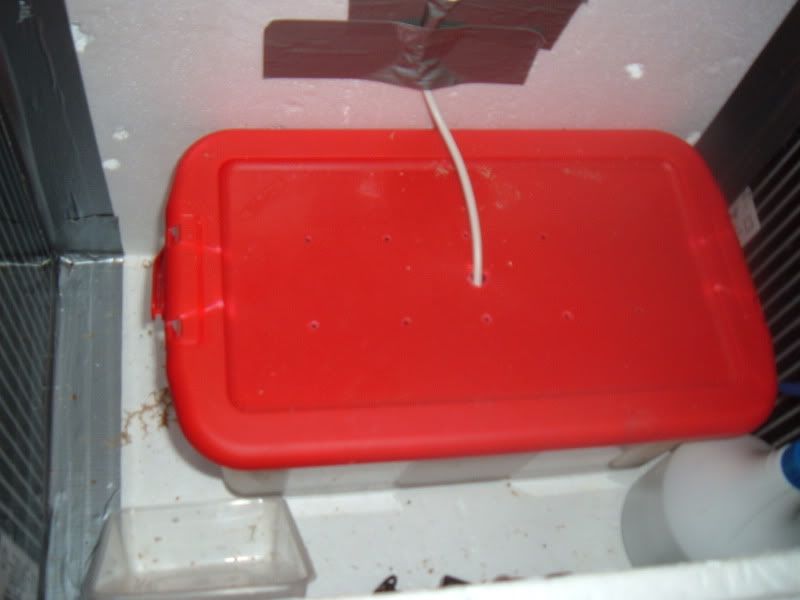
The incubator is made from a poly box, with heat mats conected to `pulse stat`. The incubator was tested and monitored over several weeks to make sure a `good ,constant heat` was maintained.
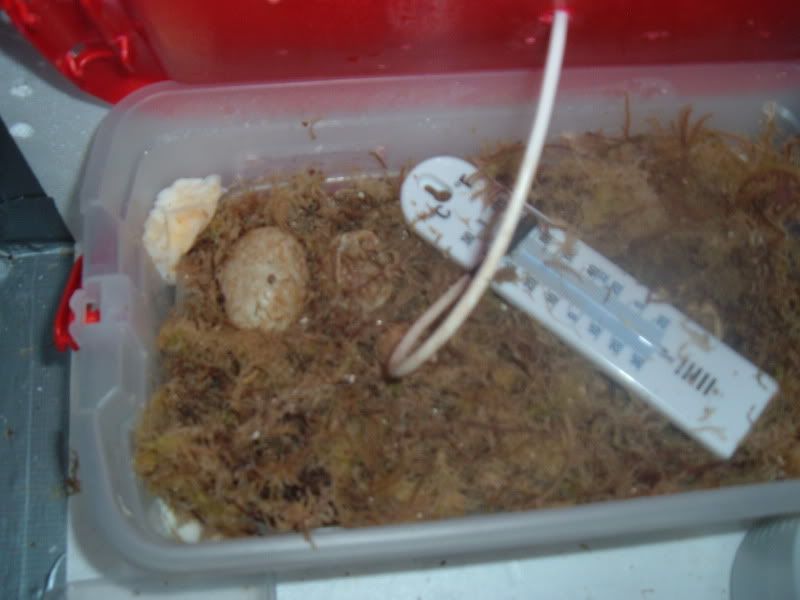
Inside the poly box i had a second box with about an inch of water ,and inside this box ,on mountings (so as above the water)was my incubation box, containing vermiculite.
the vermiculite was soaked,and then squeezed in my hand to get rid of excess water (again this is what i do with the Hoggies).
The air would only be circulated when i opened the lid for a `very quick look in` (every few days or so),not opened long enough to drop temps!
The young were all dead in thier eggs! There is still one surviving egg (which looks good to me!)
hope my description of the incubator is o.k. for you guys to understand, `reading my own description it seems very complicated,.....but it,s not (lol)`
now i,ll post some pics of the incubator
Many Thanks Again Guys
Heather/Carey
oakbank
May 21, 2010 12:10 PM
Pics as promist
Snakesunlimited1
May 21, 2010 10:15 PM
Too wet
Jason
oakbank
May 22, 2010 01:30 AM
"God, i hate Human Error!!!"
You guys have convinced me,...`too many of you,saying the same thing!.................`Too Wet!!!`
the last egg has started to deflate today (Sat.22 07.00am)....
`Strange thing though,is this is how i incubate my `Western Hoggy eggs`,with very good results.Last year we hatched 51 out of 53 eggs
i will def. `take on board what you guys are telling me`...and fingers crossed for next year
"Maybe, i,d be better of sticking to breeding Sanzinia (lol)"
Kind Regards from `Sunny Scotland`
Heather xxx
Snakesunlimited1
May 23, 2010 12:09 AM
Well on the bright side you got them very far with very bad incubation technique. That tells me they are good eggs, from good parents, with an excellent chance to hatch out healthy babies next year with a change in set up. If you are doing this with colubrid eggs they are probably too wet too but you get away with it at lower temps but end up with big water logged swollen hatchlings that take longer to feed. Over the years I kept making my incubaion mix drier and drier with kings and rats and found them to hatch out just as well or better as when they were wetter but the babies did better and less dead in egg full term babies.
Hopefully Tom will post his egg pics and you can take note of what he has going on in the box, where the eggs are and how big the box is.
Jason
Tom Keogan
May 23, 2010 03:47 PM
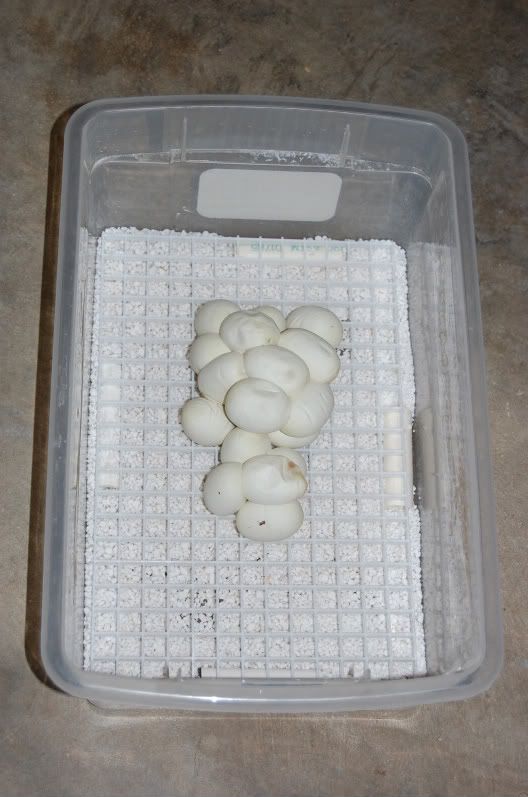
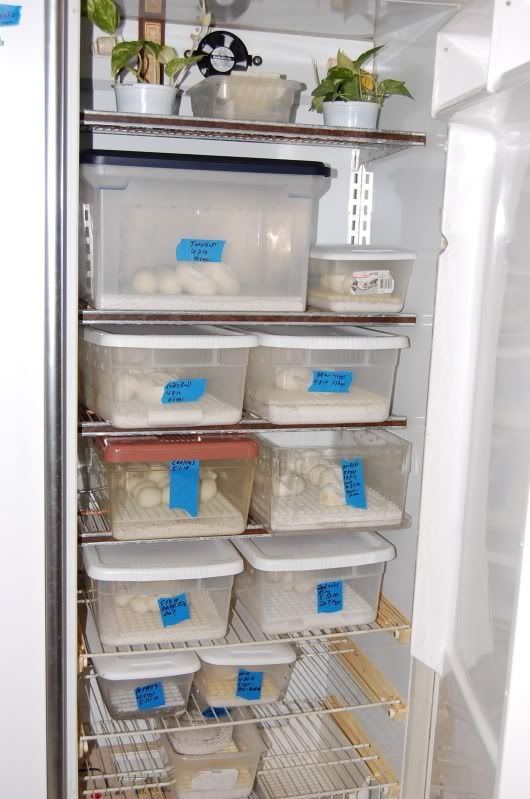
Well here are some 2010 ring eggs and a pic of the right half of my incubator. The eggs are kept pretty dry and have high humidity. Hope that helps.
oakbank
May 24, 2010 01:14 AM
Thanks Tom for the pics.Just a couple of question please,what is the substrate below the eggs,and is it mixed with water for humidity?
Many thanks Again Guys to `all of you` for your help. `Fingers Crossed for next Season!`
Kind Regards
Heather
Tom Keogan
May 24, 2010 02:46 PM
Its called perilite but you can also use vericulite. It is damp but does not have standing water just enough to add humidity. Hope that helps.
willstill
May 25, 2010 12:35 PM
Hi,
I have been hatching python eggs for 20+ years and I must agree with Tom's assessment of the eggs likely being too wet. In addition to the excessive pressure put on the baby from too much water in the egg, some herp species' eggs have thin shells and these eggs are also suseptable to damage caused by changes in pressure within the egg container. This problem can be compounded when the internal pressure within the egg is too great from excessive moisture. When an incubation chamber/egg box is sealed, the pressure within is constant and often greater than the air pressure in the outside environment. This can be a problem when a sealed egg box is suddenly opened. The pressure change is dramatic and the shell can be damaged. Symptoms of such shell damage are leaky eggs, specifically, wet appearing, translucent spots on the egg surface with moisture droplets. Now opinions vary, but many folks believe, myself incuded, that the areas of the shell that are damaged no longer have the capacity for air exchange that they once had. As the python gets close to hatching (is fully formed and colored) its metabolic rate increases dramatically (causing the increase in egg temperature at the end of incubation). This development causes an increased need for oxygen. If the shell is damaged and can't support this need, the baby suffocates full term in the egg.
This phenomena is well known to monitor breeders, but is not seen as often in pythons or colubrids (as their eggs seem to be able to handle pressure changes better...usually). It is very common for an entire clutch of monitor eggs to develop moisture droplets at the end of incubation and and die full term. the solution is often very simple. For me, drilling one or two small air holes in the egg box allows internal air pressure to stabilize with exterior air pressure and solve the problem. If you keep the egg box a bit drier, perhaps by switching to perlite as an incubation medium and by poking a few holes in the box, though not enough to encourage humidity loss, your problem might be solved. Good luck.
Will

willstill
May 25, 2010 12:58 PM
Hi,
I just saw your pics and yup, your eggs are way too wet. It appears that you do have some holes for air exchange, so that aspect of the pressure problem shouldn't be an issue for you. You might consider switching to perlite as an incubation medium as well. It seems to be much more forgiving than other media. Perlite keeps the egg box humid, but it is not as absorbant as vermiculite or moss, so the wetness is pulled, via gravity, to the bottom of the box and the eggs are surrounded by very humid air, but remain relatively dry.
Will
jkruzic
Jun 06, 2010 01:59 AM
I use the same setup as Tom with great success. The eggs are surrounded by air that has a relative humidity of almost 100% without sitting in a wet substrate. The only thing that I would add is don’t panic when the eggs start to dent in after 4 or 5 weeks and add more water. Most of my eggs dent in the last 2 or 3 weeks of incubation. Good luck next year and don’t give up!
