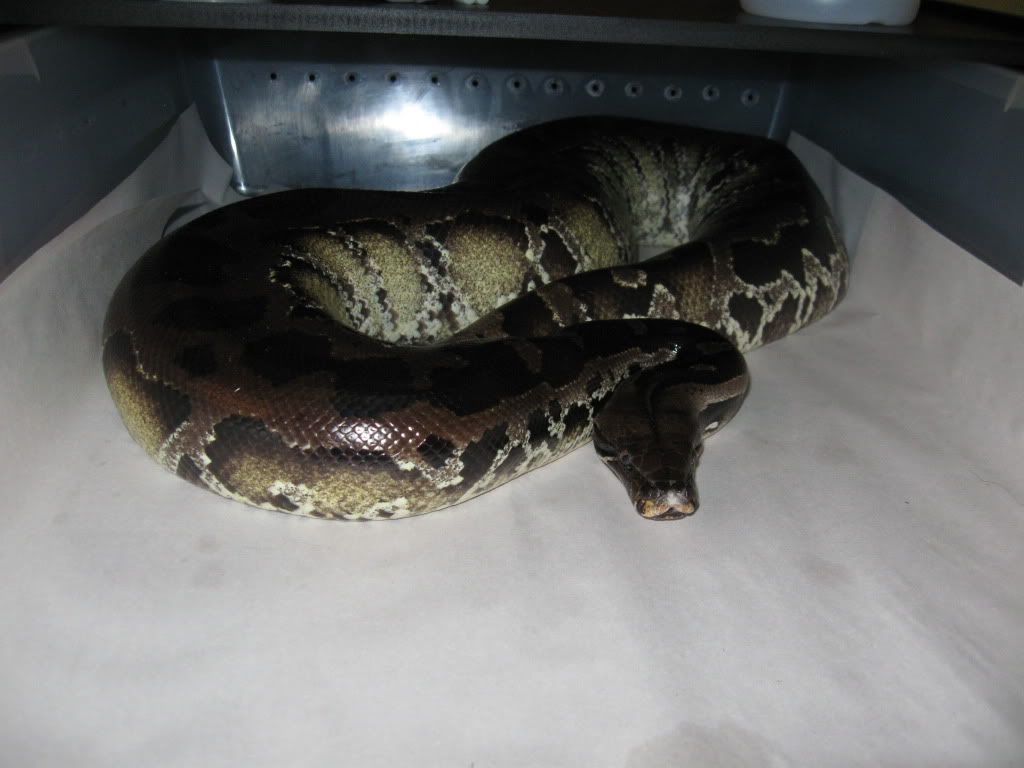
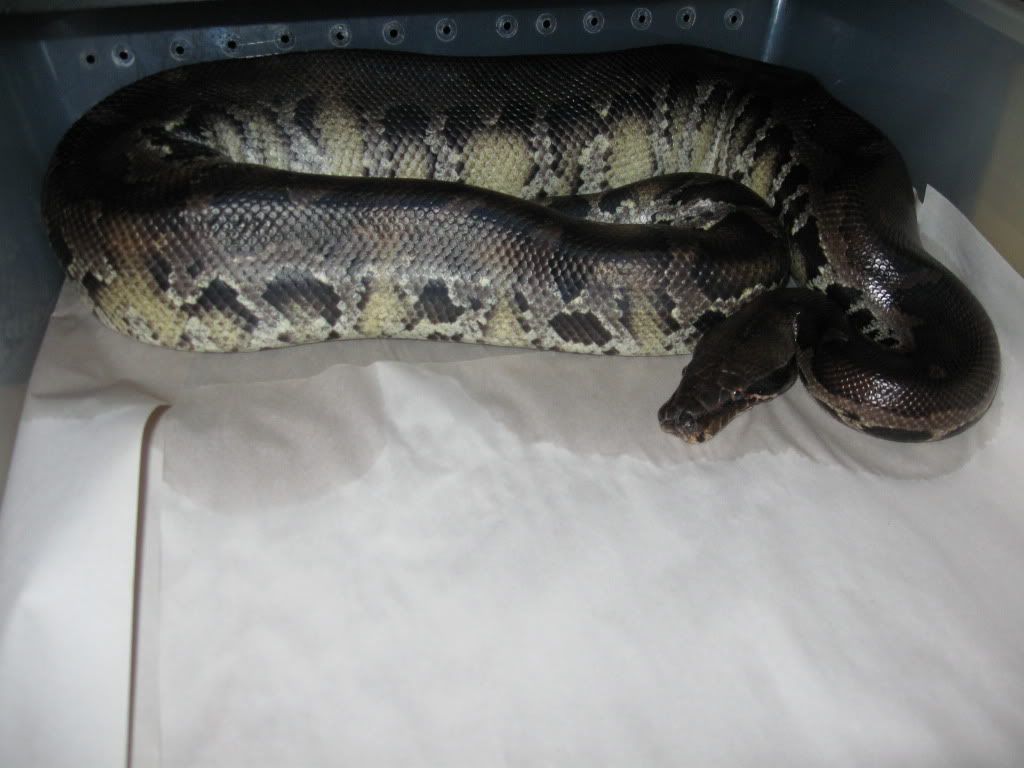
Some pics of my blood.I am not sure if she is a light Sumatran or maybe a mix.Requesting any opinions -Thanks HS (from earlier post)
 " alt="Image">
Reptile & Amphibian Forums
Welcome to kingsnake.com's message board system. Here you may share and discuss information with others about your favorite reptile and amphibian related topics such as care and feeding, caging requirements, permits and licenses, and more. Launched in 1997, the kingsnake.com message board system is one of the oldest and largest systems on the internet.



Blood type II
gothic5
May 25, 2010 09:21 PM
Replies (19)
2kdime
May 26, 2010 07:53 AM
Why the second thread?
All you gotta do is, save the picture to your desktop.
Open your Photobucket account, and upload the picture to it
Copy and paste the IMG CODE on the page into the reply field here.
Still a possible cross or Borneo to me, like Rich said before.
The picture is too small to tell anything definitively, we need bigger pictures.
Z_G_Reptiles
May 26, 2010 09:30 AM
I had a few mins so I figured I'd help gotic5 out and make the pic bigger

Zack
-----

Zack Greens Reptiles
2kdime
May 26, 2010 10:36 AM
Looks a bit like a Sumatran Short Tail to me
AKA Black
Rich_Crowley
May 26, 2010 12:39 PM
It looks like a Borneo and possibly a cross since it looks like there are no sub-oculars. Again tough to see from the picture.
-----
================================
www.richcrowleyreptiles.com
Support your local herp society
www.chicagoherp.org
Kelly_Haller
May 26, 2010 01:08 PM
a breitensteini and a brongersmai going by the pattern characteristics. As Rich said, there is not enough detail to see the subocular pattern.
Kelly
PHLdyPayne
May 26, 2010 09:24 PM
The picture itself is rather dark...maybe some better lighting on her will make it clearer. Not that I can tell what it is, but the experts who commented above, they certainly will be better able to tell.
-----
PHLdyPayne
iant
May 29, 2010 11:19 AM
NP
-----
Buckeyebloods.com
gothic5
May 27, 2010 07:26 PM
Slacker-Thanks for posting the pic.Is there a place I could bring the snake in to have a better ID ? HS
2kdime
May 27, 2010 08:57 PM
You could take some CLEAR pictures of the top of the head.....
And some of the eyes and scales around the eyes
That would help
Iant
May 28, 2010 07:23 PM
100% Sumatran Short-Tail. My wild caught stock looks just like that. compare if you wish.
-----
Buckeyebloods.com
2kdime
May 28, 2010 07:59 PM
That was my thought Ian
Sumatran Short Tail
Kelly_Haller
May 29, 2010 02:27 AM
Ian,
This python does not show any of the three main characteristics that distinguish P. curtus. The main feature it lacks is the absence of a lighter border around the edges of the dorsal blotches. Look carefully at all of your adult Sumatran Short-tails and you will see they all have dorsal blotches that are not outlined in lighter pigment and they clearly blend into the background coloration uninterrupted. The lateral side blotches are almost always outlined by white in P. curtus, but never the dorsal blotches. The python in question does show numerous dorsal blotches clearly bordered in a lighter color and could therefore not be P. curtus.
I copied and enlarged the photo and looked closely at the head and eye scalation. While somewhat fuzzy, I could not see any evidence of small subocular scales on this python and it appeared that the supralabials were in direct contact with the orbit. And lastly, while it was very difficult to tell without a much better photo, it did appear that the anterior parietal scales were in broad contact, something you would not see in P. curtus. However, these last two items would need to be verified with a much clearer photo.
I still believe this to be a hybrid, as it shows conflicting traits. However, it could also possibly be a brongersmai X curtus hybrid.
Kelly
Rich_Crowley
May 30, 2010 11:56 AM
Kelly provided good key identifiers to help narrow down the type. My experience with the few hybrids that I have seen, all lacked subocular scales typical of P. brongersmai. Once additional point of confusion comes from the exporters when they list the snakes as "sumatran blood or short-tail python". There is some natural integration that appears to occur and what you get might be a sumatran integrade between P. curtus and P. brongersmai. There is a great paper with graphical resprsentations of the head scalation and other identifiers out on the web. If you want to explore this technical paper, here is the citation/reference:
Heavily exploited but poorly known: systematics and biogeography ..
-----
================================
www.richcrowleyreptiles.com
Support your local herp society
www.chicagoherp.org
Kelly_Haller
May 30, 2010 02:50 PM
Rich,
You’re absolutely correct in that there have always been errors in the common names applied to the three “curtus” group species. This occurs probably more so than with any other python taxon. It sounds like from what you have seen, the supralabials of hybrids do in fact contact the orbit, and that is good information to know. I am also curious about the natural hybrids between brongersmai and curtus. I have not seen much data on that at all and would be interested to acquire any available. It appears that this would be an extremely rare occurrence as the only possible zone of natural intergradation would be in a very small area at the extreme southern tip of Sumatra. I don’t believe the geographical range of P. curtus and P. brongersmai overlap at the northern tip near Banda Aceh, but I could be wrong on that. The Bukit Barisan mountain range along the western spine of the island literally runs tip to tip and forms a very powerful biological barrier to lowland species. My bigger fear would be of acquiring captive produced hybrids between any of this group, and I think this should be strongly discouraged.
As far as morphological distinction of P. curtus, I suggest that people check out the photo on Ian’s homepage. It also helps to copy the photo and enlarge it to see the head scalation. This is a classic adult P. curtus showing all three of the main identifying traits of this species. All of the dorsal blotches running the length of the back are not outlined in lighter pigment and clearly blend into the background coloration on the back. There is a row of small subocular scales separating the supralabials from the orbit. And the anterior parietal scales are small and in very minor contact at the centerline of the head. Additionally, there is no brown or tan coloration on the back, and this specimen is definitely an excellent example of P. curtus in my opinion. For clarification purposes, young and juvenile curtus will have coloration variance, but the adults lose virtually all of their brown and tan pigmentation, especially on the back.
That paper you referenced is probably the best out there on morphological characteristics, and also has some excellent info on the biogeography of the “curtus” group. Thanks,
Kelly
Iant
May 30, 2010 05:26 PM
Thanks Rich and Kelly! Yes the paper you referenced is a really good article and unfortunately one of the few on these pythons.
Kelly I do now understand the dorsal coloring after rereading your description and comparing it to my lovable Curtus "squishy" BTW many thanks. I would like to see some more photos of the said snake in question. I think us blood nuts love to dissect questionable bloods lol. As far as natural integration with the "southern Curtus" I will call it and the Brong has there been a large importation of this or is this a few and far between thing? Again many thanks Kelly and Rich for your info on this
-----
Buckeyebloods.com
gothic5
May 30, 2010 10:31 PM
Thanks for all of your id information on P. Curtus.Just a final question-Are there any light colored variations of P. curtus? And are they of a particular locality? Aside from all the id info it was also interesting to hear about specific localities of these snakes.I for one would rather have a pure animal.I never cared for people who mix snakes like different colors.To me it has a lessening rather than an enhancing effect even if you produced a 3-d snake- HS
Kelly_Haller
Jun 02, 2010 11:48 PM
I am not aware of any “light-phase” P. curtus, however the coloration within this species is somewhat variable. That said, they do not appear to have near the color and pattern variation that is seen with the two other curtus group species. The greatest color and pattern variations within P. curtus are most pronounced in very young individuals. As they mature into adults, they all tend to become pretty dark in coloration and lose the yellow or brown tones. Regarding your python, if possible, a clear and focused close-up view of the top and side of the head would help very much in attempts to verify the species, or identify it as a intergrade. I believe pure curtus can definitely be ruled out at this point.
Kelly
gothic5
Jun 03, 2010 11:23 AM
Kelly-I will try and get those head pics soon.HS
gothic5
Jun 02, 2010 07:17 PM
Ian- The pictures you posted sure look like the same snake.I have been reading about the scale patterns of P. Curtus and see how my snake differs in that reguard.Just curious if you have speculated on any particular blood type. (mix or whatever) Also reading about how Brongersmai and Curtus are both found on the island of Sumatra.I had originally thought (hoped) it was a light P. Curtus.I also was curious if it could be a Breitenstien Sarawak.I would be interested in any comments you might have-Harold
