How big would everyone say adult conicus get? I have a female that i think is rather large but id like to see what everyone else says. thanks
mark
Reptile & Amphibian Forums
Welcome to kingsnake.com's message board system. Here you may share and discuss information with others about your favorite reptile and amphibian related topics such as care and feeding, caging requirements, permits and licenses, and more. Launched in 1997, the kingsnake.com message board system is one of the oldest and largest systems on the internet.



Size of adult Conicus?
coldbloodednj
Jun 26, 2010 05:49 PM
Replies (14)
Kelly_Haller
Jun 27, 2010 01:46 PM
I had a large breeding colony of conicus in the 1980's and 90's. My largest female eventually topped out at 35 inches. She was a great breeder and would typically drop 13 to 14 young. Most of my other adult females were in the 28 to 32 inch range and would typically have 9 to 12 young depending on the size of the female. I never consecutively bred any females, always only breeding them every other year. My largest male was right at 20 inches, with most of the other adult males between 16 and 18 inches.
I have heard reports of female conicus over 36 inches, but those individuals would be very old and very rare indeed.
Kelly
coldbloodednj
Jun 27, 2010 04:34 PM
Thanks for the info Kelly I appreciate it. I only had a few juveniles i was growing up and i just picked up an 04' pair this week that had never been bred. the female is in the 30" range and i was thinking that was rather large for them but not now haha. thanks again. i love these guys, I like em better then my ksb's.
Thanks
Mark
RanL
Jun 30, 2010 10:46 AM
Haven't got much experience with Eryx conicus myself (I only had my first conicus litter a couple of days ago), but look what I found on YouTube:
www.youtube.com/watch?v=-uCD1LIiSRQ&feature=related
(I hope the link works; if not - please copy & paste it in the address line of your browser.)
I Don't know how small the guy holding them is, but they just look huje to me.
Best,
Ran
CBH
Jun 30, 2010 02:18 PM
Wow. Those are big. Very cool video. Thanks for sharing!!
-Chris
-----
Christopher E. Smith
Contact
Captive Bred Herps
Wildlife Research & Consulting Services, LLC
coldbloodednj
Jun 30, 2010 09:00 PM
Wow those are big. My female is right in the 28"-30" area. Alot of the stuff i read says there the 2nd most common sand boa to kenyans but i almost never see conicus for sale, rarely online or at shows. I know Scott miller is working with some awesome Conicus that id love to get my hands on.
Mark
RanL
Jul 01, 2010 12:39 AM
I live in Israel, and the situation here (regarding the availability of E. conicus) is much worse than in the US: no breeder that I know of breeds these animals here, and they are very rarely imported.
I've talked to one of the major reptile importers here in Israel, and his excuse for not dealing with this species was this: he cliamed that no one in the US has CITES exportation permits E.conicus. Can this be true?
Ran
Kelly_Haller
Jun 30, 2010 10:04 PM
in that YouTube video. The red sand boa on the left is most likely Eryx whitakeri. It is showing too much red in the background color to be E. conicus. The right one is lighter and looks to be conicus. They are both very large and close to the maximum size for the species. Thanks for the video link.
Kelly
RanL
Jul 01, 2010 12:44 AM
Nice to know. Thanks. By the way, can you refer me to some literature on E. whitakeri? (I know nothing about this species, except for its name and the fact that it is quite similar to E.conicus.)
Thanks,
Ran
Kelly_Haller
Jul 01, 2010 10:44 PM
The species was first described in 1990 in a paper by Indraneil Das in the Journal of the Bombay Natural History Society, vol. 88. The paper is titled - A New Species of Eryx (Boidae: Serpentes: Squamata) From South-western India. For many years, specimens of this species were thought to be a hybrid between E. conicus and E. johnii before further investigation by Das. They are very similar to conicus, but differ mainly in the reddish background coloration, smooth dorsal scales, and 201 - 206 ventrals as opposed to 161 - 196 with conicus. E. whitakeri appears to be found only in arid scrub areas of southwestern India.
With regards to exportation, it is extremely difficult to export any animals out of India due to strict wildlife conservation laws, let alone a CITES Appendix listed species.
Kelly
RanL
Jul 02, 2010 02:07 AM
Thanks for the info on E. whitakeri.
As for the exportation thing - I figured it would be hard to export E.conicus from India; what I was surprised to hear was that it was impossible, or nearly impossible, to get CB animals, with CB CITES permits, from US breederds.
Best,
Ran
CBH
Jul 02, 2010 09:53 AM
Here is a photo of a possible E. whitakeri that was posted here a while back. Though I am not sure that E. whitakeri is worthy of full species status.
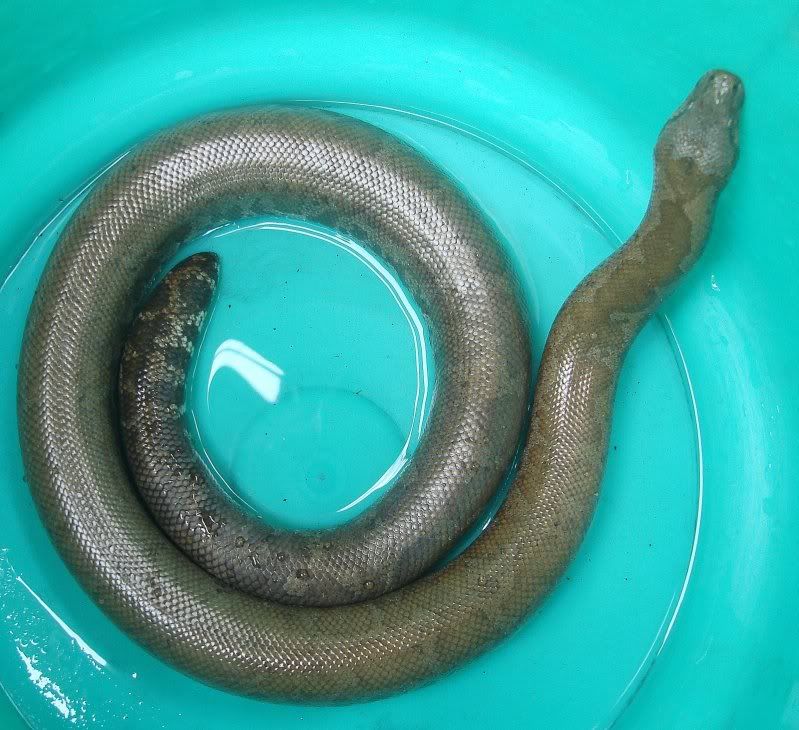
Note the differences in tail morphology. The individual in the photo has a blunt tail more typically associated with E. johnii, while the individual in the photo has a pointed tail more typically associated with E. conicus.
Personally, I think they are hybrids and until molecular work is done to prove me wrong, that is my opinion.
Cheers,
Chris
-----
Christopher E. Smith
Contact
Captive Bred Herps
Wildlife Research & Consulting Services, LLC
Kelly_Haller
Jul 03, 2010 06:39 PM
I would say that the photo is most definitely whitakeri as can be seen by the smooth dorsal scales. E. whitakeri was given species status in 1991 based on morphological distinction from all other erycine species. It shows absolutely no other morphological similarities to E. johnii other than the semi-blunt tail, and this is still fairly distinct from johnii, which shows an extremely rounded tail. E. whitakeri is in fact obviously quite similar to conicus however does have a different ventral count range and smooth scales on the dorsal surface and head, and distinct color pattern. Additionally, the geographic ranges of both conicus and johnii are mostly sympatric wherever they occur over the entire Indian sub-continent, but whitakeri has only been found along the extreme southwest coast. If hybridization were occurring, boas with morphology similar to whitakeri would be showing up in other parts of India, not just in one area representing less than 10% of their shared geographic ranges.
Kelly
CBH
Jul 03, 2010 08:49 PM
Maybe they are turning up in other parts of the country.... not many herpetologist doing work over there. Heck, we are still finding new species and unknown hybrids in the U.S.
I am not saying I am right, just that I would like to see some molecular data to support the morphological data.
Cheers,
-Chris
-----
Christopher E. Smith
Contact
Captive Bred Herps
Wildlife Research & Consulting Services, LLC
Kelly_Haller
Jul 04, 2010 08:24 PM
As far as herpetological activity and research, India probably ranks near the top worldwide. Some of the most well know research scholars come from India. Dr. Indraneil Das, the person who described E. whitakeri, is one of the world’s foremost herpetologists and Chairman of the IUCN South Asian Reptile and Amphibian Research Group. Rom Whitaker, after which this new species of sand boa was named, is extremely well known not only for his research on reptiles in India, but many other counties as well. Dr. Anselm de Silva, while from nearby Sri Lanka, is also extremely well known throughout the world herp community for extensive research on reptiles and amphibians of India. All of the above are affiliated in some way with the Center for Herpetology/ Madras Crocodile Bank Trust, one of the worlds most recognized herpetological research institutes founded in the mid 1970’s. Many other professional herpetologists are connected to this institute and involved in numerous research projects in India. They also publish the very well known professional herpetological journal Hamadryad.
On the hybrid issue, I definitely agree with you in that it would be interesting to see mDNA sequence data on these three species to determine their phylogenetic relationships. However, my guess would be it most likely would show that whitakeri is very closely related to conicus, and that these two are only distantly related to johnii by a similar margin. The red specimen in the previous video may indeed be a hybrid, but most likely a hybrid between conicus and whitakeri. Great discussion on an interesting topic.
Kelly
