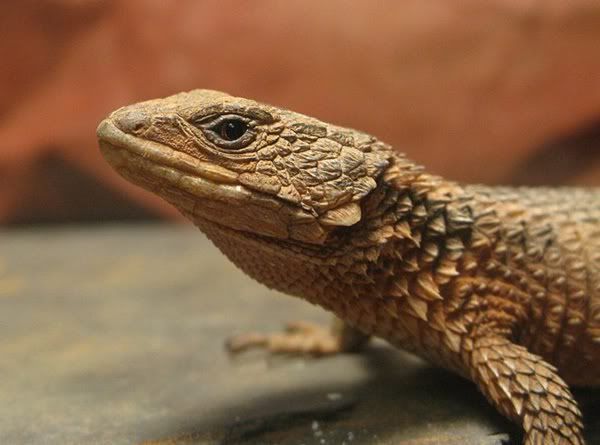
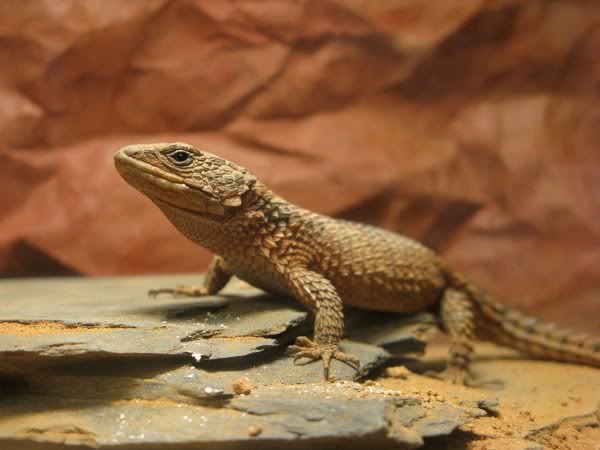
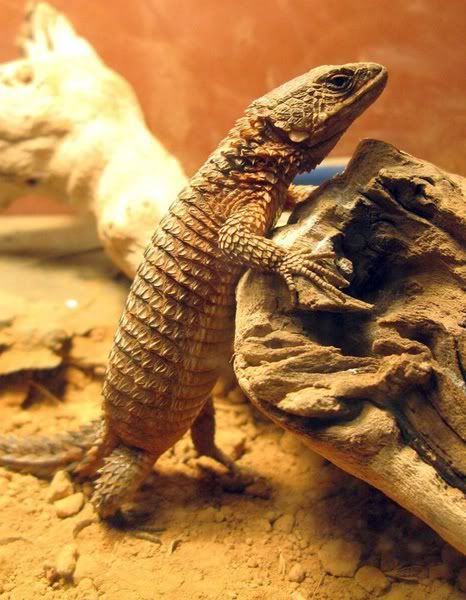
Hello everyone. I added an adorable new lizard to my critter family about a week ago.
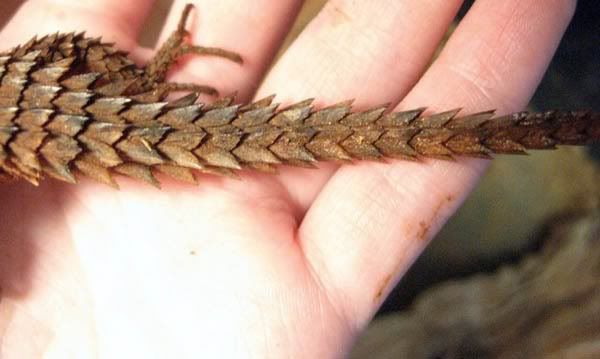
He was listed as an 'armadillo lizard', and when I went home to research before my purchase, and make sure I had the right spare supplies on hand, I learned he was probably a 'forest' a.k.a. 'tropical' armadillo lizard'- Cordylus Tropidosternum (the common pet store much cheaper alternative to the 'true' armadillo lizards)
Although there were a few other cordylus species I saw online that looked similar enough, so my 1st inquiry is a verification on whether it is Tropidosternum or not.
Also, she is about 6 1/2", which is what I read is full grown for these lizards. Is this true or will she get bigger?
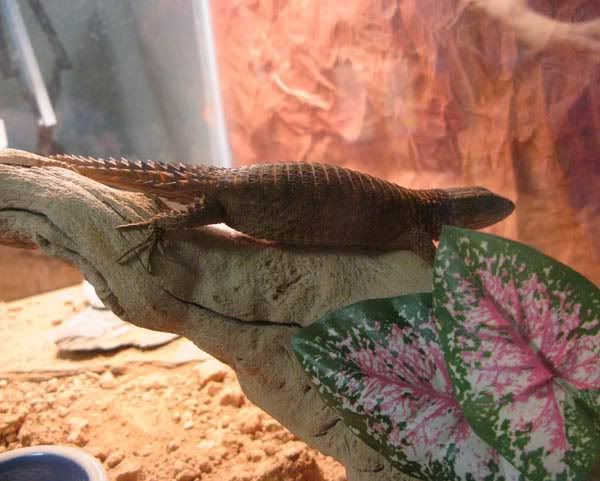
Sadly, there isn't much info on Cordylus, so I am hoping I am giving her correct care so far for a 'tropical desert' area. She has a sand-soil substrate, a few stacked flat slate pieces, a branch that she can climb as well as hide under, a small pool she enjoys soaking in, a couple of leafy plants in one corner, and a food bowl.
I have been giving her a variety of insects including crickets, mealworms, and baby dubia roaches. I use the vitamins & calcium powder I use for my bearded dragons, and she has a temperature gradient that ranges from 103 degrees at the hottest basking spot with a multi step gradient down to 98, 92, and the cool side is 80.
If anyone experienced recommends anything changed, let me know. This is all gathered from the little bit of info online as well as instinct and observing what she likes.
Also, is there any way to tell if she is more likely male or female? From what I have read, females commonly have a more slender head and fatter tummies then males. Mine seems to have a slender head (though I can't compare it to anything) and she has a chunky, round tummy. So I have been calling her 'she'.
But anyway, I am so glad that I bought this little lizard! She opened a whole new lizard world for me! I have had bearded dragons, different geckos, emerald swifts. But I had never heard of the genus Cordylus before! And it's a shame because they are such cool little lizards! I would have started keeping these long ago if I knew they existed