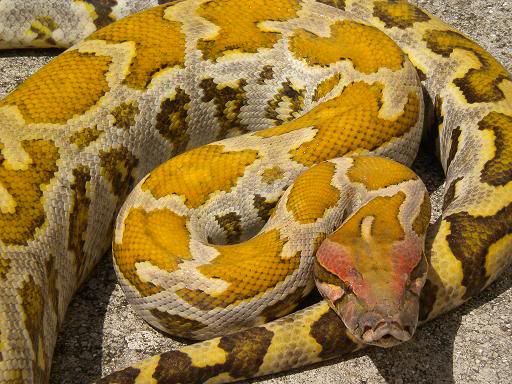
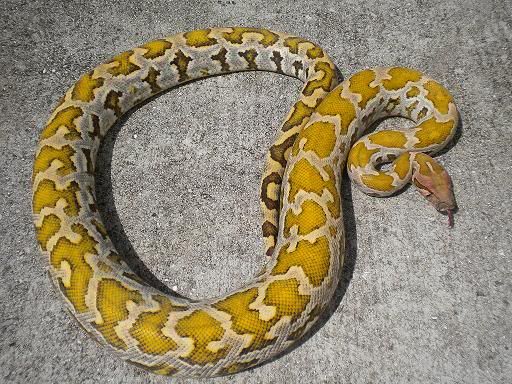
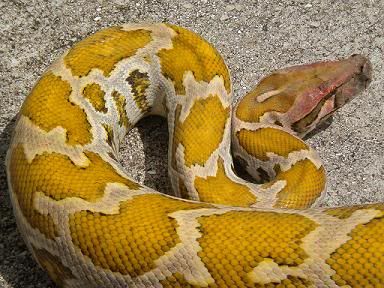
I had this pure Sri Lanka python Python m. pimbura out today and decided to snap a couple shots of this great looking snake.
ERNIE EISON
WESTWOOD ACRES REPTILE FARM INC.
Welcome to kingsnake.com's message board system. Here you may share and discuss information with others about your favorite reptile and amphibian related topics such as care and feeding, caging requirements, permits and licenses, and more. Launched in 1997, the kingsnake.com message board system is one of the oldest and largest systems on the internet.


I had this pure Sri Lanka python Python m. pimbura out today and decided to snap a couple shots of this great looking snake.
ERNIE EISON
WESTWOOD ACRES REPTILE FARM INC.
Daaaaaang!!!!!!! that is a beauty!!!!
Is that a standard look for them?
Are you breeding them?
Rob
The female was a little to small to go this year. The color isn't any type of "morph" but its not what I would call standard ether. Ones like this that have a light golden look to them fall into the extra nice category. Sri Lankans are one of those old school snakes.They remind me of a simpler time in the world of reptile keeping.
ERNIE EISON
WESTWOOD ACRES REPTILE FARM INC.
Beautiful animal, I really love the the blushing on the head.
-----
Michelle 
www.AssortedSerpents.com
All things bright and beautiful,
All creatures great and small,
All things wise and wonderful:
The Lord God made them all.
That's a fine specimen you've got there, Ernie! Beautiful!
Thanks for sharing her with us!
Have a good one!
HH
-----
Due to political correctness run amuck,
this ol' hillbilly is now referred to as an:
Appalachian American
Among Sri Lanka pythons, the highland form is typically represented by the darker, smaller individuals and you don't see much of them in the U.S. Most of the lowland specimens I have seen tend to have lighter coloration and a fair number are faded to different degrees similar to this individual. All of my Sri Lanka collection is representative of this lowland form. Almost all will show a yellow ventral color, however I have never seen one with this degree of yellow on the dorsal surface. This is a very unusual individual. They tend to vary considerably in appearance even within local populations, and I have also seen considerable color and pattern variation even among hatchlings from the same clutch. Thanks for posting photos of such an outstanding specimen.
Kelly
Aren't the Sri Lankans Appendix II?
jsc
-----
"As hard as I've tried, just can't NOT do this"
John Crickmer
John,
All boa and python species in the world are listed as CITES Appendix II species. The only python species in the world that is listed as CITES Appendix I is Python molurus molurus which would include both the Indian and Sri Lanka pythons. Any captive bred and produced Appendix I species, if produced from legal animals, are then considered Appendix II animals and can be traded as such with the proper CITES documentation. The caveat in the U.S. is that P. molurus molurus also falls under the U.S. Endangered Species Act which only applies in the U.S. and is separate from any CITES regulations. These CITES regulations would only come into play if you were moving listed animals from one country to another. CITES Appendix I species are essentially under trade lockdown and cannot be exported or imported except under extremely unusual and controlled circumstances. Appendix II species can be exported or imported with the proper CITES documentation.
There has been a constant back and forth argument for quite some time as to whether the Sri Lanka specimens are a separate subspecies. They were at one time considered P. molurus pimbura, but their current official status is P. molurus molurus of Sri Lanka origin. Many people, including myself, still continue to informally refer to them as pimbura. The main problem is that there are no definite morphologic characteristics to definitively distinguish them from mainland India molurus molurus. Color and pattern differences are usually relatively obvious, however no scalation or structural variances have been identified.
Really nice Sri Lanka specimens are hard to come by and genetic purity is always a major concern. There are only two main visual identifiers to distinguish them from mainland molurus. While some Sri Lanka individuals have a partial arrow on the top of the head, a complete lack of the arrow will pin it down for certain as no mainland specimens will ever show this total lack of an arrow marking. The second thing to look for is a series of dorsal “H” pattern markings. Mainland specimens will rarely show these, and if so, only one or two as opposed to a series of them. One of my females below shows both of these definitive traits. I believe nice Sri Lanka specimens are one of the most beautiful python species in the world.
Kelly

Help, tips & resources quick links
Manage your user and advertising accounts
Advertising and services purchase quick links

