Reptile & Amphibian Forums

Welcome to kingsnake.com's message board system. Here you may share and discuss information with others about your favorite reptile and amphibian related topics such as care and feeding, caging requirements, permits and licenses, and more. Launched in 1997, the kingsnake.com message board system is one of the oldest and largest systems on the internet.

Click for 65% off Shipping with Reptiles 2 You
Click for ZooMed
Click here to visit Classifieds

DIAMONDS AGAIN THIS YEAR!

TOM_CRUTCHFIELD Aug 01, 2010 05:57 PM

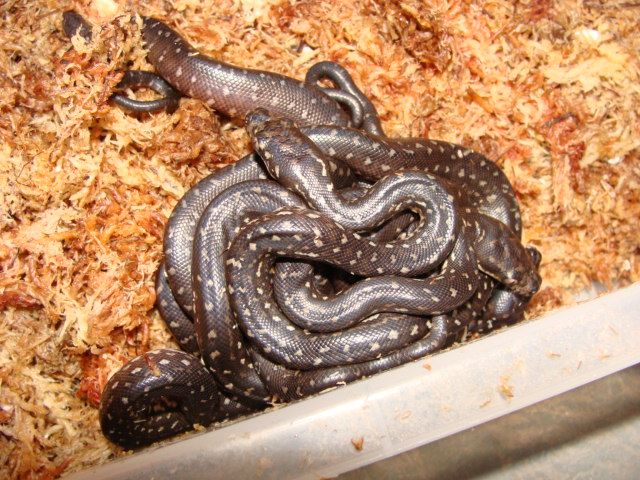
Well keeping Diamonds outside all year seems to be the key as I had 3.3 here and got 3 clutches of fertile eggs. Two clutches have hatched with one more to go. Here's a pic of a few pre-shed neonates..Thanks for looking...


-----
Tom Crutchfield
www.tomcrutchfield.com

Replies (52)

derekroddy Aug 02, 2010 07:17 AM

That's great Tom. Looks like I need to head down there again! Haha.

D.

Jaykis Aug 02, 2010 10:13 PM

Tom, did you keep them outside during the cold snap?

TOM_CRUTCHFIELD Aug 03, 2010 06:58 PM

Yup I temp gunned them at 35 degrees on the coldest night. Not one got sick and I had 100% production on all 3 females with a 90% plus hatch rate on the eggs [so far anyway..one clutch yet to hatch]....
-----
Tom Crutchfield
www.tomcrutchfield.com

Kelly_Haller Aug 03, 2010 10:36 PM

Tom,
I think Boelen's would be a prime candidate for the outdoor regime you ran the Diamond's through. Even though Boelen's are virtually equatorial, the altitude differential gives their climate much similar seasonal temperature dynamics to most of the year in higher latitude Florida. Both species are exposed to winter night lows well down into the 50's on a regular basis in their natural environs. I think this heavy night-time cooling and daily temperature climb will be imperative to breeding Boelen's in captivity. I've taken some other species of temperate type climate boids down into the 50's at night with no problems as long as you have a daily warming period. Definitely let me know how it goes with this project. Thanks,

Kelly

Jaykis Aug 04, 2010 06:42 PM

Kelly, I've long thought that that was the way it would work with Boelens. The altitude range is different with them and Diamonds, but the temps are very similar.

GPZO Aug 04, 2010 12:42 PM

thats 4 degrees colder then the record low on the australian continent in the last 60 years

Jaykis Aug 04, 2010 06:43 PM

I swear it was in the low 40's when I was in Sydney in '96 in the winter.

TOM_CRUTCHFIELD Aug 04, 2010 07:20 PM

It was the coldest here I've ever experienced personally....
-----
Tom Crutchfield
www.tomcrutchfield.com

Kelly_Haller Aug 04, 2010 11:27 PM

The higher plateau regions of southeast New South Wales and eastern Victoria, which are within the geographic range of the Diamond python, have an average night time low temp in the upper 20’s during the winter. This area also receives several feet of snow each winter as well. While the Diamond’s inhabit the lower elevations of this plateau region, they are still routinely exposed to night time temps in the low 50’s and upper 40’s, and occasionally lower during the peak winter months. Tom’s excellent success rate with them shows that they are responding well to this natural seasonal deep cooling cycle.

Kelly

TOM_CRUTCHFIELD Aug 05, 2010 07:32 AM

Tiliqua nigrolutea hibernate the entire winter as they are a beautiful Montane species and one has to wonder that the lack of success in captive reproduction has a lot to do with the keeper afraid to let them get cold enough. Even when the Diamonds body temps are in the 40's they still are mobile enough to crawl into the sun to bask. The cold nights and the ability to heat up the next day I believe are crucial to captive reproduction and believe that's why many others fail. It is EASY to get them to breed but difficult to get fertile eggs. I've only done it now for 2 years but both years we had every female lay fertile clutches. I'm keeping records so in a few years I should have a lot of info about this common Python that little is known about their reproductive strategies...
-----
Tom Crutchfield
www.tomcrutchfield.com

GPZO Aug 05, 2010 04:52 PM

your right i dont know were i got that figure from, no doubt some out dated internet site. but i did find out that the lowest temp in recent history for sydney aus (well within the ACTUAL range for diamonds) was 43 degrees farenheit. i understand the proof is in the pudding and you had great hatch rates but i think you got lucky. And u definitely took a risk. what you risked was the life and well being of the animals.

TOM_CRUTCHFIELD Aug 05, 2010 06:49 PM

Luck is when you do it once. When you do it consistently it becomes skill. I've done this a LONG time and have an intimate knowledge of most types of herps and breed a lg variety of species now. I was the first to permanently maintain Cyclura outside in the middle 1970's and began hatching Rhino Iguana's which until then were considered hard if not impossible to breed. When I had the Croc Farm I looked at individual species in nature and found that diet is the single biggest factor [there are others as well] and bred 11 species of crocodilians. It's a waste of my time to continue but I figured the results would be as they turned out way before I put it to practice. It was a calculated risk like all of life. This was my first year trying to breed Desert Crotalus...I tried to breed C. stephensi and Crotalus enyo which supposedly here in extreme S. E. Fl is very hard to do. I just had a clutch of 7 Crotalus enyo and I'm waiting on the stephensi to drop any day now...Only time will tell...I know, just luck...
-----
Tom Crutchfield
www.tomcrutchfield.com

GPZO Aug 06, 2010 11:51 AM

you can not keep tropical or sub tropical reptiles at 35 degrees without getting respiratory infections. if you can please... by all means share this skill with us tom. please. tell us how u do it.
Jason
GPZO

TOM_CRUTCHFIELD Aug 06, 2010 04:30 PM

First of all Diamond Pythons are NOT a tropical boid. Second of all I've NEVER said I'm keeping all my boids outside but I am experimenting with a few. So far I've kept and bred both Diamonds and Cuban Boas outside here now for the last 2 years. I believe it would be possible to keep many species with only a simple 75 watt bulb in the retreat box by ALLOWING THEM TO BASK IN THE DAY AND CHOOSE THE TEMPS THEY WANT TO BE AT. The key is allowing them to bask. The Cubans were out last year also with only a 75 watt bulb in their box and all females are gravid and NOT one got sick. On a cold day here in the winter it normally gets into the low 60's for a high temp. The snakes can bask and absorb heat and when I temp gun them their body temp is in the high 80's to even the 90's on a cool day. You do not keep them cold all the time. They are outside. Our average high in Jan. is in the 70's and our average low in the 50's. I've jus explained to you how to do it. Undoubtably for some species this might not work but for many I think it will work and work well. I did keep Sanzinia and Acrantophis madagascariensis outside this winter with a 75 watt bulb in the retreat and they also did NOT get sick. They were surplus and now sold but they did just fine. Everyday like clockwork they would crawl out and bask. You know you sound like some folks when I told them I was going to keep CYCLURA OUTSIDE YEAR ROUND IN THE 70'S. I was told the lizards would likely die and now people even much further north than me keep their Cyclura out year round also with great success. All of this is interesting and I'm learning a lot of stuff I didn't know and it keeps it fun for me...thanks

p.s....BTW I only turn the 75 watt bulbs on if the temp is going to dip below 45 degrees
-----
Tom Crutchfield
www.tomcrutchfield.com

TOM_CRUTCHFIELD Aug 06, 2010 04:33 PM

I'll make the answer simpler than the long one. IT'S CALLED LETTING THEM HEAT UP IN THE DAY BY BASKING. NOTHING IS BETTER THAN NATURAL SUNLIGHT...
-----
Tom Crutchfield
www.tomcrutchfield.com

Kelly_Haller Aug 05, 2010 07:08 PM

The average winter night-time low temp during the coolest month each year in Sydney for the last 50 years has been 43 F. The lowest recorded temperature for Sydney over that same time period is 32 F. At the very southern end of the Diamond pythons range on the border with Victoria, average winter night-time lows are in the upper 30's and in the mid 60's for daily winter highs. These are temp averages in the lower altitude areas from where these pythons live. These are true temperate climate snakes that can tolerate very low temperatures, much more so than any other python species.

Kelly

derekroddy Aug 05, 2010 09:05 PM

I was in Sydney a couple weeks ago and, it was easily in the low 40's at night.

D.

GPZO Aug 06, 2010 11:58 AM

i found a study that monitored the internal temp of 18 free ranging diamond pythons that stated the lowest internal temp recorded over a 34 month period was 17 degrees Celsius or roughly 62 degrees Fahrenheit. another study also indicated that the animals migrated to northern slopes of hill sides during cold weather. these northern slopes face the equator and allow the animals to optimize the suns warmth. it took me 15 minutes to accumulate this information by the way.

Jason GPZO

TOM_CRUTCHFIELD Aug 06, 2010 04:40 PM

This is exactly what I tried to explain to you when I said the snakes CHOOSE their body temps in the day. Are you not aware of the HUGE problem over the feral population of wild Burmese Pythons that breed here? Burmese are far more cold sensitive than many other species of boids. Here on the Deering Estate in Miami is a small feral population of S. American Boa Constrictors that have been documented here for over 20 years so you are DEAD WRONG when you say it can't be done without them all being sick or dying. Explain to me why they are here in the wild then....
-----
Tom Crutchfield
www.tomcrutchfield.com

Kelly_Haller Aug 06, 2010 11:38 PM

Jason,
The site of the study you are referencing was in two valleys north of Sydney. That is 300 miles north of the southern populations of the Diamond python. These southern populations live in a climate that is much cooler than the study site and show how well these pythons can adapt to cooler temperatures. These are not tropical pythons, but true temperate latitude snakes. The climate around Sydney is almost identical to an average year in southern Georgia USA. Definitely not tropical.

Kelly

GPZO Aug 09, 2010 12:07 PM

the study im referencing did not state its actual location theres no way you can deduce that it was 300 miles north of sydney. honestly this is my last post on this topic. i would like to conclude by saying diamond pythons are just that PYTHONS. all pythons are tropical animals. the reason diamonds are so rare is you have a tropical reptile trying to survive in a temperate climate. life in the wild is hard enough lets not make life in captivity any more difficult by keeping them at 35 degrees.

viva la resistence
Jason

TOM_CRUTCHFIELD Aug 09, 2010 12:56 PM

Their NOT kept at 35 degree's. That is simply the lowest temp I measured them at the coldest morning. Your argument has no validity at all....
-----
Tom Crutchfield
www.tomcrutchfield.com

CrocodilePaul Aug 09, 2010 01:12 PM

Hi Jason,

Without going into too much detail, tropical species can come from very different climatic zones even within a small area. "Tropical" does not always mean hot. For instance, in Venezuela you will find different types of vipers thriving in higher elevation cloud forests, where temperatures are a cool 55-83f range. Go just 100 miles to the east, you begin to see much hotter environments where these snakes could not survive.

I have seen Tom Crutchfield's Diamond python set-up. I have also been to the part of Australia twice where Diamond's occur naturally and have observed the wild snakes. My impressions at the time I visited Tom(before he had bred the pythons!) was that he was very close, if not identical to the pythons natural temperature range and husbandry preference. I am not surprised by his great results.

Truly,

Paul Bodnar
Crocodile Wildlife Conservationist

Jaykis Aug 09, 2010 01:41 PM

Absolutely untrue, Jason. Diamonds are found in the Blue Mountains not far from Sydney, and not ALL pythons are tropical. Indian pythons tolerate far less temp ranges than Burms. To say that pythons are only tropical animals is absolutely false. I've got over 30 years experience w/pythons, 50 with reptiles, and Tom has forgotten more than I know about herps.

Kelly_Haller Aug 09, 2010 04:41 PM

If you spent a few more minutes of research and read the original study, you would find that the Slip and Shine Diamond python telemetry study was carried out in two valleys near Belrose and Cowan NSW. That is just a short distance north of Sydney. That puts it 300 miles north of the southern populations at the Victoria and New South Wales border.

Kelly

vegasbilly Aug 14, 2010 12:45 PM

Fabulous thread! I'm wondering if a modified regimen like this will work for Bar Neck Scrubs? Here in Vegas our winters are basically moderate w/just a few days in the low 30s. I have 5 good copulations from my pair last winter but "knew" they were insufficiently cooled in the snake room..no eggs but plenty of action!
I will also be cycling my Sanzinia at the same time this season which usually starts around Nov. I may construct outdoor pens and have a hide box w/a heat panel/Herpstat governing the absolute cold temps and allow them to move into the sun for the requisite basking. A basking lamp would be incorporated w/a timer to compensate if natural ambients to reach a "healthy" level. Sufficient cooling is always an issue here. I welcome any thoughts/contributions to my musings here!
Bill

Kelly_Haller Aug 14, 2010 06:22 PM

The cooling regime is obviously highly relative to the species. As such, I would be very careful with bar-necks as the winter low temps this species experiences in their natural habitat are relatively not low at all. I doubt if this species ever sees temps much below 70 even in the coolest winters. I know that successful reproduction has occurred with this species using a winter temp cycle of low 80’s for daytime highs and 70 for nightly lows. I don’t believe I would allow the ambient temp to ever drop below 70 at night. These are true tropicals.

As far as Sanzinia, they can tolerate lower winter temp cycling, but I don’t believe I would allow the ambient temp to ever drop below the low 60’s for a winter nightly low. The daily winter highs should probably be back up in the high 70’s to 80 if you go that low at night. I would be interested to hear from others more experienced with these species.

Kelly

TOM_CRUTCHFIELD Aug 14, 2010 09:41 PM

I kept a pair outside here last winter but locked them inside the retreat with a 100 watt light bulb during that incredibly cold 14 days or so last year. In the mornings because the box was made of plywood I temp gunned them in the middle 40's but in the day the body temps were in the hi 70's. They did not get sick and I finally sold them in July.....thanks
-----
Tom Crutchfield
www.tomcrutchfield.com

TOM_CRUTCHFIELD Aug 14, 2010 09:46 PM

I'm talking about Sanzinia NOT Scrub Pythons. I'm not sure how well they would do in cooler temps as most are very tropical. My guess is the rainy season in the Molucca's is the key but not sure how...thanks
-----
Tom Crutchfield
www.tomcrutchfield.com

vegasbilly Aug 15, 2010 11:18 AM

Points well taken and thanks! I think I'll just run the AC in the room to get the Bar Necks into the very low 70s..fortunately I have radiant panels to govern all those in the room that don't need to be cooled (Boiga, Gonyosoma). I still need to contend w/the Sanzinia as they require a much cooler cycle than would be healthy for the Bar Necks. David Means got 3 nice clutches from his Bar Necks this year and only allowed them to drop to 70F..maybe 68F at the lowest. Fortunately I have enough time to figure this all out.

Bill

Kelly_Haller Aug 15, 2010 01:23 PM

Indonesian scrubs and barnecks are definitely lowland tropical pythons. The lower elevations on the island of New Guinea and the Moluccas island chain have one of the most consistent and stable climates in the world. They see very little daily change in highs or lows with the seasons throughout the year, usually only a 5 to 10 degree delta over the entire year at most. It’s extremely unusual for the nightly cool season ambient temps in this region to drop below the mid 60’s even in the coolest years. I think heavy cooling of any of the Indonesian scrubs will cause big problems. I agree with the temp regime David used and definitely wouldn’t go any cooler. Cool season nightly lows in the natural habitat of Sanzinia can get down into the 50’s on occasion, so they have adapted to slightly cooler temps than many pure tropical lowland species.

Kelly

Snakesunlimited1 Aug 18, 2010 08:25 PM

Also the light cycle can play a much bigger role than many give it credit for. Between lights and food you can keep most other things close to the same and just cycle food and light and do pretty good. Get your lights on a timer and your thermostat on one as well (same or different unit as lights for "winter" and I bet you have success pretty easily with everything. Good luck!!!

Jason

Kelly_Haller Aug 19, 2010 12:35 AM

Agreed, I seasonally adjust photoperiod on all of my breeders, even equatorial species. The combination of temp and photoperiod cycling is critical with most species. People in temperate climates that say they don't temp cycle their breeders and still have success are kidding themselves. Outside winter temps will still have an effect on cage temps no matter how well you try to avoid it.

Kelly

GPZO Aug 14, 2010 02:26 PM

Im over this conversation but i will say that if the spca catches you keeping diamond pythons at 35 degrees im pretty sure you wont have diamond pythons any more.

TOM_CRUTCHFIELD Aug 14, 2010 04:59 PM

Why don't you send them out. My address is on my website...Is there something wrong with you? I'm going to be keeping P. m. molurus outside this winter as well. Did you not know that Burmese Pythons in small numbers in the wild survived the great freeze last year and they're a lot more cold sensitive than Diamonds which are a subtropical Python to perhaps a temperate zone Python to begin with. My third clutch has hatched and I have damn near 50 baby Diamond neonates here. Who else do you know that has that many? I've always wanted to meet Wayne Pacelle and his gang of black dressed ninja wannabe's so inform them I'm keeping Pythons outside year round along with about 2,000 other herps as well...
-----
Tom Crutchfield
www.tomcrutchfield.com

Paul Bodnar Aug 14, 2010 06:49 PM

Hi Tom,

He is just looking for a continued argument. You have been more than patient with him, more so than I would have been. Your knowledge and information on keeping Diamonds is among the best in the world Here in the USA I'd bet it is the BEST! Ninety eight percent of AZA Zoo's could not replicate your superb results.

The results are successful, methods are proven, and he just does not "get it".

Let him keep Diamonds like a tropical species, and have him learn the hard way. He won't be producing any babies and may be lucky just to keep them alive.

PIC- Wangi Falls, NT Australia.

Truly,

Paul Bodnar
Crocodile Wildlife Conservationist

Jaykis Aug 15, 2010 10:02 AM

I'm amazed at the lack of knowledge that GPZO shows. As far as I knew, Diamonds don't live as long in tropical environment as they do when there's a cool down period for them. Read Dave Barkers first book, and you will understand. They don't grow as fast, either.

And what idiot would think the that the SPCA would do anything about healthy animals, kept in good conditions? See you on Friday, Tom!

Jaykis Aug 15, 2010 10:04 AM

And I assume boas are all tropical animals, too? Check the range for the rubber boa!

TBrophy Aug 15, 2010 11:00 AM

Also, he never stated he kept them at 35 degrees. He said he gunned them on a single cold night at 35 degrees. Doubtless they basked during the following day and their temps increased. They are temperate snakes. Sort of an Australian black rat snake!

Snakesunlimited1 Aug 18, 2010 08:20 PM

Dude you are ignorant of this species and their natural history. Tom is not reinventing the wheel here at all he is copying an old style, this is the standard method of keeping diamonds in Australia. Read a book, or actually read that research paper you referenced, look into their natural history, ask someone in their native range. Why anyone would be amazed that this method of keeping these animals worked and was successful toward breeding them is beyond me, there is a guy that does this in the Netherlands and has breeding success!!!

This is not a new method of keeping them, the Ozzies suggest the only way to avoid "Diamond Python Syndrome" is to keep them outside with full sun access and deep cool down. Some Australians in warmer areas say they worry about being able to keep Diamonds outside because it gets too...HOT!! If they are right then Tom is out of luck come summer if they can not get to AC. At any rate you are completely wrong.

Jason

R.Mikkelsen Aug 24, 2010 01:48 AM

I was even thinking of keeping them outside here in Denmark..
That could work..with a bulp..on colder days..

People who haven´t had Diamonds in there care..learn from others like Tom..

You can read a lot of book on reptiles..but getting your own feeling working with them is where you learn..

any link to the Guy from Nederlands with pics ??

TOM_CRUTCHFIELD Aug 24, 2010 10:24 PM

I have been in contact with a guy in Switzerland who keeps them outside even there with but enough heat to prevent freezing. I've seen pics with SNOW around their cage. It is closed wooden and not wire but he has skylights for the sun in winter and YES HE BREEDS THEM....
-----
Tom Crutchfield
www.tomcrutchfield.com

TOM_CRUTCHFIELD Aug 24, 2010 10:21 PM

I have to make sure they have PLENTY of cool retreat areas for them. Again the Diamonds CHOOSE the temps they wish to be at except at night...thanks..Yes their outside in the summer also...
-----
Tom Crutchfield
www.tomcrutchfield.com

CaseyLazik Aug 06, 2010 10:58 PM

Nicely done Tom!

Your success is not by accident or luck. You obviously get it. If you're wrong, then so am I .

Casey

PS Here's an off topic pic just for you.

Casey Lazik Reptiles

TOM_CRUTCHFIELD Aug 07, 2010 06:40 AM

Yea go ahead and rub it in. That's one of those things I really regret especially now that I'm dinking around with Crotalus...


-----
Tom Crutchfield
www.tomcrutchfield.com

CaseyLazik Aug 07, 2010 01:55 PM

I know what you mean.

Casey Lazik Reptiles

R.Mikkelsen Aug 23, 2010 03:09 PM

thats is one killer snake

R.Mikkelsen Aug 23, 2010 03:25 PM

great job Tom..was wondering what type of incubation you use..

are eggs dry,with humit surroundings..
or in humit material..
a pic would be great..

I bred Diamonds a few times but never had 100 % hatch rate..

best regards
Rolf

TOM_CRUTCHFIELD Aug 23, 2010 06:07 PM

I incubate just like most other pythons with the exception I incubate at about 87-88 degrees. When I'm saying a 100% production I mean every female lays eggs that are fertile eggs [not slugs]. I had a clutch of 16-18-15 egg clutches this year and only the 15 egg clutch did we hatch 100% of the eggs BUT we hatched CLOSE to 100% on the rest....
-----
Tom Crutchfield
www.tomcrutchfield.com

R.Mikkelsen Aug 24, 2010 12:42 AM

Thanks a lot Tom..I did 87-88 F..

R.Mikkelsen Aug 24, 2010 12:47 AM

one of my old Diamonds ( dead now) I have 1.3 from my 2006 breeding from her..real nice black and white..have raised them slow for breeding 2011.
Image

TOM_CRUTCHFIELD Aug 24, 2010 10:26 PM

That is the right weight. Do NOT let them get fat....
-----
Tom Crutchfield
www.tomcrutchfield.com

Site Tools