

Reptile & Amphibian Forums

Welcome to kingsnake.com's message board system. Here you may share and discuss information with others about your favorite reptile and amphibian related topics such as care and feeding, caging requirements, permits and licenses, and more. Launched in 1997, the kingsnake.com message board system is one of the oldest and largest systems on the internet.

Click here for Dragon Serpents
https://www.crepnw.com/
Click for 65% off Shipping with Reptiles 2 You

How to Identify the 3 species W/ Pics

Z_G_Reptiles Aug 03, 2010 07:39 AM

If anyone is like me, they do best with visual images to help explain, locate, and identify the different scales so I thought I’d post explanations and images showing and explaining the differences between the 3 species.

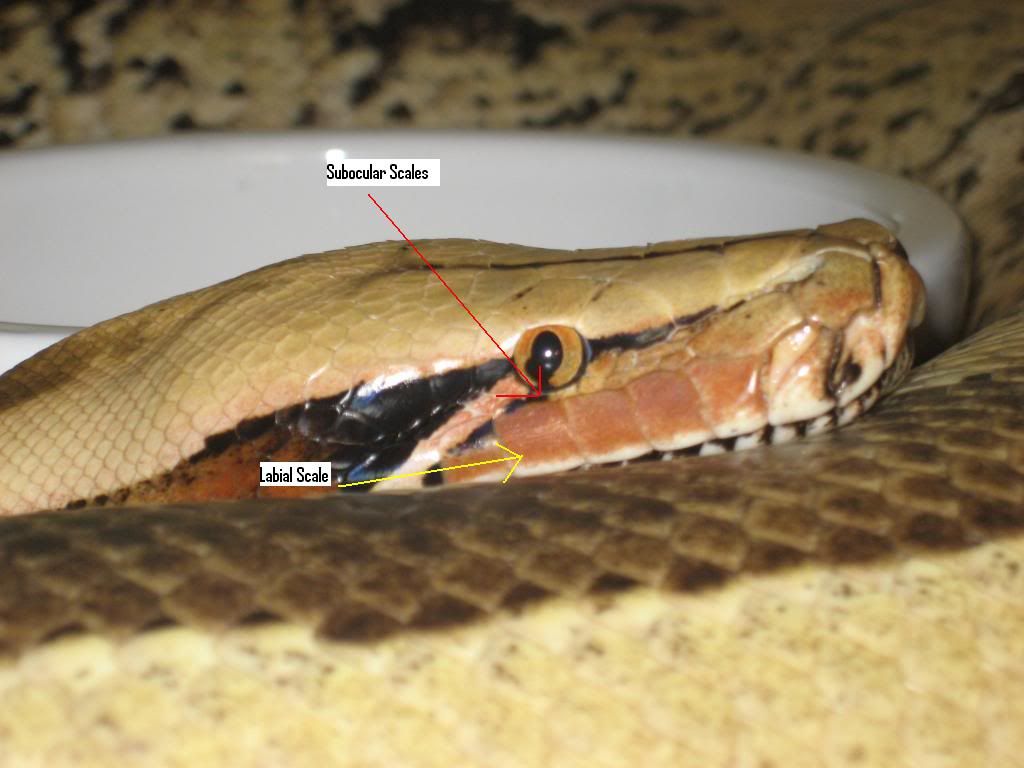
P. Brongersmai - No Subocular Scales, Labial Scale goes all the way to the eye, Parietal Scales meet with large area at center line on top of head

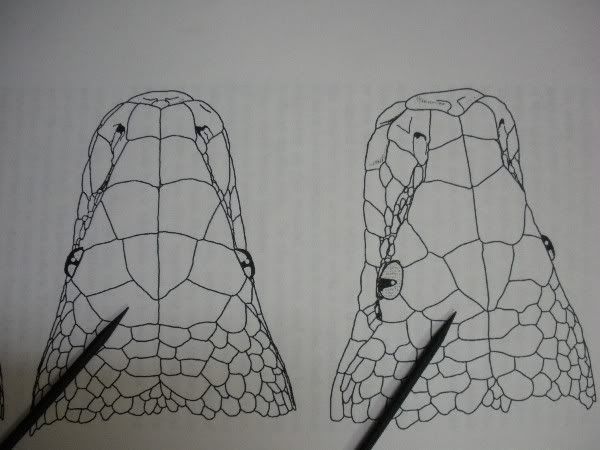
P. Breitensteini - With small Subocular Scales between the Labial Scale and the eye (however I have been told this doesn't always hold true, but to me majority rules), Parietal Scles meet with large area at center of line on top of head, much like P. Brongersmai

P. Curtis - With small Subocular Scales between the Labial Scale and the eye, Parietal Scales meet at a point, or little contact, at the center line on top of head

Here's a few pictures I did to show
This is a pic of my P. Brongersmai showing the Labial scale going up to the eye.

With Tim Mead’s permission here is a pic he took and I labeled the subocular scales and the Labial scale showing how the Labial scale does not go up to the eye but is connected to the subocular scales, which P. Brongersmai does not have.
And this third pic, Kelly Haller showed me this drawing that shows the difference between the parietal scales on the P. Breitensteini and P. Curtis.
P. Breitensteini on the Left and P. Curtis on the right
-----

Zack Greens Reptiles

Replies (15)

Kelly_Haller Aug 03, 2010 10:18 PM

Zack,
You beat me to it, but good photos of these species with the main key points of differentiation. Other addition points to consider are the characteristic coloration markers of P. curtus. Adult curtus show a highly faded anterior dorsal surface where the background is mainly black, and not brown or tan. Also, the anterior and mid-body dorsal blotches of adult P. curtus are never outlined in lighter pigment and they neatly blend into the background coloration uninterrupted. Additionally, the lateral side blotches are almost always outlined by white in curtus, but never the anterior dorsal blotches. If you see anything other than this on an adult curtus, I would strongly question the identity of that specimen and also check the head scalation carefully.

Another check is the ventral scale count. P. brongersmai has 167 or more, while breitensteini and curtus have 165 or less. These are very difficult to count on adults, but very young specimens can be placed on the glass of a photocopier and the paper copy is easily counted. This works great for ventral counts on any small snake. Also, as Rich pointed out earlier, hybrids or intergrades between these species can many times be extremely difficult to determine accurately.

Kelly

PHLdyPayne Aug 04, 2010 09:23 AM

Not sure I like the idea of photocopying a snake....photocopiers do use a very bright light. It would be far simpler to just count the scales on the shed skin, if intact, or place the snake in a clear bottomed container and take a picture. Also, for those of us who don't have 3 in 1 MFD's at home...I don't think too many bosses would appreciate us bringing snakes to work to take photo copies of LOL (unless you work at a pet store or breeders)

The head scales do make it easier to check for Brongs (unless the baby is a real feisty one..may end up hanging off your nose while you lean close to check)
-----
PHLdyPayne

Kelly_Haller Aug 04, 2010 11:39 PM

Agreed that many don't have access to photocopiers, but if you do, it is the easiest and most accurate for young snakes. It's easy to miscount ventrals on small sheds, and they're only good if intact. Copier light is not a problem as it's very brief and you're shooting the belly. The nice thing about a copier is that you have a permanent record and you can write the number of each scale right on the paper.

Kelly

PHLdyPayne Aug 05, 2010 02:26 PM

I doubt I can get a baby blood to sit still on a copier bed for the time it takes to scan its belly LOL At least not my current blood...I can pick her up once, then when I put her down, she turns really feisty. Makes it a bit difficult to change her cage...I can get her out and into the holding box, but getting her out of the holding box and back into the cage, is a fun series of her striking like crazy...to reduce stress I usually use a toilet paper tube to cover her head then scoop up her body. Once she's resting in my hand, she doesn't strike...its just the reaching down part.

Hopefully she grows out of that...only had her about month and a half now. Haven't handled her much as I want her eating regularly before I do so...so far she's getting more regular with eating.
-----
PHLdyPayne

2kdime Sep 15, 2010 03:52 PM

Hey brother

What do you think about animals within each species group that dont line up with the "bible" of scale counts?

For instance, a Red Blood that has suboculars but 4 scales above the eye...etc etc

luckydog Sep 16, 2010 04:50 PM

Kelly, I look forward to your reply, always ENJOY reading your posts..I'd bet this one will be no different..Hybrids are hitting hard in the clan and has ruffled some feathers amongst the groupies of..I'll say it was inevitable as you know..But it sure is a bug in the shorts..BTW,SURE WOULD like to see your brain cells where this all goes on...
Thank you Kelly,
Tim..
-----
www.serpentim.com

Kelly_Haller Sep 21, 2010 12:20 AM

When several morphological characteristics fail to come together to clearly identify a certain snake as a specific species or subspecies, definitely start thinking intergrade specimen. While there are always a few abnormal specimens in any given population that won't conform to the standard morphology of a given species, these are usually pretty rare and can usually be weeded out by looking at a series of characters. This is because it usually isn't numerous discrepancies in these types of cases. Intergrade specimens will usually show several characters of each of the parent species, but this is not the case every single time, and that is one of the big problems with identifying hybridized offspring. As Tim said, intergrade specimens can cause some pretty big identification problems, especially if two very similar species are hybridized. And Tim, good luck finding any brain cells up there. Thanks,

Kelly

luckydog Sep 22, 2010 06:23 PM

Thank you Kelly, and yes they are but it was inevitable..So we'll have to deal with it and educate those who need it..
The lack of preocs in Brietenstieni is not near as rare in captivity as it is in wild populations..LOL,ya know what I mean gene..LOL, Thanks again..
-----
www.serpentim.com

JohnRobinson Sep 20, 2011 02:47 AM

OK, now I'm confused. It looks to me like breits have a complete ocular ring, including preocs. Are you saying there is a lack of preocs in breitensteini? Zach says that brongersmai have no subocs but from the picture they look like they do have preocs. I'm trying to get this straight. I was memorizing "breits and curtis have subocs, brongers do not." Now I' rattled!

Kelly_Haller Sep 21, 2011 05:53 PM

John,
Don’t focus on the preoculars because all three species have them. Your last statement is the correct one in that only P. brongersmai always lacks suboculars.

Kelly

DNA_Curtus Sep 21, 2011 06:30 PM

VPI's line of super stripe borneos will from time to time lack sub ocs. Who knows what pops up once you actually get beyond 3,4 or even 5 generations of in/line breeding though.... not many have. All the ones that have though seem to end up with animals without them and will have siblings with them. Inbreeding may preserve certain traits but can cause a drastic loss of other things.

http://vpi.com/galleries/images/144
-----
DNA_CURTUS "It's in our Genes"

Kelly_Haller Sep 22, 2011 12:48 AM

You are correct. Some breitensteini in the wild have been recorded lacking subocular scales, but it is rare. That's why I stated that P. brongersmai is the only "curtus" group python species that always lacks suboculars.

Kelly

DNA_Curtus Sep 22, 2011 10:42 AM

My mistake! I re-read where you put p. brong will ALWAYS lack...
-----
DNA_CURTUS "It's in our Genes"

Snakemanmoss Feb 03, 2011 07:52 AM

I agree with Tim. I have made a post in the past referencing your knowledge on Pharmaceutics, and this is no different. Thank you for bringing such good knowledge to this forum with no trash talking, or disrespectful staements. I hope some day I will be as well versed as you are. Thanks again, cheers!-Rob

googo151 Oct 12, 2010 01:09 PM

Nice job!
-----
Have you hugged your Blood today?

Site Tools