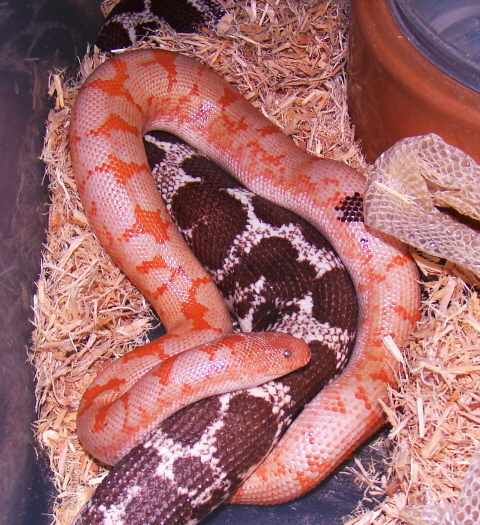
Hello, I am wondering if anyone knows what snakes make the different morphs. I have a few of the KSB and would like to learn more about obtaining the different morphs. Thanks.
Reptile & Amphibian Forums
Welcome to kingsnake.com's message board system. Here you may share and discuss information with others about your favorite reptile and amphibian related topics such as care and feeding, caging requirements, permits and licenses, and more. Launched in 1997, the kingsnake.com message board system is one of the oldest and largest systems on the internet.


Different Morphs of kenyans?
Kylegep
Aug 05, 2010 06:23 PM
Replies (18)
CBH
Aug 05, 2010 08:02 PM
Rather than listing all of the possible morphs, what morphs do you have and what do you hope to produce?
-Chris
-----
Christopher E. Smith
Contact
Captive Bred Herps
Wildlife Research & Consulting Services, LLC
Kylegep
Aug 06, 2010 10:26 AM
I have an anery and a norm. I would like to develop a flame, if that is possible. I know it won't work with the two I have but I would like to figure some of these morphs out.
CBH
Aug 06, 2010 01:01 PM
I am not familiar with the 'flame' kenyan sand boas, but they are most likely a line bred trait. You will need flames to produce flames.
-Chris
-----
Christopher E. Smith
Contact
Captive Bred Herps
Wildlife Research & Consulting Services, LLC
Kylegep
Aug 06, 2010 01:28 PM
Can you tell me what a nuclear is? And how or what forms it.
CBH
Aug 06, 2010 01:57 PM
The nuclear is the same kind of thing. It is a line bred trait and you need nuclears to produce it.
-Chris
-----
Christopher E. Smith
Contact
Captive Bred Herps
Wildlife Research & Consulting Services, LLC
keego73
Aug 07, 2010 01:16 AM
Chris is right that you'd need Flames to produce Flames, and Nuclears to produce Nuclears. "Flame" is sort of a market name for the Dodoma locality. Nuclear is a the name of a very clean line bred KSB. Neither can be truly produced if you introduce another line.
With the snakes you have, you can produce F1 normal, het for anery; and F2 normals, normal het anery, and anery. From there, it depends on what snakes you breed.
If you want to produce "Flame" or Nukes, you'll need to buy those lines. If you do, make sure you get them from a legitimate source, as many people are mixing them these day. Some people are selling mixes for high $$$ as well, so you really should make sure to get a trusted name, not just a high price tag.
That being said, it's not worth while to get into either line if you are wanting to be a casual snake owner. Those are both very long term, dedicated lines.
Kylegep
Aug 10, 2010 06:44 AM
What does F1 and F2 mean?
SandBoaMorphs
Aug 10, 2010 10:38 AM
Flames in the pet trade market are a cross between a dodoma and a normal. The end result is a cleanier snake that won't 'fleck' out (the orange color scales will start to darken and dull as the snake ages in Kenyans) as the snake ages. There is nothing line bred about it, the dodoma genetics have proven out time and time again. Anyone who has worked with dodomas should agree that dodoma blood is a must if you are going to breed kenyans.
While the Nuclear line (super extreme orange/red) is definitely a line bred trait, there is more too the line than that. Nuclears first off, tend to be reduced patterned, which is associated with the Dodoma line. I do not know if Roy Stockwell bred dodomas into the line years and years ago, but we do see some strange things coming from nuclears being cross bred into other kenyan morphs. Jeff Holloway has possibly the best example with that crazy anery that is mostly white with just a few black spots. It has nuclear blood.
http://sandboamorphs.blogspot.com/2010/07/adult-male-female.html
If you follow the above link there is a picture of a 5-6 year old adult normal female, I think she looks like a standard adult female, her orange scales have dulled and some have turned black/brown like her saddles. Whereas the 5-6 year old 100% dodoma does not have have any flecking, his color is the same as when I first purchased him from the Turners. The babies that he produces are flames. They will not fleck out as they get older and will typically have reduced patterns.
Scott and Jeff have a lot of experience with these two lines and could probably better clarify and possibly expand on my thoughts.
-----
Mark Huntley
Sand Boa Morphs
Sand Boa's
2.1 Rufescens
6.6 Albinos
0.1 Hypo Albino
1.1 Dodoma
2.0 Nuclear Meltdown
0.1 Flame
10.22.14 Normal (orange)
7.16 Anery
5.4 Snow
2.2 Yellow Snow
0.1 Splash Albino
1.0 Splash Anery
1.0 Orange Stripe Het Anery
3.0 High Orange Stripe
1.0 Yellow Stripe
1.3 High Orange Tiger
2.3 High Orange
1.0 Snow Paradoxes
0.1 Albino Paradoxes
1.1 Javelin Sand Boas
2.1 Rough Scales
1.1 Indian Sunsets F3
Western Hognose
15.6 Normal Hogs
6.2 Green Phase
1.2 Red Phase
2.1 Boston Terriers
0.2 Sooners
1.3 Rhode Island Reds
0.3 Barred Rocks
0.2 Range Hens
0.1 Favorite Wives
1.1 On the fence in-laws
2.1 Rug Rats
CHECK OUT MY NEW KENYAN SAND BOA BLOG
http://sandboamorphs.blogspot.com/
WWW.SANDBOAMORPHS.COM
kylegep
Aug 10, 2010 09:03 PM
So, What is the main difference between Nuclears and Dodoma? Don't they both have an extensive brightness even with age?
SandBoaMorphs
Aug 10, 2010 10:45 PM
Dodoma's color varies from a yellow to an orange and the color is not what you are after them for. The Nuclears are super extreme red/orange. Do a search and you'll see Roy Stockwells nuclears in the photo section at KS.
-----
Mark Huntley
Sand Boa Morphs
Sand Boa's
2.1 Rufescens
6.6 Albinos
0.1 Hypo Albino
1.1 Dodoma
2.0 Nuclear Meltdown
0.1 Flame
10.22.14 Normal (orange)
7.16 Anery
5.4 Snow
2.2 Yellow Snow
0.1 Splash Albino
1.0 Splash Anery
1.0 Orange Stripe Het Anery
3.0 High Orange Stripe
1.0 Yellow Stripe
1.3 High Orange Tiger
2.3 High Orange
1.0 Snow Paradoxes
0.1 Albino Paradoxes
1.1 Javelin Sand Boas
2.1 Rough Scales
1.1 Indian Sunsets F3
Western Hognose
15.6 Normal Hogs
6.2 Green Phase
1.2 Red Phase
2.1 Boston Terriers
0.2 Sooners
1.3 Rhode Island Reds
0.3 Barred Rocks
0.2 Range Hens
0.1 Favorite Wives
1.1 On the fence in-laws
2.1 Rug Rats
CHECK OUT MY NEW KENYAN SAND BOA BLOG
http://sandboamorphs.blogspot.com/
WWW.SANDBOAMORPHS.COM
kylegep
Aug 11, 2010 07:52 AM
So, you get the dodomas for their ability to retain the colors, correct? And then the nuclears for their vibrant colors?
SandBoaMorphs
Aug 11, 2010 08:38 AM
That's it in a nut shell...however, it appears the nuclear line also has the same ability to retain its colors as they age, too. Roy Stockwell developed that line and does visit this forum, he'd be better to ask about that.
-----
Mark Huntley
Sand Boa Morphs
Sand Boa's
2.1 Rufescens
6.6 Albinos
0.1 Hypo Albino
1.1 Dodoma
2.0 Nuclear Meltdown
0.1 Flame
10.22.14 Normal (orange)
7.16 Anery
5.4 Snow
2.2 Yellow Snow
0.1 Splash Albino
1.0 Splash Anery
1.0 Orange Stripe Het Anery
3.0 High Orange Stripe
1.0 Yellow Stripe
1.3 High Orange Tiger
2.3 High Orange
1.0 Snow Paradoxes
0.1 Albino Paradoxes
1.1 Javelin Sand Boas
2.1 Rough Scales
1.1 Indian Sunsets F3
Western Hognose
15.6 Normal Hogs
6.2 Green Phase
1.2 Red Phase
2.1 Boston Terriers
0.2 Sooners
1.3 Rhode Island Reds
0.3 Barred Rocks
0.2 Range Hens
0.1 Favorite Wives
1.1 On the fence in-laws
2.1 Rug Rats
CHECK OUT MY NEW KENYAN SAND BOA BLOG
http://sandboamorphs.blogspot.com/
WWW.SANDBOAMORPHS.COM
StevePerry
Aug 11, 2010 09:01 PM
While I agree with most of what has been said in this thread, I have to politley disagree with the comment that the dodoma and nuke are not just line bred traits. You cannot have a het for dodamo, flame or nuclear. Can these line bred traits show through in their offspring? Of course they will just like your own children will have a tendancy to look similar in some ways to both parents. Does this mean that a line bred trait is not genetic? No, obviously if some traits will be passed on through dna then it is genetic but not in the way that everyone thinks.
A morph must be able to be reproduced consistantly.
We see the dodoma influence in many of the other morphs that are on the market, this is called, get ready, a "line bred morph". lolol. pretty simple IMO.
If I remeber correctly, which I may not, Roy started with some very high orange dodoma animals and went from there.
-----
Steve Perry
North Idaho.
vjl4
Aug 12, 2010 11:28 AM
I think that Mark may have meant that Dodoma is a naturally occurring trait and not line-bred by some one. Which is true, but I think of them as a naturally line bred because they come from a relatively isolated population.
Vinny
-----
“There is a grandeur in this view of life, with its several powers, having been originally breathed into a few forms or into one; and that whilst this planet has gone on cycling according to the fixed laws of gravity, from so simple a beginning endless forms most beautiful and most wonderful have been, and are being, evolved.” -C. Darwin, 1859
SandBoaMorphs
Aug 12, 2010 06:51 PM
No one has ever mistook me for Mr. Science...all I know is if you breed a dodoma to another snake the resulting litter (which is refered to as a flame in the pet trade) will exhibit 2 traits (or whatever you want to call it) 1) They will have some signs of a reduced pattern 2) and most important, their color will not 'fleck' (dull in color) as they get older.
Does that mean it is a Morph? I don't know. But I do know it is a very important 'something' to all Kenyan Sand Boa breeders, especially the ones seeking new 'types' of Kenyan Sand Boas.
I bought this guy from the Turner's, he is about 5 years old. I breed him to almost all of my normal females. Here's a normal female about the same age as him, notice the flecking. This is the standard normal.


-----
Mark Huntley
Sand Boa Morphs
Sand Boa's
2.1 Rufescens
6.6 Albinos
0.1 Hypo Albino
1.1 Dodoma
2.0 Nuclear Meltdown
0.1 Flame
10.22.14 Normal (orange)
7.16 Anery
5.4 Snow
2.2 Yellow Snow
0.1 Splash Albino
1.0 Splash Anery
1.0 Orange Stripe Het Anery
3.0 High Orange Stripe
1.0 Yellow Stripe
1.3 High Orange Tiger
2.3 High Orange
1.0 Snow Paradoxes
0.1 Albino Paradoxes
1.1 Javelin Sand Boas
2.1 Rough Scales
1.1 Indian Sunsets F3
Western Hognose
15.6 Normal Hogs
6.2 Green Phase
1.2 Red Phase
2.1 Boston Terriers
0.2 Sooners
1.3 Rhode Island Reds
0.3 Barred Rocks
0.2 Range Hens
0.1 Favorite Wives
1.1 On the fence in-laws
2.1 Rug Rats
CHECK OUT MY NEW KENYAN SAND BOA BLOG
http://sandboamorphs.blogspot.com/
WWW.SANDBOAMORPHS.COM
vjl4
Aug 13, 2010 09:45 AM
LOL! People have called me many things 
I wouldn't call Dodoma (or nuclear for that matter) a morph because I like to reserve that word for simple genetic traits, i.e. things that are either recessive (albino, paradox albino, anery, or combinations of them), co-dominant, and incomplete dominant. With these traits your expectations are pretty clear, for example if you bred an albino to a normal you will get hets, bred the hets you get an albino, breed that albino to a completely unrelated animal and you will get hets, breed those hets and you get an albino, repeat until the end of time and the results will be the same. There is one mutated gene involved and you can passage that single mutant gene into any animal because it is not blended in. That one mutant gene is maintained.
But for Dodoma and other line bred and line bred like things you cant pull off the above breeding cycle for. Take the most awesome Dodoma (or nuclear) and mate that to the most butt ugly dark tipped out monster of a kenyan and you will get offspring that are not like mom nor like dad; some may be more Dodoma looking and some may be more butt ugly but its likely to be some where in between. Then, take those offspring and breed them to each other, sure you will get some that look like Dodoma and some that look ugly, but there not hets and more than a puggle is het pug or het beagle. Then, take the best most Dodoma-like animal from that cross and breed it to some unrelated brown boring Kenyan, bred those offspring together and you get animals that are not very Dodoma like. Repeat a few more times and you will no longer get anything that even faintly looks like Dodoma (or nuclear).
For those line bred traits its the particularly combination of gene variants (alleles) that produce the appearance. Start to dilute out that combination by out-crosses and the pattern will be lost, 50% in the first generation, 25% in the second, 12.5% in the third, 6.25% in the fourth, etc.
Best,
Vinny


-----
“There is a grandeur in this view of life, with its several powers, having been originally breathed into a few forms or into one; and that whilst this planet has gone on cycling according to the fixed laws of gravity, from so simple a beginning endless forms most beautiful and most wonderful have been, and are being, evolved.” -C. Darwin, 1859
SandBoaMorphs
Aug 13, 2010 10:40 AM
I fully understand...no not really, but, I know you understand where I'm coming from, yes, maybe the pattern and the 'butt ugly' may be hard to overcome, HEY take a look at me! But, when you breed that dodoma to a butt ugly, those litters will still look the same 5-6 years down the road without the dull and flecking.
I've seen Jeff Holloway's anerys and they are super reduced patterned and maintain their color as they age, I don't know what % they are of dodoma/nuclear, but they sure aren't 50% or 25%, they are anerys, so they are multiple generations removed from a nuclear or dodoma, yet they still hold their color.
How much 'dodoma/nuclear' blood does a snake have to have to exhibit this 'trait'. I am unsure, but it does not appear much. That's the point I'm trying to make. It seems like we look at 'line bred' traits as negatives (or atleast, less desirable), because if you have a super high orange bred to a super high orange and some in the litter don't come out high orange, well, it isn't going to throw you a litter of high orange when you breed it later to a normal.
But, it will retain its color as it ages even multiple generations of litters down the road. Breed that litter to other Kenyans and the resulting litter would do the same (retain its color, but may still be butt ugly). Again, what you want to call it, I don't know, but 'line bred' insinuates, the high orange to high orange example above. So, I'm against calling the dodoma's ability to maintain its color over its life a line bred trait. The reduced pattern is most definitely a line bred trait, no doubt.
Is that your nuclear or your meltdown in the middle? One of my males is getting more nuclear color after every shed (a 'Screamer' as the father of the meldowns recently called them!), the other one is not...damned line bred traits! LOL!
-----
Mark Huntley
Sand Boa Morphs
Sand Boa's
2.1 Rufescens
6.6 Albinos
0.1 Hypo Albino
1.1 Dodoma
2.0 Nuclear Meltdown
0.1 Flame
10.22.14 Normal (orange)
7.16 Anery
5.4 Snow
2.2 Yellow Snow
0.1 Splash Albino
1.0 Splash Anery
1.0 Orange Stripe Het Anery
3.0 High Orange Stripe
1.0 Yellow Stripe
1.3 High Orange Tiger
2.3 High Orange
1.0 Snow Paradoxes
0.1 Albino Paradoxes
1.1 Javelin Sand Boas
2.1 Rough Scales
1.1 Indian Sunsets F3
Western Hognose
15.6 Normal Hogs
6.2 Green Phase
1.2 Red Phase
2.1 Boston Terriers
0.2 Sooners
1.3 Rhode Island Reds
0.3 Barred Rocks
0.2 Range Hens
0.1 Favorite Wives
1.1 On the fence in-laws
2.1 Rug Rats
CHECK OUT MY NEW KENYAN SAND BOA BLOG
http://sandboamorphs.blogspot.com/
WWW.SANDBOAMORPHS.COM
vjl4
Aug 13, 2010 10:46 AM
LOL, damn those genetic dice! Actually, the one in the middle is the mother. She is awefull pretty though
Thats why I dont like calling them morphs, you cant really tell whats going to happen and given enough outcrossing the trait will disappear. But, that isn't stopping me from breeding them into the aneries and albinos either!
Vinny
-----
“There is a grandeur in this view of life, with its several powers, having been originally breathed into a few forms or into one; and that whilst this planet has gone on cycling according to the fixed laws of gravity, from so simple a beginning endless forms most beautiful and most wonderful have been, and are being, evolved.” -C. Darwin, 1859
