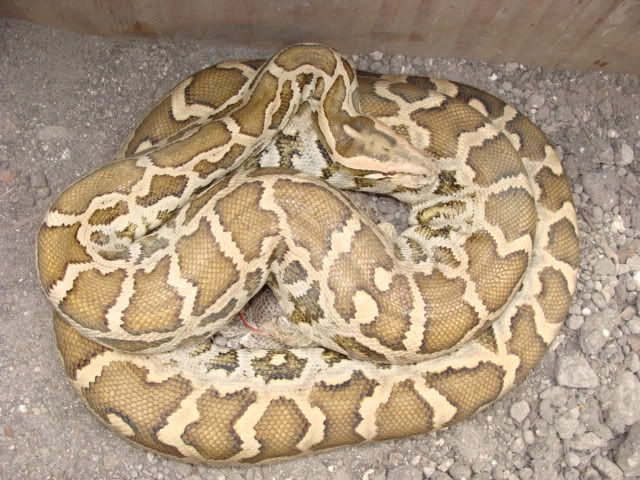
How many of you out there are working with PURE Python m. molurus anymore? They've all but dissapeared from Herpetoculture over the years and it's a shame as they're a handsome snake...
-----
Tom Crutchfield
www.tomcrutchfield.com
Welcome to kingsnake.com's message board system. Here you may share and discuss information with others about your favorite reptile and amphibian related topics such as care and feeding, caging requirements, permits and licenses, and more. Launched in 1997, the kingsnake.com message board system is one of the oldest and largest systems on the internet.


How many of you out there are working with PURE Python m. molurus anymore? They've all but dissapeared from Herpetoculture over the years and it's a shame as they're a handsome snake...
-----
Tom Crutchfield
www.tomcrutchfield.com
Here's an interesting link with an Indian python story .http://www.805online.com/index.html Scroll through the photo history of this band. The snake almost looks more like a burm than an indian to me but it is kind of hard for me to tell from the old discolored (and b & w ) photos. The thing about taking it to quebec is kind of interesting. I'm thinking this was illegal in 1979/80 and most certainly would be an international incident these days. 805 was a great progressive rock band from Syracuse N.Y. btw.
Link
I would say that's definitely a Burmese Python. That was very interesting however..Prety cool!!!
-----
Tom Crutchfield
www.tomcrutchfield.com
While listed at low risk by the IUCN, not so by the ESA here in the U.S. Makes it kinda hard with no interstate commerce allowed.
quote" Python molurus is listed by IUCN as lower risk, near threatened. Since June 14, 1976, P. molurus has been listed by the U.S. ESA as endangered throughout its range. The subspecies P. molurus molurus is listed as endangered in Appendix I of CITES. Other P. molurus subspecies are listed in Appendix II, as are all other species of Pythonidae. "end quote
quote" The U.S. Endangered Species Act (U.S. ESA) is the primary legislation that affords federal legal protections to threatened and endangered species in the United States, and is administered by the U.S. Fish and Wildlife Service (USFWS) (http://endangered.fws.gov/) and U.S. National Marine Fisheries Service (NMFS) (http://www.nmfs.noaa.gov/prot_res/overview/es.html). As defined by the Act, endangered refers to species that are "in danger of extinction within the foreseeable future throughout all or a significant portion of its range," while threatened refers to “those animals and plants likely to become endangered within the foreseeable future throughout all or a significant portion of their ranges.” Plant species and varieties (including fungi and lichens), animal species and subspecies, and vertebrate animal populations are eligible for listing under the Act.
Status under the U.S. Endangered Species Act provided by NatureServe Explorer is based on formal notices published by USFWS or NMFS in the Federal Register. The date shown alongside the status (in parentheses) refers to the formal Federal Register publication date regarding the status designation. Dates appear only for taxa and populations that are specifically named in a Federal Register Notice of Review Table or in the section of a Federal Register Proposed or Final Rule that proposes or declares an amendment to 50 Code of Federal Regulations Part 17 Section 11 or 12 (i.e., changes to the Lists of Endangered and Threatened Wildlife and Plants). "end quote
jsc
-----
"As hard as I've tried, just can't NOT do this"
John Crickmer
Bengal Monitors are the most common Asian Monitor but are listed as endangered on the ESA...Water Monitors are much rarer..thanks...Indian's from the info I'm getting from folks living there are fairly common but are found in disjunct colonies...
-----
Tom Crutchfield
www.tomcrutchfield.com
The original intent of ESA legislation was to protect species, foreign or domestic, from decimation from commercial exploitation by over collecting in their native countries and excessive importation into the U.S. The main source of control at the time under the ESA was by making importation and interstate trade within the U.S. in those species illegal. Protection of foreign species within their own countries in the 1970’s was much more difficult as the IUCN was weaker then and CITES was just getting started. The Indian python was subject to over collection within its range and was about the only boid in high demand in the 1970’s. I think there was also serious pressure from the Indian government as well to help protect the species. I think most also believe that a re-evaluation of this species is in order, but don’t hold your breath.
The ESA and CITES list P. m. molurus as endangered. You are correct in that the IUCN Redlist shows Python molurus as Lower Risk/Near Threatened instead of endangered, but if you look closely, you will see that the IUCN listing lumps all species of P. molurus together, so their listing also includes all populations of the burmese python, P. m. bivittatus as well. This would definitely skew the overall status of the species with regards to the IUCN listing. Not that I would disagree however, and I feel that the ESA listing for P.m. molurus is probably not warranted for specimens produced within the U.S. with supporting documentation.
Kelly
Gordon Rodda doesn't believe it's a separate subspecies. He needs to be educated with a 2X4.
if someone already stated this, sorry, I haven't had time to read all the posts. However, Rocky Mountain Retics breed Indian pythons.
Ahh, the species that lured me into exotics when I was a child. The Indian Pythons always have & always will have a special place in my heart.
Back in the late '60s or early '70s there was a popular snake book that had a drawing of an Indian Python coiled around a leopard. I drew the picture for an art class project at the time and I've been hooked on Indian Python's since. A few years later I got my first Burmese, which, at the time, was the closest I could get to an Indian.
Maybe one of these days the stars will align. I'd love to work with them.
Thanks for the memories, Tom!
Mike
-----
Due to political correctness run amuck,
this ol' hillbilly is now referred to as an:
Appalachian American
Help, tips & resources quick links
Manage your user and advertising accounts
Advertising and services purchase quick links

