

Hi all,
I'm getting ready to take collection photos for my soon to be website, but I'm wondering what kind of lighting works best. I've taken some pictures using natural sunlight, but that seems to wash out the colors on some morphs esp. my caramel albino (I keep BPs). Would it help to make/buy a light box (not sure if that's the right term)? Here's a pic of my caramel...he's more purple in person and I'd like to capture his colors more accurately... I don't have a fancy camera, but I'm hoping I can get one this year.
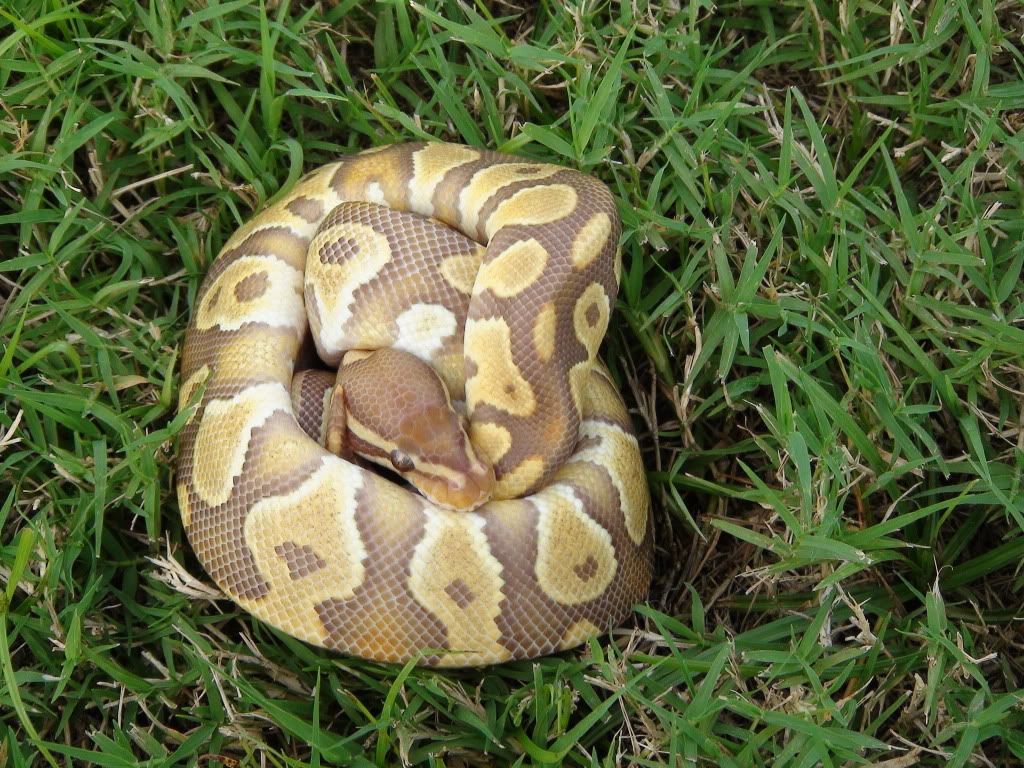
 But please avoid say... black velvet! A weathered silver log or other warmer colored natural substance would be of benefit perhaps. Please read my thoughts below on eyes bein in focus! Back away from the animal slightly, remembering your lens has a minimum focusing range! Try taking some "bracket" shots, which is to say take a picture as the computer suggests, then switch to manual and take a picture at one or more f-stops less and some at one or mor f-stops more. You can generally shoot at less than full f-stops as well. In doing this you'll run the gamut of possibilities and hopefully get a primo picture out of the bunch! Another thing to consider is a screw-on polorizing filter... this will substantially improve your color saturation which is to say the camera will "see" the animal more like you see it! Diffused flash can be effective but one always runs the risk of washing out the "highest" areas of the body, say the ridges of the spine. Practice!