Reptile & Amphibian Forums

Welcome to kingsnake.com's message board system. Here you may share and discuss information with others about your favorite reptile and amphibian related topics such as care and feeding, caging requirements, permits and licenses, and more. Launched in 1997, the kingsnake.com message board system is one of the oldest and largest systems on the internet.

https://www.crepnw.com/
Click here to visit Classifieds

Hatchling Deaths

hodgepodgepython Nov 14, 2010 10:16 AM

Good Morning.
I was wondering if anyone has experience with hatchling deaths? I want to see if this may be an incubator issue or something else. I use 2 hovabators and early this year I had 2 clutches in one and One of the babies came half out of the egg and dies. I later found that his insides were on the outside. I just hatched my first Albino X Het Albino clutch and This same thing happened. It was a large 10 egg clutch, I frikN dropped one egg.. So out of the 9 left, I had one with its insides on the outside and one that is bloated and has kinks in its back. So far the kinked one is doing ok, and the swelling seems to have went down some. This sucks when it happens and even worse when 2 of the snakes mentioed were/are albino. The Kink back has some awesome markings too..
The Albino Clutch was Laid late and just hatched a few days ago so I had put the incubators away and I am not sure if it was the same one that this happened on a previous clutch or what. I am worried maybe the incubator spiked ?
Any Ideas to why they come out kinked or deformed?
-----
Hodgepodge Pythons
Hodgepodge:noun
: a heterogeneous mixture

Vist us @ www.hodgepodgepythons.com
email jason@hodgepodgepythons.com
Replies (18)

joeysgreen Nov 14, 2010 10:35 AM

Malformed offspring is not an uncommon event, and is usually blamed on temperature spikes. This seems like a sensible, logical explaination to me, but there are likely other possibilities as well.
What species is this?
If you are having the same problem with the same pair of adults, it is possible that they are genetically incompatable. Unlikely, but it has happened before. Certain hybrids are sterile for this reason. I wouldn't be surprised if sooner or later, a particular morph gene became associated with such an anomally.
In any case, review your incubation techniques. It helps to have a digital thermometer that records maximum and minimum temperatures. This will allow you to catch temp spikes and drops should they occur. Some setups have an alarm, so these problems can be rectified as they happen, hopefully before harm is done.

For your kinked offspring that survived, I'd have to say the outlook isn't very good. Most (not all) tend to get more severe as the snake grows in my experience. Depending on where the kink is, this can create problems with locomotion and digestia passage quite soon.

Ian

hodgepodgepython Nov 14, 2010 10:46 AM

The Snakes In question are Ball Pythons and this was the first time this pair mated. Also for the record, they are from 2 totally different breeders and born different years and should in no way be related. The other instance I spoke of was a different pair of normal balls.

Secondly, I usually use the Max/Min gages and some seem to fog up or go out before 60 days.. I had used one and never seen any spike, but Once the temps appear to be stable, I was not checking them as much. I am leaning towards the spike, but I also know that just as with all animals and reptils, deformities can occur. Thanks for the input.

I am not saying I am a professional by no means, but I have owned BP's since before there were morphs available and I had some breed over the years, but just recently started into breeding. I am not a total rookie, but looking for input to determine iof the incubatoir was the culprit. I am already looking for a nice incubator or look to convert a fridge for next season. I have also had a total of 6 clucthes the past 2 years and this issue happened in just 2 of them. I hate to try again, but I bet if I marked the incubator I would see it happen in just that one again..
-----
Hodgepodge Pythons
Hodgepodge:noun
: a heterogeneous mixture

Vist us @ http://hodgepodgepythons.webs.com
email hodgepodgepythons@yahoo.com

Kelly_Haller Nov 15, 2010 01:05 AM

This definitely sounds like an incubation temp issue. And I further do not believe that this was a temp spike, as this would have been a long term temp issue to cause the developmental abnormalities you are seeing. The two important questions are what is the incubation temp you are setting for, and what device are you using to measure that temp.

Kelly

joeysgreen Nov 15, 2010 08:48 AM

I"ve found digital thermometers to really suck in high humidity. They'll die, but usually before that, they'll post bogus temperatures, or lose their max/min function. Consider a remote sensor probe; where the computer part can sit outside of the incubator.

Ian

hodgepodgepython Nov 15, 2010 07:27 PM

Well I used a digital temp gage inside and its brand I have used and i also have a lazer temp gun, ichecked the temps and they were always 88-89 and I savedd the settings where I have my thermostat and heating element for the incubator. I also hatched multiple clutches using the same method and had no troubles with the equipment other than these 2 clutches. I honestly think its the thermostat or the incubator itself. I may just use this set up and let it run with a max/min gage and see if it does spike. either way I am going to biult or make a larger better incubator and buy a new johnson control for it for this season. I have been lucky and only had 4 or less clutches at a time, but if I have any more I will def need a larger one anyways..
-----
Hodgepodge Pythons
Hodgepodge:noun
: a heterogeneous mixture

Vist us @ http://hodgepodgepythons.webs.com
email hodgepodgepythons@yahoo.com

Kelly_Haller Nov 15, 2010 09:31 PM

It could have very easily been a faulty thermostat, temp gauge, or heating element malfunction. I always have a good laboratory grade mercury thermometer within the egg chamber of the incubator, when I use one, as a check on the system. Also make sure that it is classified as a full immersion type thermometer. They are considerably more accurate than any digital or electronic temp measurement device and will not malfunction. Temp guns are handy, but they are typically only accurate to within a couple of degrees at best. Good mercury lab thermometers will be accurate to within a few tenths of a degree.

Spinal deformities or kinks are usually associated with excessive incubation temps, especially if seen in more than one individual of a clutch. If the true temp of the incubator was just a few degrees higher than what you thought it was over the entire incubation period, you could easily have the outcome you experienced. It would be worth it to set up this incubator again for a dry run, monitor it closely, as see if you can spot the problem.

Kelly

Sonya Nov 16, 2010 11:05 AM

Now I am curious. I have hatched childrens, BP, and NA ratsnakes. With the pythons I aimed more for a 86* range. With the rats a few degrees lower. I have friends that likewise aim lower and are happy to wait the extra week for hatching. Heck I know a few that set corn or ratsnake eggs up on a warm shelf in the low 80s.

What do other folks aim for for hatch temps? To me the 88plus is just opening you up to troubles the second anything is out of line.
-----
Sonya

I'm not mean. You're just a sissy.
Happy Bunny

Kelly_Haller Nov 16, 2010 10:29 PM

Most colubrid eggs are incubated at around 80 to 82, or with some species just slightly higher, and they will withstand even long term variations of a few degrees with no problems. However, python eggs require a minimum of 85 to 86 for normal development, and based on field studies, even this is a little low. Non-physiological thermoregulating species like the smaller Australian python species, ball pythons, etc, control the egg mass temps by periodically basking and then coiling about the eggs to radiate the absorbed heat back into the egg mass. Egg mass temps of these species measured in the field while being maternally incubated showed temps ranging from 87 to 89 degrees.

Maternal incubation by true physiological thermoregulating species such as burmese and reticulated pythons show temps even slightly higher. Burmese python females maternally incubate their eggs at the highest temps of all python species and are probably the most consistent with regards to temp control. They hold the egg mass temp at an average of 92 degrees, allowing only slight variations. Not only is this well documented in various studies, but I have personally measured intra-coil temps with dozens of brooding females and can verify that fact.

The optimum incubation temp for ball python eggs is probably about 88 to 89 degrees. While they can withstand short-term fluctuations of a few degrees either higher or lower without issue, they would not survive temps below 85 or above 92 if they were over an extended period of time.

Kelly

HappyHillbilly Nov 17, 2010 10:20 PM

There's a lot of good input here. I just thought I'd try to help drive home the importance of knowing.

Remove all doubt that you can. Know your incubating system. Check temps at various times of the day, day-in, day-out. It takes a while to fine tune an incubator. You can't necessarily control genetics, although I believe that the well-being of the female can cause genetic flaws.

I mostly breed Burmese Pythons and I built my first, and only, incubator out of an old refrigerator a few years ago. I know that it maintains the temps I set it for. I incubated Burm eggs, from the same parents, two years in a row, at 92(F) with no deformities.

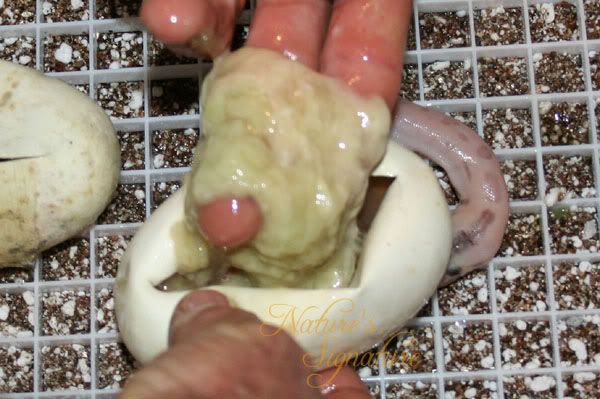
Last year I bred a different pair of Burms and got 25 dud eggs. This year the female layed 26 duds and 4 good ones. Incubated at 92(F). Produced two healthy hatchlings, one kinked, and one mind boggling deformity. I'm so confident of my incubating system that I have very, very little doubt that this was a genetic case.

This snake was alive when I cut the egg open a few days ahead of hatch schedule. It moved within the egg as I was cutting it open. It was dead when I pulled it out. Below is a photo of the mass that was in the egg with it.

Protect your investments. Know your incubating system and take the time to fine tune it before you have eggs.

Ya'll take care!
HH
Image
-----
Due to political correctness run amuck,
this ol' hillbilly is now referred to as an:
Appalachian American


www.natures-signature.com

HappyHillbilly Nov 17, 2010 10:29 PM

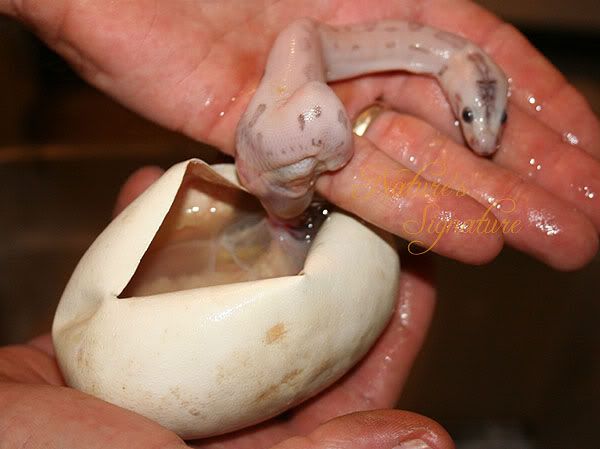
Here's another view.

HH
Image
-----
Due to political correctness run amuck,
this ol' hillbilly is now referred to as an:
Appalachian American


www.natures-signature.com

HappyHillbilly Nov 17, 2010 10:36 PM

Looks like the new link didn't copy to my clipboard. Sorry 'bout that! I'll try again.

HH
Image
-----
Due to political correctness run amuck,
this ol' hillbilly is now referred to as an:
Appalachian American


www.natures-signature.com

Kelly_Haller Nov 18, 2010 01:00 AM

Mike,
I would definitely suspect as you stated that this defect is most likely of genetic origin. It is showing multiple developmental issues such as anatomical malformations as well as under development with respect to the age of the embryo. I definitely agree with your comments about "knowing" your incubator setup. I believe the number one error involved with incubator issues is not "knowing" the actual ambient temperature environment right where the eggs are setting within the incubator chamber. Many digital temp monitors or controls can be a few degrees off, and in my opinion should always be checked with a decent laboratory grade mercury thermometer setting in with the eggs. Nice work on the documentation.

Kelly

Sonya Nov 18, 2010 12:19 PM

Now did you have all this stuff zinging around in your head? Does that scare you a little.

All great info. I guess I would be back to precision in measuring and time for a worthy thermostat. I moved all my herps into 'the dungeon' so that overheating was not a problem without mechanical failure. Since then I have not had spikes but rather usually have at least one major power outage during incubation time I worry more about that. Thankfully less heat waves in Upstate NY.

This year and in future I have to have two incubators anyway as this is the first year I will (good Lord willing) have clutches from both colubrids and pythons at the same season.

To the OP, sounds like some bad luck and possible spikes and I hope future hatches work better for you.
-----
Sonya

I'm not mean. You're just a sissy.
Happy Bunny

Kelly_Haller Nov 18, 2010 08:53 PM

Thanks for the comments. I have been studying maternal incubation in various species of pythons since the late 1970's. It is an amazing physiological process carried out by a true poikilothermic animal. The most amazing are the larger python species which physiologically thermoregulate to an incredible degree of accuracy and can maintain this accuracy even when ambient background temps drop by 10 degrees or more. Below are a couple of photos I've taken over the years of some of my females on eggs. The upper photo is one of my first and is a burmese from around 1980, and the lower photo is a Sri Lanka python.

Kelly

joeysgreen Nov 19, 2010 01:05 PM

Kelly, I'm curious. I know that you also breed anacondas, correct? Being live-bearers, do you know if they maintain as precise of a temperature as these pythons?

Ian

Kelly_Haller Nov 19, 2010 06:47 PM

Ian,
With the physiological thermoregulation carried out by the larger python species, the heat is produced endogenously by muscular contractions and is therefore able to be very highly controlled within extremely tight limits. Live-bearers like anacondas and smaller egg laying python species, are unable to produce significant heat endogenously, and therefore must rely on spatially orienting themselves to absorb and retain solar radiation. While they are pretty good at temperature control through basking behavior, they still do not possess the degree of control seen in certain large python species.

Kelly

joeysgreen Nov 22, 2010 01:45 PM

...

mingdurga Nov 16, 2010 09:44 PM

When I hatched out BP's the following was used: Large styrofoam box with smaller one inside. The smaller box had a glass cover which was cleaned once weekly for moisture removal. Used hovabator cover, with thermometer that came with it and a herpstat with no night drop. Never used a humidity gauge.

Most important thing to do when incubating python eggs is run tests for about a week to make sure temps don't fluctuate.

The other responses are right about excessive heat causing deformities. I've seen it many times in colubrids, which is why I hatch colubrids at room temp (low to mid 70's). I've never gone below 87 or higher than 90 with BP's based on the data gleaned from other breeders, especially after watching the Barker video on BP's.

Mike

Site Tools