I was just wanting to know if there were any Mandarin Ratsnakes out there? I think I saw some pics of some a few years back, but dont remember where?
Reptile & Amphibian Forums
Welcome to kingsnake.com's message board system. Here you may share and discuss information with others about your favorite reptile and amphibian related topics such as care and feeding, caging requirements, permits and licenses, and more. Launched in 1997, the kingsnake.com message board system is one of the oldest and largest systems on the internet.



Mandarin morphs of any kind out there?
PnPreptiles
Feb 03, 2011 10:04 PM
Replies (5)
DMong
Feb 22, 2011 03:15 PM
As far as any true simple recessive trait morphs are concerned, I don't really think there is any available in the hobby that I am aware of. However, here is a link to a hypomelanistic W/C individual. It has a copyright on the photo, so I don't want to post the photo. This animal is probably long dead though. Wild-caught imports have a notoriously horrible track record for dying from stress and high parasite loads.
If this animal did survive long-term, you can bet it is worth BIG BUCKS to Mandarin breeders!!...and especially if it was a fertile male.
If you scroll about half-way down, it is with some normal Mandarin's in the next to the last column of pics. The thing is/was AWESOME!
~Doug
Eur-asian ratsnakes
-----
"a snake in the grass is a GOOD thing" 
my website -Serpentine Specialties
garweft
Mar 04, 2011 01:31 PM
There are pics of an anery, striped, and a hypo on extremehogs website. Scroll down to the bottom of their misc. photo album and you'll see them. Here's a link to the page.
DMong
Mar 05, 2011 03:57 PM
Wow!,........those are outstanding mandarin morphs for sure!. Thanks for the link there! 
Although the "anery" morph there is actually an axanthic mutation since there is no yellow pigment whatsoever. The greek word "xanthos" literally meaning yellow, and axanthic = complete lack of yellow.
To confuse the terms a bit more, erythrophores can also be responsible for both yellow and reds however, depending on many factors like the animals predisposition for carotenoid retension within the pigment cells. If it were missing ONLY red pigment it would be considered anerythristic (lack of erythrin).
For some reason, many folks in the hobby seem to associate any snake that looks similar to an anerythristic cornsnake as being truly anerythristic, when this isn't the case at all with many other types of snakes. It all depends on what their colors would normally be. The anery corn is indeed anerythristic, but still displays yellows, therefore it is indeed anerythristic and not axanthic.
A pure black and white Desert kingsnake(L.g.splendida) would be a perfect textbook example of an axanthic animal since it's normal coloration does not involve any red whatsoever, and only yellows besides the normal dark melanin pigment all display.
~Doug
-----
"a snake in the grass is a GOOD thing"
my website -Serpentine Specialties
DMong
Mar 05, 2011 04:01 PM
I meant to say "xanthophores" can also be responsible for both yellows and reds, not "erythrophores"..LOL!
Xanthophores
These chromatophores produce red and yellow pigments known as pteridines. These may vary in color from pure yellow to pure red, as well as intermediate shades. Xanthophores possessing a predominantly red coloration are referred to as erythrophores.
Xanthophores also retain yellow to reddish pigments contained in the diet in the form of carotenoids. Carotenoid retention continues throughout life, and intensity of pigmentation varies based on the quantity and types of carotenoids contained in the diet. Additionally, the animals' genetic predisposition towards and ability to store carotenoids will affect appearance.
-----
"a snake in the grass is a GOOD thing"
my website -Serpentine Specialties
JKruse
May 05, 2011 05:46 PM
There is also the axanthic Mandarin rat. These are incredible!
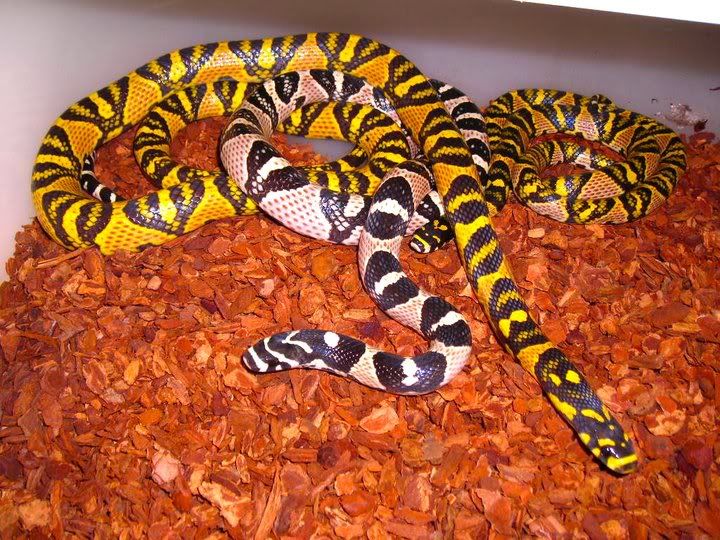
" alt="Image">
-----
Jerry Kruse
www.zonatas.com
And God said, "Let there be zonata subspecies for all to ponder..."
