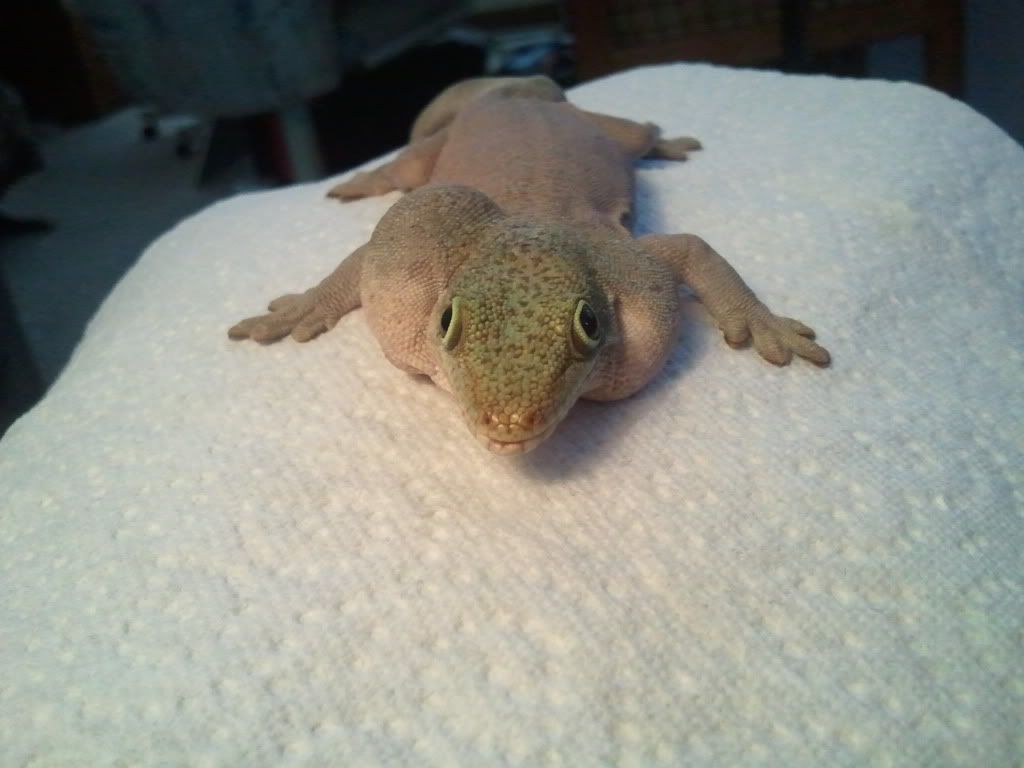
I have a female standing's and her right calcium sac seems to have solidified a few weeks ago. It's larger now and I wonder if anyone has experienced anything of this sort before.
Here's a large picture.
Reptile & Amphibian Forums
Welcome to kingsnake.com's message board system. Here you may share and discuss information with others about your favorite reptile and amphibian related topics such as care and feeding, caging requirements, permits and licenses, and more. Launched in 1997, the kingsnake.com message board system is one of the oldest and largest systems on the internet.



Day gecko with solidified calcium sacs
pollyfrogman
Mar 01, 2011 12:23 PM
Replies (5)
Geckoranch
Mar 03, 2011 08:05 PM
Hi! Cindy Steinle asked me to respond. I am a Phelsuma breeder with 18 years of experience breeding over 30 species of Phelsuma. I have not seen a case this pronounced with the excessive calcium sacs. These need veterinary intervention by a non-domestic vet, either by medication and or surgery as these hardened deposits are painful to the gecko. I'll speak a little about this gecko so we can process and understand our total experiences.
P. standingi is a large Day Gecko that is from an arid area of Madagascar. They need a basking temp of about 95-100F to feel comfortable and exhibit their best color - yours is not exhibiting good color, which is cause for worry. This whitish off-color yours displays, which is normally blue/green/gray, is likely because of a temperature and or nutrition issue. Since we have discussed temperature, let's talk about supplementation and then nutrition.
P. standingi produce some of the heaviest calcified eggs in the genus of Phelsuma, and females need a lot of calcium to do this in their diet. Supplementation is critical. I am curious to learn what supplement this gecko is on and if she is kept under full-spectrum lighting. She is unable, for some reason, to metabolize all the calcium she is getting. In order to metabolize calcium properly, other vitamins and minerals, such as D3 and phosphorus in particular, need to be in correct ratios. If these ratios are off, due to supplementation and/or diet and lighting (full spectrum/regular incandescent).
I have had a few cases of female P. standingi with big calcium sacs and hypocalcemia (not enough calcium). This was evidenced by eggs not hatching, and x-rays of a female with four broken legs with huge calcium sacs. This was with no full-spectrum lighting and RepCal Ultrafine with D3 and Herptivite, which I eventually used 2 parts RepCal Ultrafine with D3 and Herptivite, and my results did not improve.
I have since switched to Calcium Plus by Allen Repashy, which for non-breeding females and males is fine, however, I am using one of his higher D3 supplements, the SuperCalMeD, which has a bit more D3 to help with Calcium metabolism for breeding females. This is mixed equal parts with SuperVite, his multi-vitamin companion part of this system. I use full spectrum lighting, so I am reluctant to use the highest D3 he has, SuperCalHyD, thinking I will overdose them on D3 and get big calcium Sacs. Results: the females calcium sacs are a bit bigger using this technique, their color is good, we'll see what happens this breeding season to see what we can conclude about this solution. If you female is not breeding I would use Calcium Plus for now and see what the vet recommends to either get rid of those sacs surgically or with metabolic solutions like the one I am using with Allen Repashy's custom supplements and full-spectrum lighting.
Just a note, leaving calcium out in the terrarium with a gecko in this condition will exacerbate the condition. Many folks do not understand how calcium is metabolized and they often just supplemented it by itself and not with the necessary vitamins and minerals like phosphorus and D3 so the gecko can process the calcium properly. Geckos have particular requirements in these ratios, I feel Allen Repashy has this sorted out as well as it can be by anyone and has been proven out on my large collection of over 100 Phelsuma for many years. Many supplements are have toxic levels of D3 (too high) for geckos so beware.
As far as diet, mine get Repashy Crested Gecko MRP, also his Day Gecko MRP (MRPs already supplemented), and three week old crickets supplemented with either Calcium Plus or the custom higher D3 mix depending if the gecko is breeding or not. During the peak season the geckos eat three times a week, winter twice a week, crickets usually given once a week, sometimes every other week.
I hope this helps, please let me know some more details about this gecko's husbandry and we can go from there.
pollyfrogman
Mar 04, 2011 12:15 AM
Hi! Thanks for all the info. She was in a 48"x24"x24" container with a male. They've been together for five years or so with no egg laying or reproductive activity, though I've not really tried to promote it. That cage had an ambient temp of around room temp with a basking spot in the 90-100 range.
She had trouble with her last shed getting the skin off the underside of her toes so she wasn't able to climb around and get to the basking spot, hence the inability to metabolize the calcium. I have her in her own tank now with the appropriate temperature and a UV bulb. I'm feeding her baby food, peach mainly with a mix of 1:1 herptivite:repcal supplements once a week added. Aside from the giant ball she is acting normal and she doesn't seem to be having any issues processing the food. Should I hold off on supplementation until this calcium rock is dissolved?
Geckoranch
Mar 04, 2011 01:00 PM
From the info you are supplying here she sounds run down (incomplete shed, lack of eggs, lethargy, off-color, can't catch crickets to eat?) and likely hypocalcemic. To get her to stabilize I would use Allen Repashy's Rescue Cal, a powder you mix with warm or boiling water to create a liquid calcium that goes right in the bloodstream. I have attached a picture of the label, I can send a spec sheet if you like (or anyone else). This stuff works fast and more effectively than the other common remedy of Calcium glubionate, which is really hard to find nowadays. You could mix it into her food or give it to her orally.
A non-domestic veterinarian I know and trust feels that oral D3 may be problematic for certain reptiles, which affects their processing of Calcium, and full spectrum lighting may be a better way to supply it. Many products on the market have what many consider is an overdose of D3 for geckos. The regimen of RepCal and Herptivite you are using does not work (used it for many years here with same results as you) for female P. standingi that are adult breeders so I would phase that out for sure and switch to Calcium Plus (middle of the road D3, less than RepCal) for now with full-spectrum lighting you are doing and hope eventually it will decrease the size of those sacs.
Be advised full-spectrum lighting my need to be replaced as often as 6 months, it is a good idea to put a date sticker on the housing somewhere so you can keep track of that and follow the manufacturer's directions.
I would also switch to the Day Gecko food I helped develop at the Gecko Ranch Allen Repashy just came out with to drastically improve her nutrition over the carb load of babyfood. It has the same nutrients (protein, Calcium Plus and a lot more) as Crested Gecko Diet, and a flavor combo they can't resist (Fig and Cherry). I haven't used any baby food here on my Phelsuma since Crested Gecko Diet came out many years back!
Please keep us posted on how she does. I have another non-domestic vet interested in the case, so I will post any relevant details as they become available.

pollyfrogman
Apr 04, 2011 12:43 PM
Howdy! I haven't gotten any of the supplementation you recommended yet, but she has been in her own ten gallon for about a month now with an incandescent UV bulb and a heat lamp. She's been eating and is much more active now, the calcium sac itself is decreasing in size very slowly as well. I'm feeding her some peach baby food a few times a week and supplementing the herptivite multivitamin with the babyfood about once a week. She's eating superworms a couple times a week as well. Am I correct to assume that her body will take advantage of the solid calcium mass when it can before it takes it from her bones if I provide her with a proper vit. d3 and phosphorous balance? Will baby food made from fruits higher in phosphorous aid in the mass of calcium's metabolization?
pollyfrogman
Feb 16, 2012 12:46 PM
She still has this problem. Does anyone actually know the cause of it?
I bought the repashy day gecko MRP and she eats it regularly. The only problem is that it has caused her calcium sacs to grow larger and they are still solid. Is she not creating liquid calcium? Does this have something to do with the amounts of Vit. D3 or phosphorous relative to her calcium intake? Does anyone have an idea on any high phosphorous baby foods I could supplement and, assuming I could get the sacs down to normal size, if she will synthesize liquid calcium properly ever again? I have tried looking this up elsewhere and I cannot find any information about it so any help is appreciated.
