Reptile & Amphibian Forums

Welcome to kingsnake.com's message board system. Here you may share and discuss information with others about your favorite reptile and amphibian related topics such as care and feeding, caging requirements, permits and licenses, and more. Launched in 1997, the kingsnake.com message board system is one of the oldest and largest systems on the internet.

Click for 65% off Shipping with Reptiles 2 You
Click for ZooMed
Click for 65% off Shipping with Reptiles 2 You

Give shot to giant tortoise???

ShadyLady Mar 02, 2011 08:37 PM

Just wondering how it could be done!

My eight pound sulcata, Donald, has an upper respiratory infection. He has to have a shot every three days for a month, as well as drops in his nose. It is all we can do to pull a front leg out far enough to get the shot in. It takes about a 15 minute struggle to do that.

How on earth could anyone give a shot to a really big tortoise? Can it be done?

How do you guys that have the really big guys treat illnesses?
-----
----------------------------------------------------------
Amy Claiborne

Don't let them take your wasted time. J.T.

Replies (18)

drsam Mar 05, 2011 05:05 AM

I assume you are injecting Amakacin that is why you are going into the front leg, is that correct or are you using Fortaz.
I’ll take a pic for you later today of how it is done.

Sam Pascucci
www.FloridaIguana.com

ShadyLady Mar 05, 2011 07:22 PM

Thanks, Sam. It is Fortaz. The vet told us to inject in upper front leg. Today went better, not sure why LOL! Could have been the dorito he got before and after? I can't believe how strong he is.
-----
----------------------------------------------------------
Amy Claiborne

Don't let them take your wasted time. J.T.

drsam Mar 06, 2011 08:40 PM

Sorry I dint realize I couldn’t imbed the pics right in the forum.
I am having the web master upload the information so you can just click the link.
Don’t know if he will have it tonight but it will be there by tomorrow. Thanks for your patience

Sam Pascucci

shadylady Mar 07, 2011 01:56 PM

Thanks so much. I'm anxious to see how to do it.
-----
----------------------------------------------------------
Amy Claiborne

Don't let them take your wasted time. J.T.

ALDABRAMAN Mar 06, 2011 10:36 PM

We have not had that issue yet! It will be tuff!

drsam Mar 07, 2011 07:00 AM

Giving injections and taking blood from those guys is really easy.
I think I could do it with my eyes closed.
They sure are beautiful.

However, I do see one serious flaw in those animals.
That are not on my farm !!!!!

As for imbedding pics, I meant you cant upload a pic to imbed in the form , you have to have a URL,
I haven’t posted the injection pics on my web site yet.

But thanks for the input, always great to hear from you Greg.

Sam Pascucci

shadylady Mar 07, 2011 01:55 PM

Hey, how fast can those guys go? Standing up like that, they look like they could really move!
-----
----------------------------------------------------------
Amy Claiborne

Don't let them take your wasted time. J.T.

ALDABRAMAN Mar 07, 2011 06:25 PM

Some are faster than others, LOL.

emysbreeder Mar 07, 2011 09:39 PM

Unreal,they are some mind blowing tortoises! I'm sure your tired of this question but, how old are they? VM

ALDABRAMAN Mar 07, 2011 10:49 PM

Thanks Vic, all of our breeders we guess are 100 .

unchikun Mar 07, 2011 10:21 PM

WOW, what great pictures of healthy-looking animals! how many do you own? i'm guessing you live someplace with a good climate for them -- i can't imagine having to house so many big guys when it gets cold!

ALDABRAMAN Mar 07, 2011 11:11 PM

SW Florida, perfect for a breeding program of large tortoises.


amazoa Mar 10, 2011 06:52 AM

Beautiful Tortoises! You definately got it going on.......Did you have to reinforce the bottom of your chain link fence or do they even test it? Thanks for sharing your enclosure. Here is mine on a much smaller scale=====Richard

-----
Richard -amazoa-

"Changes in behavior occur when the pain of staying the same outweighs the pain of change."

drsam Mar 07, 2011 08:08 PM

Giving a large tortoise a shot
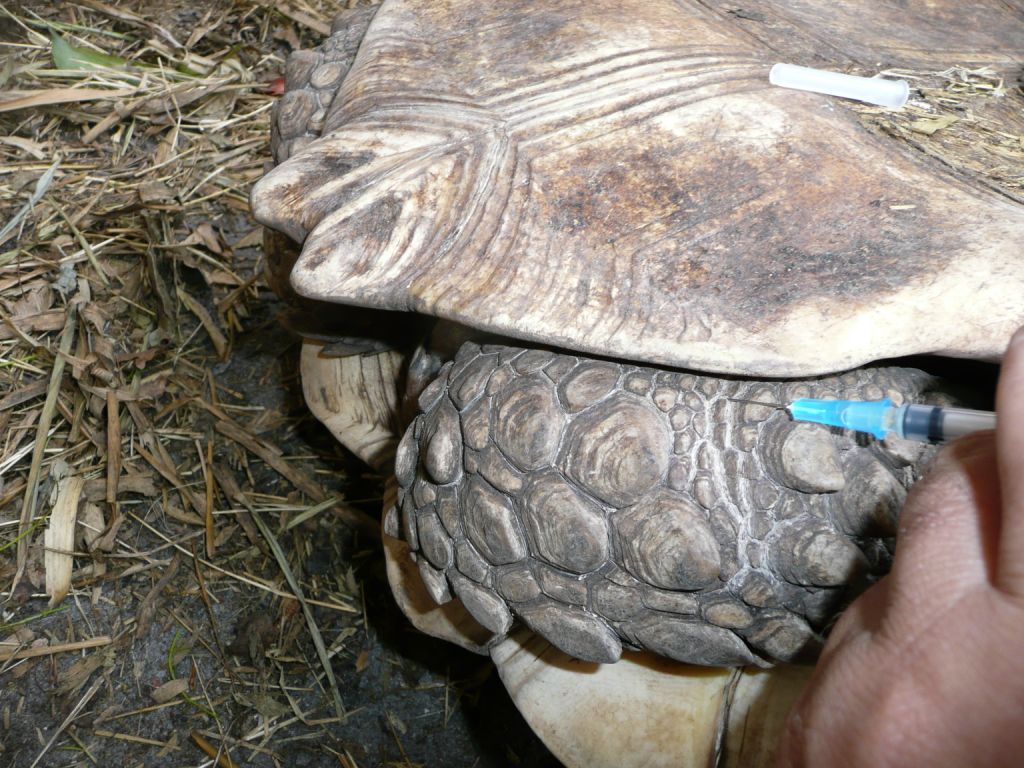
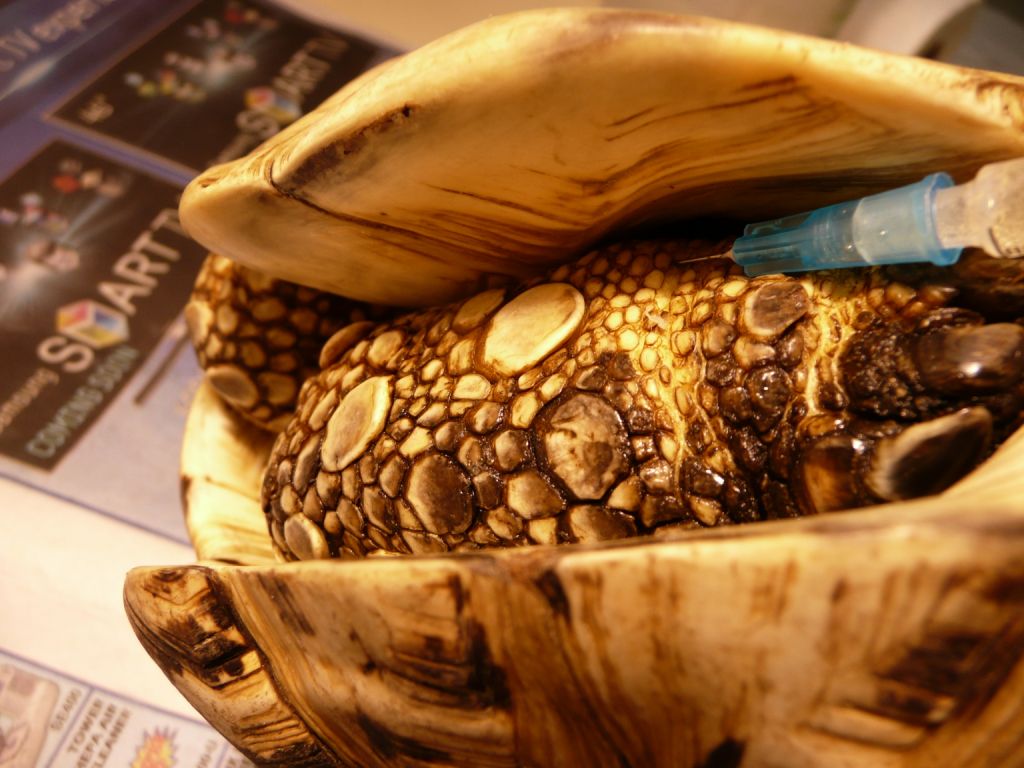
Several people have asked me, “How do you give a large tortoise an injection?" If you have a large tortoise that is still fairly strong it can be a daunting task to pull out his leg in order to get to the inside leg to find the deep muscle.

I have made two examples: the first three pictures show injecting sites for a Leopard Tortoise, which is 4kg. (Just about 9 pounds)
The last two pictures are of a 60 pound spur tortoise. The concept discussed here holds true for all large tortoises, all the way up to our 600 pound Galapagos.
In this procedure it is actually better to force the leg in rather then try to pull it out. This gives you a lot more control over the injection; the last thing you want is a tortoise with a needle in his flailing leg.

The injection site is at the bottom part of the leg. (the part of the leg that is closest to the ground) The top part of the leg has less muscle and more bones, so you want to avoid that area. Flip the tortoise over and locate the bottom part of the leg that is close to the wrist. Now if you probe along the area with your finger or another device such as a pen you can actually feel the soft muscle.

You need to feel the muscle first so that you have an idea of where you are going to inject. As you travel up the leg towards the body or towards the top of the leg, you will notice that you can’t detect that soft muscle. You will also notice the scales get much smaller when you are close to the injection area. Stay away from the large spurs or scales. Another important part of this procedure is to use the appropriate needle size; if the needle is too long than that is not good and neither is it being too short. Your vet will supply you with the proper needle size.

Important: please note in the pictures how I am holding the syringe in such a manner that even if the animal were to pull his leg in, the shell would not hit the needle or the syringe. The needle is somewhat parallel to the bottom of the tortoises shell. Never inject perpendicular to the bottom of the shell. The idea is that if the tortoise pulls in that leg he will bend (and could even break) the needle in his arm.

Clean the injection site, use alcohol and scrub the area. Many times I first have to use a scrub brush with soap and water and then scrub again with alcohol. After you have selected your injection site and the needle is in, before delivering the drug gently pull back on the syringe and check to see if you can see blood coming in the tip of the syringe. If you see blood you have hit a vein or artery and you will need to select another location typical I move to the other leg.

As you are delivering the drug with a slow and even push be prepared to let the syringe go if the tortoise suddenly moves his leg. You don’t want to be jamming or bending that needle in his arm, it is better to just let it go.

Remember this procedure is to actually force the leg into the shell as this helps to immobilize the leg. As always, be careful for the tortoise may have different ideas. After you have selected your injection site direct the needle into the deeper muscle, you don’t want to be too close to the surface of the skin as you’re trying to get the drug into the muscle. Make sure that you’re not close to the edge of the leg so that you go right through the leg.

Summary
•Flip the tortoise over.
•Force the leg in.
•Probe the injection site first until you detect the soft muscle.
•Alcohol scrub the site.
•Inject on the bottom or underside of the leg.
•Inject around the small scales and stay away from the large scales.
•Pull back to check for blood.
•Guide the needle towards the deeper muscle.
•Hold pressure on the site for a minute so that the drug doesn’t leak out of the puncture wound.
•Alternate legs when you are injecting. Don’t keep injecting the same site in the same leg day after day. Move from left to right.
•Keep records; the drug, the dose and the site.

Date: March, 07 2011
Sam Pascucci
Giving a large tortoise a shot


drsam Mar 07, 2011 08:13 PM

Sorry I haven’t figured out how to add multiple pictures to the same post.
For the compete description and additional pictures you can go to my web site at this link.
http://www.floridaiguana.com/pics/Medical/P1030951.JPG

Sam Pascucci
Link to how to give a Tortoise a Shot

ShadyLady Mar 08, 2011 06:57 PM

That is so much easier! Maybe Donald is too fat, but there is very little non-spurred meat visible. Hope I didn't just shoot it through the top of the skin LOL! We were told to give the shot higher up on his leg. We'll see how we do in three days when he's due for his next shot.

Thanks a million zillion Sam! This is one of the great benefits of these forums!
-----
----------------------------------------------------------
Amy Claiborne

Don't let them take your wasted time. J.T.

drsam Mar 08, 2011 07:28 PM

That’s great way to go Shady Lady.
If your injecting Fortaz the dose on an 8 pond tortoise should be .26 ML
Your fine in that spot.
What you have to worry about is injecting large volumes of the antibiotic Baytril which can destroy cell structure (necrotic to skin and muscle).
So always be careful of what drug you are injecting where.
Always follow your Vets instructions.

Remember to alternate the legs that means its going to be 6 days before you back to that leg.
The more you do it the better you’ll get. Just try to get the needle in the deepest part of the muscle as possible.
Use the Probe to find the best spots.

I hope the instructions and pictures were clear.

Sam Pascucci

herpervet Jul 25, 2011 10:49 PM

Just to add to the great discussion. For Aldabra's a really nice trick is to take a water hose to them and they will stand up and freeze there as long as you spray them and for quite a while after. Some will do this if you scratch them on the neck. Others are shy and do not appreciate the attention.

You can draw blood from the brachial vein (crook of front leg) while they stand without any restraint at all and inject meds as well. This works with my teen age pair very nicely.

Elliot Jacobson told me he will hand feed a bannana to large tortoises (aldabras/galapagos) and slip a butterfly catheter into the jugular vein while their neck is extended to get blood.

The bottom line is that if you can get away with minimal to no restraint it is way better for everyone the tortoise esp. Otherwise you are left with a rodeo and using ropes to hold the front legs out of a 600 pound galap is a major undertaking.

I concur with Sam's comments on Baytril. I have seen sloughed skin from injections in the region he describes. Personally I really try to avoid that drug in tortoises if I can. Some will have odd reactions as well (vomiting esp. red foots in my experience)

Pete Koplos DVM

Site Tools