Reptile & Amphibian Forums

Welcome to kingsnake.com's message board system. Here you may share and discuss information with others about your favorite reptile and amphibian related topics such as care and feeding, caging requirements, permits and licenses, and more. Launched in 1997, the kingsnake.com message board system is one of the oldest and largest systems on the internet.

Click here to visit Classifieds
Click for ZooMed
Click here for Dragon Serpents

Incubating, water dripping on eggs

moreliascom May 03, 2011 02:06 PM

Hi,

Iv had 2 clucthes of python eggs go partialy bad.
I didnt candle theme, and one started to go bad a week before the other. And now there is only 30% left of both clucthes.

This is what Im afraid has happend, water drops from consendation killing theme.

For some reason Iv had alot more consendation on the lid this year than ever before.

I use the no substrat egg crate method with wet perlite and another with wetsponges below(a experiment).

Both works, 100% humidity etc.

But there is the problem of condensation, what do you guys do to stop condensation forming or to soak it up without having to take of the lids on a daily basis wiping it dry?

Also is waterdrops detrimental to python eggs in it self, Iv heard both to be hounest. And Iv seen diamond python eggs with water dripping on theme that still all hatched.

I once did Maternal incubation and that female urinated on here eggs etc so I do not think 1 drop of water would kill theme.

If anyone has some points Iv posted they could clear up or tell me something I didnt know, Id be very happy for any help.

Thanks
BÃ¥rd

Replies (11)

Tom Keogan May 03, 2011 05:02 PM

Bard, Yes excess moisture can kill some python eggs! There are many questions to ask you about your whole incubator setup before we try and fix your moisture problem. Size and type of incubator?, heat source and where is it placed?, do you have fans?, what are your temps in and out of the egg container?, what size egg box? how many eggs and what type of eggs are they? do you have holes in the egg box? what stage in incubation are the eggs? Are the eggs fertile? Maybe some pictures would help.

But to fix your moisture dripping issue tilt the egg container so the water runs off and does not drip onto the eggs.

What you really need to do is figure out why your getting so much condensation on the inside of the container. It sounds like you have a temperature and humidity difference between your incubator and your egg container. I personally like to keep the incubator humidity high so there is not much of a difference between the egg box and the incubator.

Good luck.

Tom Keogan May 03, 2011 08:27 PM

Bard, here is a good website to see how RH and Temperature can cause issues with condensation/dewpoint.

http://einstein.atmos.colostate.edu/~mcnoldy/Humidity.html

Kelly_Haller May 03, 2011 07:33 PM

A lot will depend on the species of python you are dealing with. For wet tropical climate python species, water dripping on the eggs will have absolutely no detrimental effect on the eggs. This would only be a possible issue with more sub-tropical or drier climate species depending on the actual amount of water involved. I have seen the eggs of wet tropical species hatch even when setting in a few millimeters of water, although that would not be recommended as standard procedure. I use mainly maternal incubation with wet tropical climate species and routinely spray water across the backs of the incubating females every few days. It is obvious in their natural environment that these females would be exposed to frequent rainfall events.

As far as correcting the moisture build up under the lid, angling the container as Tom suggested would work to eliminate most of the dripping problem. With regards to the reasons behind the build up of condensation, this has nothing to do with actual temperature, but everything to do with temperature differential. The humidity difference between the exterior of the egg container and the interior will not case this problem, and would only be a very minor part of the issue only if both were near 100%. However, if you are having a fair temperature differential between the exterior and interior of the egg container, then you will have significant condensation at interior humidity levels nearing 100%. The main cause of the excess build up of condensation you are seeing however, is most likely the evaporative surface you are using within this incubation system. If overly wet, the perlite, and most definitely the sponges, will have a significantly large evaporative surface and wick large amounts of water vapor into the interior air beyond the saturation point. If the exterior temperature of the container is even slightly below that of the super saturated interior air, you will then start to see significant condensation development on the interior of the container, the amount increasing with an increasing differential. To help resolve the condensation issue, either increase ventilation very slightly, use less water in the perlite, equalize the interior and exterior temps, or remove the sponges and let the water evaporate directly from the water surface. Evaporation from the water surface alone is the least efficient evaporative process due to the surface tension and will help avoid super saturation of the interior air. Either way, you will obviously need to monitor the interior humidity to make sure it doesn’t fall too low.

Tom also had two other questions that were important. At what day in the incubation period were these eggs first noticed to be going bad, and were they checked for embryos? I know this is not always possible to determine, but if embryos were found, were they well formed and symmetrical, or did they show possible deformities?

Kelly

MoreliasCom May 04, 2011 01:03 PM

Kelly And Tom,

First I want to thank you both for taking your time to respond to my post. Your answears where very helpfull.

What I use is a small fridge(48" tall) converted into a incubator.

I have a 40 watt heatmat taped to the back with 1 Computerfan situated 1,5" inche bellow the roof on the back wall 1,5" above the heatmat. Iv used the large mat to have it go from bottom to top to uniformly heat the unit.

The probe is placed on the mid level of the fridge.

Both clucthes of eggs where from carpet pythons.
One clucth was 9 smaller eggs the other was 10 1 slug normal sized carpet eggs.

The incubation boxes are about 1G and 2.5G and is what Iv used before with good resulst. Only change is that these have a rubberlip sealing the box, the previous boxes did not have that seal. Maybe that answeard my own question with regards to why I have a humidity buildup larger than before..

This is the larger one, love it:
http://www.ikea.com/us/en/catalog/products/40131909
perfect with premade hole
http://www.ikea.com/us/en/images/products/ikea--food-saver-white__0116911_PE215932_S4.JPG
(sad thing is the storage of this modell burnt down, so impossible to find now)

I did not candle the eggs as Iv just been swamped with school and exam preps. Im realy in grief about that now.
So I do not know if there was any veins or live embryo in theme previously.
Both clucthes started to go bad around day 15.

Iv bougth some larger 4 gallon boxes Ill use for the next clucthes I have comming. witch from the looks of the females has to be in the 35 range.

With these boxes Ill pop a list of plexi into one side and situate a sheet of glass so its tilted. making the water run of into the side.

Kelly, is super saturation of the box air a bad thing if it is impossible for water to drip on the eggs?

Iv candled the remaining eggs and they are viable and there is a dark area I presume is the embryo.

Il open the bad eggs up tomorrow to see what is in theme.

Thanks again.

BÃ¥rd

Tom Keogan May 05, 2011 07:01 PM

Bard, you have not mentioned if you have containers of water or what your RH is in the incubator out of the egg box. I personally would put holes in the egg container if you have high humidity in the incubator. If you don't I would put the egg container with holes in it in a larger container to stop the condensation issue. I also would not use a lid that is so tight fitting unless I was using a really large container. I use sterilite containers that have loose fitting lids and still normally put holes in my egg boxes since I keep a incubator with high relative humidity. Good luck with the remaining eggs!

MoreliasCom May 12, 2011 01:49 PM

Hi,

Sorry for late reply but got down with bad fever and nasties, and has been shut down for the last few days.

I have no water in the incubator, just heattape and probe.

Iv reduced the water content in the box, squesed the perlite and that seems to work.

Clucth # 1 with alot of infertiles is all gone.

Clucth # 2 3 eggs remain and those look good, its a blow. But those 3 will probe the project anyhow. So Im happy with that.

I expected a new clucth and picked it out yeasterday, 14 eggs and 1 slug.
I put this in a 3,5g incubation box with less sponges on grid and its looks good.

1 day in, there is humidity on the walls and lid of the box but nothing near drops. Witch is what Iv usualy had.

Candled these eggs: 12 with good veins and 2 with week, so not shure if those 2 will be anything.

MoreliasCom May 05, 2011 08:02 AM

So got my gloves on and cut the eggs, what a repulsive smell.

First clutch was 1 with 1 embryo, 1 with twins, the other 5 just yolk. 1 good egg left and 1 hopefull.

The second was 5 ebryo, 1 twin 1 slug. 3 good left.

So a total of 5 eggs to go.

Removed the sponges, and squeased the water out of the perlite.
Put the eggs back in on a grid with wet perlite below.
Tomorrow Ill check on theme again.

Kelly_Haller May 06, 2011 01:14 AM

That's a fair number of fertile eggs to be dying out of a clutch this small. What is your temp when measured at the surface of the egg, and if not, what are your current temps and where are the tips of the measuring devices. Have your temp measurement instruments been calibrated or checked. I only ask because some of these have been found to be faulty or out of calibration.

Full air saturation is not a bad thing as long as the eggs aren't setting on an overly wet substrate. The ambient air humidity in the cages of my maternally incubating pythons holds between 90% and 95% during the entire incubation period. This would put the intra-coil humidity somewhere between 95% and 100%. If your box interior temp can be kept close to the temps of the egg container, you will not see the large degree of condensation. Also, as Tom mentioned, a very slight amount of ventilation will help as well, as it seems your egg containers appear very tight. Cutting back on the moisture of your substrates as you did will also help.

Kelly

MoreliasCom May 12, 2011 02:00 PM

Kelly,

Sorry for late reply, but first work over the weekend and then Iv been sick since monday.

I have a dualprobe thermometer inside, on top and bottom shelv.
And I use a tempgun a few times a week to triple check.

Ill stop using the rubberlidd type and get back to the loose fitting curver brand boxes Iv used before.

As I wrote in the post to Tom, Iv put 14 new eggs in the incubator.
These I have candled 12 good 2 with litle veins.

But the box setup seems to be good. 4 sponges in 1" of water, eggs elevated 1" above the sponges on a grid.
There is humidity on the walls but nothing forming drops, so I think this clutch will be good too go as this is set up.

I want to thank you alot for helping me out with my questions!

BÃ¥rd

Kelly_Haller May 13, 2011 05:17 PM

Sure sounds much better, and good luck with them. Thanks,

Kelly

illbeyoursoldier Jun 15, 2011 08:51 AM

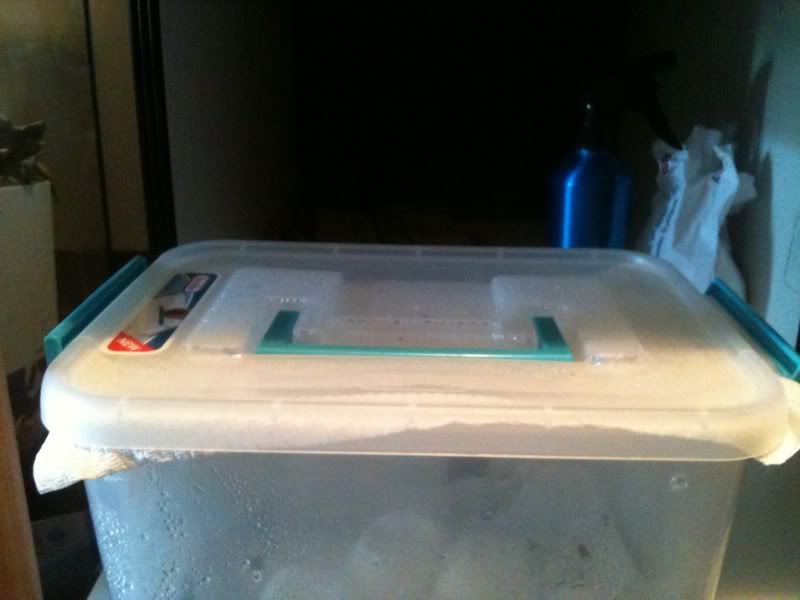
I keep a paper towel in the lid of the egg box. Just lay it across the top of the open bin, and close the lid over it. This works like a charm for me, without fail. I do this will all my eggs bins, as a precaution. I don't really have a problem with condensation dripping on it's own, but when you open the lid and the movement makes it all slide together and drips off... *grrr*

This is a simple and easy, solution.


-----
Cheers!
• Chelsea Lynn Gardiner
(and Frank M. Wood)

Site Tools