Reptile & Amphibian Forums

Welcome to kingsnake.com's message board system. Here you may share and discuss information with others about your favorite reptile and amphibian related topics such as care and feeding, caging requirements, permits and licenses, and more. Launched in 1997, the kingsnake.com message board system is one of the oldest and largest systems on the internet.

Click for 65% off Shipping with Reptiles 2 You
https://www.crepnw.com/
Click for 65% off Shipping with Reptiles 2 You

Albinism in Kenyan Sand Boas

sstephenson May 09, 2011 01:36 AM

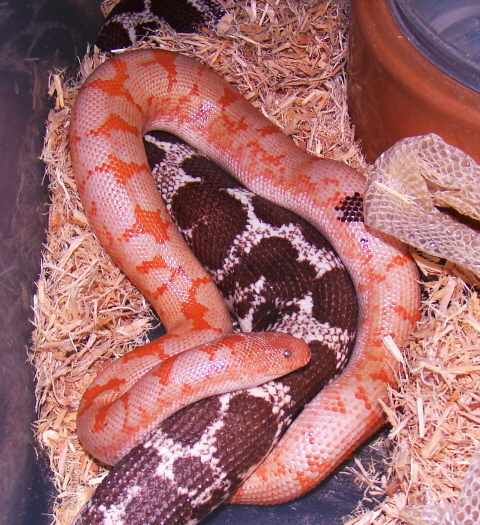
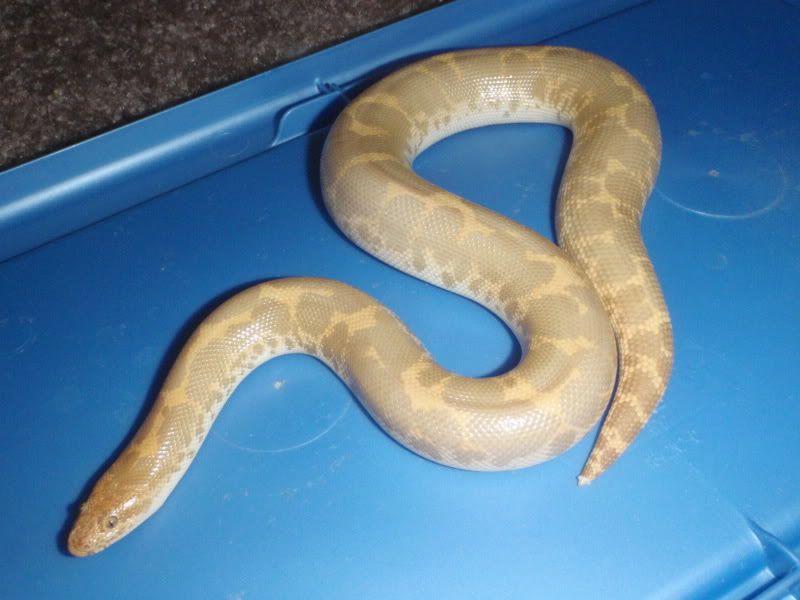
I have a question regarding the genetic recessive trait for albinism in Kenyan Sand Boas. Based on the photos that I've seen of albino Kenyans, there appears to be a least two distinctly different looking albino phenotypes. I would describe the first as having bright yellow color with nearly fluorescent looking orange markings. The second has saddles that I would describe as a light lavender or purplish color with orange or peach colored markings. Are these animals genetically compatible? In other words, if you paired Type 1 with Type 2, would you get albino offspring?

I've read that albinism in rosy boas is not necessarily compatible. For example, if you breed an albino Whitewater rosy boa and a Limburg albino rosy boa, you will not produce albino offspring. Just wondering how it works with Kenyans. Thanks.
Replies (6)

CBH May 09, 2011 12:39 PM

From my limited experience with both variations, I would say, 'yes', they are compatible. 'Normal' kenyan sand boas are quite variable and I believe it is that variation in combination with the amelanistic gene that produces the differences in albinos you mentioned. It may be possible (starting to see some evidence) that the different variants can be selectively bred for via 'line-breeding'. Maybe someone with a little more experience with both types of albinos will chime in.....?

It is worth mentioning that there is a breeder (who will hopefully chime in) that has 'hypo' or possibly 'T-plus albino' kenyan sand boas that are likely not compatible, but appear to be inherited as a simple recessive trait.

Photo of one of my 'caremal' albinos (produced from a 'normal' albino X light albino het snow)

Cheers,
-Chris
-----
Christopher E. Smith
Contact
Captive Bred Herps
Wildlife Research & Consulting Services, LLC

sstephenson May 09, 2011 11:18 PM

Thanks for your reply Chris. That's what I figured since I hadn't read anything about the variants not being compatible, but I'm learning new things about KSBs all the time.

I would like to hear more about the 'hypo' or 'T-plus albino' kenyans. I'm not familiar with them at all.

CBH May 10, 2011 12:05 PM

Here is a link to a thread about the hypo-

forums.kingsnake.com/view.php?id=1735943,1735943

-Chris
-----
Christopher E. Smith
Contact
Captive Bred Herps
Wildlife Research & Consulting Services, LLC

StevePerry May 11, 2011 12:24 PM

I would say Chris is correct in his statements. Most looks are coming from the variation of the het that produce them and are being line bred.
here are a few examples of mine.
(sorry I don't have pics of all of them)

this male is now light orange on an almost 2 tone green/grey background

orange on cream(Paradox)

kind of a pastel orange on Green

orange on cream with nearly all scales tipped in orange(paradox)

T-poss Albino???

-----
Steve Perry
North Idaho.

sstephenson May 11, 2011 12:52 PM

Thanks Chris and Steve. That does makes sense.

Here's another related question: Based on my very limited experience, it seems to me that the genotype that carries both the albino and paradox traits are most often (if not always) the lavender colored phenotype. Am I wrong about this? I don't remember seeing a bright yellow/orange paradox albino.

StevePerry May 11, 2011 01:26 PM

I would say yes, but not all paradox albinos have this lavender color to them and the ones I've raised up do not keep the same coloration.
-----
Steve Perry
North Idaho.

Site Tools