Reptile & Amphibian Forums

Welcome to kingsnake.com's message board system. Here you may share and discuss information with others about your favorite reptile and amphibian related topics such as care and feeding, caging requirements, permits and licenses, and more. Launched in 1997, the kingsnake.com message board system is one of the oldest and largest systems on the internet.

Click here for Dragon Serpents
Click for ZooMed
Click for 65% off Shipping with Reptiles 2 You

Head shape diffs - East African sandboas

markg May 09, 2011 03:23 PM

Have you breeders of "Kenyans" noticed a slight difference in head shape or size among your breeders? For example, lightly wider snouts on some, slightly pointed on others?

Was looking at pics of a few collections, and it seemed evident in the pics. But pics can be deceiving so I ask here.
-----
Mark

Replies (8)

CBH May 09, 2011 09:37 PM

I have noticed differences in head size, growth rate, over-all size between 'kenyans' and 'rufescens'. The latter typically being a bit smaller.

-Chris
-----
Christopher E. Smith
Contact
Captive Bred Herps
Wildlife Research & Consulting Services, LLC

SandBoaMorphs May 10, 2011 10:08 AM

I've noticed snout size differs quite a bit. Some are short from eyes to tip of nose, some are more elongated, there is definitely differences. Rufescens for instance tend to have a shorter eye to end of nose snout than regular Kenyans.
-----
Mark Huntley
Sand Boa Morphs

Sand Boa's
3.2 Rufescens
6.7 Albinos
0.1 Hypo Albino
2.1 Dodoma
1.1 Nuclear
1.0 Nuclear Meltdown
2.6 Flame
10.22 Normals including hets
7.16 Anery
5.7 Snow
2.2 Yellow Snow
0.1 Splash Albino
1.0 Splash Anery
1.0 Orange Stripe Het Anery
1.0 High Orange Stripe
1.3 High Orange Tiger
4.5 High Orange
1.3 Snow Paradoxes
3.4 Albino Paradoxes
1.1 Javelin Sand Boas
1.2 Indian Sunsets F2-F3

Western Hognose
0.4 Regulars
1.2 Green Phase
2.2 Extreme Red het Albino

2.1 Boston Terriers
0.2 Sooners
1.3 Rhode Island Reds
0.3 Barred Rocks
0.2 Range Hens
0.1 Favorite Wives
1.1 On the fence in-laws
2.1 Rug Rats

CHECK OUT MY NEW KENYAN SAND BOA BLOG
http://sandboamorphs.blogspot.com/

WWW.SANDBOAMORPHS.COM

chrish May 11, 2011 09:11 AM

I have noticed that captive raised animals tend to have smaller heads relative to their bodies than wild caught adults.

This is the same thing you see in many captive born snakes. I suspect it has to do with the excess caloric intake of captive snakes affecting their relative growth rates. It is really obvious in ratsnakes.
-----
Chris Harrison
San Antonio, Texas

chrish May 11, 2011 09:12 AM

I might add that another species that this is very obvious is Eryx conicus. You rarely see the big blocky heads of wild-caught snakes on captive raised animals.
-----
Chris Harrison
San Antonio, Texas

markg May 11, 2011 02:52 PM

Do the heads ever "catch up" so to speak on the captive animals you speak of?
-----
Mark

chrish May 12, 2011 09:38 AM

>>Do the heads ever "catch up" so to speak on the captive animals you speak of?
>>-----
>>Mark

I don't know, but I suspect not. My thinking is that, just like with humans, head development and cranial ossification occurs early in life. This has sometimes been called pin-head syndrome in captive snakes.

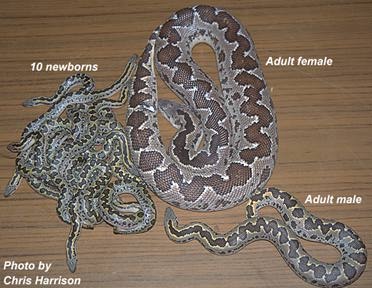
Take a look at this small photo if you can see it. This was a clutch produced by a large wild-caught female and a captive male. Look at the relative size of the head of the male. Yes, he is several years (at least) younger than her, but his head looks sort of 'normal' for a captive conicus.
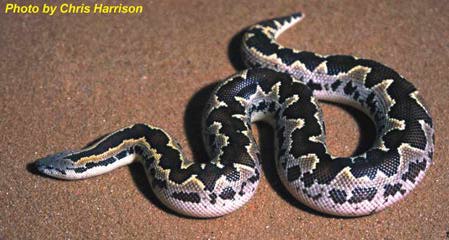
Heres a smaller captive born female as well. Notice that her head is relatively narrow. I had her 10 years, and it she kept this overall morphology the whole time.
(I guess I need to rescan these slides since I scanned them about 15 years ago. Back then 450 pixels wide filled half you screen and took forever to download! )
-----
Chris Harrison
San Antonio, Texas

markg May 12, 2011 01:50 PM

>>>>Do the heads ever "catch up" so to speak on the captive animals you speak of?
>>>>-----
>>>>Mark
>>
>>I don't know, but I suspect not. My thinking is that, just like with humans, head development and cranial ossification occurs early in life. This has sometimes been called pin-head syndrome in captive snakes.
>>
>>Take a look at this small photo if you can see it. This was a clutch produced by a large wild-caught female and a captive male. Look at the relative size of the head of the male. Yes, he is several years (at least) younger than her, but his head looks sort of 'normal' for a captive conicus.
>>
>>
>>
>>Heres a smaller captive born female as well. Notice that her head is relatively narrow. I had her 10 years, and it she kept this overall morphology the whole time.
>>
>>
>>
>>(I guess I need to rescan these slides since I scanned them about 15 years ago. Back then 450 pixels wide filled half you screen and took forever to download! )
>>-----
>>Chris Harrison
>>San Antonio, Texas
-----
Mark

markg May 11, 2011 02:54 PM

Two of the pics of the Kenyans I saw with large heads were both wild-caught animals.
-----
Mark

Site Tools

