

Reptile & Amphibian Forums

Welcome to kingsnake.com's message board system. Here you may share and discuss information with others about your favorite reptile and amphibian related topics such as care and feeding, caging requirements, permits and licenses, and more. Launched in 1997, the kingsnake.com message board system is one of the oldest and largest systems on the internet.

Click for 65% off Shipping with Reptiles 2 You
Click here for Dragon Serpents

Rubber worms!

ALT Jun 26, 2011 02:40 PM

How can you not love rubber worms?

I tracked down a pair of these in 2008 after wanting them for ages. They were purchased as 1.1. I keep going back and forth on whether I believe it or not. I'm usually trusting of breeders who have worked with a species I haven't, but I have a bad track record of ending up with 2 males. For a long time, these guys looked the same to me; spurs, growth rate, proportions etc. Today I noticed the difference, but I haven’t seen enough of these guys to be totally confident that it is sexual dimorphism and not just individual variation.

On to the pictures.
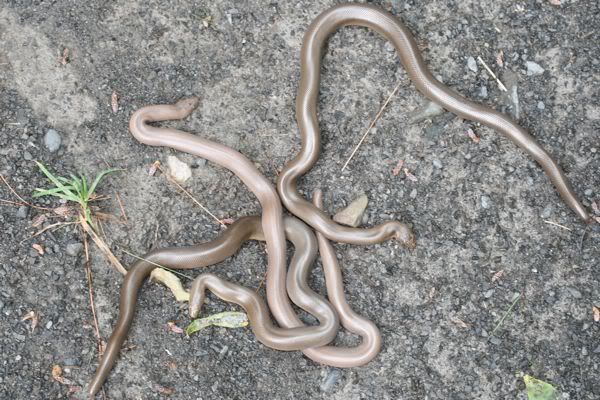

The pile. Two 2008s and a 2010 female (lightest one) who was a random lucky score at a Hamburg, PA show last October. She has a crazy feeding response and didn’t skip a meal over the winter! She even struck at me once! The 08s pretty reliably shut down from about September to about January.
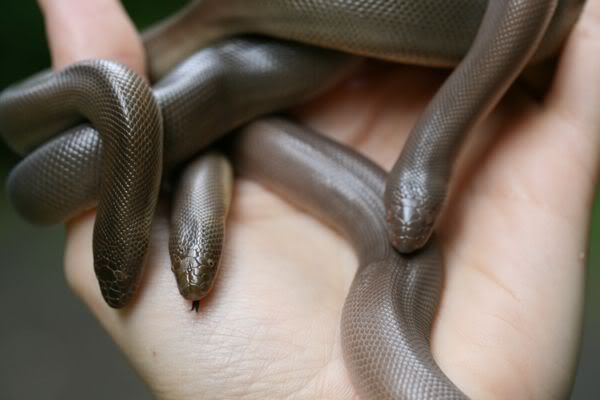

Handful.
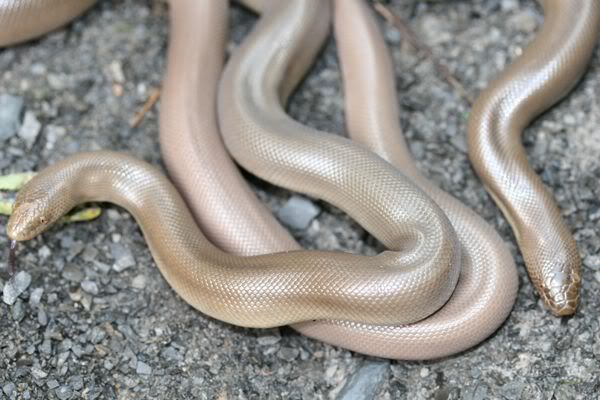

2008s. I love how dark they are getting.


2010 female on a log.
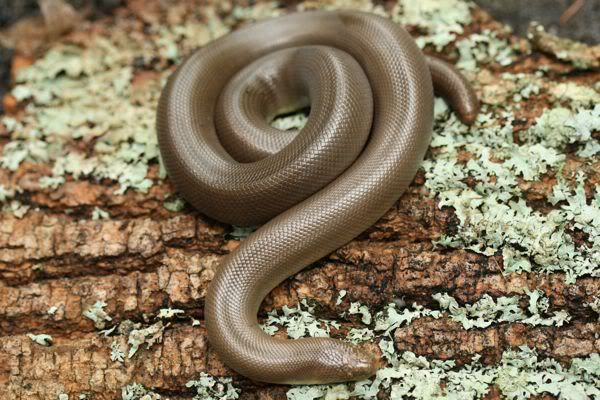

2008 male on a log.
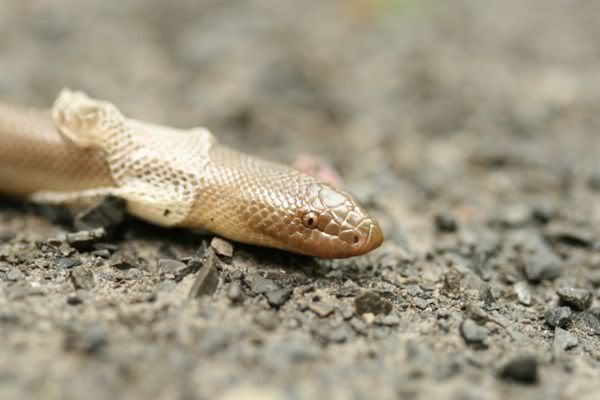

The 2008 “female” started shedding while I was messing around with the camera and wouldn't sit still or pose nicely on the log for me.

Here’s the butt shot part:
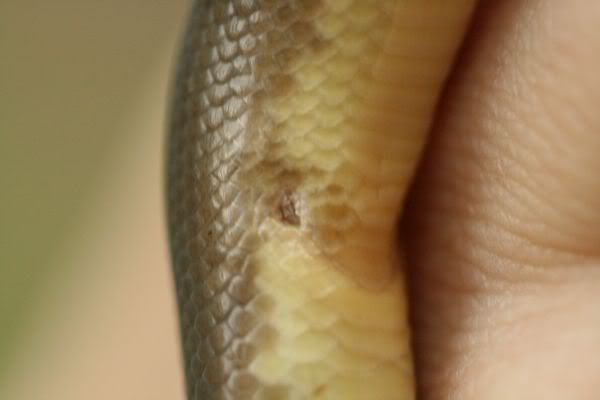

2008 male spur.
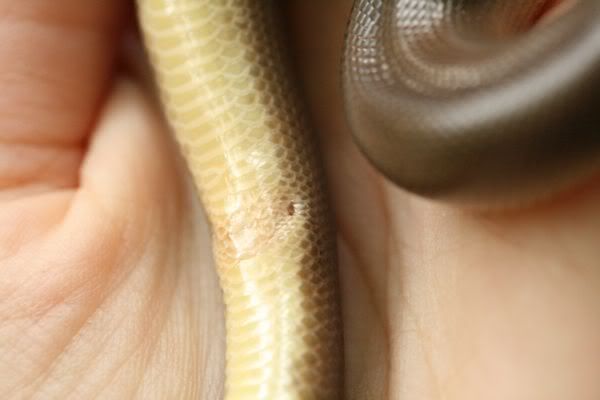

2008 female? Smaller spurs than the male, but much more noticeable than the 2010.
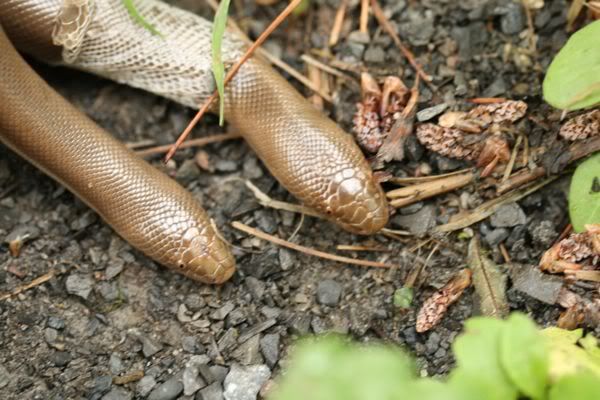

08s head comparison.
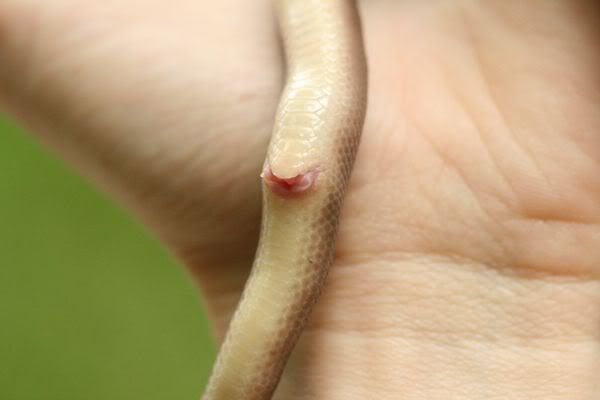

2010 female vent/spur. She’s a little turd, always peeing and musking on me when handled.

So what do you folks think? Do I have 1.2, or 2.1?

Replies (6)

StevePerry Jun 26, 2011 11:19 PM

2.1
-----
Steve Perry
North Idaho.

grnpyro Jun 29, 2011 09:38 PM

So, Based on the experiences I have had with wild ones that I have caught or seen in the southern bay area near San Mateo county. (including babies that were only a few inches long.)
All of the males I see have hook shaped spurs. Like the one that you claim male in the picture, It is definatley male. The one in the second picture is at a weird angle and can possibly be a male also, If you can send a pic of it with the same angle as that male I can say for sure. (Females have a more cone shaped smaller spur)

Color of spur is a variation that can even happen within the same locality. Shape and size is the key, even in the smaller southern rubber boas that I have seen in the san bernardino mountains. I will take a picture of my male and female today or tomorrow morning and post them. 2 males and 1 female is my guess also.

ALT Jun 30, 2011 09:55 AM

Thanks for the responses. Yeah, two 08 males is what I've been fairly certain on, but one can hope right? Actually, with these guys it doesn't really bother me too much aside from the fact that it seems to be about the billionth time I've purchased a "pair" of something only to have it come up two males. Serves me right for being trusting and getting into less commonly worked with, harder to sex species. Breeding them some day will be nice since they're not that easy to find as captive bred, however my main reason for getting them was to use for teaching and outreach. It's nice to have native US species, and animals that aren't much drama with regards to temperament and transport temperature. I call them (and my hognoses) "gateway snakes". They're small, docile, slow moving, and cute...great to get people previously afraid of snakes to give them a chance. After falling in love with the rubber boas, it isn't too hard to get them to handle the bigger "scarier" species. Besides, rubbers are so interesting with regards to ecology and evolutionary lineage.

grnpyro Jun 30, 2011 11:46 PM

Yea, they definitely are a cool species, I own an adult pair and had 4 babies last year. The babies took fooooorrreeeevvveeerrr to eat. I may try lizards this next time around to see if there is any chance that there is a preference for lizards when they are young??
Do all of yours eat well?? My current female eats from early spring to late fall and eats 3 small fuzzies every 3-5 days unless in shed.

RichardFHoyer Jul 01, 2011 12:01 AM

ALT:
Actually, the Rubber Boa along with the Rosy Boa, are probably the two easiest species in N. America to identify to sex. Both species have spurs and if you know what to look for, adult Rubber Boas can be identified as male or female as fast as you can handle them. Only the small subadults and juveniles pose a problem where magnification may be needed to detect the presence or absence of spurs.

In most populations of the Rubber Boa I have examined, the spurs of most females are hidden behind scales or if present are exceedingly small in relation to overall body size. Male spurs are far more prominent and are larger in relation to body size. But of course, all of that take experience with handling the species so it is understandable that those not very familiar with the species can become mistaken. And as mentioned, the shape of female spurs (when visible and not hidden) are different from those of males. But to detect that difference, most individuals would need the use of a hand lens

The one region in which male spurs may be somewhat more difficult to detect are the populations of the species throughout S. Calif. in which the spurs of almost all males lack pigmentation and are clear or translucent similar to those of juveniles. However,in the vast majority of boa populations, male spurs are pigmented from tan to dark brown or even black and thus much easier to observe.

As for the species evolutionary lineage, a second mtDNA study was completed as a master thesis project about two years ago. The grad student who complete that project earlier this month had his thesis accepted by his committee. So the next step will be for his thesis to be transformed into a publishable draft and submitted to a herp journal.

For you or others that may know something about Rubber Boa taxonomy, the first mtDNA study of the species was published in 2001 and urged recognition of the subspecies Charina bottae umbratica be elevated to species level distinction, that is Charina umbratica or Southern Rubber Boa found only in the San Bernardino and San Jacinto Mts. of S. Calif.

To me, the adoption of the separate species scenario was premature as there was evidence at the time that the SRB was not all that unique with respect to the morphological traits that were suppose to define the SRB from all other boa populations. In addition, the most recent mtDNA study shows that the population of the Rubber Boa that inhabits the extreme southern end of the Sierra Nevada Mts., the Southern Kern Plateau, aligns with the Southern Clade or Southern Rubber Boa and not with the Northern Clade or Northern Rubber Boa. This revelation pretty much shoots down the separate species scenario and also may force a re-evaluation of the subspecies arrangement in Charina bottae as well.

Richard F. Hoyer

ALT Jul 01, 2011 10:02 AM

Thank you for the detailed response, Richard. I'll keep an eye out for new phylogeography papers. While I haven't really dug into the rubber boa literature, I'll agree with you on the opinion that the taxonomy stuff was premature. MtDNA studies are great for investigating intraspecific biogeographic patterns, you need good nuclear marker sampling and great range-wide geographic sampling as well before you can make any reliable statements regarding taxonomy. It was far too common in the past for studies to run off renaming/revising species and subspecies before obtaining robust enough sampling to know whether morphological variation was a gradient across the range or true fixed differences between populations. The field has come a long way in the last decade in understanding the pitfalls of interpreting a gene tree as a species tree as well. Good to hear someone is out there trying to sort things out with the rubber boas.

Grnpyro- congrats on the breeding! I don't worry at all about the regularity of my boas eating. They eat for a while, then they don't, then they do.... It's normal for the species. As long as they're in good body condition and their temperatures are appropriate I'm happy with letting them do what they want. Never had a problem feeding captive bred babies mice (granted my sample size is small!), but newborns may want to hibernate before taking a first meal. If I were you, I'd just cool the babies and try live pinkies in the spring if they're being stubborn. Lizards aren't worth the hassle and potential parasites. I breed western hognose and keep coachwhips too, and never feed non-rodent prey...even if it means force-feeding (not recommended unless you really know what you're doing) until they get the point. They always come around, although those blasted coachies will not switch over to frozen-thawed yet! Grrr. I hate dealing with live rodents.

Cheers folks!
-Amanda

Site Tools
