Does anyone have knowledge of the maximum length of the smallest species of sand boa or boas?
Richard F. Hoyer
Welcome to kingsnake.com's message board system. Here you may share and discuss information with others about your favorite reptile and amphibian related topics such as care and feeding, caging requirements, permits and licenses, and more. Launched in 1997, the kingsnake.com message board system is one of the oldest and largest systems on the internet.



Does anyone have knowledge of the maximum length of the smallest species of sand boa or boas?
Richard F. Hoyer
The smallest species would be Eryx jayakari and maybe Eryx elegans. From what records I have seen neither species exceeds 40cm. Of course, I assume that means female maxima because I suspect they would be the larger gender as they are in most Erycines (they are in jayakari).
There aren't many/any? elegans in captivity, but there are quite a few jayakari in captivity, so maybe someone has a large female?
I'm not sure how big Eryx somalicus gets since there have only been a few specimens found and some of those have been noted to be juveniles.
I don't remember what the newest taxon of Eryx that was described recently was called (Eryx sorri or something like that), but it just looked like like Eryx somalicus from what I saw.
-----
Chris Harrison
San Antonio, Texas
CH:
Thanks for the input. Forty cm is about 15 3/4 inches and much smaller than I thought would be the case with species of Sand Boas.
I was curious because during the last number of years, I have been gathering information on a dwarf form of the Rubber Boa that occurs from the S. Kern Plateau and southern Greenhorn Mts. on south in S. Calif. The largest members of that dwarf morph (females), are a shade over 22 inches or about 56 cm.
Thanks again. Richard F. Hoyer
The longest recorded length for E. jayakari that I am aware of is for a female from northeastern Saudi Arabia that measured 54.5 cm. Lengths of large females in the 40 to 45 cm range are not overly uncommon and there have been several found in the 45 to 50 cm range in Saudi Arabia and Kuwait.
Kelly
Interesting thread!
The smallest species of sand boa I kept is Eryx miliaris. My reproductively mature males (proven) are about 30 grams and 30 cm. My adult females are about 225g and 58 cm. These are relatively young snakes though ~ 5 years old.
** Photos from cellphone**
Males-
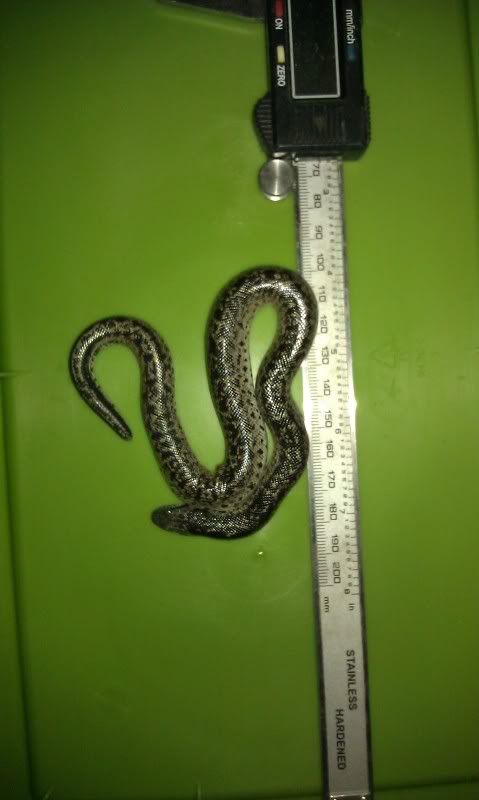
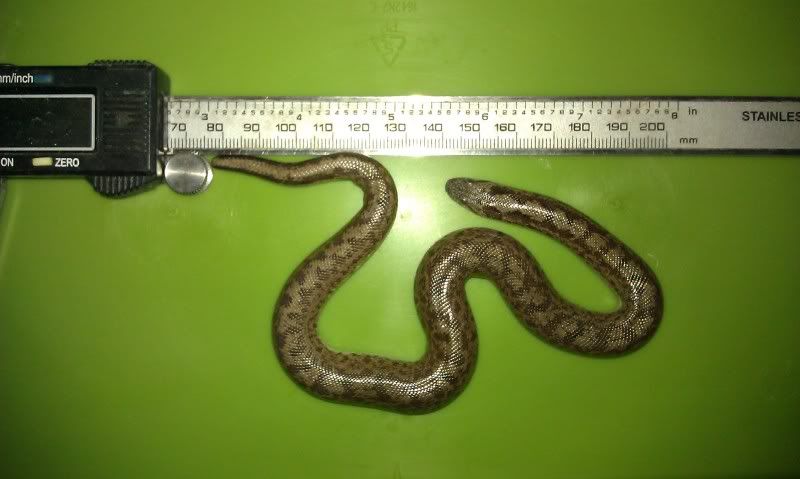
Female-
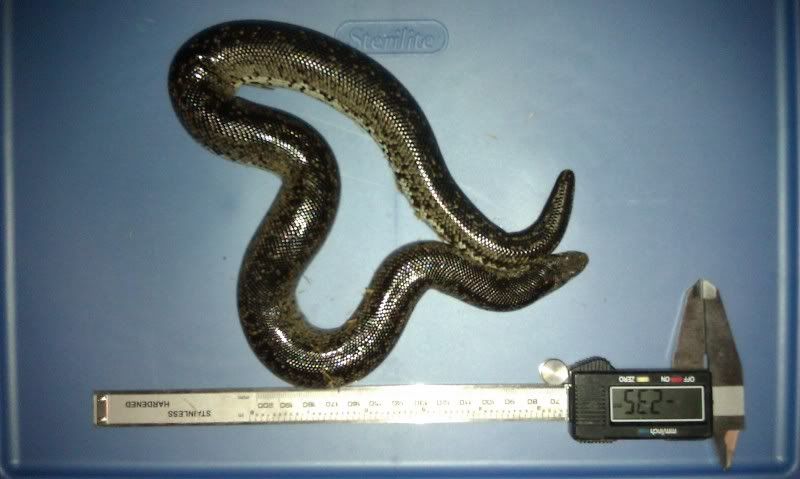
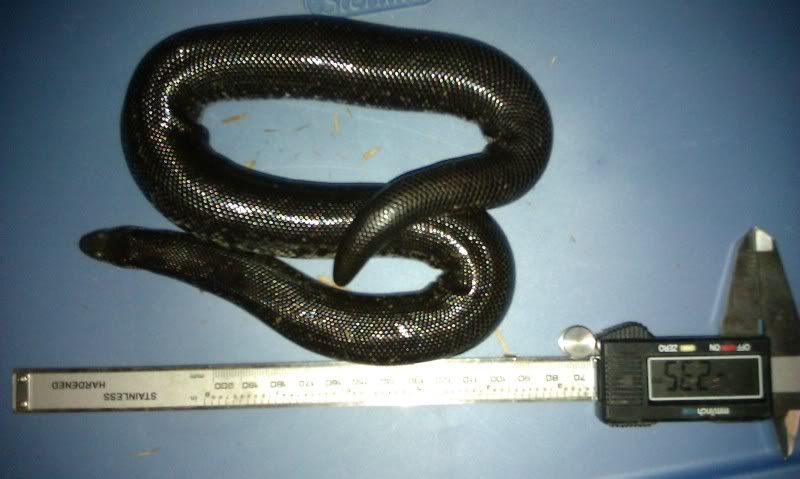
Cheers,
Chris
-----
Christopher E. Smith
Contact
Captive Bred Herps
Wildlife Research & Consulting Services, LLC
I think 60cm is about the average adult female for miliaris, but the problem is that the literature lists the species getting to a meter or more.
I think part of the problem is that there is confusion about the separation of miliaris and tataricus across their range.
Furthermore, I suspect most miliaris in captivity come from a relatively small area of the species range. Looking at other better known Erycines (Charina/Lichanura) there is some significant variation in maximum sizes across the species range. I suspect the same could be true of miliaris.
-----
Chris Harrison
San Antonio, Texas
Kelly:
Thanks for the added input. I was wondering if the dwarf morph of the Rubber Boa was the smallest member of the boa family but that seems not to be the case.
And it might seem that the Rubber Boa seems to be larger than a number of sand boa species. Last year, a female measuring an even 33 inches (838.2 mm) was found just west of the town of Scappoose, Oregon about 25 miles northwest of Portland.
Earlier this year, I found a female in the Santa Cruz Mts. that measured 30 1/4 inches. The previous largest female from the West Bay Area I had measured was about 26 3/8 inches. The largest female from the East Bay Area of Calif. I have measured was a female of about 27 inches found in Contra Costa County.
The genetics of different color morphs in sand boas and the Rosy Boa have been discussed on this forum now and then. If I were to post the results of my crosses between the two size morphs of the Rubber Boa, would anyone be interested in trying to determine the mode of inheritance that is involved?
Richard F. Hoyer
The genetics of different color morphs in sand boas and the Rosy Boa have been discussed on this forum now and then. If I were to post the results of my crosses between the two size morphs of the Rubber Boa, would anyone be interested in trying to determine the mode of inheritance that is involved?
I'm sure we could try and put together the pedigree and take a shot at it, but there are two concerns I would have. First, length data are generally not qualitative enough because of the overlap in the size classes. For example, are males of the large morph smaller that females of the small morph? Is there a size threshold that separates females of one group from the other?
Secondly, are the crosses between the two size classes intermediate in size? If so, it points to a type of inheritance that won't be easily identified by a simple pedigree. Human size is polygenic and I suspect snake size is as well.
-----
Chris Harrison
San Antonio, Texas
Chris H:
Since no one responded other than yourself, I have changed my mind about posting the results of crosses in C. bottae. It would take a pretty lengthy post or series of posts to both lay a foundation of understand as well as outlining the results that have emerged thus far. Clearly there isn't much interest on this forum with the Rubber Boa let alone someone fooling around with crosses in the species.
But I appreciate your remarks and if you wish, I could send you the information on those crosses via a private message. I can be reached at charinabottae@earthlink.net
Richard F. Hoyer
Help, tips & resources quick links
Manage your user and advertising accounts
Advertising and services purchase quick links
