Reptile & Amphibian Forums

Welcome to kingsnake.com's message board system. Here you may share and discuss information with others about your favorite reptile and amphibian related topics such as care and feeding, caging requirements, permits and licenses, and more. Launched in 1997, the kingsnake.com message board system is one of the oldest and largest systems on the internet.

Click for 65% off Shipping with Reptiles 2 You
Click here for Dragon Serpents

Will a S. obsoletus tame down?

calebjg Sep 21, 2011 07:52 PM

I hope I spelled that right..I just found a young Western ratsnake in my mouse bin.Very very fat and all my pinks and most of my fuzzys gone.I would say its around a year old?
I cant let it go in the barn as the cats will kill it and if they dont the chickens will.Its supposed to be cold the next week too.So I put it in a critter keeper over some heat.

Will this guy be at an age he might tame down?

Replies (12)

jtupper Sep 21, 2011 08:38 PM

To quote Doug Mong:

"Well, sometimes that is the case, and other times the more frequently they are handled, the more frquently you get bitten."

Some snakes tame down with regular human interaction and some snakes remain unfriendly their entire lives. However in my limited experience with one that young if you gently handle it often it will likely settle down....operative word being LIKELY.

J

calebjg Sep 21, 2011 08:53 PM

Hmm. I might give it a go.I cant let it go till the weather warms up anyway and I could just keep it till next spring.Either way its going very far from my mice and my chickens.

DMong Sep 23, 2011 03:27 PM

too funny man!...AND very true!..

Yes, you hit it pretty accurately with what you mentioned there.

To the OP........if the ambient room temps are in your cooler living quarters, just put some underneath heat with a heating pad so that ONLY one end on the SURFACE is in the low to mid 80's so it can thermoregulate to properly digest it's huge belly of all your rodents. Otherwise if the temp is in the 70's it could easily regurgitate all that it ate through putrification(rotting) within the gut.

As the poster mentioned, a small young ratsnake can easily become very tolerant of gentle handling, but as he also said, there can be definite exceptions to this as well.

It's very important to NOT do any handling at all for at least two days or more after it has eaten substantial meals. Doing so can also cause it to regurgitate from anxiety from feeling nervous and threatened. This is a typical natural response to swiftly lighten their load and quickly divert the attention of the predator(you in this case) to the stinky mess it just vomited up as it quickly utilizes these precious few seconds to go bolting off to safety.

good luck with that cool little ratsnake!...you certainly know it eats anyway..

~Doug
-----
"a snake in the grass is a GOOD thing"


serpentinespecialties.webs.com

monklet Sep 23, 2011 06:51 PM

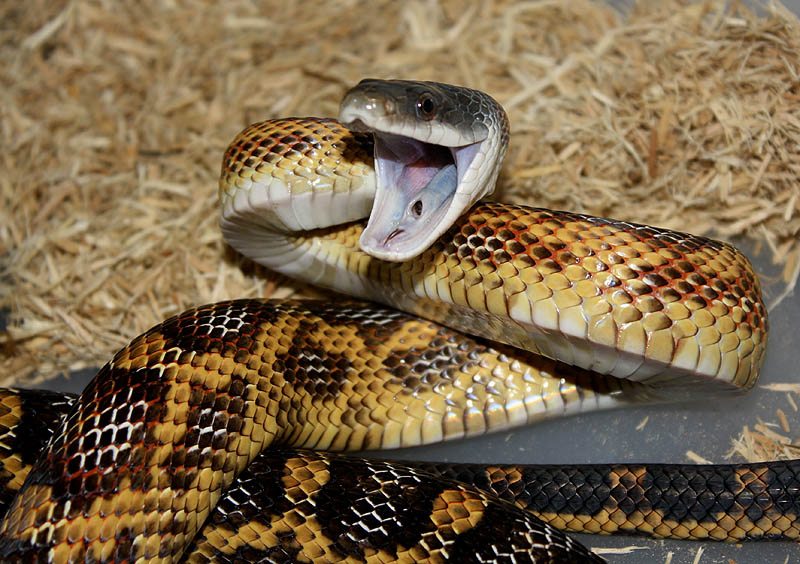
My sweet little WC T-Rat is actually losing her edge ...most unfortunate ;(

I love her more when she's all kissy face like this...

-----
See all my snakes at SerpenTrack.com

DMong Sep 24, 2011 04:11 PM

Yes, how "unfortunate"..

Gosh, that really is a gorgeous example of a T-rat!...and the photo is very cool too.

~Doug
-----
"a snake in the grass is a GOOD thing"


serpentinespecialties.webs.com

varanid Sep 25, 2011 10:39 PM

holy crap that one is aces.

Mine's actually calming down. He'll still bite while I'm picking him up but once in hand he's fine...surprises me. But I've got one fairly calm E carinata too so...
-----
We wouldn't have 6 and a half billion people if you had to be beautiful to get laid.

calebjg Sep 25, 2011 12:32 PM

At some of the other boards.Ive gotten quiet a few people that have said that black rats tame down quite nicely if caught young enough.I know texas rats are supposed to be aggressive.
Ive never tried taming a wc animal of any kind so this is will be a first for me.But Ive got a couple cb that arent any better tnen a wild caught so might as well try.

DMong Sep 25, 2011 03:10 PM

Positive remarks are nice to hear, and it could very easily become easy-going and tame down substantially in time. This happens quite often as a matter of fact. We are only being realistic about this is all. Out of countless ratsnakes I've kept of many different kinds, you never really know how they become unless you give it a whirl and find out.

I have some "greenish" Yellow x Black intergrade ratsnakes that are very well-mannered, and others from this same line that are quite nervous and nippy. The very bottom line is ALL individual snakes have very different personality traits in any given environment and situation.

Cornsnakes are usually pretty easy going too, but I have a W/C female here that is as agressive about biting as a junkyard dog!. By the same token, a couple others captured only feet away are very calm and gentle, and seem like almost all other captive corns.

I have numerous young miksnakes too that are generally flighty , sling musk, and are typically nervous as all HECK that can often bite at that young age, but I also have a few that came right out of the egg that just calmly move around slowly in my hand and even didn't thrash around and crap all over me while biting as I sexed them too.

You just never know until you work with them a while. I really do suspect that your young Black Rat will probably be quite manageable with time, but we are only letting you know that it isn't always this way with Black rats or other individuals of all different types.

Your assessment of Texas Rat attitudes is generally pretty accurate, but some are quite well mannered as well.

After 45 years of owning countless thousands of snakes in my lifetime, I don't think anyone is going to realistically convince me that my wild-caught cornsnake is going to become a great handleable pet snake at this point from what I have observed...

Best of luck with it. And if you see that it doesn't work after a while, simply let it go in a safe spot near where you found it when good weather permits.

A good way to get nervous striking snakes out of a cage to hold them is to fashion a little hook out of a stiff piece of wire or clothes hanger. Then just go in and assertively hook it at mid-body, lift it out, and slowly lower the hooked snake into your other free hand. After doing this make SURE to not put your ffree hand in FRONT of the snake so it can "zero-in" on it as a threatening target, but rather come up slowly from underneath at it's blind side and let it be supported in a sort of "escelator" fashion.They don't nmaturally see this nearly as offensive as a giant "monster hand" swooping down and grabbing them to do harm.

You can also do it this way. Again, just methodically go down without hesitating giving it time to notice you and "zero in" on your hand and simply go in with an open flat palm while in the same motion covering the head and grasping it. This often doesn't give them enough time to prepare to strike if you just do it as soon as the lid is lifted. But you may want to use the hook method over this depending on how comfortable you feel.

Over some time of doing these things it is very possible that the snake will no longer associate you with having to protect itself, and gradually become very used to you.

.............or not!..

~Doug
-----
"a snake in the grass is a GOOD thing"


serpentinespecialties.webs.com

calebjg Sep 25, 2011 06:46 PM

I picked him up today and this being the second time only he never did anything.I mean he rattled his tail a bit but otherwise, wow.I have a cb cornsnake that bites me on a regular basis so this guy is sweet compared.He still has a very slight bulge so maybe he is still in a food coma.I hope not cause he sure is amazing looking.Not in a bright colorful way but has very cool patterns.

What exactly is the snake I have? The book I have calls it a Western ratsnake(scotophus obsoletus)
Is this the same as a Pantherophis obsoletus or black ratsnake.
And Ive seen it called Elaphe obsolete....So which is it?

DMong Sep 25, 2011 09:43 PM

What exactly is the snake I have? The book I have calls it a Western ratsnake(scotophus obsoletus)
Is this the same as a Pantherophis obsoletus or black ratsnake.
And Ive seen it called Elaphe obsolete....So which is it?

Well, it is all three of those names..LOL!, but it really depends on what location of the country it was captured.

All Black Rats used to be classified as Elaphe obsoleta, then not long ago Pantherophis obsoletus for Western Ratsnakes, and just recently re-classified as Scotophis obsoletus west of the Mississippi River. If you live east of the Mississippi, they are now designated as Scotophis alleghaniensis due to some alleged DNA differences that were found to be genetically different.

Yes, that's very typical for ratsnakes to vibrate their tales, that just means they would rather not be messed with is all. It sounds like he just might do real well for you. Just watch the handling when it's belly is full as I mentioned earlier. That is taking a chance that it could regurgitate, and this could snowball into HUGE very serious problems that are an entirely different topic you don't want to have to deal with.

cheers, ~Doug
-----
"a snake in the grass is a GOOD thing"


serpentinespecialties.webs.com

calebjg Sep 26, 2011 11:40 AM

Well then I can safely call it a Western ratsnake, we are in kansas. Thanks for that, it gets confusing.

DMong Sep 26, 2011 01:19 PM

...or simply a "Black Ratsnake" which they have always been known to everyone as for many decades until all of this recent taxonomic change and confusion..

In my opinion the new name "Western Ratsnake" is FAR more confusing to everyone even though that is the latest taxonomic nomenclature for that specific animal now.

I think that all of this constant "re-inventing the wheel" due to recent DNA science is many times very counter-productive to the whole idea of visual taxonomic classification. Ironically, this was the entire idea for taxonomy in the first place....to describe the visual characteristics of their individual phenotypes(visual outward looks) and scalation in order to have a more standard and accepted way to classify regardless of their different common names that are used in different regions.

If these scientific groups didn't justify all the funding and time that goes into this sort of thing, and continually come up with newer findings and data, it would probably be looked at as a complete waste of time and funds if they didn't periodically come up with these ideas to re-invent the "wheel" that has worked perfectly well for all these years, and they would be out of jobs...LOL!

I can guarantee that there is some geneflow from both S. obsoletus and S. alleghaniensis in at least close proximity to the Mississippi River due to many naturally occuring events over the millenia. Floods, swimming over, and floating over onto either side on debri have certainly had to have happened countless times in the past. As to just how far on both sides this is evident in their DNA, from how broad an area, or even how many different snakes in their sample study were used for these conclusions is probably the real question I would think.

Alot of times when scentists have a biased notion to find something, they will often find it somehow and disregard other things contrary to their goal..

~Doug
-----
"a snake in the grass is a GOOD thing"


serpentinespecialties.webs.com

Site Tools