


Reptile & Amphibian Forums
Welcome to kingsnake.com's message board system. Here you may share and discuss information with others about your favorite reptile and amphibian related topics such as care and feeding, caging requirements, permits and licenses, and more. Launched in 1997, the kingsnake.com message board system is one of the oldest and largest systems on the internet.



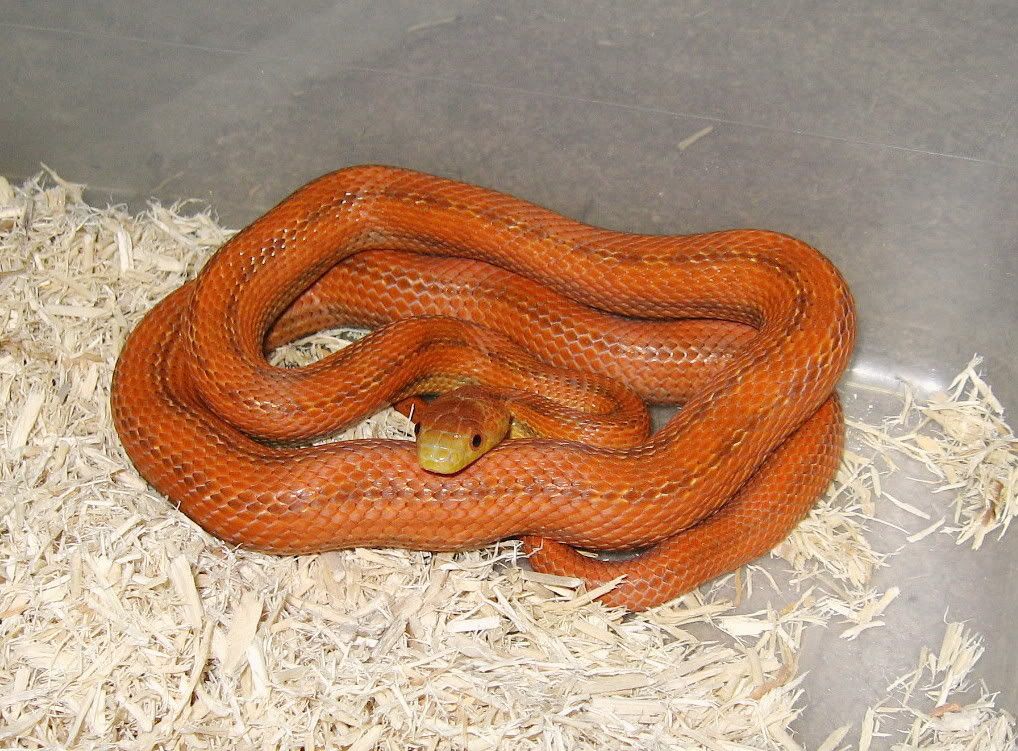
Everglades?
MariaA
Oct 08, 2011 01:44 PM
Replies (9)
Greg Longhurst
Oct 08, 2011 06:42 PM
Absogolutely! No boudt adout it. ~~Greg~~
DMong
Oct 08, 2011 06:49 PM
Yes, a nice hypomelanistic Everglades at that!..
A normal Everglades would display four light logitudinal stripes along it's length and they often have slight remnants of their blotching visible as well such as this nice one I used to own.
~Doug
-----
"a snake in the grass is a GOOD thing" 

MariaA
Oct 09, 2011 08:15 AM
Thank you!
That's what I thought. I got the snake recently and the information I got was that it is an everglades, female and four years old. Nothing about hypo. She is small, a little bit smaller than an average corn snake. The difference between my snake and most pictures I've seen of hypo everglades is that mine has a white chin, the others have yellow.
I'm very happy about her and thanks for replying!
DMong
Oct 09, 2011 11:23 AM
Yes, I definitely noticed the white chin/throat right off the bat which seemed a bit odd for an Everglades rat.
Now, are it's pupils black or pink/red?. If they are pink or red, it is amelanistic(albino,..total lack of melanin), not hypomelanistic(greatly reduced melanin pigment).
Also, without knowing it's precise genetic origin, or knowing anything about precisely what both parents were, and grand-parents, etc...it could very well have some Yellow ratsnake geneflow in it's lineage too, as they are far more prone to displaying white chins and throats. There are quite a few albino Yellow rats in the hobby mainstream. A good friend of mine wanted to give me a nice male albino Yellow Rat hatchling this year at the Daytona Reptile Expo, but I simply have too many breeding projects here as it is.
Anyway, since the throat/chin area do seem to be whiter than normal, if the eyes are red or pink, the chances of it having some amel yellow rat geneflow in there are fairly likely, even though it is phenotypically more orange colored.
It's a very nice looking animal either way you slice it!..
~Doug
-----
"a snake in the grass is a GOOD thing"
MariaA
Oct 11, 2011 03:35 PM
Thank you!
Yes, it IS a nice snake
The pupils are definitely black and I think there is a small dark red, almost black, circle around them.
I have experienced the yellow rat as much larger than the everglades but I'm not sure. It seems to me like there are two "types" of snakes people like to call everglades. The smaller one (like mine in the picture) is one and a kind of yellow ratsnake selectively bred for their orange is the other. I'm confused since I've seen many different pictures of everglades. And I know there are a lot of crosses too. (And no, I'm not American )
Can we ever know the origin of a snake? I think not...
DMong
Oct 11, 2011 10:53 PM
Yes, if the pupils are black, then it's most definitely a hypo. Andy Barr developed a smaller strain of Hypo Everglades than the the far more common strain, but the one's I have see had a very bright yellow face, throat and chin, so tough to say.
And yes, there are many Yellow Rats that can display high degrees of orange coloration too, and can be virtually impossible to really distinguish from alot of Everglades as you mentioned. Identifying an intergrade, especially with unknown percentages of either subspecies are real tough to identify with certainty too as you could imagine.
Very true, there are many crosses of the two, and also many other crosses too, and even three-way crosses called "Bubblegum" Ratsnakes that are a composite of crossing the amel Black rat into the Yellow Rat's and Everglades. Bill Love developed these right around the late 80's early 90's.
Everglades as a very general rule are a bit smaller than most yellows, but this can of course also depend on many different variables.
Well, yes, the term "origin" is all relative as how far back one is talking about as all organisms literally constantly evolve and change for all sorts of various geographic reasons and causes. But you can certainly know the origins of many snakes up to a given point. For example the Yellow rats I have captured here on the extreme east coast of central Florida have no geneflow from any other obsoletus ratsnake subspecies, such as the Everglades to the southwest, the Gray Rat to the northwest, or the Black rat even further away to the north, etc..so it has become it's own distinct entity in this area. Another simple example would be a Florida kingsnake captured from as far south as you can get in the Florida peninsula by Everglades National Park. That would certainly be a genuinely authentic Lampropeltis getula floridana beyond any question.
Captive-bred snakes can also have very well-known origins too, it just depends on what animals originally started a particular bloodline and exactly where they originated from, and who they were acquired from. Lot's of this can often be traced directly back to certain localities and/or a certain known selective breeders in the hobby.
Also, how well they "key-out" meristic-wise taxonomically(as described by science) from very precisely, methodically described holotypes for their particular race are all indicative of how authentic a particular type of snake actually might be compared to others.
A "Stillwater" hypomelanistic bullsnake would of course trace directly back to wild stock from the Waynoka rattlesnake roundup west of Stillwater OK. There are thousands of them in the hobby today that trace directly back to that very specific locale. Same thing with countless Okeetee cornsnakes originating from the 50,000 acre Okeetee Gun Club estate in Jasper County, South Carolina, etc..., etc....
Anyway, I'm sure you get the idea here of what I mean..LOL!. There are so darn many man-made crossed "counterfeit" types of snakes in the hobby now it is ridiculous, and I see examples of them all the time on a very daily basis on different snake forums, reptile shows, and in any classifieds.
sooooo...........enjoy your hypo!..
cheers!, ~Doug
-----
"a snake in the grass is a GOOD thing"
MariaA
Oct 12, 2011 04:44 AM
I really appreciate the long comment. I find it especially interesting that there are two kinds/lines of everglades, kind of
I will post another snake soon
KMat
Oct 12, 2011 09:16 AM
Doug made some very valid comments regarding origins. It is extremely difficult to determine if you have a "pure" animal whenever you are dealing with snakes that are classified intimately with their geographic location, as well as their unique coloration/characteristics like the Everglades ratsnake. There are just too many "hobby" varieties out there to be sure unless you purchase from reputable breeders, or capture them yourself. Start throwing in the recessive traits like hypomelanism or albinism, and the waters muddy even more. Like Doug said, just enjoy your snake!! It really is a beautiful animal.
MariaA
Oct 12, 2011 01:10 PM
Thanks!
Yes, she is beautiful
