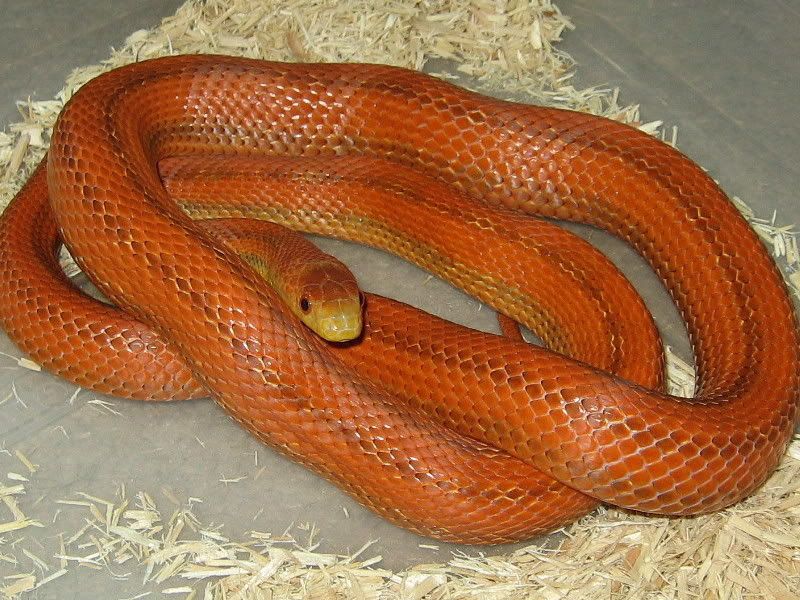
Hello, I'm new to the forum. I would like to figure out if the hybrid rat snakes I've bred are unique. Also to try to figure out a price for them. First, a little history on the mother of the clutch. In summer of 2005 I found an Everglades rat snake by a park near my home. It may have been a hybrid. She had some sporadic white trimming around scales in an odd pattern along her body. The weird part is I live in Pinellas County Florida, Tampa bay area. Everglades rat snakes are not native this far north in the state. It turned out after bringing her home and keeping her she laid 14 eggs in my cage. These eggs were incubated and all hatched. They had the normal neonate rat snake pattern greyish with dark blotches. Later some of the babies turned yellow and some orange like an Everglades rat. This convinced me of my seemingly obvious assumption that the father of the brood was a yellow rat snake which IS native. So I sold and released a few of the babies. In the end I kept only one. She is orange like an Everglades rat snake but is apparently a Yellow/Everglades cross. I have raised her to breeding age and this year I have successfully bred her with a Leucistic Texas rat. I ended up with 11 from the first clutch and I have 6 eggs from a second clutch that should be hatching on Nov 2nd. I have not seen anything stating this hybrid has been seen yet. I am curious to know what they may be worth, and if anyone is interested. Here is the link to the pics that I didn't have in the first post. http://flic.kr/ps/23RbT9
Link
Reptile & Amphibian Forums
Welcome to kingsnake.com's message board system. Here you may share and discuss information with others about your favorite reptile and amphibian related topics such as care and feeding, caging requirements, permits and licenses, and more. Launched in 1997, the kingsnake.com message board system is one of the oldest and largest systems on the internet.


Possible new hybrid Rat Snake.
Replies (12)
By the way, sorry about any confusion my post causes. I posted this in another forum and just copied and pasted it here. No one replied on the other forum I posted it on. That is the first post here. I hope someone replies. Thank you.
" I am curious to know what they may be worth"
Yeah, that's great!. Did you ever give any thought to this though?. It wasn't bad enough to produce the normal looking crosses that will go on to confuse people as to what they really are later on, and now when you sprinkle these het babies all around and are paired up, they will then produce white leucistic snakes that will be TOTALLY indistinguishable from the leucistic Texas and Black Rats already out there in the hobby mainstream.
Could you maybe take up another hobby that is harmless like model building, fishing, or coin collecting, etc..?
How about producing some genuinely authentic subspecies of some kind?, or is that too "boring" because it has already been done for countless millenia?. You could have made some nice genuine subspecific morphs too without a cross of any kind being tossed in.
BTW, there are some orange-ish yellow ratsnakes that look extremely similar to some Everglades Rats here and there in their natural range. I seriously doubt you had a Yellow x Everglades, it just looked a bit more orange and was merely a natural variant.
~Doug

-----
"a snake in the grass is a GOOD thing" 

C'mon Doug! Tell us how you really feel! 
-----
Kent
1.1 Hypo (het lavender, striped) corn snakes, 2010
1.2 Gray-banded king snakes, blairs phase, 2008
0.0.17 Gray-banded king snakes, 2011
1.1 Oregon rubber boas, w/c 2000 and something
Colossians 3:17
Wow, That's pretty harsh Doug. You know, if you were just gonna reply with negativity you could have just kept it to yourself. You should have had a mother to tell you something along those lines. If you knew what you were talking about you would know that now they have their neonate patterns and will eventually change to their adult patterns. Who knows what they will look like. Also, you are not dealing with a seasoned veteran breeder. I'll be the first to admit that. I happened to have these two and decided to breed them. I didn't set out to make it a project. I have lived in this area my whole life. My childhood was spent in woods, and parks, and ditches, and swamps, continuously looking for snakes. I have never encountered one of these orange yellow rats. Though I do not doubt the possibility of Orange Quadrivittata. This snake had a red tongue which Quadrivittata does not have. Thanks for your input, regardless of how valueless it was.
" If you knew what you were talking about you would know that now they have their neonate patterns and will eventually change to their adult patterns"
No kidding?......thanks for explaining all this to me. After 45 years of owning countless thousands of snakes, I would have never guessed that they now have their juvenile patterns and would ontogenetically transform into their adult patterns (whatever that may be now that you crossed them). Very likely a dark brown/orange background with darker saddle blotching and maybe some vague remnant longitudinal striping.
"Who knows what they will look like. Also, you are not dealing with a seasoned veteran breeder. I'll be the first to admit that. I happened to have these two and decided to breed them"
Yes, I was able to pretty much pick up on that right away, thanks...
And what do you think those snakes, and their future babies, and their babies hatchlings and so on and so on will later be bred to when they matured later on?. Do you think all of those babies would be accurately identified and bred to more of those exact same precise crosses you started with and that everyone would know they are indeed man-made crosses?. Or do you think they might later get bred to whatever type of genuine ratsnake many people happen to have and that yours seem close enough?
The bare-bones reality of all this is that the one's you just produced, and whatever THEY go on to produce depending on whatever people think they are and breed them to will later get labeled as whatever subspecies they "seem" to best represent at any particular time down the road. And they will all have some substantial variation from the other subspecie's influence they contain.
Anyway, the real point is that this would have all started from this simple notion.......
"I happened to have these two and decided to breed them"
.....and not bothering to go get another closely-matched mate or just simply skip the breeding for the time being until you did get an orange Everglades to pair up with it. That or get another Texas Rat for your leucistic.
Yes, I realize that I am the horrible "bad guy" for realistically pointing all this out, as well as dashing your dreams of creating something "amazingly different" for the hobby, but the honest reality is they certainly will not, and only dilute things further.
Rest assured that many of those snakes will be grossly misrepresented down the line because many will never be informed what they actually are, or even remember, or care. The bottom line is they will be called whatever people "think" they probably are and do nothing more than muddy-up more collections of authentic types of ratsnake subspecies as they go. My whole intent with all this isn't to come across as mean and nasty, I am merely pointing this all out so you are more aware of how the true dynamics of this hobby actually works. I am stating this from 45 years of experience owning and working with many different types of snakes.
cheers, ~Doug
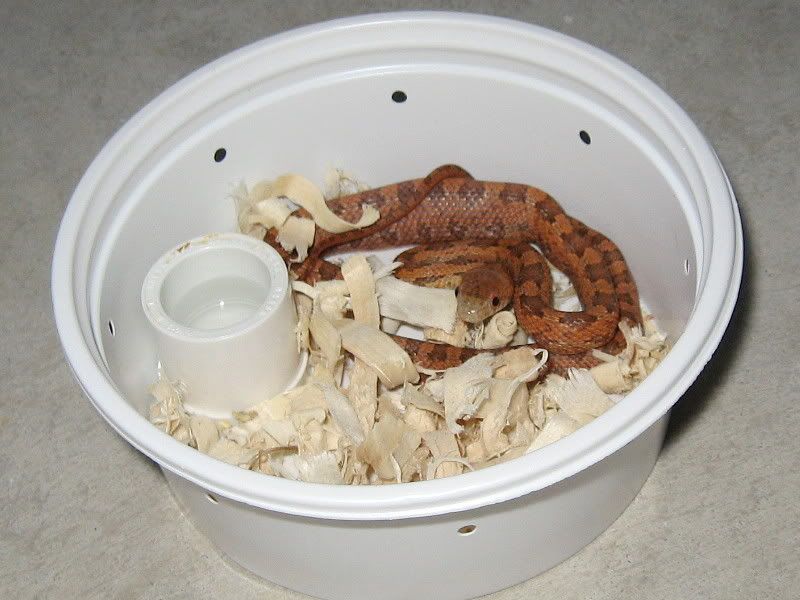
Same snake 2 years later.....
-----
"a snake in the grass is a GOOD thing"
I agree that public forum differences of opinion should be expressed politely. However it should be pointed out that releasing hybrids into the wild is not ok. You never know what effect they might have on the local snake populations as well as the predator/prey niches they fill.
Really it's bad to release any snake that was born in captivity, or has been in captivity, into the wild. This can expose wild populations to diseases, bacteria and parasites that might not be native to their natural environment. Most states probably have laws against it too.
-----
www.hcu-tx.org/
Breeding a Yellow Rat to an Everglades Rat would create an intergrade, not a hybrid. Breeding a Yellow Rat or Everglades Rat to a Texas Rat would also create an intergrade. Hybrids are the crossing of two species, intergrades are the crossing of two subspecies. Yellow Rats and Everglades naturally interbreed as do Texas Rats and Black Rats, Black Rats and Yellow Rats, etc.
The babies would be vitually worthless as there's not much demand for hybrids and intergrades. This can be easily seen by no one wanting leucistic Black Rats due to speculation that they've been crossed with Texas Rats.
It's useful to determine if people would actually want the offspring you produce (if marketed honestly) before actually producing the snakes.
Tim

Third Eye
Thanks Tim, I've heard the term intergrade. They refer to Gulf hammock rats as intergrades. Yellow and grey rat naturally breeding. I see what you are saying and wasnt really aiming to create them it kinda just happened and unwashed wanting to figure out their worth before selling them off. Thanks again.
that folks easily find these forums to feel out how much a hybrid or integrade they are producing is worth, but never find these forums in time to get sound advice against doing such breedings, or a better idea of worth before eggs are incubating/babies are born.
The animals you are attempting to produce are going to be worth whatever a person is willing to pay for them. In most cases, not much if anything. As pointed out in other replys, it is well known that these integrades or hybrids often get sold off to unsuspecting buyers mislabled or identified as what they most resemble in an effort to clear the cages or make the dollar. Thats the sad but true reality in the hobby today.
I was an avid hobbyist a few years ago, mainly working with corn morphs, but also some other locality driven species. Today I wouldnt even bother buying many of the ratsnake and even common king morphs I see expecting them to be pure subspecies or non-integrades. Same with many of the milks.
Some hybrids and crosses are beautiful and valueable to the segment of the hobby that's into those sorts of things. Many species and subspecies have been compromised but the practice of crossing can't be expected to stop. People have a right to do what they want in that regard. Therefore I think it falls mainly upon the purists to make sure they can trace their stock back to the original wild caughts if they want to be absolutely sure they have pure snakes. IMHO you really can't expect everyone to keep stuff pure.
Additionally alot of sources, ie pet stores, inexperienced breeders, etc. may misidentify stuff. A pet store could get a clutch of hatchling pure black rats and the minimum wage employee may label them as pure gray rats, just out of sheer ignorance. I've seen this sort of thing many times at pet stores. Then what can happen is a newbie buys one from the pet store and a couple years later they decide they want to breed it so they pair it up with a pure gray rat from an online breeder. The result is unintentional crosses entering the hobby. Purists have to be on gaurd against this sort of thing and countless other scenarios that result in something simply not being what it's represnted as. The only true way to combat this is to obtain from sources that can trace back to wild caught.
So I think rather than jump on people who make crosses the best thing to do is edjucate them and let them make their own choices.
I don't think crossings done between common native species are that big of a deal because a purist can still go out a collect new stock. What I would like newbies and others to really consider carefully before doing, is crossing non-native stuff that we connot just go out and collect fresh bloodlines of. Like the stuff from Mexico. When that stuff gets crossed the pure forms are just lost from the hobby, essentially forever.
-----
www.hcu-tx.org/
truly.....I used to sell mix and match stuff for $5 back in the early 90's....
....
-----
........JY
Colubrid market, at least with the common kings and rats, isn't exactly hopping right now 
-----
We wouldn't have 6 and a half billion people if you had to be beautiful to get laid.
