Reptile & Amphibian Forums

Welcome to kingsnake.com's message board system. Here you may share and discuss information with others about your favorite reptile and amphibian related topics such as care and feeding, caging requirements, permits and licenses, and more. Launched in 1997, the kingsnake.com message board system is one of the oldest and largest systems on the internet.

Southwestern Center for Herpetological Research
Click for 65% off Shipping with Reptiles 2 You

Cali. King or Milksnake? Cage Size?

Bro_1 Nov 09, 2011 01:36 PM

Hi.

I have a lot of questions, but not sure of the exact species, so I'll just include them here. :D

I've recently come into possession of what I was told (by prev. owner) is a California Kingsnake. By "come into possession" I mean "take care of it, or watch it starve to death due to owner neglect."

Bro (The name of said snake given by prev. owner) strongly resembles the pictures I've seen of "coastal phase" California Kingsnakes. (Yellowish and brown striped) But he has a yellowish Y band right in-between his lower head and neck. Which, I've read (online), is a trademark of the Milksnake. I've included a linked photo below. Bros . . . bottom . . . underneath . . . belly? is the same striped yellow and brown, and at some areas Bro has splotches instead of stripes.

And if anyone is feeling generous, I have some (Tons) of bonus questions:

Prev. owner said Bro is 3 ft. long. I don't plan on stretching Bro out to measure, but after handling Bro a lot, he seems more around 2'6" or 2'5" if I had to guess (hope) for an exact. So the smaller side of 3' ft.
Prev. owner had Bro in a (estimated) 20 Gallon tank . . . box. That IS the generous estimation. 24"x14"x12" if I had to guess.
I felt this was too small, so I ordered a 36"x18"x18". I have a lot of time to change the order . . . and now I'm thinking it might be too big. I could really use input on that. I was told length of the cage should be 6" more length than the snake? But a 36"x18"x18" would be like . . . 50 Gallons. So double the size of his current cage, which . . . is a lot. But he seems to be trying to get out a lot. So maybe it is waay too small. D:

My post is already too long. D: But I still have like 5 more questions. I will wait till this is answered. (Hopefully soon)
And I've had to retype this twice now. Once due to log-in and second time due to Bro climbing . . . crawling . . . slithering over my F5 key. xD
Image

Replies (6)

Bro_1 Nov 09, 2011 01:41 PM

That Image worked really well . . . gonna try again . . .
Image

DMong Nov 09, 2011 04:45 PM

That is indeed a banded coastal phase California kingsnake(L.g.californiae). I knew it was without even seeing the pic from your description of the "Y" shaped nuchal marking on the neck near the head. That is very indicative of Cal. kings, and not milksnakes.

The enclosure you are thinking about getting that is 36 x 18 is PLENTY big enough for the snake. The most IMPORTANT thing is the temp range on either side of the enclosure for it to feel secure and content, and be able to digest properly.

One side can be in the mid 70's that is comfortable for humans, BUT it is absolutely PARAMOUNT that the bottom of the enclosure on the OTHER END (1/3rd or so of it's length) is heated from underneath so the BOTTOM SURFACE of the enclosure(not the substrate surface) is in the mid 80's not above with a heat lamp that excessively dries the air out even more now that it is becoming the colder and drier season, as well as the home heaters/furnaces drying the ambient air just that much more.

You need to monitor the warm side temp down on the very surface where the snake's actual belly surface will be with an accurate thermometer or temp probe PRIOR to putting the snake in to "tweek" things accordingly. If you do opt for an above heat source/lamp, use a ceramic heater that doesn't blaze the light down on it so it won't always instictively choose to hide rather than move around and thermoregulate from end to end as they would normally do as needed at any given time. Now the snake can thermoregulate as needed to digest or go to the cooler end to conserve it's energy and metabolism and shouldn't be crawling around constantly trying to find a way out. This is generally a typical sign of something being wrong with the environment, and it is desperately seeking better optimum conditions. That, and/or it is very hungry from not being fed enough. And it sounds like the previous owner was doing just that.

On BOTH opposite ends you must include a low, dark, tight hide box of some sort so it can feel secure and it can use either side as it chooses. it can be almost anything from an upside down dark plastic froven dinner tray with a notch cut out as a door, to a store-bought natural looking hide. But it needs a couple hides to be content and to hide while digesting AND at the other cool end while conserving enegy as well. Also of course, a water bowl with freah water that it can't tip over.

~Doug
-----
"a snake in the grass is a GOOD thing"


serpentinespecialties.webs.com

Bro_1 Nov 09, 2011 07:56 PM

Thank you for answering!

I don't have a thermo-pointer! But I'm going to order one when I get paid next week!
I've been using the cheap plastic circle thermometers. I have a Flucker's(?) Heat Lamp with a 100w Repti Basking Spot bulb that I turn 3/4s of a way up in the morning. The temperature on the side with the lamp is around 70s, but that is where the black circle thermometer is at! (Bro likes to knock it off the wall) On the other side I use a Zoo Med 8" x 12" heat mat! But I don't have the extension which allows me to control its temperature, so I think it says it will run at 20* above room temp. I need to order that when I get paid too. D: The cage humidity is what I'm having the hardest time trying to keep the same, ranging from 30-70. I try to keep it around 50. (at least that is what the circle temp. says it is at)
One of my questions was going to be will I need to order a night-time blub? I was using a red light at night, but it burnt out after two days. Now I just turn his light off at night. The temp stays around 60* when I do . . . Where the thermometer is at least . . .
I checked the ground on top of the heat mat with the little plastic thermometer by just lying it there. It says it's pretty hot. 84 on the surface of the aspen.
I was going to ask about feeding. When should I feed Bro? I got Bro on the 25th of Oct. and I fed it a live mouse on the 27th. (prev. owner said Bro hadn't eaten since late Sept.) Then I fed Bro on the 2nd (6 days latter) cause I thought Bro would be pretty hungry, but I used a thawed out mouse this time instead of a live one. Also fed bro a thawed one today to. (7 days latter) Should I feed Bro every 7 days?
Bro has eaten every mouse I've fed, and I've never found any regurgitated ones. Though I have found lots of poop. xD Bro didn't eat the first one/live one for a good bit(I actually tried to feed Bro on the 26th, but I also cleaned Bros cage right before that, so I think Bro was freaked out.)
I was also wondering how I

Bro_1 Nov 09, 2011 08:00 PM

I think I ran out of room. xD
My last question was:
I was also wondering how I could tell what sex Bro is? (Which is why I've been referring to Bro by its name or as an it) I think the prev. owner might've just named Bro because he thought it was funny. D:

DMong Nov 09, 2011 11:37 PM

Read this post I made just a few further down. You can post a few good straight-on pics from underneath if you want. If the pics are good enough, they should be very easy to tell. Kings tails are nowhere near as long and thin however.

Link

-----
"a snake in the grass is a GOOD thing"


serpentinespecialties.webs.com

DMong Nov 09, 2011 11:26 PM

Not on the surface of the aspen!...the surface just below the aspen on the FLOOR of it's enclosure where it will bury into somewhat. See, it all depends on how thick the substrate is. If it is 84 degrees on the top surface of the aspen and you have a solid 1 or two inches of substrate, the temps below that are far too high. Just put enough aspen on the bottom to absorb feces, maybe 1/2 inch and check the temp at the suface. the snake will dig in some under the hides I mentioned earlier.

No, it doesn't need any kind of night light at all.

Humidity of between 40 and 50 are good. much less than about 40 and it could have some shedding issues.

Since the snake is young and about 2-1/2 to 3 ft., it should be fed meals large enough to put a very noticable lump at mid-body about every 5 days. I give young growing kingsnakes two appropriately-sized rodents per feeding usually.

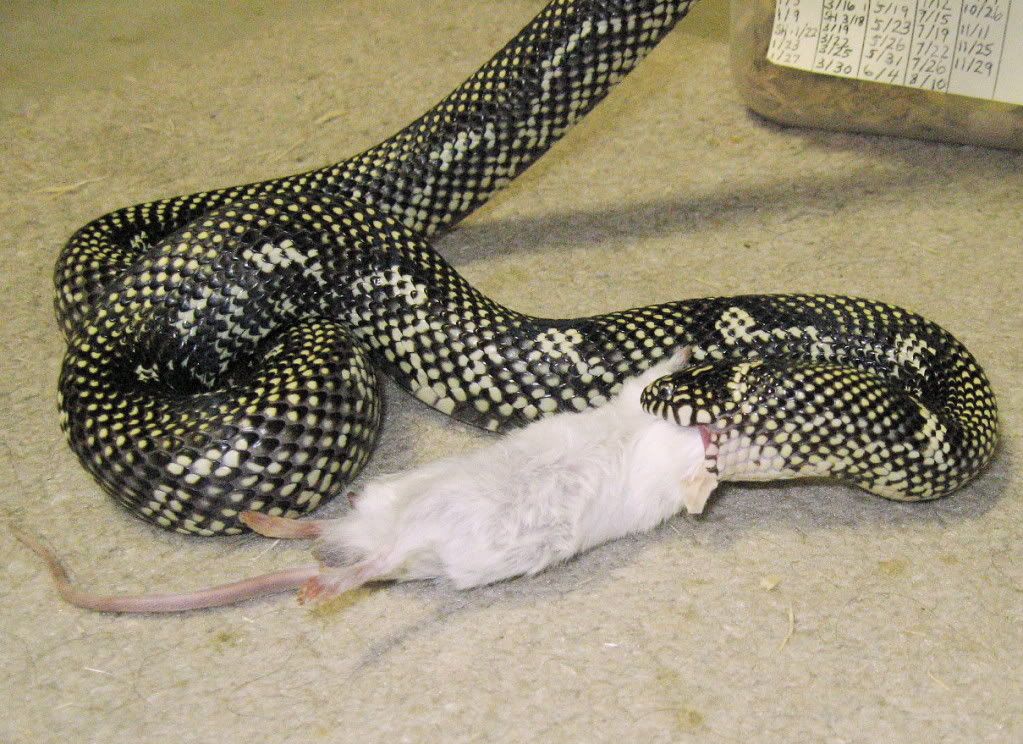
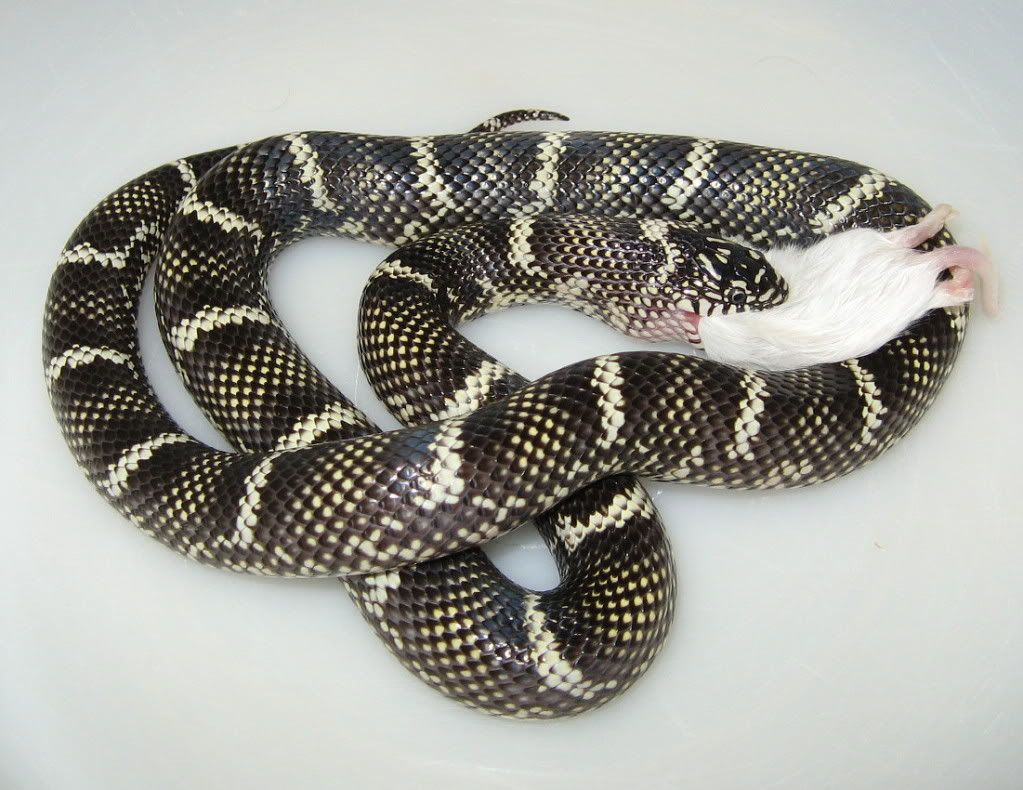
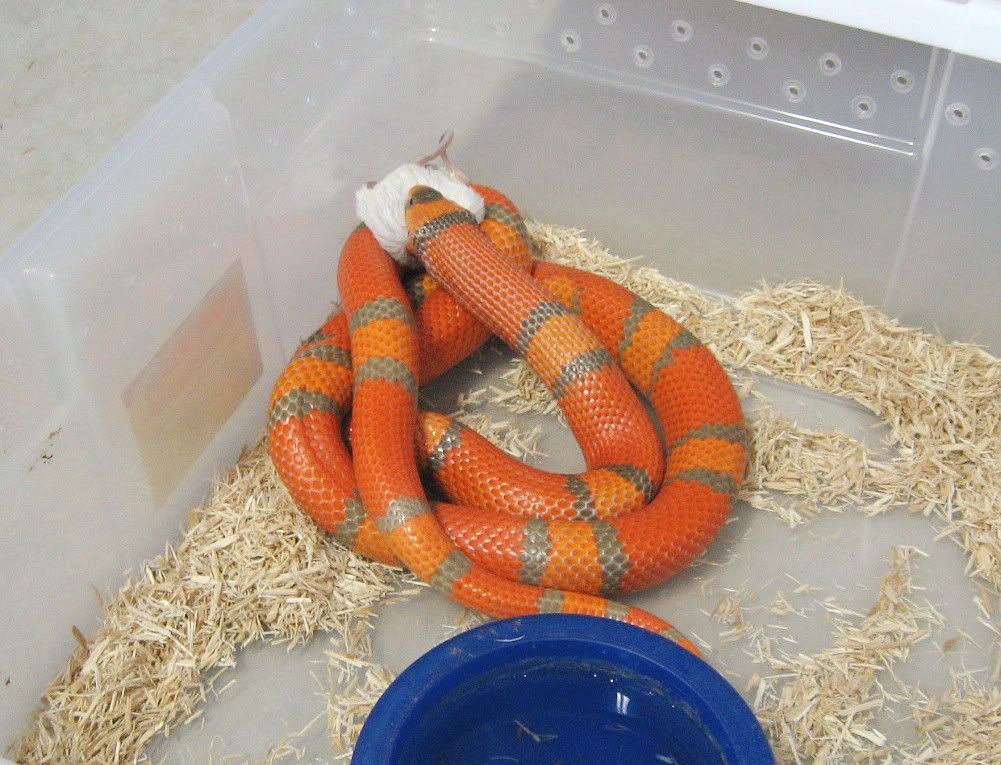
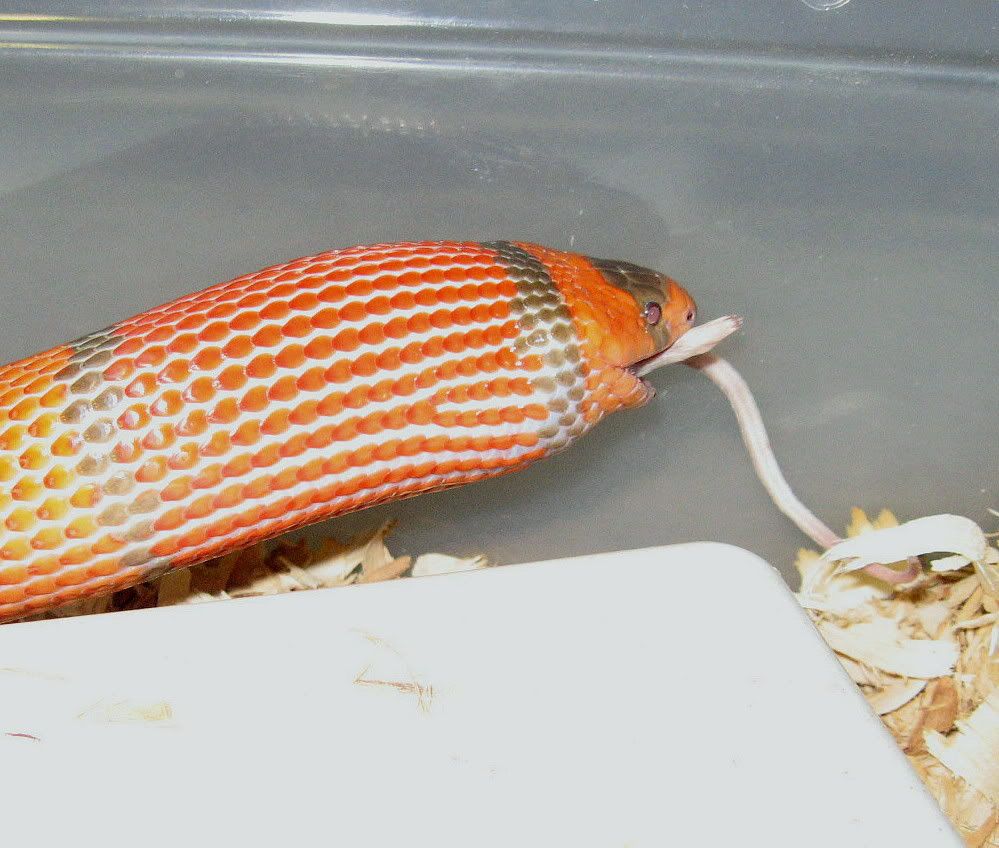
Here are the size you should be giving it. It should be big enough to have to work a bit and stretch the jaws well, and not small enough it can gulp them down easily. About 1.5 times the diameter of the snake at mid-body.

Here is the size of the prey you should give it such as these Outer Banks kings, Florida kings, and Extreme hypo Honduran are eating. Two every 5-6 days, but make sure it has fed several times to make sure it's stomach is used to digesting real good first from all the previous neglect. You can always cut the food back some if later on you start seeing skin between its scales well after it has eaten, but this won't happen any time soon and it will use the colories to grow some more.

Just remember, it has to have some warmth on the one side where it's belly surface can make contact and thermoregulate in the mid 80's for proper digestion and metabolize substantial meals. the cooler end is just as important.

~Doug


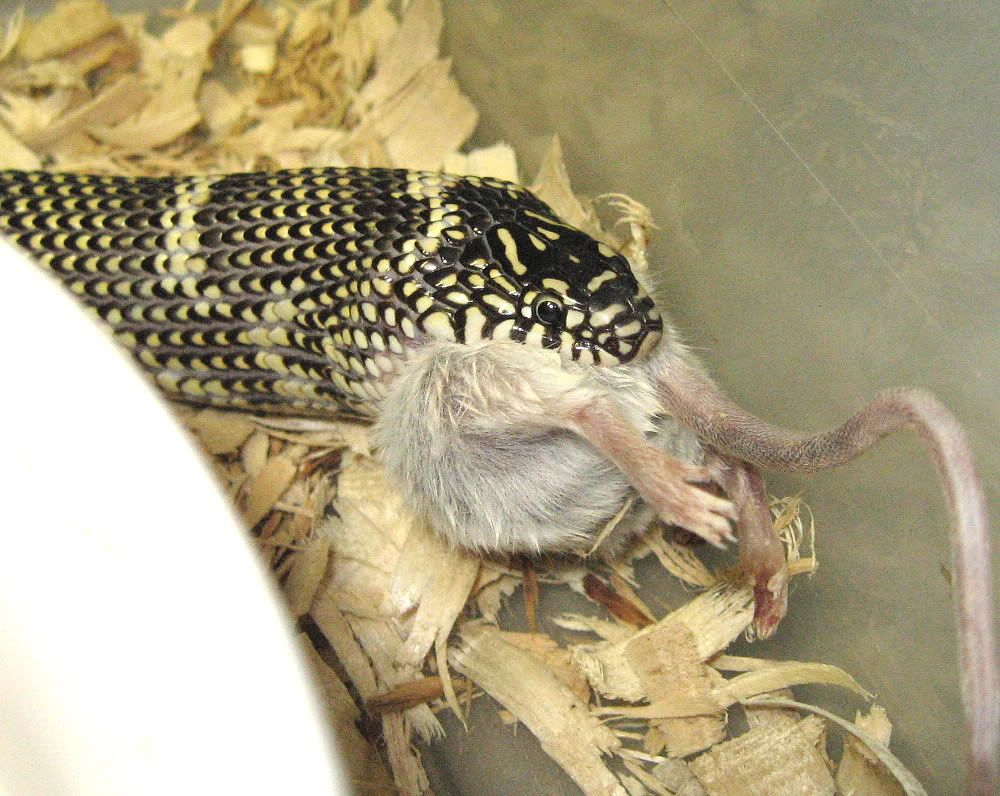
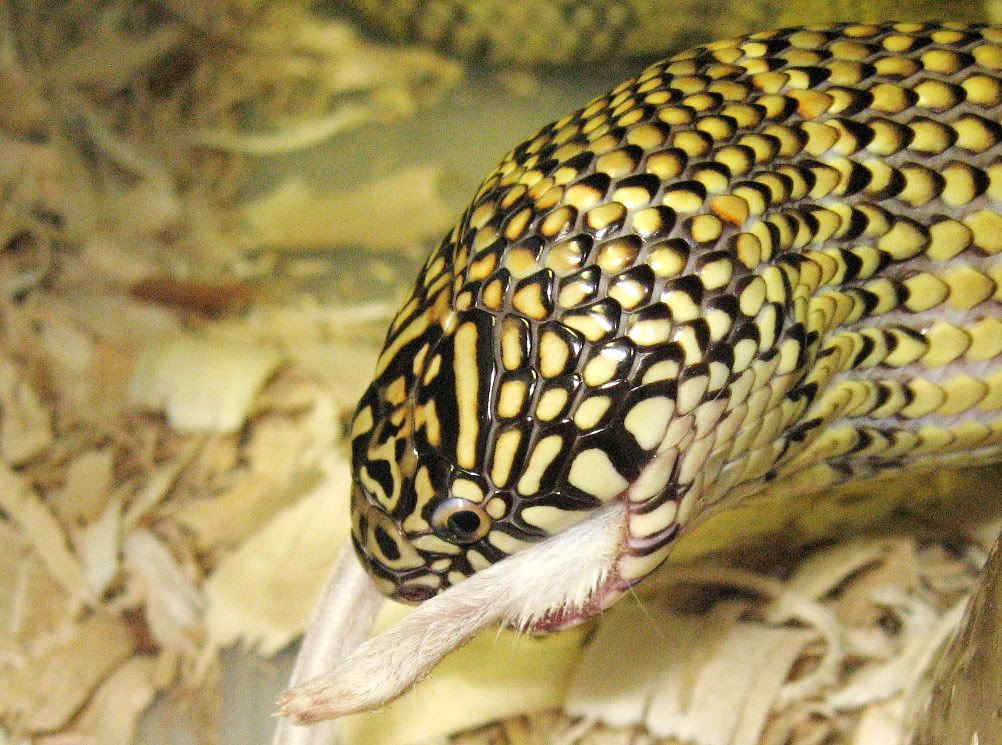
Just make sure the meals aren't quite THIS LARGE, because this girl was JUST BARELY able to cram this HUGE adult breeder mouse down her head.

This was her outermost maximum limit as far as meal size went. It took her quite some time to finally get down, so don't make them that large..


-----
"a snake in the grass is a GOOD thing"


serpentinespecialties.webs.com

Site Tools