Not just a light colored normal/locality animal.
Here she is, doing what she does best. LOL
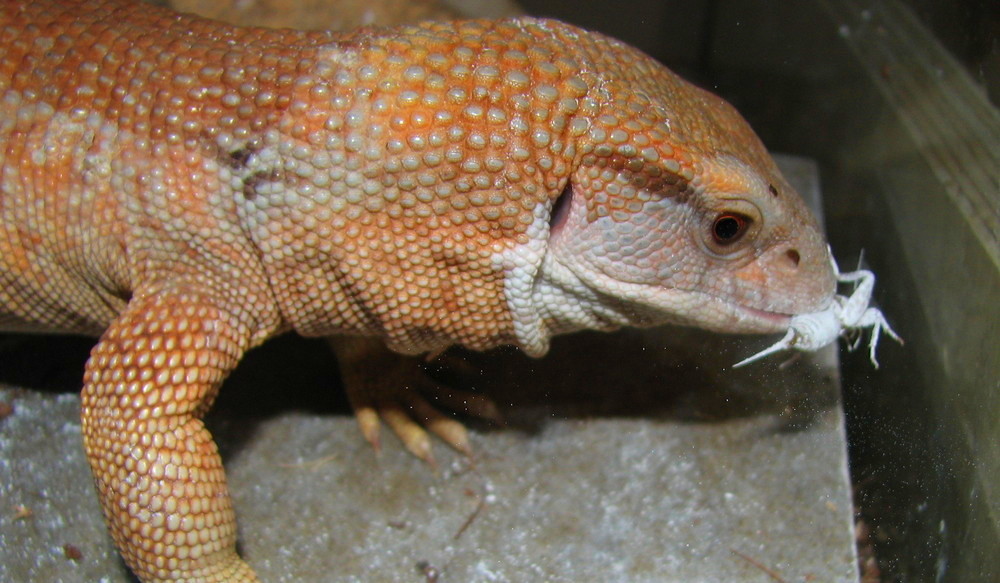
Notice the clear nails in this photo.
Welcome to kingsnake.com's message board system. Here you may share and discuss information with others about your favorite reptile and amphibian related topics such as care and feeding, caging requirements, permits and licenses, and more. Launched in 1997, the kingsnake.com message board system is one of the oldest and largest systems on the internet.


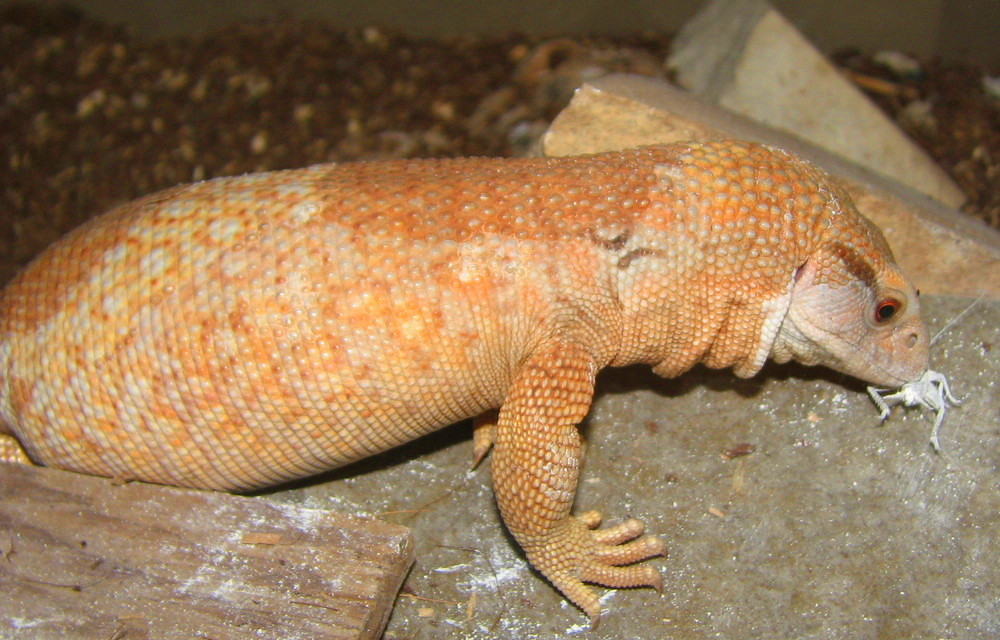
Not just a light colored normal/locality animal.
Here she is, doing what she does best. LOL
Notice the clear nails in this photo.
looks good
Where did you score that beauty??!!
Bryan
Hey Greg
Absolutely BEAUTIFUL!
Good luck breeding her!
Is this going to be the "Ball Python" of the Varanid world?
Again good find and good luck Brother!
Mike
-----
Nice Sav. Every so often those pop up on here. I remember one person obtaining four or five of them. But nothing came from them. I think they grew up to be very normal. Which is a problem with varanids, their color and pattern changes a lot as they age.
I have hatched many screaming bright yellow/red/orange individuals in the gouldi group and they turn out a bit liter, but nothing like when they were hatchlings.
I also hatched a few lacies that were extemely lite, as in hypo, they too grew up to be fairly normal.
So yes, as it is now, its a really nice hypo, but time will tell what it ends up like. So far, the adults have been normal. Good luck with yours.
You do know there is a group of albinos in captivity. Cheers
Thanks for the kind words and everyone else who replied.
Hey Frank, can you point me in the direction of any post with a Savannah that looks even remotely close to this one I posted? I have been searching and all I come up with are light colored normal/locality animals. Just so you know, this is no hatchling. This animal is about 16 inches long already.
Thanks again everyone.
Hello Gregg,
Many were posted on here in the past. I do not keep track of Savs. So I did not keep a record of who and when.
I do hope yours stays that way, but I doubt it. Again, its a varanid, and once it hits sexual maturity, it will start to darken up and get darker and darker as it ages. I hope yours doesn't.
Also the others that popped up, were not local types either. Varanids do that. They were picked out of shipments of thousands.
I do wish you luck and try and find another. I would contact one of the Fla importers.
As you already know, if you plan on producing those, monitors are very particular. In most cases, its best to raise the animals that you intend to breed together from as young as possible.
ALso, if that animal is 18 inches, its most likely male, as females start to drop eggs at aboutt that size. So you don't have much time to pair that animal up. Again, I wish you all the luck in the world, Cheers
Why is it that when you post something cool, some people need to crap on it?
I said the animal was 16 inches number one. Number two, even if the animal was 18 inches, how can you make a silly statement like "if its 18 inches it has to be a male"? Where is the logic in that?
Thirdly, these are not dwarf monitors and to tell you the truth, I think your theory about having to pair them up early on in life in order for them to successfully breed is 100% untrue.
Last but not least, I am very capable of sexing varanids, especially African varanids. I know the animal John picked up in the bin of imports is 100% a female.
Thanks for the cunstructive post Frank, but I am far from new to this. Sorry if I sound harsh but I dont appreciate you implying that I do not know what I am talking about.
Wow Gregg... relax. He was trying to help you.
You said that Frank stated "if its 18 inches it has to be a male" and that such a statement lacked logic.
But you are misquoting what he said. What he said was "if that animal is 18 inches, its most likely male, as females start to drop eggs at aboutt that size." The logic is that if it is 18 inches and hasn't dropped eggs or dropped dead from reproductive failure it is LIKELY a male. Nobody said anything about HAS TO BE. HUGE difference.
Regarding the color, Frank has hatched and raised hundreds or thousands of monitors and has been working with them for multiple decades. His EDUCATED GUESS about how yours will look when it is an adult probably has some merit. That doesn't make your monitor any less cool. It really is smokin!
You say you are experienced at "this." What experience do you have? Have you bred monitors before? How many types? How many generations? Honest questions. I know nothing about you.
Now, you stated that "I think your theory about having to pair them up early on in life in order for them to successfully breed is 100% untrue."
What is your basis for that belief? What evidence do you have to support it?
I already know and have tested Franks ideas and have found them to be valid. Why do you think they lack validity?
Firstly, I never asked anyone for "help". I was simply showing off a really cool monitor that my partner picked up.
Saying that an animal is most likely male because it is however many inches and has not laid eggs is just a silly thing to say. Not every female reptile will lay eggs when they hit a certain size/age. They can skip ovulation, they can re-absorb eggs, and so on.
It is VERY easy to visually sex African varanids.
As far as color goes, you can not compare animals that NORMALLY hatch out brightly colored and dull out as they age to an animal that strays so far from the normal looking animal at any stage of its life. Two totally different things.
If you must know what I have done in this hobby, by all means, look my name up and I am sure you will find plenty of info. I am not going to sit here and blow my own horn. Trust me, I am far from new to keeping and breeding reptiles and this includes varanids.
Now, a question for you. Do you think that monitor lizards pair up early in life in the wild before they are sexually mature? If you believe that you are a bit off. Varanids do not pair bond for life and they do not become "childhood friends" before they start to become sexually active. So if this is not a need in the wild, why would they need to be introduced at an early age in captivity?
I know many people who do the exact opposite to what Frank thinks everyone should do and are still very successful. What is your point?

"Do you think that monitor lizards pair up early in life in the wild before they are sexually mature?"
The difference is, in captivity you have a limited number of lizards available for pairing and you have a limited amount of space available for them to live. In the wild, they can court, shag, and separate at will. In captivity, they are stuck with each other in a little box for as long as you want them to be together, or until one kills the other one.
Hi madwhitehat, you took the words right out of my mouth!
Of course it can work introducing them later too, but much riskier, particularly when one of the animals is habituated to the enclosure, so by raising them from hatchlings/juveniles together in the same (tiny) space, more chance of success, I think.
You (Gregg) have a beautiful looking Bosc`s, whatever happens in the future!
Sorry for you attitude, but from experience, as I mentioned, many savs like yours have been posted here in the past. And they turned dark, maybe not as dark as a normal, but close enough to not be called hypos.
I also said, I hope yours keeps those colors and it could. But you ignore me saying that part.
Also the twenty inch female statement is directly from Daniel Bennetts field work and what is SEEN in captivity. I do not keep Savs.
Most people are not prepared for that to occur and as such lose their females. For you to understand that they can and do cycle at that size is a benefit to you, so you can be prepared.
Also I could give a flying crap how people keep their animals, After all, its their animals, But I do offer methods that have proven to support life events such as growth, pairing, nesting, reproduction and longevity. You know, based on successful personal(my)experience.
The most important advice I offer is, "listen to the animal" and not people, which includes me.
I do wish one day one of those folks you talk about that do things differently, would post their successes, that way, I could learn a thing or two. But sadly, so far, those that do things differently have not have levels of success that even got close to what our lucky monitors have achieved. or any success other then keeping their monitor alive for a year or two.
I have never said, our methods are best, all I have said is, our results seem to be consistant and allow superior life events in captivity. That is, superior growth, reproduction and longevity. You know, express good results.
With that in mind, why on gods earth would I recomend "other" methods, that have not shown results????? What am I suppose to do, tell you folks something I have no results from??? I know, that is common in the varanid world.(captivity)
Lastly, you can do anything you want, so why on friggin earth does what I say bother you????? That is a question you have to answer.
Next lastly, I said over and over, I hope your Sav stays that way. But history is against that, which does not mean YOUR SAV WILL TURN DARK. It only means, SO FAR, they all have turned dark. I am not predicting what will happen to yours, I just am offering what has happened already.
ALso, that trait is most likely like some of the ball python traits, its not a pure recessive, which means line breeding can express that trait stronger and stronger. To a point that the adults may not turn dark.
The point here is, your going to have to take that savs genes to several generations. With your attitude, good luck with that, I hope your friends can help you.
So get your bum to work and find mates and do your thing brother. Surely I am not doing it for you. Good luck, and Cheers
FR, did they post more pictures of the darkening colors of those particular savannahs over the years, or are you basing that off of conversation you had with them? I've just never seen anything like it, I remember coming across a few reports with questionable validity, but never heard anything about the colors going away. To an extent, that would be similar to what happens with varanus dumerili right? - with the severe difference in colors and patterns as they age
I've seen those sort of pink and copper toned Savannahs that are light for a time and then darken up as adults. I'd have to say the one pictured above is different with the pastel tones. I'd hang on to that one and try to pair it off to something soon, light or not, as she's getting close. Nice find Gregg.
Krusty
All of the above. over the years they have popped up, every year or so, for a while.
This one pictured is basically the same, but a real nice one. As nice as any I have seen.
As I mentioned, at least one person gathered a number of them. But nothing came of them.
Also as I said, who knows what this one will turn out like. I hope it stays that way.
Sadly, even the albinos did not end up attractive adults, with varanids.
The color change is one thing, but more importantly, no one has nad success breeding them. Which is another note of history. I do not think they would be a problem, but then not many folks have bred varanids through generations, and thats what it takes to breed out a genetic line.
If I were that person, I would get it in the hands of someone with proven success. That would be the SMART move. If the owner is from Fla. Then into krustys hands as quick as possible. Good luck
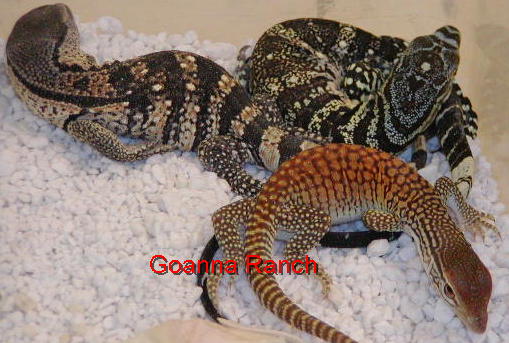
LOL. Thanks Frank. Gregg and "his partner" have hatched quite a few Varanids themselves, they just don't come online as often showing them. I have faith they'll do that animal justice.
Jesus that is a pretty Flavi in with the Lace and Albig pic.
Happy Holidays,
Krusty
Hi Justin,
That flavi is a orange normal, unlike those two beautiful flavis you posted. Those are starting to be what I poorly named reverse flavis, as you can see the black is gathering into black dots. The one above is lacking black and those black spots.
Now that your hatching these fellas, you will see a huge variation in color and pattern.
I wish I would have kept more like the one in this picture. As its an extremely nice normal pattern, normal being like the original adults.
One of the adult females I am working now has the pattern like the baby pictured. It grew up to be a very nice adult. Cheers
"I have hatched many screaming bright yellow/red/orange individuals in the gouldi group and they turn out a bit liter, but nothing like when they were hatchlings."
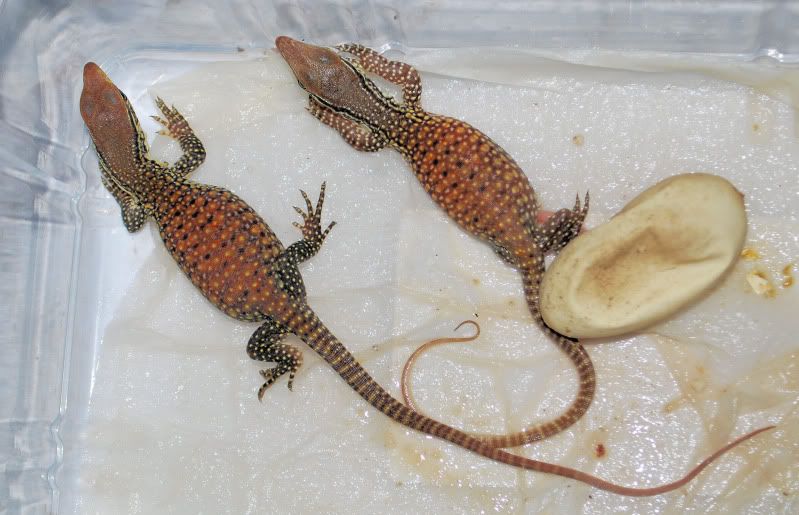
......Dammit. 
That isn't a Hypo. Just a light colored pastel Sav. Seen plenty come through and most turn darker. Cool looking right now though.
Ok, you have seen plenty of them. I am so sure. Every importer we have shown this animal to said they have never seen a savannah like it. They see thousands of savannahs every year.
Can you post a singlr link to a photo of one that looks like this? Preferably one that shows it as a "dark" adult? I have been on these forums for years and have not seen one posted like this nor have I seen any comparison photos from neonate to adult. There is no record of this at all to be found anywhere. So please, enlighten me and everyone else as to what you have seen that no one else has.
You should also know that this animal is not a baby and it is actually getting ligher as it grows. It has put on about 4 to 5 inches since it first arrived. It is just getting brighter and lighter.
Also, can you explain the clear nails (a huge indicator of hypomelanism in lizards) and the light colored tounge? I am sure you have seen that plenty of times as well as well.
Help, tips & resources quick links
Manage your user and advertising accounts
Advertising and services purchase quick links
