Reptile & Amphibian Forums

Welcome to kingsnake.com's message board system. Here you may share and discuss information with others about your favorite reptile and amphibian related topics such as care and feeding, caging requirements, permits and licenses, and more. Launched in 1997, the kingsnake.com message board system is one of the oldest and largest systems on the internet.

Click here to visit Classifieds
Click for ZooMed
Click for 65% off Shipping with Reptiles 2 You

Gravid Savannah Monitor?

bsartin Jan 14, 2012 02:35 PM

Question for the forum: Have a ~1.5 year old savannah. Did not know the sex of the animal until (she?) suddenly blew up like a football and began wandering oddly around the enclosure - as if looking for something. That was middle last week. Unusual behavior for this particular animal - unfortunately what is also unusual behavior is digging. I've never seen the animal dig or show interest therein - even though there is enough dirt and playsand in the enclosure to sink a good sized boat.

The animal is 36" total length. She has not come in contact with other monitors - not sufficient for breeding anyway.

As of yesterday - the tail base shows a noticeable decrease in mass. The quantity the animal will eat at one time has also decreased. Eating and crapping - but in smaller quantities. My guess is she is searching for a place to lay unfertilized eggs - and the reduced appetite is a function of pressure on her stomach. Our vet is out until Tuesday - and I'm starting to become concerned. Not sure the vet would be a big help for this anyway.

Any reason to believe the animal may not be gravid?
Why isn't the animal digging out a nest?
The more important question is: What should a proper savannah nest consist of?

Perhaps the enclosure lacks these ingredients.

Thanks -

Replies (90)

murrindindi Jan 14, 2012 04:50 PM

Hi, I`ll make this short; the whole enclosure is the "nest", if she doesn`t find anywhere suitable underground, she will probably either drop them absolutely anywhere, or withold them.
And just out of interest, it`s quite possible if she is gravid, the eggs could be fertile, though it hasn`t been recoerded in this species (yet), perhaps your monitor will be the first.
I hope everything works out, fertile or not, and she stays healthy, which is the main thing.

varanusaurus Jan 14, 2012 05:38 PM

Check your temps. What are they?

Your sav should absolutely be digging. They all dig, and you don't own the exception to the rule. It's possible the enclosure is so consistently cool that it will halt this behavior out of necessity.

The other reason I suspect the temps are off is your description of its body weight. Bloated body, thin tail... That is a telltale indicator of an under-heated, overweight monitor.

I have nothing at all against veterinarians, but I doubt bringing your lizard out to see one will do any good. Instead, you should go check the temps.

bsartin Jan 14, 2012 06:40 PM

Thanks but - temps I thought of. Basking surface area is 145F and quite wide. Ambient is 85. Cold side is around 77. Humidity stays consistently between 70-85. All are regulated. I doubt sufficient heat and/or ability to thermoregulate are issues here.

The tail comment in my original post stated 'as of yesterday'. The animal's tail has been the size of a baby's arm for much of its life -- again until the last 36 hours. There here has been a noticeable - very recent decrease in mass only at the base.

Murrindindi - Thank you for the reply. What happens if the animal withholds the eggs? That - and adverse impacts to the animal's health - are the root of my concerns.

varanusaurus Jan 14, 2012 07:59 PM

Admittedly, I skimmed through your original post. My b.

She flying solo in that enclosure?

FYI, the retention of eggs is the leading cause of death in paired, well-taken-care-of females. I hope that isn't the case w/ yours.

FR Jan 15, 2012 09:17 AM

First off, your measuring Air temps and reptiles do not go by air temps. You should take the temps at burrow depth and see what they are.

ALso as mentioned, Soil type is KEY, think of them as birds, each bird species has a particular way to nest and uses a particular material. You know stick nesters, or muddabbers, etc.

Monitors are very much that way. They are very particular about soil type. ALso soil temps are key, again as mentioned.

About what happens when they hold eggs and that is very very common when theres no proper nesting. Sorry to say, they die. Or die soon. After a few failed reproductive events.

If your only interested in a pet, then do take her to the vet and have the eggs and ovaries removed. She can then live a very long life without concern of reproductive failure. Of course assuming she is a she and is full of ovum or eggs.

Lastly, varanids can lay eggs that hatch without breeding. Rare but does occur.

Good luck

crocdoc2 Jan 14, 2012 08:49 PM

Sounds like she might be gravid, if she's showing sudden weight loss around the hips and tail base, reduced appetite and more digging behaviour.

You'll want a large area of deep dirt or a dirt/sand mixture, humid (but not wet) and compacted so that it will hold a burrow well, with temperatures below the surface of around 30C/86F. Put some large flat objects on the surface (thick pieces of plywood or large pieces of bark) to support the burrows once she digs under them.

I've never bred this species, so this is all based on what has worked for other breeders working with this and other monitor species.

Gregg_M_Madden Jan 15, 2012 12:59 PM

Why as no one mentioned making a nest box? It is the best way to ensure your varanid has a proper spot to lay its eggs. The easiest way to make a nest box is to buy a suitable sized rubbermaid bin, cut a hole large enough in the lid for your varanid to get into the bin. Fill the bin with with damp coco peet and play sand. 75% coco peet and 25% play sand. Put the nest box in an area where the temps will be around 85 degrees inside the nest box.

9 times out of 10 monitors will choose a nest box to lay in over other part of the cage. It will save you from digging out an entire cage of dirt and will more than likely keep your varanid from retaining its eggs.

crocdoc2 Jan 15, 2012 01:28 PM

I use a nest box with my lace monitors (and have done for many years) because they are pretty much obligate termite mound nesters in most of their range and it's easy to replicate the conditions in a termite mound using a nest box.

I wouldn't do the same with a medium to large ground burrowing species. Have you tried it with any largish non-odatria species? My only experience with breeding ground burrowers was when working with perenties a few years ago and the extent of the nest burrows the female made would have precluded any nest box.

FR Jan 15, 2012 03:59 PM

Nest boxes have proved reliable. And for many reasons.

As CrocDoc mentioned, many species including Savs, make fairly long burrows for the safety of the nest, then bury them deeply and hide all signs of the nest.

This must be very important to them.

Also if you provide decent heat options, its hard to keep the nest box cool enough, if its above substrate level.

ALso, Many monitors just do not recognise a box as anything usable. They do even try to nest in them.

So for the most part, above substrate level nesting has not worked to well, and when it has worked its been very inconsistant. But there have been a few exceptions. Sadly, not with Savs.

I have to wonder, how did you come up with those ideas of yours?

Paradon Jan 15, 2012 11:53 PM

If you keep the substrate damp enough...they will lay in them. I think having it a little warm will also encourage them to laid.

FR Jan 16, 2012 09:29 AM

Hi Paradon, It really doesn't work like that. Which is why your advice often is contrary to the reality of varanids.

You often say, varanids are easy, which is so very naive of you.

If it was easy, then everyone would be breeding them like colubrids or boas, or balls or beardeds and geckos. What that has not happened even thought, I have been producing them in number for a couple decades. And a few others as well.

Nest is the most critical part, because its not only life or death for the eggs, but also life or death for the female. And in the case of Savs, normally death. Sometimes after the first attempt, but normally after the second or third.

Of course it HAS to be the right temps, humidity(not damp) the right depth and feel, but also the right material. And it all needs to be there at the time of copulation. There is no last minute stuff here.

The real problem is prejudiced keepers, like you and Gregg, you often think like the masses of other snake keepers and come up with that old rubbermaid nest box thing. Well that has been tried and failed a million times, oh a success here and there, but only temporary successes.

As you may have noticed, there are no Sav breeders that have had generations of success, none, zero, nada.

I produced Whitethroats thru several generations, and they are very closely related. Cheers

Paradon Jan 16, 2012 02:05 PM

I didn't say anything about a nest box... I said the cage substrate.

FR Jan 16, 2012 03:48 PM

Yea huh? I added that, because its a common idea thats somehow out there without support.

I think there is something wrong with the word encourage. All we have been able to do is, allow them what they REQUIRE to do.

I think the problem is, you can do anything you want to the wrong material and it will not work.

Its a hard one to explain. They KNOW with their lifes what works and what does not work. They pay no attention to what does not work.

We as humans have the ability to rationalize, they do not. It either fits or not. And truely they do not mess with what does not work.

Paradon Jan 16, 2012 09:23 PM

Of course, you're right as usual.

wldktrptls Jan 16, 2012 11:03 PM

Well, get used to it! The old fella really does know his stuff... I resisted at first too. Then after filling my roughneck cage with a foot of leaves and.crap off the ground from Under some trees, which I thought was quite simply insane and certain to kill the pair, they began mating then laying. Dang it! He WAS right! Guess decades of breeding these guys has some benefits after all... guy
Image

crocdoc2 Jan 16, 2012 03:54 PM

Damp has the potential to kill eggs and would discourage a female from nesting. It has to be humid but not actually wet.

Temperature is really important - well beyond "having it a little warm will encourage them to lay", monitors have very specific temperature requirements when it comes to nesting.

It has to be said, I agree with FR in questioning your activities on this forum. For someone that does not keep monitors and has even said they don't actually like monitors, you do spend a lot of time hanging around a monitor forum (which is fine and harms no one) offering poor advice (which is not fine, as it affects others). This forum may be a social outlet for you, as it seems to be for a lot of people on many of the forums of which I am a member, and I have no issues with that (although if it were me and I didn't actually keep monitors, I'd be doing something else involving going outside and getting fresh air). However, when you try to offer advice to others the readers may not realise you've never kept monitors and get themselves, and their monitors, into trouble. Even if you think you're just typing out the same words that you've read elsewhere, slight change in phrasing ('damp' vs 'humid' for example) can make a huge difference in outcome.

Gregg_M_Madden Jan 16, 2012 04:55 PM

You keep putting me in groups of people you seem to think are no good for this hobby or should not be heard out. Do you know me? Anything about me or what I have done? Is it impossible that there are people who have been working with monitors for as long as anyone that you dont know? What bothers you Frank? Is it the fact thst if you stop short Gregg will not come flying out of your mouth? Is it the fact that I have proven some of your posts to be absolute nonsence?

Do you think that offering a nest box will do any harm?

Seriously, why do you think varanids are so much different than any other reptile species? They need the same as any other lizard species. When it comes to nesting they look for the proper temps and humidity levels. If you can provide the ideal conditions, they will lay their eggs in the nest box. Some of you make it more complicated than it really is.

FR Jan 16, 2012 05:42 PM

Hi Gregg, did I ever say you were no good for the hobby?

I am sorry but all I know of you is what you write here.

The problem is, what you say is exactly the same as so many before you. With the same thoughts etc, and they failed. I am trying to help you.

They think because they did well with other reptiles, they will automatically do well with Monitors. So far, that has not worked out so well. Not in the least.

Monitors seem to rely more on behavior and less on instint. Or so it seems.

With most types of reptiles you can follow a recipe and achieve average results, Monitors buck that trend.

About reptiles, I have been breeding lizards since 1962 and snakes since 1964, many world firsts in various areas, etc etc etc. I have kept and bred all manner of reptiles.

Then in 1991, I entered the world of varanids and have succeeded very well, again many world firsts, etc. And generations upon generations of around 20 species of varanids. Including producing 18 different species in one year, but thats a bit of history.

Oh and I still keep and breed other types of reptiles and do field work too.

I still keep and breed varanids. Some hatching as we speak.

I have bred, indo, african and australian species, from amoung the smallest, V.kingorum, caudolineatus, gilleni, etc, thru the largest, V.salvatorri and Varius.

So I report to you what has worked. I wish you well with your first monitor. Cheers

Gregg_M_Madden Jan 16, 2012 09:35 PM

Frank, my first monitor was back in 1992. Monitors are no different than other reptiles. The sooner people realize this, the better they will do with them. They are not complicated or hard to keep. You make it seem like so much more work than it really is Frank. They are simple. Awesome, but simple.

You know nothing about me or what I have done. To imply that I just got my first monitor is foolish of you. There are people on this site who know me so you just make yourself look rediculous.

You do not know it all Frank. Going out herping does not constitute "field work". I am out cayching snakes all spring and summer long. Am I doing "field work"? LOL. I love you you try to make yourself look so important. You blowing your own horn does not impress me one bit.

By the way, is V. salvatorri a new species?

varanusaurus Jan 16, 2012 11:55 PM

Is all this nest-box banter coming from the same guy who can't get his dumerilli to produce, or am I mistaken?

"Monitors are no different than other reptiles."

What an irresponsibly foolish thing to say on a forum such as this. You must be a wholesaler. Well, thanks for advertising your blatant ignorance.

BTW, is rediculous a new word? Perhaps it bypassed the Latin spell check.

Gregg_M_Madden Jan 17, 2012 07:33 AM

I do not now and have never owned V. dumerilli. I am a private breeder and have no reason to wholesale anything off. I have no problems selling my offspring at full price. You are clearly thinking of someone else.

So now, tell me, besides their awesomeness, what makes varanids so much different from any other reptile? And seriously, dont make them out to be more than they really are.

FR Jan 17, 2012 09:43 AM

Gregg, go find captive hatched Savs in the states, or in Europe.

Go find any truely captive hatched varanids.

Now tell me why its kinda of a problem, why are there only a few people actually breeding varanids? If its so easy.

No one has to sit and tell you why, all you have to do is some research like try and find truely captive hatched. Of any type.

To actually understand this, we have been producing species after species since 1991.

So you explain to me why its so simple when others have so much trouble doing it. seriously Gregg, what makes you so smart that you can come here where so many people are failing and say, There simple. Yet you have not ever succeeded once. Gregg, no offense but you sure do think a lot of yourself. Good luck

moe64 Jan 17, 2012 07:43 AM

You know when things are headed in the wrong direction when the spelling errors are pointed out.How bout when the people who like Frank says have had more than marginal success with Sav's post their success things will be more definitive.If you don't like what Paradon says or anyone else post your thoughts,or ignore-those with some kind of commonsense will quickly rule out bad advise.My thoughts are if they rule out the advice of Frank,Murrindindi,CrocDoc they are probably going to fail.I have marginal success with monitors,i have an opinion which differs from many on here,that won't cause someone to fail.In an unproven topic such as Sav's people have the right to voice their opinions in generalized way on topics such as diet or husbandry. Moe

FR Jan 17, 2012 09:30 AM

Sorry Greg, I only know what you tell me.

So here, you have only mentioned one Sav. and your thoughts are very similar to that experience level.

Also about attacking me, how silly of you. I do sanctioned field work authorized by the state, permits required etc. Been doing that for a very long time.

But thats not the point, the point is Varanids.

If you would take the time to read, I stated that varanids are very generalized, and that can and does mean SIMPLE.

The point is, if they are so simple, why haven't other reptile experts had ANY SUCCESS, muchless some success. Why haven't you.

Also attacking my spelling, how ignorant of you. That has nothing to do with varanid experience. That you have so little, out of of that resume, you pick out a misspelled word, hahahahahahaha why heck Gregg, you could do that in just about any paragraph I write.

The point is still the same, your theories, are identical to a long list of those before you, I only respond to you, with hopes that you do not have to go through the same set of failures those others have.

To put it simple, if you want a pet sav, then keep up with your theories, your sav will grow well, become adult, then perish looking very fat and healthy. That is the true history of your approach.

If your intentions are to breed them, and you have a unique individual, which means you cannot just go get another one, You really should listen to those with repeated success with varanids. It would be to your advantage.

ALso, if you are really good, you would adapt and change to the needs of your monitor, but because you put up this stubborn fight and do not try to listen, my bet is again, your in for a very hard time.

Again with varanids, its not the physical part thats a problem. In fact, to me, they are far easier then other reptiles. The problem is BEHAVIORAL. which is often ignored with other reptiles.

Also, hi metabolism reptiles are kept out of the hobby, as they are too much work and do not follow recipe husbandry. You know, the fast active types of any group.

So I wish you well. Again, I do not know you from Adam, so unless you can tell me something or give me something to go by, thats all I know of you. Again, your approach is all I have to go by, and its common and in all cases resulted in failure. I do wish I could not say that.

Again, naivity is not knowing, you call them simple, because you never experienced the complicated part. Which is pairing and nesting. That result in hatchable eggs. Oh by the way, very few other reptile types will throw eggs at you like varanids do. Its the hatchlings that are rare. Cheers

Johnantny Jan 17, 2012 10:11 AM

Hi Frank,

Just to clear the air a bit... Gregg M is a good friend of mine and is better known in Hognose, Gaboon and Gecko circles. He helps care for my varanids when i am away and has been instrumental in the design and production of the S.I.M. Egg Container by Squamata Concepts.

The Hypo Savannah was purchased by me from a FL importer back in Nov. Its in our care and is thriving. We have it set up with the best possible outcome in mind. I have best intentions to captive breed this female, and have now acquired a young male normal Sav. Gregg will play a role in its care when I travel, and has done so for me for years. He spends a lot of time at my place and knows how maniacal I am about varanids. For those that do not know me, I have been a dedicated keeper since 1989. My website cybersalvator . com was one of the first dedicated to varanids, and had a better following for years. I have a fairly good handle on the lizards' needs and I will post more about its coming events. Currently, I produce some dwarf monitors such as ackies, tristis, glauerti, and others.

Gregg knows that we all face difficulty in producing cbb varanids. He too can learn a bit more about these lizards and I can as well. I've told him to just listen well and post his argument without being argumentative.

Varanosaurus, Gregg might not be able to spell certain words without a spell check but I can vouch for him in telling you this: You were not correct. Gregg has never worked with Dumerili.

Hope this helps all parties.... I am not prone to post here much lately, but there was a time...

Thanks and good day!!!

John

varanusaurus Jan 17, 2012 11:32 AM

I appreciate your publicist approach, Johnantny.

To be more or less fair, Gregg (if I can call you that), I did 'jump the gun' on you. Indeed, you are not who I suspected. Actually, I think it's a great thing that you and your friend have done with the egg box. I still maintain, however, that you are wrong about the nest boxes, and infinitely more wrong about varanids being just like any other reptile. And I thought it pertinent to let you know that because you threw a very low jab at a man for whom I have immense respect.

FR Jan 17, 2012 08:43 PM

No John, it does nothing. Gregg acts as if, he is one with knowledge and experience. wHich is so very wrong.

he attacks me, as many have in the past, ones without the foggist idea of what is going on.

I guess you make it simple for him. Yet, he knows nothing on his own. And that is a period.

I do wish you luck with that Sav. And I hope you know better then to try a nest box FIRST. Cheers

wldktrptls Jan 17, 2012 02:50 PM

LW stands for lizard whisperer not legendary writer. Catch a clue and read.
beyond the spelling. Juzt to pizz off a bun h of olks ya shoulda seen the bibles First Draft! Hanging participles, run on. Clauses and the punctuagion,! Guess he hadn't come uo with spellcheck yet. Try going past what you alreadh know and think hat there mrapley be more to learn.... could net maybe...... guy

murrindindi Jan 17, 2012 11:48 AM

Varanids aren`t simple, neither are they like any other reptile in many respects, on the contrary, some of their features make them totally different (captive care wise).
Do you (Gregg), treat them like your snakes, other lizards (families), and advise others to do the same?
Isn`t that precisely why so many newcomers fail even to keep them alive for any length of time...
Experience and knowledge (understanding), are two entirely different things, when someone with both those things offers advise, I listen very closely.
Frank Retes doesn`t have all the answers, never pretends to, but his depth of knowledge is great, his RESULTS speak for themselves, all the "young pretenders" have many miles to go to even come within sight...
I know you had a Savannah monitor for (17?) years, so how did you do it? That`s truly a very rare occurence!
That info could help so many animals LIVE instead of die much too soon... Details, please!

Gregg_M_Madden Jan 17, 2012 05:02 PM

I know all about keeping difficult reptiles. Gaboons, rhino vipers and bush vipers are some of the hardest reptiles to keep alive and to breed. As John stated, I am well known for my success with these species. I am no stranger to keeping and caring for varanids as Frank seems to think. I have been involved in the successful breeding of a few species.

My very first varanid was a sav. This was back in 1992. In the begining, The care I gave it was sub-par in todays varanid keeping standards. I learned a lot about keeping them through the years from John and my very good friend now resting in peace, Mark Bayless. I changed my way of keeping because of those two individuals and have done well.

Since my first ever sav, I have owned other various species like niles, ornates, black throats, white throats and croc monitors. John, what was it, 1994 when we first got those crocs? I got out of varanids to focus more on my venomous. Just as a side note, I have never had a monitor die in my care from being egg bound. I have bought a couple of crappy imports that have died shortly after buying them but never a healthy well started animal. Also John and myself were the first people in over 20 years to import Varanus spinulosus into the US 2 years ago. Got the paper work if anyone cares to see it.

Anyway, why I think nest boxes can solve some issues.
I have always offered nest boxes for my female varanids. Every species I have ever had that laid infertile eggs did so in a nest box without fail. This includes savannahs. To totally disregard the use of a nest box is foolish. I can not hurt to offer one and can actually solve a problem someone is having. What would someone have to loose by offering another laying option?

When I say Varanids are no different from any other reptile I mean that they will thrive just fine when given the proper environment. If you do not keep a garter snake properly it will not breed, thrive, or live long in your care. I am not saying you should keep a varanid like a cornsnake. I am saying if you keep a varanid properly, you will have no more issues than someone keeping a cornsnake properly. They are not creatures of habbit like Frank wants to have people believe. If that was the case, there would not be much that would keep them from breeding in captivity. They are animals that run on instict and environmental cues. They are lizards, not primates or pack animals. They do not need company or companionship. They would rather be solitary. Sure, you can find a few varanids under the same rock. I can lift a board and find 20 garters under it. This does not make them social.

Franks way works for him. Franks way does not work for everyone and Franks way is not the only way. There are many people who have success without doing anything like Frank. There are many more people who keep and breed varanids than most people realize. Just because they do not post here it does not mean they do not exist.

Frank, About the captive bred savannahs. They are a 2 dollar import. Is it really worth the time and effort to produce huge clutches of 5 dollar animals? For someone who really likes the species it would be worth it. For a breeder looking to capitalize on their work, not in the slightest. Hopefully the Savannah John and myself will be working with will help change that outlook and there will be lots of true captive born and bred savs on the market that can fetch more than 10 bucks each.

murrindindi Jan 17, 2012 06:32 PM

I find you quite ignorant (as in not very knowledgeable) about varanids; they are very sophisticated, intelligent animals, undoubtably capable of learning to a great extent...
You seem to have a very "old fashioned" view of reptiles as being somehow inferior, at least in cognative abilities, when compared to mammals?
Can I ask how many times you`ve bred V. exanthematicus, as you mention you always offered a "nest box" and they always used it?
Who said these should never be used, or wouldn`t work?
You have some strange ideas about these animals in the wild (I refer to our discussion on another forum), where you seem to suggest the wild is almost a "picnic" for varanids; food always available, they have no trouble securing a meal each day??
I`m guessing you`ve never seen a varanid in it`s country of origin (in person), you surely haven`t explored my country (Australia), or Africa, India, Asia etc, if you think the wild`s a "paradise", because some of your remarks were unbelievably naive!
OBVIOUSLY, ALL captive varanids would flourish if conditions were such they were fully supported, so lets hear your "secrets", and what the vast majority should do to get it right, so the wholesale slaugher can stop.....(You clearly think you have the answers).

FR Jan 18, 2012 01:37 PM

How about asking where they got the basking temps from, or security, hides, etc from, hmmmmmmmmmm I do wonder why he challanges my methods then uses them.

I was very lucky to be at the right place at the right time. Fortunate that my "different" methods worked so well with varanids.

Now these Johnny come latelys use my methods and think they are somehow the originators of something.

All the species they have success with was done longer before them. With my methods. How funny is that.

Sorry for the rant, but dang these folks are funny

FR Jan 17, 2012 10:27 PM

A couple of things Gregg, what have YOU DONE, not what John has done.

You see, I have worked at several zoos and bred all manner of Zoo animals, but I never take credit for that. And for many reasons, As I did not buy those animals out of my pocket, nor did I make or buy the cages or food, etc. Those animals were bred by the ZOO. Not me.

That you take care of Johns animals while hes gone, hmmmmmmmm and you take credit for that. Good on you.

No offense to John, but those animals he is breeding, I pioneered, either world first, or U.S. first or second, but I did establish them. No offense, hes very easy to do something thats already done.

About my methods, God I love this, what are they? I do whatever it takes to succeed, I often go against my methods, whatever they are.

You read something on a forum or listen to a bunch of Yahoos and you think you know me, hahahahahahahas Gregg, your acting Like FR. hahahahahahahahahahaha

Good luck helping John breed that Sav. By the way, if you would have just started out telling the truth, like JOHN did, I would have said, listen to John. But you didn't you led everyone on that you were actually doing something. good luck with that.

Gregg_M_Madden Jan 18, 2012 07:46 AM

There are still some things you are missing Frank. John is away on business 4 months out of the year. Those 4 month I am fully in charge of those varanids. I am also partners with im on a couple of those animals.

Yeah yeah, you pioneered this, that, and the other thing. You doing your thing again. Making yourself look important. Like if it were not for you we would have no dwarf varanids. Thats all good Frank because soon you will be seeing some firsts from John and myself. Rather soon actually.

You still have no idea what I have done with varanids Frank. You assume I have done nothing but tthe people who matter know what I have done and capable of. I am just not going to justify your nonsence with my details.

I have seen varanids breed and lay viable eggs while being kept in conditions where you would say its impossible. Heck I even thought it would have been. John could even tell you. He has seen it as well. The fact is, there is no special formula. If they are offered the right conditions they will do what they are programed to do and that is eat and reproduce. No matter ow capable a varanid is of "thinking", those two things are instinctive. Getting them to breed and lay eggs is not hard to do. Getting the eggs to hatch can be difficult. However, John and myself have fixed that issue with te SIM container. LOL.

Also, for the record, you attacked me first when I posted the picture of that hypo sav. Right away you thought it should go into the hands of someone that can care for it properly without knowing a single thing about me.

FR Jan 18, 2012 10:35 AM

STop it Gregg, I could careless what you have done, you have already acted in such a weird way. Pretending or whatever your helping John is.

Sir there is a difference between owning and being a helper.

ALso, I do not know what you have done, because nothing you have done has EVER been reported on here or other forums or magazines, etc. Simply put, you do not register, at all. And you did not put the real cards on the table. You act as if ITS ALL ABOUT YOU.

You have not done anything for this hobby. That I can be aware of or am aware of, Have you?

Sim incubators, I am sorry I cannot get into that. The reason is simple, I have been successfully incubating varanid eggs since 1991 continiously. I have had monitor eggs in the incubator, each day, every month, shy of one month since then. So I ask you, if you were me, would you get all excited about those containers? Oh and I/and millions of others, have been hatching all manner of amniote eggs for a very long time.

You made a commerical product, good on you. But its not needed in the least. I hope its good and has a value and you make some money.

The problem is, your approach is sad, considering the whole of readership here. I hope it works for you, you know that nesting thing. But sadly my bet is, John and you have had tons of problems nesting larger varanids. So what your talking about is THEORY. Tell me if I am wrong. The only way I could know better is you or John tell me.

If you were half as smart as you want us to believe, you would have waited until you had success, then posted your stuff. At least then WE could debate success to success.

Can nest boxes work, yes, In the several thousand successful nestings I have had, I have had a few dozen successful nest box events. So what should I tell others, the nest box events, which also had many many dozen failures, or the repeated generation after generation, of many many species, whole cage nestings? I ask you, what should I tell folks?? This is a good and real question, what should I promote, what has a better chance of working or what has a limited chance of working? Answer this Gregg.

Gregg, it would be stupid and WRONG of me to advise folks to follow a method with limited success.

The larger the area for medium sized varanids, the greater the success. Its that simple. The problem is and will be SPACE for larger varanids.

You see, a cage is a BOX. fill it with suitable material and its a nest box. A little box(your nestbox) within that box is highly restrictive and has to be perfect as in just right, no room for error. The whole cage has room for error on the keepers part. So what do you want, a limited chance of success, if all things are perfect, or a method where theres lots of ROOM for error? answer this too.

The point is, if you are so frogging smart and figure out exactly what those Savs need in a small box, good on you.

Do you think we are all as smart as you???? the cool part is, I do not have to be as smart as you. I can be dumb and still kick your arse with repeated success. I would do so, by letting the monitor use ITS SMARTS.

So please sir, come back after you produce some generations, not challange me before you do anything. Guezzzzzz how common sense is that.

That you challange known success with theory, makes you one very egotistical person.

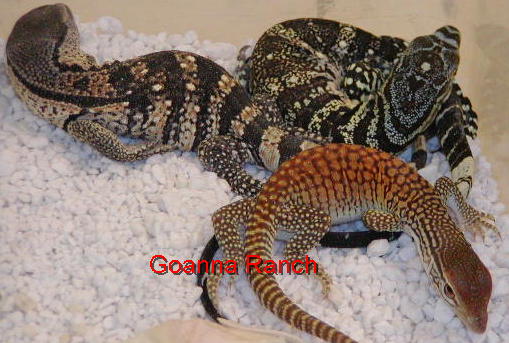
Could you post a pic of varanids You owned and produced, all by yourself, without John holding your hand or telling you what to do.

The picture is a little sample of what hatched here in one day
Gregg_M_Madden Jan 19, 2012 07:39 AM

Great pic from what, 2001 Frank? Try posting something more up to date. Its like that 40 year old chic on facebook who posts pictures of herself when she was 22 years old and 25 pounds lighter. You know, so people will think shes still hot.

Anyway,
Here is your problem Frank. You measure success buy how many viable eggs someone can get from their animals. I mesure success in keeping by how long you can keep your animals alive and healthy for in captivity. Keeping reptiles is not all about breeding. Who is more successful, they guy who gets 2 clutches out of a female and drops dead the next seson or they guy who does not get eggs and keeps that animal alive and healthy for 15 years?

nother problem you have is that you think your way is the only way. It is not. Wht works for you does not work for others and what works for others does not work for you. It is that simple. Here is what I think. There is no one particular formula when keeping a species. You should be open to other ideas and ways Frank or atleast let others give their advice from their personal experience without pulling your usual brand of nonsence.

Have a good one.

WillStill Jan 19, 2012 08:58 AM

Hi Gregg,

I see it as two different outlooks as to what defines success.
It is my personal view (and the view of many others) that a reptile's goal in life is to reproduce and contribute to the next generation of their given population. I do not believe that their instinctual drive changes in captivity. Using that logic, I absolutely believe that it more important to support animals to the level where they are allowed to reproduce than, living a long, static life alone in a box. If they die after a couple of clutches that only alerts the keeper to the realization that their husbandry sucks. I have been keeping herps for more than 30 years and I have seen, and continue to see daily, that they benefit from contact with others of their own species. If you haven't seen evidence of that, perhaps you should ask yourself why not, instead of preaching those antiquated "solitary existance" theories to keepers here, who may not have the experience to know better. You asked a somewhat rhetorical question in an earlier post as to whether seeing 20 garters under a board makes them social, well, yeah it does; so does seeing a large group of spotted turtles foraging together year after year; so does seeing captive kingsnakes and monitors tending to gravid females. I know that these behaviors may not fit Webster's definition of social, but then again, I am not so arrogant as to assume that because a human decided what the definition of social should be, that is the last word on the subject.

An animal's behaviors do not change once they are captives. Their behaviors are based on their genetic potential that has been fine-tuned via natural selection over the millenia. To think that humans can supercede natural selection and change inherited behavior because we put them in a box is incredibly arrogant. To claim that behaviors do not exist because you are not seeing them is incredibly arrogant. I have bitten my tongue throughout this thread because I don't know you, but what you are claiming is just not what many of us have seen, and continue to see. You can do what you want, and luckily for you, the animals that you keep will likely continue to reproduce for you in the manner in which you keep them. However, that does not mean that if you stepped outside the box so to speak you wouldn't witness other behaviors. Observant keepers would and do see these things every day, yet that often goes unreported because they are tired of dealing with the nay-saying, antiquated book-quoters on this and other forums.

So, while I repect your accomplishments with gaboons, rhinos, bush vipers and hogs, I do not appreciate your blanket statements regarding behaviors that you have not seen. The behaviors myself and other have witnessed go well beyond the boundaries of animals "tolerating" one another, and while they may not be social by definition, they are social in the reality of the natural world. Thanks.

Will

FR Jan 19, 2012 02:29 PM

I have to say, you really don't know what your talking about.

Lets see, ackies, 18years, lacies 18 years, perenty 15years. Flavi, 15 years and going strong.

One cross lived 14years and produced over 80 clutches, and they were reported here, as they occurred.

on and on and on.

As you should know, high basking temps are from me. Retes boards are from me. And such things as heatum and feedum(Scott Selsted and I) Also the term Life events. More accurately captives should achieve basic life events like GROWTH, REPRODUCTION and LONGEVITY. All three sir(and I am not sure I mean that in a good way anymore)Not one or the other

It appears your so far behind its pathetic.
This hatched today, well actually yesterday, hahahahahahaha

Whats the matter you cannot read, I have had varanid eggs incubating continuiously since 1991. I did miss some days in a month recently, but close enough.

So keep going with your wacky stuff, your making John proud. Cheers

Gregg_M_Madden Jan 19, 2012 06:40 PM

Frank, not everyone keeping vranids needs to have them reproduce for them. Some people are just fine without ever breeding their monitors. And you now what? Its ok and it does not make them unsuccessful keepers. You keep saying how far behind I am and how I know nothing. You saying it over and over again does not make it true. You are like a child who is not getting their way. Like I have said before, people who know me and what I have done know better. What you think has no effect on me. If you think your insulting posts are hurting my feelings, guess again. My skin is a bit thicker than you might think. It going to be funny when Things pan out. I am sure you will still have something stupid to say though.

And no Frank, the high temps did not come from you and neither did the wood stacks. The Germans and other Europeans have been using "your methods" long before you got involved in Varanids. You just took other peoples ideas and made them your own. As much as I hate to admit it, the Europeans are far ahead of us as far as varanid care and reproduction goes.

WillStill,
While I do not fully agree with your post (I do for the most part) I appreciate you posting your thoughts like a gentleman and being respectful instead of like Frank does.

Reptiles do not have a social structure. Keeping reptiles in groups has proven to be detrimental in more times than not. In the wild, there is a way to avoid situation and escape danger. In a cage, there is no escape.

I have seen the same behaviors you mention. I just do not view them as social behaviors. They are more like survival mechanisms. Pack/pride animals and primates have social structure with a clear cut hierarchy. You will not see such a structure in any species of reptile including varanids. They do not even have a primative social structure like birds do.

Agian, what we see in reptiles are basic survival mechanisms that even insects display. In fact, honey producing bees and ants display more of a social stucture. Not because they are "smarter" but because it benefits them as a species.

Reptiles never evolved a social structure because it is not needed for their survival individually or as a species.

Someone asked me how I was able to keep my Savannah alive for so many years in a post above. My secret is, I keep thins simple. That is how I am successful with so many other species when it comes to reproducing and keeping them alive and healthy. I do not look for things that do not exist in their biology. I do not complicate simple tasks. I do what works for me. If it works for me, it can work for other people. Like I said, there is more than one way to do something. As long as the end results are positive, you reall can knock someone.

varanusaurus Jan 20, 2012 01:47 AM

If not versed in varanid husbandry, you certainly know a thing or two about manipulating a conversation.

Calparsoni Jan 20, 2012 03:18 AM

Corucia zebrata,-live in colonies, Tiliqua (trachydosaurus) rugosus -form permanent pair bonds, basilisks-live in groups- basically harem type situations, Anoles-same as basilisks (easily observed here in fl if you ignore mickey mouse and look around you). there are countless other examples of social structure in reptiles particularly in lizards. There was a researcher here in fl. whose name escapes me right now. he did research on gopher tortoises and found that they communicate with sounds below our range of hearing and determined that they have a language similar to that of whales ( his words not mine....He did a talk about it one year for the CFHS .) as I said his name escapes me right now but he was a well respected researcher on gopher tortoises.
Reptile social structures may not be on the level of wolves or Lions or Domestic rats but they do exist and quite often on a level comparable to many species of artiodactyls.

WillStill Jan 20, 2012 07:38 AM

Hi Calparsoni,

Great examples, thanks. I've sat and watched anoles on numerous occasions. Observant herpers can learn a lot from their physical displays/communication. Thanks again.

Will

Gregg_M_Madden Jan 20, 2012 08:56 AM

Again, there is a difference between social structure and survival mechanism. It is easy to confuse the two. Coming together for certain events like mating or for the same optimal conditions does not make a a species social and there certainly is no structure. One huge thing that determins a social structure that reptiles completely lack is emotional bonding complex thinking (not instinctive reaction) and a hierarchy. Not even a pecking order.

Interesting about the gophers. Got a link? That would be the first ever recorded vocal communication in reptiles. Big news I would think.

So, give me an example of social behavior in varanids. That is the topic we are on here, not shinglebacks. I will give you that one though. The for life pair bonding in that species is pretty interesting and should be looked into mre.

I am not saying they are stupid mindless drones. However, they are not social animals with complex thought processes and emotional ties to others.

jburokas Jan 20, 2012 10:06 AM

I'm sure as heck not getting involved in this spat, but:

"That would be the first ever recorded vocal communication in reptiles."

Ever seen Alligators during mating season? Look up "water dance" in crocodilians. I see it here in FL every spring. Pretty amazing to hear and see.

http://www.youtube.com/watch?v=PAS_aULdSsQ

crocdoc2 Jan 20, 2012 05:58 PM

Yeah, what he said:
"I'm sure as heck not getting involved in this spat, but:"

I've got another reply to add to "That would be the first ever recorded vocal communication in reptiles."

Geckos.

The first time I heard tokay geckos calling in Southeast Asia, I knew right away how all geckos got their name. That particular species has a call that sounds just like their Latin name: Gecko gecko (although, if you listen for long enough, it can also sound like 'tokay tokay').

murrindindi Jan 20, 2012 12:11 PM

Hi again Gregg, I really don`t know where you`re getting your info? Have you read any of Tsellarius`s studies (over 15 years) on the Desert monitor? They have quite a complex social structure.
You make these statements based (seemingly) only on what you have read, that`s a very strange way to learn, because all the results you haven`t seen/read don`t figure in your responses!? You CLEARLY are lacking in knowledge (understanding) of Varanids, experience is NOT knowledge, they are two entirely different things!

Gregg_M_Madden Jan 20, 2012 04:56 PM

Justin, Thanks for the correction on that. Didnt even consider the gators in my argument.

Murrindindi,
Just because I do not mistake survival mechanisms for social behavior does not mean I am clearly lacking in knowledge. I am being realistic and not making these animals out to be more than thay really are. There is no need to. They are awesome just the way they are.

Tell me more about this "complex social structure" in desert monitors. You are telling me that what I know or think comes from reading and at the same time you are asking me if I have read someone elses findings.

Experience is better than book knowledge but the books help too. From my experience, varanids have no social structure. They do not bond to others. They do not need eachothers company, and they are far from emotional. There is much more to being social than just being found in the same log, under the same rock, or under the same sheet of tin. You need a structure, a hierarchy, emotional bonding, and complex thought processes.

murrindindi Jan 20, 2012 05:59 PM

Hi again Gregg,
the studies by Tsellarius were on wild populations, not captives held in tiny boxes of dirt, THAT`S what makes them so interesting and "real". The articles are not available to view online as far as I know, but I`d be most happy to PM you the titles etc, if you`d like to get copies from a library?
I think you still have much to learn, that`s in no way disrespectful, but unless you have more info you cannot make such broad statements. They don`t need spoken language to communicate, or to show cognative abilities, they ARE animals which have very clear learning abilities, beyond just acting on "instinct" as you claim!

Gregg_M_Madden Jan 21, 2012 10:08 AM

We all have a lot to learn. Even Frank does. But to imply I am clueless is just rediculous. I have a lot more experience keeping varanids than most people on this site. Frank only started keeping them a year before me. Never had an interest in breeding them until recently. I never bred varanids because I never kept them in pairs or groups. I have had females lay tons of eggs though. All in nest boxes by the way.

I never said they run purely on instinct. I know they can "learn" basic things that help with their survival. Most animals are capable of basic learning through repetition. However, they are not capable of complex thought, reasoning, or emotional bonding. Look at their brains. They lack certain areas of the brain responsible for those things. Just peel away the entire wrinkled mass of our brains and that is what a varanids brain looks like.

It is clear that they are not emotional animals. When they get injured, there is no emotional responce like you see in mammals.

A lot of behaviors you see in captivity are nothing like what you would see in the wild. We are keeping these lizards in boxes. We are forcing them into situation they would normally not partake in in a wild situation. Someone had mentioned that you can not change a reptiles behavior by keeping them in captivity. This is mostly true. What happens though is that behaviors are often misread. Like when you see a few animals in the same area of the cage. Is it because they want to hang with their buddies or is it because they are going for the same optimal part of the cage? When you find numerous snakes under the same board in the wild it is because it is the only board in that particular area. It is not because they want eachothers company or because they are social.

In the early spring and late fall I find dozens and dozens of timber rattlesnakes in the same area. During the summer, they are only found by themselves. Just like captivity, certain things force these animals together in the wild. It has nothing to do with being social.

WillStill Jan 21, 2012 03:30 PM

GM - "It is clear that they are not emotional animals. When they get injured, there is no emotional responce like you see in mammals."

WS - Sure there is! Observe what they do, notice their hyper-sensitive responses to stimuli. Check their heartrates. just because they are not outwardly weeping doesn't mean that they don't have a response.

GM - "A lot of behaviors you see in captivity are nothing like what you would see in the wild."

WS - Of course they are, they are exactly as you would see in the wild; given a similar set of supporting environmental contitions or stimuli.

GM- "We are keeping these lizards in boxes. We are forcing them into situation they would normally not partake in in a wild situation. Someone had mentioned that you can not change a reptiles behavior by keeping them in captivity. This is mostly true. What happens though is that behaviors are often misread. Like when you see a few animals in the same area of the cage. Is it because they want to hang with their buddies or is it because they are going for the same optimal part of the cage?"

WS- Well, if the keeper offers limited choices in the enclosue, then yeah, animals will congregate to the optimum sites, regardless of preference. That is obvious. However, cohersing behavior with minimal options is not what we are talking about. When the same choices (security, temps, humidity) are offered in other portions of the cage and the animals choose to repeatedly rest together in physical contact, when it is not required to maintain physical conditions, it means that they are doing it for a reason. A reason that still occurs even though it many not be understood by the observer.

GM - "When you find numerous snakes under the same board in the wild it is because it is the only board in that particular area. It is not because they want eachothers company or because they are social."

WS - Not even close. I have observed many common snakes: E. garters, N. browns, N. redbellies, E. ringnecks, E. milks and N. waters, year after year, and continue to observe certain individuals together for extended periods of time outside the breeding season in areas rich in suitable habitat and cover(where they don't "need" to be together). I have seen similar behaviors from spotted turtles in NY and green anoles, when I lived in Fla.

GM - "In the early spring and late fall I find dozens and dozens of timber rattlesnakes in the same area. During the summer, they are only found by themselves. Just like captivity, certain things force these animals together in the wild. It has nothing to do with being social."

WS - I disagree. They may seperate for periods of foraging or gestation, but if you had access to their "gathering sites" which are likely underground, you would find them together for extended periods of time.

Gregg, I'm not discounting your observations, I'm merely stating that their might be more going on than your seeing. Thanks.

Will
--------------------------------------------------------------------------------

crocdoc2 Jan 21, 2012 05:47 PM

Gregg, there are many lizards that live in groups in the wild, so I disagree with your statement that there are no social reptiles. They don't have the same social structure as a social mammal, but there are many species that are commonly seen in groups for reasons other than simple common environmental needs. If it were purely environmental needs that governed those groups being together, then the groups wouldn't have a predictable structure and should be a random assortment of adults and juveniles, males and females. By way of example, when I go looking for monitors around here, two lizards I frequently encounter are eastern water dragons, Physignathus lesueurii lesueurii, and Cunningham's skinks, Egernia cunninghami. Whenever I see more than one water dragon in an area it will usually be a pair (one male and one female) or a group of one male and several females. They're quite site loyal, so if I see a pair in a spot I know where to start looking for them the next time I have overseas herpers visiting that have never seen one in the wild. The same pair will always be there, unless something happens to one of them. I've also taken videos of females signalling to each other by bobbing their heads and waving their arms, while the male looks on from a few metres away.

Cunningham's skinks have a different social structure, for they live in family groups consisting of an adult breeding pair, young from previous years and the current litter of offspring. If you see one adult Cunningham's skink in a rock crevice, hang around patiently and you'll often see other heads poking out to look at you after a short while. An acquaintance of mine did his postgraduate thesis on these skinks, looking at their DNA. What he discovered was that they went to great lengths to avoid inbreeding and the original pair in the group were the only ones to produce offspring. If young from previous years stayed around until they were adults themselves they still did not mate with their parents, or each other.

Having said all of this, I do agree that monitors are not one of the social lizards. Certainly not the large, free roaming monitors that I am most familiar with. When they are found together, there's a common feature of the environment they are after, rather than each other's company (mating season aside). That doesn't mean keeping them together in pairs in captivity is a bad thing, though, for once they get used to each other it removes the danger of repetitive reintroductions. Introducing two large monitors with sharp teeth is a nail-biting experience that no one wants to be going through on a regular basis.

GM - "A lot of behaviors you see in captivity are nothing like what you would see in the wild."
WS -" Of course they are, they are exactly as you would see in the wild; given a similar set of supporting environmental contitions or stimuli."...Well, if the keeper offers limited choices in the enclosue...
Ah, but there's one thing we can't supply in captivity that's at the crux of this whole issue and that thing is unlimited space. All enclosures are limited.

As Gregg said:
GM- "We are keeping these lizards in boxes. We are forcing them into situation they would normally not partake in in a wild situation.

Will, no enclosure offers the same options as the wild does, so no matter how large you think it is or how many basking spots and hide spots it offers, the monitors in that enclosure are still forced to live within a distance they may not chose to in the wild. In that sense their behaviour in captivity is definitely greatly altered from what it would be in the wild. If the enclosure were 3m long one might say "they are always within three metres of each other". To assume that was also the case in the wild would be an error.

No two hide spots are exactly the same as far as the monitors are concerned, either, so finding captive monitors together in the same hide spot doesn't necessarily mean they do so out of a need for each other's company, even though the other hide spots in the enclosure 'seem' to be the same to our primitive human senses. One thing I've noticed with wild monitors is that they will often use the same basking spots as other monitors of the same species, apparently picking out the tree by scent, as long as the original monitor which marked the tree is not there. That's one of the explanations for situations in which a keeper has had two monitors escape at different times, but has found both monitors hiding in the same spot or tree. The other explanation is that two monitors of the same species will likely have similar instincts as to what constitutes a good hide spot.

The other factor to take into account with captives when it comes to observing their preferences to 'hang out together' vs 'do their own thing' is our biased and flawed memory, which is subject to what has been referred to by some authors as 'availability error'. What this means is that some memories are more immediately available for recall than others because they seem more important to us. Most of us will photograph two monitors when they are lying together with their arms around each other because we are subject to anthropomorphisms and it makes for a cute photograph. We rarely photograph a pair of monitors when they are at opposite ends of the enclosure because 1. it is difficult to get them both in frame and 2. because there's no neat story we can tell about that photo other than that they were 'doing their own thing'. However, if you were to put a time lapse camera on an enclosure containing a pair (and the female isn't going through a reproductive cycle, for they really are inseparable then), you'd find that sometimes they are together and sometimes they are not. If the enclosure was the size of the great outdoors, the chances of finding them together would be slim.

Again, as I said before, that's not to say keeping them together in captivity is a bad thing, but to assume that because they get along in captivity they must be social in the wild would be incorrect.

WillStill Jan 21, 2012 02:17 PM

Just because we cannot interpret (or even recognize sometimes)the subtlties of their forms of communication does not mean that they don't occur.

Well said sir, thanks!

Will

murrindindi Jan 21, 2012 03:01 PM

Hi WillStill,
anyone who`s seen the "Lizard Kings" film cannot doubt the intelligence of these animals. There have been precious few studies done on intelligence in any reptile, it`s a great shame that people like Gregg have such closed minds, almost a "Victorain" attitude to these animals: "Reptiles are just slow, dimwitted creatures, incapable of any sophisticated action, fuctioning mainly by instinct, and much inferior to mammals and birds". NOT true!
By the way, they have been doing more "intelligence" tests with Varanids, though the results have not yet been published, I wait with interest to see the results.
Prof. Dr. Tsellarius was truly amazed at what he found during his 15yr studies, previously believing what I`ve stated about reptile behaviours.
Varanids are surely at the top of reptilian evolution...

crocdoc2 Jan 21, 2012 05:57 PM

"Varanids are surely at the top of reptilian evolution"
Although I disagree with Gregg's assessment on monitor intelligence, placing a value judgement on intelligence, such that it appears at the top of an imaginary evolutionary hierarchy, is also a very Victorian way of thinking. Evolution doesn't have a value system.

murrindindi Jan 21, 2012 06:31 PM

Hi crocdoc2,
sorry, I didn`t make myself clear, I wasn`t suggesting I thought they were at the "top" of reptile evolution because of intelligence, but because of all their adaptations together... (I won`t list them, and you certainly know what those are).
I don`t believe I`m the only keeper who finds them in many ways totally different to most other captive reptiles, especially in view of their clear responsiveness to their captors (in many cases at least, here in captivity), and their "awareness" of the world around them, for want of a better description.
Not too sure why you consider that`s a "victorian" outlook?

crocdoc2 Jan 21, 2012 06:57 PM

M - "sorry, I didn`t make myself clear, I wasn`t suggesting I thought they were at the "top" of reptile evolution because of intelligence, but because of all their adaptations together... (I won`t list them, and you certainly know what those are). "

Murrindindi, I can only go by what I read, and this is what I read:

M - " anyone who`s seen the "Lizard Kings" film cannot doubt the intelligence of these animals. There have been precious few studies done on intelligence in any reptile, it`s a great shame that people like Gregg have such closed minds, almost a "Victorain" attitude to these animals: "Reptiles are just slow, dimwitted creatures, incapable of any sophisticated action, fuctioning mainly by instinct, and much inferior to mammals and birds". NOT true!
By the way, they have been doing more "intelligence" tests with Varanids, though the results have not yet been published, I wait with interest to see the results.
Prof. Dr. Tsellarius was truly amazed at what he found during his 15yr studies, previously believing what I`ve stated about reptile behaviours.
Varanids are surely at the top of reptilian evolution...I don`t believe I`m the only keeper who finds them in many ways totally different to most other captive reptiles, especially in view of their clear responsiveness to their captors (in many cases at least, here in captivity), and their "awareness" of the world around them, for want of a better description."

Seems to me that the focus was on intelligence, but regardless of that I didn't say they weren't intelligent and weren't interesting for their numerous adaptations to a high metabolism lifestyle. What I said was that evolution doesn't have a value system. To assume that an animal is at the 'top' of an imaginary value system based on their intelligence (or responsiveness to keepers, however you want to word it) is very Victorian because it assumes that evolution has a direction and that direction is towards intelligence (ie towards human-like qualities we admire because we are... human, coincidentally).

Even if you were to look at the whole 'package' of adaptations, not just intelligence, to put them at the top of an imaginary evolutionary hierarchy, there are many other reptiles with far more derived features. If you want to put a value on the total lot of specialised, derived features, crocodilians would be at the 'top' of that list, anyway.

murrindindi Jan 21, 2012 07:11 PM

Of course, there`s no "top" literally speaking, but perhaps you can contact the scientists who also think along those lines, and describe varanids that way, and tell them they have very Victorian views. (Wink)!

crocdoc2 Jan 21, 2012 07:17 PM

Perhaps you can name those scientists that describe varanids as being 'at the top' of reptile evolution and I will follow your advice to contact them. (Wink)!

Gregg_M_Madden Jan 22, 2012 10:28 AM

Just to get a few things sraight.
Croc Doc, I understand there are exceptions to every rule but we are talking about varanids in particular. You used a great word in one of your posts. Anthropomorphism. Most pet keepers do this. From putting sweaters botties on their dogs to incorrectly interpreting behaviors. I am glad someone is sort of seeing things the way I do. I appreciate your insightful post

WillStill,
I respet your opinion and they way you argue your point. I do not agree with some of it but I respect it all the same.

Emotional responce and instinctive reaction are totally different. Increased heart rate and increased sensitivity to outside stimuli are not emotional responses. Simply put, emotional responses are coltrolable and instinctive reaction is not.

Also, you really can not consider the congragation of species as a social gathering. They are coming together because environmental cues are forcing them to gather in the same area. You mention denning. Well I know from years of watching Timber rattlesnakes in the wild that they have no choice but to gather in the same dens. Reason being is that den sites are very limited in the area. They all need to be there to brumate. They are only together when they need to be. Once late spring hits and the night time temps are stable, they leave the den and will not return until autum. Go to a den site during the summer, you will not find any snakes other than a couple of strays. Breeding happens during early spring and even during brumation in some cases. Go to a den.

Murrindindi,
Again, I never said varanids were mindless and run soley on instinctive behaviors. Most reptiles are capable of learning simple things like where to find food and how to get it. I just do not understand why people need to make them to be these super intelligent reptiles that are so different from any other type of reptile. They should be appreciated for what they are. It is easy to confuse instinctive behavior and adaptation for "intelligence" and emotions.

murrindindi Jan 22, 2012 11:14 AM

Hi again Gregg, because you`re mind`s "made up" so to speak, there`s really no point in discussing it, you`re quite entitled to your opinions, whatever they are!
The pity is, you, like myself, are experienced in keeping these animals alive and in good health for many years (that`s a true rarity) in this hobby. How did you miss so much???
Accepting of course, if kept in a tiny box, they really have no way of showing whether they are "different" to most other reptiles in terms of behaviour (responsiveness, learning abilities etc)...
They show what you allow them to, if you don`t have the time, patience, openmindidness to accept they possibly could be that little bit different in the terms I`ve mentioned, what`s the point? ( I try really hard NOT to anthropomorphise)!

Gregg_M_Madden Jan 22, 2012 02:45 PM

Hey Murrindindi,
I really have not missed anything. I just dont look for thing in these animals that just simply do not exist. I interacted with my varanids daily and spent hours a day watching them. I am also at John As house every other day or so. (It is no secret that John is in charge of the varanid end while I am in charge of the snake end) I did not and still do not see any social behaviors. I see no emotional behaviors or complex thought processes. A man who has these animals basically living in his back yard has even backed the fact they are not social animals. I have seen similar behaviors in leopard geckos and even in some of the snake species I have kept and still keep.

Also, aside from the fact that some of the larger varanids may be capable of maintaing a body temperature, they are not mammal like at all. Give me an example of where varanids are in any way similar to mammals. Adaptation and survival mechanisms are not intelligence indicators. I would consider reptile "capable", not intelligent.

While varanids are obviously more "needy" as far as space and options go, I have not seen a huge difference in their basic behaviors from other predatory reptilian species. Ofcorse every species is different and even individuals in the same species might have slightly different preferences. They are just not hugely different. Varanids are not "super" reptiles. They are no more "special" than a day gecko. Just like any other reptile, if you keep them right, they will thrive.

I do not believe there is an actual formula to keeping them. There are other ways to do it sucessfully. I am all for high temps, deep substrates and tons options. In my opinion that is how most reptiles should be kept. I keep many of my snakes much warmer than the "experts" recommend and if leopard gecko people seen how hot I run my gecko cages and how much substrate I offer, they would have a heart attack. LOL. The fact is I keep many of my reptiles similar to how good keepers maintain varanids. John A will back this up. Colubrids use hot spots that go into the 100 degree range. Many of the expert colubrid keepers will tell you corns will die if they are kept higher than 90 degrees. Not only have I proven that theory to be wrong but it has also proven to be very beneficial to keep them with high basking spots. The hot spot in my hognose enclosers will sometimes peak over 100 degrees.

murrindindi Jan 22, 2012 03:24 PM

Will you do something that may at least give you food for thought, will you watch the "Lizard Kings" video on youtube?
Then visit venomdoc.com website, take a look at the Komodo dragon vids, and read what Bryan Grieg Fry has to say...

Gregg_M_Madden Jan 22, 2012 03:49 PM

I will ofcorse take your suggestion and check out the vids. I am always up for good reptile related information. Thankyou for the suggestions Murrindindi.

RobKnox Jan 22, 2012 06:18 PM

asi.emailhandlers.net/assets/library/174_jaws060103.pdf

A little off topic but I think interestingly relevant. The above is a link to a .pdf of a publication about training aldabra tortoises. As you would expect it is quite easy for them to train them using food response but what is interesting is how easy it was to train them using tactile stimulation as a reward too. I suggest reading the article in its entirety though. Its not monitors but I believe torts should be considered at least debatably intelligent.
The other thing I would like to add is my perspective as a classically trained and peer-reviewed/published scientist. I think its important to acknowledge we are far less removed from other mammals than reptiles. Therefore their behavioral ques will be more similar to ours and easier to interpret. It should be at least considered reptiles may have behavioral ques for communication that naturally elude us as mammals. I also wonder if we may be misinterpreting their congregate/aggregate/congregate/aggregate behaviors. You say they come together out of necessity and then separate out of preference. I wonder if they come together out of preference and separate out of necessity ie when they are in their feeding primes no small area could possibly sustain them all so they separate but when possible to sustain them all in an area (while they brumate or during rainy/breeding seasons) they gather. I am not necessarily referring to your rattlesnake story, just a generalization on the pattern in many reptiles. Just a thought

murrindindi Jan 22, 2012 06:31 PM

It`s a good thought! The fact is, so little work`s been done, we really have no idea of what these animals "think", "feel" etc, too often we just assume they`re inferior in every respect to ourselves (mammals in general)...

Gregg_M_Madden Jan 23, 2012 08:13 AM

Truely social animals come together and normally stick together out of necessity and preference. I understand what you are trying to say but in your honest scientific opinion, what is the case more likely to be? Environmental changes driving these animals together, or their need for companionship?

In Asia, in areas where food is in high quantity (ie; A garbage dump), you will find numerous varanus salvators in one small area feeding together. How often do you think you would see that on the coast line of a riverbank or lake? The food abundancy is the force driving them together, not their need for company.

Winter brings reptiles who live in temperate climates together. The need to gather in dens to be able to survive the winter. It is their need to brumate that brings them together, not because they want to make some new buddies. In those dens you will also find other species that normally do not come into contact with eachother otherwise.

Murrindindi,
No one said reptiles are inferior to mammals. In some ways, I think they are superior to most mammalian species. They are just very different. They did not evolve certain types of behavior because they never needed to. They do not need to live in groups to survive. Mothers do not need to keep then safe for any length of time or teach them how to hunt. It is proven that eptiles are much more instinct driven than mammals are. That is why reptiles can thrive with no social structure.

I know they can learn to associate objects and sounds with food (or what some would call reward). Now is this actual intelligence or is it a survival mechanism that just about every living vertibrate has? Also, being aware of you surroundings in not a sign of intelligence. When you are an apex predator you need to be aware of your surroundings. When you are an animal that get preyed upon by apex predators, you need to be aware of your surroundings. It is needed for survival. However being aware of your surroundings does not make you self aware. Self recognition is an indicator of higher intelegence.

murrindindi Jan 23, 2012 11:41 AM

You seem to be saying that unless an animal lives in a group it isn`t intelligent, then you state reptiles are (mainly) driven by instinct, not learned behaviours (unless I misunderstood)? One example; would you say a (male) tiger is not as intelligent as "social" mammals, because male tigers are solitary animals the majority of the time (as are very many other of course?
It`s almost impossible to get through to someone who has such a closed mind onn the topic, you`ve decided you have everything worked out, nothing will change your opinion, so you never gain more knowledge on said topic....
Once again, because you`ve decided what "intelligence" is, if it doesn`t fit into your very narrow definition, it`s rejected!?
In fact, what is your definition of "intelligence"??
Is it the following:
"They aren`t social, therefore, they act (mainly) on instinctive behaviour"....
"They don`t "speak" in ways I (meaning you) can understand, therefore, they have no language"... Etc, etc...
You`ve lost me; my instinct tells me you cannot (don`t really want to understand)!
Did you watch the "Lizard Kings" video, and visit venomdoc.com?

wldktrptls Jan 23, 2012 06:04 PM

Does effective implementaion of such training imply intelligence on the part of the creature in question? Been too many years since my last psych class.... ji have utilized it successfully with overzealous varanids in the past, even savannahs! Any thoughts?
Guy

RobKnox Jan 23, 2012 05:10 PM

You should take another look at that tort article or read my previous post again. One of the conditioning goals was achieved through training using tactile stimulation and NOT food.

"honest scientific opinion"
That statement right there is why this conversation will go nowhere and also why many of your past "conversations" on here were laughably pointless. The problem is you do not seem to think very scientifically or at least you do not argue scientifically and not do you present your ideas in a scientific manner. There is no such thing as a scientific opinion, the two are mutually exclusive.

Science states these animals go through a congregate/aggregate cycle and because this cycle repeats based on temporal patterning there must be an outside stimulus and/or an internal clock. Science would also state there are many possible driving influences which could lead to this type of patterning. Each of those possibilities should be initially considered and weighted equally because there is a lack of empirical data. As empirical data accumulates different possibilities should be re-weighted until a possibility can be completely discounted.

Individuals have opinions. Some of these individuals have training in science. It is my personal opinion there is more to what is going on than we are aware at the moment. The problem is you state with such certainty and defend so arduously points which are ultimately indefensible with what we know to be true, that its impossible for the discussion to move beyond where it is because you just keep circling back to malformed ideas and fallacious logic (not all of them). Reptiles are different, that is the only thing we can say with any kind of "certainty".

Gregg_M_Madden Jan 23, 2012 06:16 PM

Well we are talking about varanids here. Where is there any scientific data that is not opinion based that supports people saying that they are social, express and feel emotions, or communicate with eachother. Is there any scientific literature that states what I am say about them coming together only when environmental pressures force them to is untrue? If so, please provide it. Anyone?

Lately, scientific data is more agenda driven than anything. The proof is in the "scientific data" the helped along the banning import/export and interstate transport of large costrictors here in the US. That happens to be a huge hit to our hobby. I wonder if varanids will be next on the hit list.

RobKnox Jan 23, 2012 06:47 PM

Interesting how varanids are just like any other reptiles when its convenient for your argument but when its not "Hey come on we're talking varanids here, they are different." As far as data from sources other than private keepers I am aware of none that is not subject to a great deal of interpretation. This is precisely why I did not say they WERE social nor emotional nor communicate with each other. I simply gave one proven non-biased example in another reptile because hey you said it, "all reptiles are the same"... Before that experiment was done it was believed it could not be done in that species either. Are you so unbelievably arrogant as to believe you have it so figured out there is no possible way some behavior remotely similar to those torts exists in monitors and we have not discovered it yet?

Finally saying scientific data is agenda driven is idiotic. There is no agenda behind data and the scientific method does not discriminate there are only morons that do not ask the right questions of the data. Those "projections" were bull[bleep] by any academic standard or they would have been published in a scientific journal and not just used in political and media based arenas. The REAL problem is people like you who cannot see the difference. You know those people in that big building in that big city where all those important decisions are made you are just like them. You fault them for not asking the right questions and sorting through the information to find the truth beyond what some bureaucrat with a masters in environmental science says and yet you are just as guilty of that when you fault scientific data for what happened. You should not be yelling "That science is wrong!" you should be yelling "That's not science!"

murrindindi Jan 23, 2012 06:55 PM

Gregg, you`ve done it again (good for you), are you seriously saying they don`t communicate with each other??
Communcation isn`t defined as being a spoken language (so sign language isn`t communication in your view)!?
The definition of intelligence isn`t the spoken language, nor living in a social group, though they do the latter, Gregg!
Please define "intelligence" in relation to Varanids and any other animal (particularly mammals and birds), or why you believe they don`t have much at all.
You are so lacking in knowledge (understanding), it hurts!!

Gregg_M_Madden Jan 23, 2012 07:34 PM

It was not me who came up with BS scientific data because I was paid to do so. It was the SCIENTIST. I was taken as legit scientific information and laws were passed because of it. Had nothing to do with me. In my eyes and yours it is not science but to the general public and the law makers it was enough science to get the ban through. Saying that I am the problem is idiotic. Why am I the problem? Because I do not think varanids are highly intelligent beings or because I said that scientific data can be biased and manipulated by a paycheck?

Murrindindi,
Ok, you are right. They can put on threat displays. Instinctive behaviors that trigger instinctive responses. Communication at its lowest most basic form.

My definition of intelligence (which happens to be THE definition of intelligence) is an animal that can solve problems, capable of abstract, complex thought, reasoning, advanced communication, self awareness, and most importantly, understanding. Out of all of those thing, what do varanids display?

Certainly as already stated, there may be more to these animals that we do not yet know. But as it stands right now, in my eyes and in the eyes of science, reptiles have a comparatively low intelligence level than that of mammals and other social animals. I do not think they are brainless or totally driven by instinct but their behavior shows that they are very instinctive creatures.

jburokas Jan 23, 2012 08:41 PM

It's funny that "intelligence" is defined as what relates most to us and how we interpret things as humans. Sort of an anthropomorphic notion to attempt to "rank" animals based on how much they do things that we deem "smart" in our eyes. I think every creature has methods and tools to survive and/or adapt and that it's us who cannot see it for what it is sometimes that makes US the dumb ones.

crocdoc2 Jan 22, 2012 03:26 PM

I'm going to agree with murrindindi here in that I, too, think you're missing something if you think varanids are 'just like any other reptile'.

For starters, lets look at their high metabolic rate. Most monitor species have an optimum body temperature, the temperature they try to attain when they're hunting or digesting food, of around 36C, which is very close to a human's optimum body temperature (maintained internally rather than via basking) of around 37C and much higher than that of most other reptiles. The significance of this is that monitors are much more active than other reptiles and if you watch big monitors like lace monitors or Varanus panoptes out in the wild they spend a lot of time on the move. Studies done on many of the larger species show that their lungs have a surface area capable of sustaining quite athletic activity levels.

In Australasia, monitors are the top native predator in many environments. There are few native mammalian predators here in the small to medium size range, so monitors often fill the small to medium sized predator niche instead. There's an excellent paper about this by Sweet and Pianka. Recently I did a tally of the number of mammalian predators in the part of Canada in which I grew up and there were ten members of the weasel clan alone (the number of small to medium predators is huge when one starts adding raccoons, cats and foxes). Here most of those niches are filled by monitors.

They are also more intelligent than other reptiles, with the possible exception of crocodilians (it's hard to compare the two, for crocodilians are ambush predators and don't show the immediate reactions that monitors do, but they do learn well). It's quite easy to train monitors to do things if you try. As long as there's a reward in it for them, they learn incredibly quickly for a reptile. Too quickly, in some cases, for I could write an essay on the number of times I've had to change the feeding routine of my monitors at home so that I don't inadvertently trigger a feeding response in my male lace monitor.

Gregg_M_Madden Jan 22, 2012 04:16 PM

Again Croc Doc. This is all valuable information you are adding to the post. and I for one am greatful that you are taking the time to post your thoughts.

If you notice, I said a long time ago that they are no different from other reptiles as far as if you give them what they need, they will do well for you in captivity. Basic learning ability is a whole other subject. Fast metabolism is also another topic altogether. As far as social behavior, and emotions go, Varanids lack these things like most other reptiles. Sure they are not exactly like other reptiles. This is a given as other reptiles are not exactly like eachother but the basics are all the same. Once the basics are nailed down then you can fine tune. I just do not believe in putting blame a species or family of animals for their failure to thrive in captivity. The problem is not the varanid, the problem is the keeper. Varanids are not hard to keep. I have sucessfully kept many since 1992. From what I have seen and experienced, there is no single formula for doing so.

All reptiles need to maintain an optimal core temp. What that temperature is obviously depends on the species. It makes sence that species with an activity level and metabolic rate like a varanids would need to maintain a certain body temp. However, this does not change the fact that they are ectothermic and totally depend on their environmental conditions to maintain their optimal core temp.

murrindindi Jan 22, 2012 04:29 PM

Gregg, you`re separating the things that make varanids very different from other reptiles; ALL of their adaptations together enable them to function more efficiently in their day to day lives, having those adaptations also means their cognative abilities are improved, you need to look at the whole package!
I truly hope you watch the videos.
And from a thread that started out (it seems to me) as one person against another, this has turned into an excellent dicussion, and the best thing of all would be if you learned something new that will probably increase your fascination with these animals... They ARE "special"!

crocdoc2 Jan 22, 2012 04:42 PM

"they are no different from other reptiles as far as if you give them what they need, they will do well for you in captivity."

Well, um, yes, that's obvious. What is less obvious is what it is that they need and that's where people fail. If you try to keep them as you do other reptiles, they will fail, for they have different demands from other reptiles. That's what this discussion is about. No one here is saying that if you give them what they need they will fail.

Over the years I've been hanging around monitor forums, there's an incredibly common scenario which goes as follows: A keeper shows up, posting about having issues with their monitor. When asked about how the monitor is set up, the keeper gets very defensive, says "I have a lot of experience with reptiles, because I've been keeping pythons/boas/(insert reptile of choice here) for X years!" If they don't storm off in an indignant huff, sometimes you'll get to find out how the monitor has been kept and invariably it has been kept exactly as that keeper would house their python/boa/(reptile of choice), which is unsuitable for monitors.

murrindindi Jan 22, 2012 05:53 PM

crocdoc2, I think you`ve just hit the nail on the head as far as Gregg`s concerned (well done)!
Gregg, you do seem to be directly comparing varanids with other reptiles such as snakes and other lizards, somehow believing there`s no difference whatsoever in their capabilities in many areas, but there are quite huge differences!

Gregg_M_Madden Jan 23, 2012 07:26 AM

Well in my opinion, most, if not all reptile species kept in captivity are NOT given everything they need. I fully believe that almost all species will benefit from deep substrates and high basking temps. I even offered deep substrates and high basking temps for the montain species of bush vipers I kept. They did spectacular even though I was told they did not need the high basking temps and would most likely die from over heating. They only used the high basking temps infrequently and for a few minutes at a time. They also used it after they ate. I also kept them in groups. They "hung out with eachother" but they were far from social.

If you look at leopard geckos, people still insist on using paper towels as a substrate and they keep them with hot spote between 88 and 90 degrees. In my opinon, that is no way to keep reptiles period. My leopard geckos were kept on 6 to 8 inches sandy soil with hot spots that went over 115 degrees. They were super active, grew very fast, and were sexually mature in less than a year.

I am a big supporter of substrates and hot basking areas. I also support the fact that the more options you offer, the better they will do. This includes offering a nest box even if they have an entire cage to lay eggs in.

murrindindi Jan 22, 2012 04:17 PM

Crocdoc2, I`d like to ask you something; I know you`re very experienced and knowledgeable about crocs, forgetting the obvious size difference between many of them and most varanids, why is is possible to gain the trust of monitors (in many cases), but even with a similar sized croc there`s not much chance of that ever happening, at least to the same extent (remember, I have zero experience with crocs, so I`m making these assumptions). Do you have an opinion as to why that might be so? (I doubt it`s just time, patience, food reward, etc.)
Thanks.

crocdoc2 Jan 22, 2012 04:53 PM

"why is is possible to gain the trust of monitors (in many cases), but even with a similar sized croc there`s not much chance of that ever happening"

I don't like using the word 'trust' with monitors. I've had dogs that I could trust not to bite me no matter what I did, whereas if I were so inclined, I could probably get my 'tamest' lace monitor to bite me if I did X, Y and Z. They can be 'trusted' only within limits.

With that proviso, yes, there are many monitors that learn not to bite people and that people are benign, if not beneficial.

There are also many crocodilians that learn not to bite people. Some species are better at it than others (which is the same as monitors).

murrindindi Jan 22, 2012 05:43 PM

No, you misunderstand, I meant the monitors learn that we are no threat (to a large extent), though I agree they can suddenly become defensive if anything spooks them (so can dogs). But would you lay on the couch with a croc on your chest, feeding it something tasty?
I`ve heard that Alligators can be somewhat more "tractable", but it`s hard to imagine a salty or Nile croc becoming that way to any extent (or maybe you HAVE had one like that)!?

crocdoc2 Jan 22, 2012 08:35 PM

"No, you misunderstand, I meant the monitors learn that we are no threat (to a large extent), though I agree they can suddenly become defensive if anything spooks them (so can dogs)."

No misunderstanding whatsoever. I fully understood what you were getting at and, as I've said, I've seen tractable crocodiles and alligators as well as tractable monitors. When I said I wouldn't trust my lace monitors as I could get them to bite me if I did X,Y and Z, I wasn't referring to a defensive bite as that would be incredibly difficult to get from my adult lacies. I meant a feeding bite. With dogs I've had I could smear my fingers with meat and stick my hand into their mouths and they'd still refuse to bite, whereas if I tried that with my 'tamest' lace monitor I'd soon be known as 'leftie'.

"But would you lay on the couch with a croc on your chest, feeding it something tasty?"

No, but I would never do that with one of my monitors, either.

Gregg_M_Madden Jan 23, 2012 04:13 PM

http://www.bing.com/videos/search?q=tame croc&view=detail&mid=214973327738D3CF348D214973327738D3CF348D&first=0&FORM=LKVR20

Gregg_M_Madden Jan 23, 2012 04:17 PM

http://www.youtube.com/watch?v=kfNFc-2MIGM&feature=player_embedded

Gregg_M_Madden Jan 23, 2012 04:22 PM

Hows this for tame.
http://www.youtube.com/watch?v=d6vEB4rWiEo&feature=related

murrindindi Jan 22, 2012 10:59 AM

Hi again crocdoc2,
I know I`ve heard several quite well known scientists describe varanids as being at the (imaginary) "top" of evolution in reptiles, pretty sure Alexej Tsellarius mentioned it to me some time ago, but don`t quote me on that just now, I haven`t at this time found/looked for his letters (to me). However, George Horn certainly did say as much in Mertensiella, advances in Monitor Research (2)1999, in his article: "Evolutionary Efficiency and success in Monitors". (pages 167 to 180).
[Quote]: "It is the aim of this contribution to show that varanids are at the top of the evolution of reptiles, and in many cases they can be compared to mammals by means of behavioral characters they exhibit in the wild or in captivity"... [Enquote].
I think you made an excellent point that there really is no "top", and in my case at least (perhaps George`s also), we clearly forgot about crocodilians!
In which case, I`ll "adjust" my comments to "varanids are certainly among the most advanced extant reptiles, particularly in terms of their physical/ and (apparently) behavioural capabilities".... (If you want to cricise that please do, but be gentle)!
And on a side note; it`s nice to see you contributing here, as I know you don`t visit too many forums these days. (That`s a serious comment)!

FR Jan 24, 2012 11:05 PM

Again you know little of varanids, I found them in pairs year around. So its not coming together for breeding.

The sorry fact is, their social structure is far to complex for simple observation. And that is published too.

Dang I forget the folks who did the paper on Uta's where they found a very complex structure of social layering.

Anyway, your prejudiced towards some very old fashioned notions, and you rationlize your thoughts to fit you. You could just as well rationalize them the other way.

how about you test it like I did, then you could have conflicting answers to your own questions. Cheers

wldktrptls Jan 17, 2012 02:36 PM

You have kingorums again?

Site Tools