Hi bsartin,
how`s the monitor doing just now?
Reptile & Amphibian Forums
Welcome to kingsnake.com's message board system. Here you may share and discuss information with others about your favorite reptile and amphibian related topics such as care and feeding, caging requirements, permits and licenses, and more. Launched in 1997, the kingsnake.com message board system is one of the oldest and largest systems on the internet.


For bsartin: Any update on (gravid?) Sav
murrindindi
Jan 17, 2012 12:10 PM
Replies (16)
bsartin
Jan 18, 2012 11:02 PM
Murrindindi - Thanks for asking.
No eggs yet. Appetite and food response are up slightly though I cannot say how significant that might be in re: the sutuation.
Went the nest box route - placed inside the enclosure. Substrate temp at 85F - same as enclosure ambient - moist but not wet. The nest box doesn't add anything the enclosure didn't already have (deep substrate, hide) but willing to try. The animal took to the box fairly quickly - perhaps out of interest.
Seem to have a problem with the temp inside the nest box. Even with a hole in the lid large enough for the animal to easily pass - the temp b/n lid and substrate climbs a bit higher than the ambient - 95 F. Think 'inside of a shed on a hot day'. I'm guessing the higher internal temp drives the animal to limit time spent in the nest box - as I haven't noticed the animal inside for more than an hour or so - during daytime. The nest box is not situated under a heat lamp.
No evidence of digging yet - either in or outside the nest box. Again - thats something this animal has never done. Hoping that changes soon..
crocdoc2
Jan 19, 2012 12:12 AM
I haven't noticed the animal inside for more than an hour or so
No evidence of digging yet - either in or outside the nest box.
Putting aside the discussion about whether or not nest boxes are suitable for savannah monitors, I couldn't help but notice the two sentences above. Given that the female is able to get into the nest box, but hasn't been digging, I would assume the box isn't full to the brim with substrate. Otherwise she would have been digging to get in there in the first place. If that's the case, even a habitual nest box layer wouldn't use it for anything other than a hide box. In order for it to function as a nest box, the monitor should have to dig to get into it. The idea of the hole in the lid is that the lid helps to support the burrow, much like a monitor digging under a rock or piece of wood lying on open ground.
For what it's worth, by some coincidence I was talking to Daniel Bennett the other day about savannah monitors nesting in Ghana. Occasionally they nest in termite mounds, but unlike lace monitor nests, the termite mound savannah monitor nests he found were in dead mounds and the monitors dug into them at ground level (lace monitors usually dig near the top or high up on one side, rarely below mid-height). If it were me, I'd be inclined to really compact the nest box material and put the hole down on one side at ground level. If the substrate in the nest box is compacted enough, the burrow should hold even if dug from the side. As I said before, though, for savannah monitors I'd be even more inclined to make sure the substrate of the enclosure itself was suitable for nesting by having large areas of warm substrate with things to dig under lying on the surface.
I don't understand why the box is hotter than the ambient temperature in the enclosure if it's not under a heat lamp?
wldktrptls
Jan 19, 2012 04:55 AM
What is being used for the moist but not wet substrate in the box? Pehaps whatever it is, along with the moisture, is holding the heat to a greater extent than the rest of the enclosure, having less ability to vent, like a compost pile in a storage shed. The box might well be absorbing heat. A dark box might heat up quite a bit in proximity to lighting. Sure, rather obvious, but the simple is often overlooked.
Guy
murrindindi
Jan 19, 2012 06:46 AM
Hi again bsartin,
crococ2 has given you some great advice, plesae follow it.
In relation to his reply re the temps in the "nest box"; perhaps it`s simply because there is air space in the box, and that`s allowing the ambient temp to rise significantly inside?
In which case, if you do as suggested, and fill to the brim and make it well compacted, the temps inside should be much the same as in the rest of the enclosure...
FR
Jan 19, 2012 10:45 AM
I actually don't know what to tell you.
The problem is most likely not nesting, If you have a female and she has cycled, theres more problems to be concerned with then nesting.
Althought always having good nesting choices is a wise thing.
I would take her to the vet and have her Xrayed or ultra-sounded.
You need to find out the problem before you can apply a cure.
I hate to tell you, but in most cases like yours, they lose the female.
As husbandry got better for Iggies, my vet was seeing lots of females with egg retention problems. Most people lost them if they were not taken to the vet. Again, this is a report, not what is possible.
The vet normally spayed the females and all was well.
There is a fella here on this site that has a Blackthroat that was spayed many years ago and has remained a wonderful healthy pet.
If your intentions is not to breed them, I suggest you go that route. If not, your going to have a strong possibility of losing her, EVERY FEW MONTHS, if you keep her healthy.
If your intentions are to breed her, then your already to late and still have a strong possibility of losing her.
The problem with varanids is, they have a very particular nesting drive. Up to and including Type of soil. If its not the right type of soil for ground nesters, then it makes no difference if you have deep nesting or nest boxes or whatever. They simply have a strong desire to nest in certain types of soil.
There are many many misconceptions and discussion over nesting, but most have no real experience. The reality is, these animals know and recognize what to nest in, just by smelling it. They do not dig and dig and dig.(test digging) When that occurs, its normally to late, as in, its panic time, lay or die.
Also a huge area of debate about nest boxes is the name. You put some manner of box in a cage and call it a nest box. The problem is, you call it that. The concern is, what does the monitor call it.
The term nest box should be past tense. that is, you can call it a nest box after the female successfully nests in it. Up until then, its simply a box. And thats what the monitor recognizes it as. I hope you understand that.
As mentioned, theres more to it then a BOX with dirt. Humidity, lite levels, temps, security, etc are all very important. Simply put monitors have a very long gestation, so they place their eggs in very secure places, and I don't care if its a termite mound or deep in a burrow. Those places must have all the things mentioned above in order for the monitor to lay in.
One area thats so often ignored is lite levels, monitors simply do not nest in areas where theres lite. It must be totally dark is SUCCESS is to be achieved.
Anyway, I do not like these situations where good husbandry can cause problems and the loss of an animal. If your female is gravid, you did a great job supporting that, but are totally unprepared for the next step. Which is a critical one. Good luck
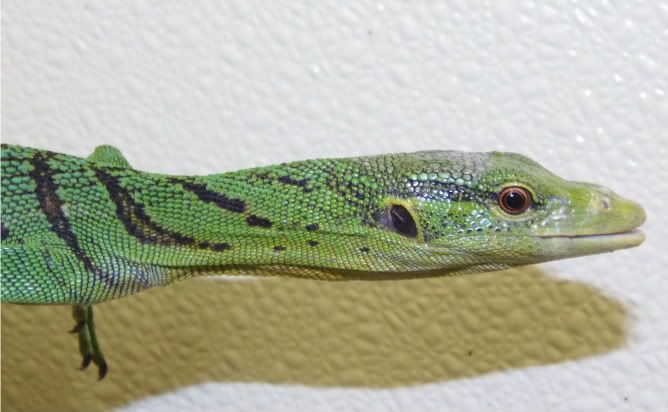
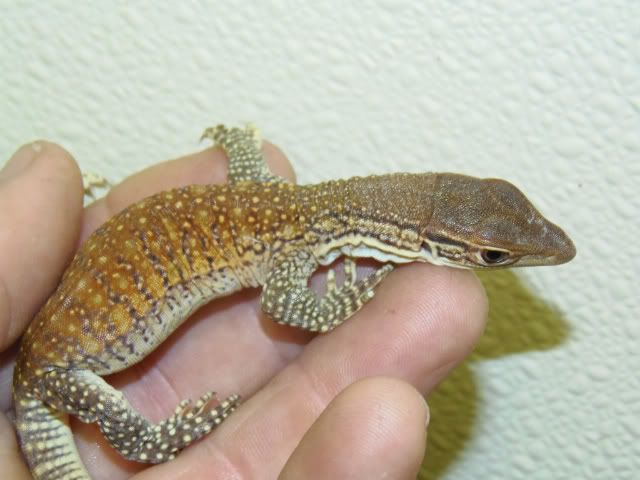
This little thing hatched yesterday.hahahahahahaha
Paradon
Jan 20, 2012 02:36 AM
What about the temperature of the nesting material? Do you think they choose the nest site based on what temperature the soil is...? Don't they need the eggs to be warm enough so they can incubate properly? I think this where the idea of the nest box comes from... I don't know if it works for Varanids or if you ever use one. What do you think about that?
FR
Jan 20, 2012 12:09 PM
Temps are just one factor, of course temps are important, We have have successful nestings from the high 70's to the low 90's.
But temps are only a part. Humidity is also a part. But lets look at those two as a set. That is, they need to be in a certain range.
That could be supplied in the cage with no nesting what so ever. Hmmmmmmm does not work so well.
So what does work well. Simply put, varanid eggs take long times to hatch. From 70 days with caudolineatus. To over a year for Lacies and gouldi types(all recorded here)
So what does conditions have to be like to take a year to hatch????? Thats the question. And each species have learned what it takes to allow their eggs to hatch and more, the neonates to survive. Its those conditions that are inhereted and utilized by each species and each female.
With monitors, if you do not supply something that gravid excepts, she will hold the eggs and suffer complications, to the point of death.
Those conditions are way past temps, how does a nest hold the same temps for a YEAR??????? Six months(very common with varanids, 3 months, common with smaller types?????????? And something the animal recognizes.
Which means, if they do not use it, it frankly does not matter what you call it or what it is.
So what superceeds temps and humidity is, soil/substrate types, depths, mass, consistancy. Which is security. The females must nest where a one legged woodpecker will not dig the eggs up. Which seems to be very important.
Also timing is important. Most non varanid keepers have some recipe value like put the box in at X time. Which kinda works.
With varanids, not so much. Normally, they dig or locate a nesting area, at the time of copulation, they stay in that area, then redig it up and lay when ready. This occurs in 8 to 30 days, successfully, after then, success drops. The longer they hold the eggs the more complications can occur, until death of the female. Which is very very very common.
Some species like torts(we breed them too) can and do hold viable eggs without problem. Varanids do not show that ability.
Monitors are so very generalized, yet very particular when it comes to nesting. Monitors are by far the easist type of reptile to get eggs from, they can lay like pez despencers, but amoung the hardest to get hatchlings from.
You will see far more success with such species as ackies as there is commonly nesting areas in their cages that are say, 2Ft by 3feet. Which is larger then the ackies. But that changes with larger species. When do folks offer a six foot monitor a nest box thats 12 feet long. Actually when do they offer a cage that big?
While some naive folks talk about boxes, the cage is a box, and a box inside the cage is another box, etc. They are all nest boxes. The problem is size. Monitors often burrow then create a chamber. If not allowed to burrow, it hinders the ability to nest.
Theres more, monitors have inherent knowledge on nesting, which includes a range of nest types, then learn from successful experience. So if you start with a first year female, and shes successful, she will attempt to repeat that nesting throughout her life.
So these are some of the problems with varanids. Thanks
Paradon
Jan 20, 2012 03:02 AM
Frank, I think you keep your monitors on a giant nest box anyway...with lots of heat. [chuckle]
FR
Jan 21, 2012 07:49 AM
yup
wldktrptls
Jan 23, 2012 06:50 PM
I happened across an article in Monitor Secrets Monthly, published by the I Can Say Anything I Want To Society(ICSAIWTS) that showetd pics of FR's set up. Now they showed a six foot lacie in a 100 gallon fish tank with a screen lid, newspaper substrate, and a hot rock. The enclosure for the croc monitors was even more elaborate! That tank had a stick and a SECOND hot rock! They also showed pics of an ackie colony in a 40 gallon tank where he was experimenting with aquarium gravel for a nesting substrate(hasnt he read about nextboxes?) The article went on to list all the food items dispenced on the weekly feeding day. How he fit all those fish tanks into that one walkin closet is beyond me! He must kick at tetris! So all these hateful things everyone's saying about crazy systematics are. Completly unfounded. After all, I saew it in a magazine, so it must be true.
Guy
Paradon
Jan 20, 2012 02:48 AM
Maybe if you create something that gives it a feel of a cave, or gives it the feel of some hole it carve out from a mound...that might work if the temperature is warm enough, too. I've seen Komodo dragons nesting on the side of a hill where the sun hits at certain time...so the mound is at certain temperature. I think the mounds were made by certain type of birds...
crocdoc2
Jan 20, 2012 06:45 PM
I've seen Komodo dragons nesting on the side of a hill where the sun hits at certain time...so the mound is at certain temperature. I think the mounds were made by certain type of birds...
'Seen', or 'seen on TV'? They're not quite the same. Often the latter is heavily manipulated and edited to tell a story, so it's not quite the same as seeing it yourself.
As it happens, in this instance the dragons have been known to show a preference for nesting in scrubfowl mounds and, as your program described, they do go for nests exposed to the sun. If you're interested, you can read about it here: Paper on Komodo dragon nesting by Jessop et al
Scrubfowl are a type of megapode, a group of Australasian birds that nest in the ground and use the temperature of the sun and/or composted material rather than sitting on the eggs and using their own body heat. Orange-footed scrubfowl, the species that occurs on Flores, Rinca and Komodo (and which also occurs in northern Australia), are known for making huge mounds. Those mounds are certainly a ready source of large amounts of diggable dirt.
I don't think monitors like a 'cave' feel or pre-dug holes for anything other than hide-spots, certainly not for nesting. A nest is something they dig out themselves so the eggs aren't exposed to potentially drying, open air for long after laying.
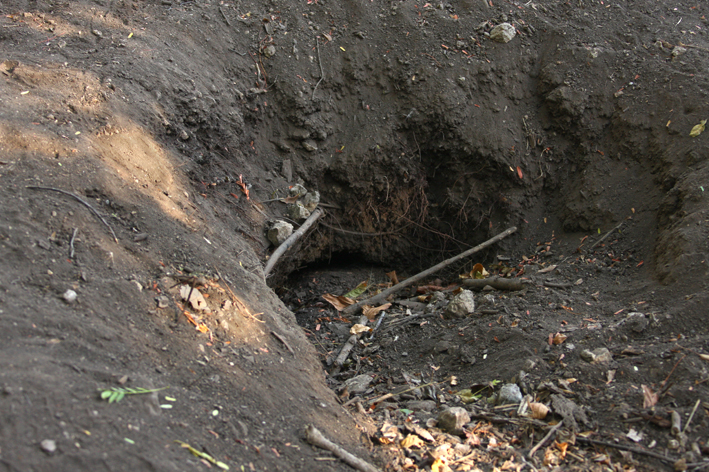
Here's a photograph of what's left of a dragon's nest burrow after the young have emerged. Not much of a shot because the whole mound was in disarray - it was late May and all of the young dragons had dispersed. I suspect the birds have long since stopped maintaining the mound.
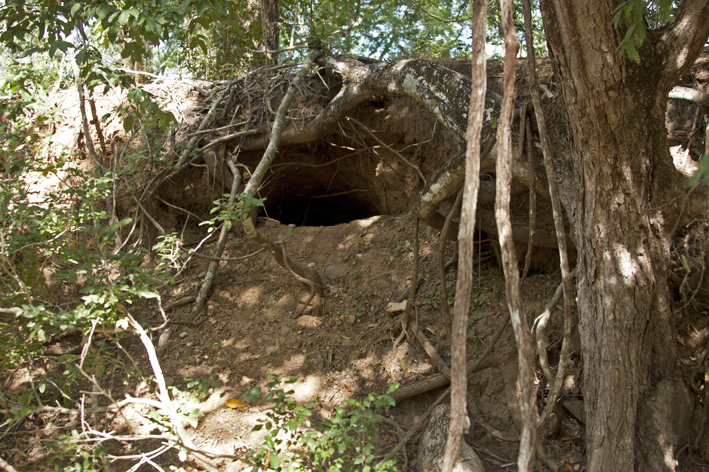
By way of comparison, here's a cave-like hide used by a dragon during the cooler parts of the dry season.
FR
Jan 21, 2012 07:05 AM
Hi Crocdoc
Nice pics and very similar to many many ground nesting species.
About paradon, hes just talking, he has no experience what so ever.
So like so many before him, you get a lot of perhaps and maybes. That is so 30 years ago. oh well
Its funny how people want to forget the past so they can reinvent the wheel.
whats funny is like Gregg, the wheel they are trying to reinvent is on the car they're driving. That is, its already the tool that got them where they are. I hope you understand that.
Nice pics, thanks
Paradon
Jan 21, 2012 05:42 PM
Thanks for the comment, Frank! [laughing]
FR
Jan 21, 2012 09:58 PM
I am sorry paradon, You are indeed entitled to carry on that conversation. Again Sorry.
Paradon
Jan 22, 2012 12:14 AM
I didn't mean to upset you! Sorry!
You're right by the way...since you have more experience than I do. I should only speak from experience like you do.
