Reptile & Amphibian Forums

Welcome to kingsnake.com's message board system. Here you may share and discuss information with others about your favorite reptile and amphibian related topics such as care and feeding, caging requirements, permits and licenses, and more. Launched in 1997, the kingsnake.com message board system is one of the oldest and largest systems on the internet.

Click for 65% off Shipping with Reptiles 2 You

Western Green Ratsnakes lock up

Ryan_Sikola Apr 12, 2012 10:55 PM

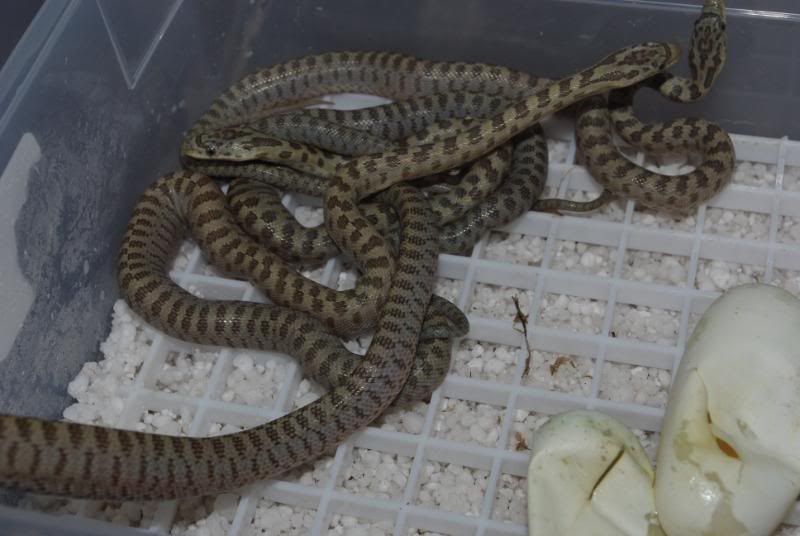
Here are my pair of CB unrelated locality green rat snakes locking up for the second year since they reached maturity.


She is hiding the majority of her body in the water bowl.

Here are some pics from year, male

Female

She laid three good looking eggs last year that went bad within two weeks. Maybe they were infertile, maybe it was my incubation method.... We will see how it goes this year.
-----
Pituophis c. annectans
Senticolis t. intermedia
Rhinechis scalaris
Elaphe bairdi
Lampropeltis zonata
Lampropeltis t. campbelli
Lampropeltis m. thayeri

Replies (7)

tbrock Apr 13, 2012 07:06 AM

Congrats on the hookup - very nice Northern Green Rat Snakes! What locality are they? Best of luck with eggs.

I have gotten four clutches from my Santa Rita Mountains LTC adults - all with some good eggs and some infertile. I have found the eggs challenging myself, with a high number of offspring hatching out slightly deformed - with slightly kinked tails, shorter than normal tails and combinations of both...
-----
-Toby Brock
Southwestern Center for Herpetological Research

RG Apr 13, 2012 12:50 PM

I've seen deformations in various kings and milks from too high incubation temps.

I think anything higher than 84 is risky.

Personally, my temps vary from a peek high of 84 F (during the day) to 75 F at night.

Yes, it takes longer for the eggs to hatch...but the neonates come out HUGE and healthy.

Just something to consider.

Also, too moist is a killer...keep a close eye on that as well.

Good luck!

tbrock Apr 13, 2012 08:47 PM

>>I've seen deformations in various kings and milks from too high incubation temps.
>>
>>I think anything higher than 84 is risky.
>>
>>Personally, my temps vary from a peek high of 84 F (during the day) to 75 F at night.
>>
>>Yes, it takes longer for the eggs to hatch...but the neonates come out HUGE and healthy.
>>
>>Just something to consider.
>>
>>Also, too moist is a killer...keep a close eye on that as well.
>>
>>Good luck!

Thanks for the tips...

I've actually done quite a bit of research on this subject, and am slated to speak on it at "Snake Days" in Sanderson, TX in June. Also - I recently wrote an article on Senticolis triaspis intermedia - my second article on their breeding and incubation for the SWCHR BULLETIN (I'll send you a copy if you want)... I did not mention temps in my post, but I have incubated my green rat eggs mostly in the high 70's - about 80 degrees F (I never incubate any of my eggs higher than the low 80's F). I started incubating my eggs in the 70's a few years ago with Chinese beauty eggs - and saw great success. Senticolis eggs are different - Just ask Gerold Merker / Thurgess Cranston...

BTW, some of my Senticolis eggs hatch out perfect offspring (not all are deformed), and my first 2010 clutch was 100% perfectly formed and healthy, and started pipping / hatching at about 88 days if I remember correctly.

I mostly keep my eggs on fluorescent light diffuser over wet perlite, these days - maintains high humidity while the eggs have good ventilation / air-flow. This is what produced my best, healthiest clutch - and the method I am going back to...


-----
-Toby Brock
Southwestern Center for Herpetological Research

RG Apr 13, 2012 12:57 PM

Really nice!

RandyWhittington Apr 14, 2012 12:22 PM

Great looking pair of intermedia there Ryan. I hope you get a nice big fat clutch from them this year!
-----
Randy Whittington

Ryan_Sikola Apr 24, 2012 11:54 PM

Thanks for the compliments and advice everyone!

Any experience with hatch-rite?

I sure hope I incubate these hopefully fertile eggs correctly.

Last year's clutch going bad for whatever reason was a terrible let down.
-----
Pituophis c. annectans
Senticolis t. intermedia
Rhinechis scalaris
Elaphe bairdi
Lampropeltis zonata
Lampropeltis t. campbelli
Lampropeltis m. thayeri

tbrock Apr 28, 2012 05:48 PM

I used Hatch Rite for my last two clutches. I had several slightly deformed offspring - but I honestly don't think the medium was to blame (Hatch Rite has worked great for me with corns, dione, and beauty snakes. I think I am going to go back to incubating on fluorescent light diffuser over wet perlite, for this species...

My temps were also good - well within the parameters for this species and actually a bit on the low side. Something else went wrong - I have done lots of thinking, talking and research on this - and have come up with a few possibilities. Some are not related to incubation parameters and methods. A couple which are related to incubation methods are: I am thinking that air-flow / ventilation may be more important with this species eggs than many others. My last two clutches were incubated in very small tubs and inside a very small incubator. My healthiest clutch was incubated in a large tub (shoebox size) inside a larger tub which had excellent air-flow. The shoebox did not have air-holes, but was opened for several minutes every week, and the tub lid was only placed loosely on top of the tub.

Also, I wonder whether phsical disturbances to the eggs may have something to do with deformites or dead in egg. There was some online discussion a few years back about vibration from incubator fan motors causing distress to developing embryos.

On dead in egg offspring - according to some (Kohler) this is often due to the female having a deficiency in vitamins and / or minerals. The babies may have enough nutrients to develop to a certain point only and not have enough to finish developing or may develop fully and then not have the strength to break out of the egg...

I suggest reading any of Merker / Cranston's articles on the species - there is a new one in Herp Nation. also, I recently wrote one on my experiences with breeding intermedia (and problems I have had) for the SWCHR BULLETIN...
-----
-Toby Brock
Southwestern Center for Herpetological Research


Site Tools