Reptile & Amphibian Forums

Welcome to kingsnake.com's message board system. Here you may share and discuss information with others about your favorite reptile and amphibian related topics such as care and feeding, caging requirements, permits and licenses, and more. Launched in 1997, the kingsnake.com message board system is one of the oldest and largest systems on the internet.

Click for 65% off Shipping with Reptiles 2 You
Click for ZooMed
Click here to visit Classifieds

display cage questions.

quentonius May 08, 2012 03:06 PM

Hi,
After 12 years of having nothing to do with snakes, my daughter inherited a couple of balls from some friends of the family. It's been a while since I've built an enclosure, and I need some input.

I'm going to build a multi-compartment dwelling (daddy plans on getting a few more higher end animals, now that it's ok with the rest of the fam), so my questions are as follows.

Building material:
It's going to have a finished facade, but what are your opinions on the following.

1.Melamine: I remember this had to be baked/cured because there was issues with toxic fumes when heat was applied. Does this still hold true?

2. RHP?
I live in the Pacific Northwest now, it gets cold here at night. I'd prefer a RHP, does anyone have experience with matching wattage vs. size of cages vs. nighttime temperatures. I tend to overdo anything and then back off, but I want to avoid overkill since I've never used RHP in the past.

3. Ventilation and temperature regulation.
For a unit that will house 4-6 different cages (1-2 small semi/arboreal). On which levels do you usually install the heating devices, or where do you place your priorities for species on them (since heat rises and can increase the temperature of the unites above--learned the hard way a long time ago).

Side Ventilation or leave space behind the unit for top vents?

Running multiple therms? Do you prefer one per level, one on the bottom, and a second one wired to act as a kill if the temperature up top gets too hot?

I'd appreciate any input, I'm not a fool, but it's been a long time since I've dealt with any of this, and I don't feel necessarily confident.

Any pictures, or design ideas would be much appreciated, especially from anyone in my region who understand how the weather is up here.

Best,
Quenton

Replies (16)

markg May 08, 2012 03:55 PM

For just ball pythons?

If so, consider getting a ball python rack. You can make it if you want, but honestly, you will spend quite a bit of time and money to make a really nice one. You can buy one made of plastic with heat installed and setup to not fry the animals for not too much more money than you will spend, if you consider your time as money.

Back to your multi-unit endeavor -
1) If too large, it is impossible to move. Much better to make individual cages, or at least individual rows of multi-compartment cages that stack. Make sure they can fit through the doorways!

2) Vent from side or top or back, not much difference.

3) RHPs are great. They work even for ground dwelling ball pythons. Probably too much money for ball pythons though considering these snakes are happy in low height cages with belly heat just the same as an elaborate cage with RHP. Again, buy a rack with belly heat and don't spend the money on RHPs to heat ball pythons. Boas and larger pythons, yes RHP. Arboreals - yes, RHP.

4) Multiple thermostats are best unless all cages are the same setup and heater. Two thermostats is always the best approach for safety, especially if your animals are pricey. For a rack, use an ON/OFF thermostat as a high temp cutoff (set it for 5 degrees above what you really want), and plug your other thermostat (set for the desired temp) into that for the desired temp. Easy to do in a rack, because all compartments are essentially the same.

With multi-unit cages, you may end up spending more money in thermostats than you thought, unless all compartments use the same setup and heater type/wattage.

quentonius May 08, 2012 05:28 PM

Hi Mark,
Thank you very much for your reply. No, not just ball pythons. My daughter inherited a pair, and well, now that my wife is ok with reptiles I'm going to go back at it.

I'm not worried much about the cost of building, for what we want racks are just tacky. I've built more racks, rooms, and incubators than I care to remember. I'm building a display case, and this isn't a breeding setup, as a family we won't be exceeding 10 animals. I prefer something that appears classy.

I'm am worried about the issues associated with building materials, and the problems that arise from building singe unit display cages. i.e. the bottom units tend to heat the top, so sometimes an extra heater on top is actual overkill, or melamine vapors under heat (improperly cured before sale).

So I'm curious to know what works best for people; especially, people from the Northwest.

It's not going to be moved very often, locking wheels on casters will be just fine.

I also don't have a room where I can afford to keep the ambient temperature in the seventies year round which is also why I'm gravitating towards a beefier setup.

markg May 10, 2012 03:14 PM

Truth is, there is no way to predict exactly what the effects of heating will be in your multi-unit caging. Too many variables. Yes, top cages will be warmer - that is true anywhere. So you need a separate controller for the top row if you want precise control.

As far as building materials, you are correct. Most have formaldehyde. This may never be a real issue for a snake, not sure. But, that is one more reason why heating from above may be best. Substrate on the cage floor limits the snake from direct contact on wood.

They do have formaldehyde free plywood now. I am using it for some cage tops (plastic food-safe containers, I make my own wood lids). But if heating from above, any plywood is fine as long as you seal it with something. Shellac is hypoallergenic once cured. Not the best moisture barrier, but good. Waterborne polyurethane has gotten better now. If you have the dinero, two-part epoxy is awesome and safe when cured.

quentonius May 10, 2012 03:33 PM

Hi Mark,

Thank you very much! Yeah, I know it's hard to predict. The weather here is pretty variable. We've been in the 70's during the day an then the 50's at night, but this week we're keeping the daytime temperatures and at night it's been dropping into the 30's. And then there's the rain... and more rain.

What is your experience using RHP's, do you make your own or buy them premade?

Thanks for the info on the formaldehyde free plywoods I'm going to hit the lumberyard and check that out today.

Best Wishes,
Q

markg May 10, 2012 04:54 PM

Purchase RHPs. They are really great heaters. Pretty much like a ceramic heat emitter in terms of the heating effect. The RHP surface does not get as hot, so it is safe if an animal touches it, whereas a CHE would burn flesh if touched for longer than a few moments. You can achieve a nice temp gradient using this type of heater.

The heat waves from an RHP are long wavelength infrared. They penetrate into muscle tissue quite well. If you hold your hand under an RHP (keep a little distance, more about that later..), you will feel warmth on your skin of course but also feel it within your hand.

The temperature can be deceiving. The air temp in the cage can still be cool but an animal below the RHP can be warming up effectively. That is why your thermostat probe needs to be placed appropriately. I place it near the perimeter of the RHP lense near the cage floor, hanging there. Also, RHPs should be used in cages that are large enough so the animal can be completely away from the RHP if desired.

There is a distance limitation - the lense surface cannot be too close to the cage floor, otherwise some heat will reflect back up and potentially damage the RHP. Leave at least 8 inches between the cage floor and the RHP lense. 10 or 12 inches is better. Too much distance and the heat will not reach the floor as effectively, meaning more energy used. I tend to stay within the 10-13 inch range, and it works well. For taller cages, build a wood rectangle spacer and mount the RHP to that to lower it down some. You can hang them with chains (like in a turtle cage), but snakes will get tangled in the chains for sure. You can use long brackets but snakes will probably climb up and sit on top of the RHP. So a wood frame spacer with no openings is best with snakes.

The top of an RHP gets a bit warm - less than a heat pad, but there is a slight warmth that increases as the ambient temps increase. So the cage floor above the ceiling of a cage with an RHP will warm up some. Not much, but some. That is why you may want air space between successive compartments to better isolate each cage from its neighbor below it.

quentonius May 11, 2012 12:07 AM

Can you recommend a brand, and what "size" or wattage do you think would be adequate for most tropical species in a 18"x6'x24" (HWD) enclosure?

At that size enclosure I'm sure that there will be enough dissipation to allow a gradient. But what size/wattage is enough to give them what they need?

markg May 11, 2012 01:38 PM

Its more about the mass of the snake. A big boa for example needs more RHP than a kingsnake, even if the cage is 6ft for either snake.

Pro Products can answer questions like this. They sell some very good RHPs. I have RHPs from 3 different suppliers, and all three work great. RBI, Boaphile and Bean Farm (I believe all three use the same heating element and lense) sell some RHPs with nice molded plastic shrouds. Pro Products RHPs do not have the attractive housings but are excellent heaters as well and are offered in more sizes.

An RHP of size 11x17 would be the smallest size for a 6ft cage IMO if the snake has some mass to it. I think that is around 50-60 watts, but heats alot more area than a 60 watt bulb would just for comparison. If the snake is a big one, an RHP of size 11x22 would be better if the room is not heated.

The snake below needs one big-arse RHP.

LarryS May 15, 2012 12:15 PM

>>Hi,
>>After 12 years of having nothing to do with snakes, my daughter inherited a couple of balls from some friends of the family. It's been a while since I've built an enclosure, and I need some input.
>>

Welcome back!

>>I'm going to build a multi-compartment dwelling (daddy plans on getting a few more higher end animals, now that it's ok with the rest of the fam), so my questions are as follows.
>>
>>Building material:
>>It's going to have a finished facade, but what are your opinions on the following.
>>
>>1.Melamine: I remember this had to be baked/cured because there was issues with toxic fumes when heat was applied. Does this still hold true?
>>

I have never used a melamine faced product for herp enclosures, but would probably go with the type that uses hardboard instead of particle board for a base material.
My material of choice has been expanded pvc sheet. It is cost effective, not too heavy, needs no finishing or sealing and is very easy to work with.
What kind of facade are you planning?

>>2. RHP?
>>I live in the Pacific Northwest now, it gets cold here at night. I'd prefer a RHP, does anyone have experience with matching wattage vs. size of cages vs. nighttime temperatures. I tend to overdo anything and then back off, but I want to avoid overkill since I've never used RHP in the past.
>>

Has been a lot of discussion on RHP's here. Probably best to check on the particular forum for the different specie you will be keeping as well as the manufacturer for more sizing information. Personally, I feel that the room should be conditioned first and foremost and then cage heating used to create proper basking area temps and cage gradient.

>>3. Ventilation and temperature regulation.
>>For a unit that will house 4-6 different cages (1-2 small semi/arboreal). On which levels do you usually install the heating devices, or where do you place your priorities for species on them (since heat rises and can increase the temperature of the unites above--learned the hard way a long time ago).
>>

Not sure I understand your question here. I would try to isolate each group of cages to run independently of the others, with regard to the specie requirements. Always set up the enclosures well ahead of time and moniter the temps etc to see how they perform. If a level is being affected differently based on its location you can modify the setup accodingly.

>>Side Ventilation or leave space behind the unit for top vents?
>>
>>Running multiple therms? Do you prefer one per level, one on the bottom, and a second one wired to act as a kill if the temperature up top gets too hot?
>>

Again lots of differing views on this, with the animals health and well being always most important.
I would use a seperate t-stat for each small group of identical cage setups, or a unit that can moniter each cage seperately. Redundancy is always good.

Ventilation requirements can also differ by specie, and will also affect the amount of moisture in the cage environment. It is a delicate balance, but once figured out easy to maintain.

>>
>>I'd appreciate any input, I'm not a fool, but it's been a long time since I've dealt with any of this, and I don't feel necessarily confident.
>>
>>Any pictures, or design ideas would be much appreciated, especially from anyone in my region who understand how the weather is up here.
>>
>>Best,
>>Quenton

Would love to see build pics as you progress.
-----
Larry Stroud - Fort Pierce, Florida

quentonius May 15, 2012 01:21 PM

Hi Larry,

thank you for your reply.

I've never thought of Expanded PVC aside from building racks. Can you provide an enclosure picture?

I'm partially decided on finish plywood, with a white oak facade or something.

We have a fair amount of environmental variability due to living in the NW, and also renting a place with insulation that's just "Meh", and crappy fan heaters. (interior room is approx 50 at night in the winter, and hot during the summer)

Hopefully in 18mo or so we'll have a house so we'll be able to provide a much more controlled environment.

Wood is the material of choice, being that it provided better insulation, although I'm intrigued by your use of PVC.

More Later, my daughter must go run at the park!

Cheers,
Quenton

LarryS May 15, 2012 08:49 PM

Hello Quenton,

I have been using pvcx exclusively for a few years now. I built several wood and mdf enclosures and realized that the sealing and finishing process was very time consuming.

There are several manufacturers out there building PVC cages. Some of them just screw the pieces together with no special joinery at all. This would be a very easy and cost effective design. You could easily build a nice wood front and join it to a pvc case.

Here is a cage built using this method. It is very strong and easy to do. This picture shows the cage with the track but not the sliding glass doors installed. I prefer black, but if you like the white color it is a little less expensive.

This cages panels were cut using only a circular saw with a home made guide. All screws were predrilled, countersunk slightly and installed manually.

The design I eventually ended up with for myself uses heat folding to form the case and can get rather complex. The above design or something similar is a great way to go.

Do as much research as possible, take your time and ask as many questions as you like. As you can see from Marks responses there are people here with a lot of experience and great information.

-----
Larry Stroud - Fort Pierce, Florida

quentonius May 16, 2012 12:14 AM

Hi!

where are you located? I'm wondering because I wonder how well PVC holds heat, I live in the "Maritime" NW. keeping a whole room in the 70-80's for the size collection we have is unrealistic in the winter.

It seems a whole lot has changed since the 90's as far as products for enclosures, materials, hell even morphs that were insane to think about are now seeming common place it's kinda overwhelming and fantastic at the same time!

I did some research on expanded PVC and most of what came up looked like Styrofoam boards, is that what I need to be looking at? how is it structurally?

The picture you sent along looks like it finishes just as fine as wood!

Mark gave me alot of helpful information!

I can't afford to purchase 4 RHP's right now so I've decided to go with (unless someone has a better suggestions):
for the enclosures:
3total enclosure 72"Wx18"Hx24D (one with 2 removeable partitions)
finish plywood (white oak Facade, banded and finished to look like a piece of furniture)
Plexi frameless doors with locks
18' x 11" heat tape
Herpstat 4 thermostat

Still undecided on sealing:
Water based sealant?
2part epoxy?

I'm also wondering how to best do the heat-tape on wood i.e. along the back wall vs. the floor (routing both).

Covering with mylar, plexi, or tileboard?

Thanks again!

LarryS May 16, 2012 09:13 AM

Hi Quenton.

Sounds like a good plan. Looking forward to build pics!

There are some others here that are much better qualified to answer the wood sealing questions. I do remember some discussion of a coating made specifically for reptile enclosures, a search may bring it up.

I did use a two part epoxy on one enclosure with very good results.

The heat tape has been used widely in these applications with very good results. There are a couple of important safe gaurds to follow.
The manufacturer recommends a 1/8" air gap to prevent overheating.
I have never found a way to cover the electrical connections that satisfies me, but since it can be a potential shock hazard it is an important area to protect.
The wire will need a strain relief of some sort in case it gets pulled, something that many people overlook.

A fellow forum member here got me using the ceramic tile on the cage floor and it worked very well. I was using it in conjunction with RHP heat source, but should work well with floor or wall heat. It acts as a heat sink much like the earth. For my arborials the RHP alone worked fine. There are some using heat tape on the cage wall or ceiling making it essentially a RHP.The best advise I can give would be to size the heat source properly, as little as possible to get the job done. If there ever were a failure in the regulatory system and it delivers full power you do not want to overheat the animal.

The possibilities are endless really, many of the methods can work equally well in the end.

Best of luck!

Larry
-----
Larry Stroud - Fort Pierce, Florida

quentonius May 16, 2012 02:02 PM

Hi Larry,

I don't have a website to load pictures to, unless I can figure out how to load attachments here.

Anyways, I do have a rather crude mspaint drawing I did of the initial plans, when I was still on the fence about some things. I still am, but things have changed a bit.

I can email that to you and Can see what you think.

so the 1/8th in airgap for the heat-tape is with spacers and a router?

As far as sealing, I think homedepot has an electrical sealant that when dry is rock solid.

RHPs are the goal eventually, but for now, just heat tape.

I'm still toying around with the design on the bottom cages and top cages. Either one on the top, or one on the bottom has to be partitioned for smaller animals and juveniles so the design and heating for that is causing me some headache.

Cheers,
Q

LarryS May 16, 2012 09:00 PM

Here is a link to the Colorique technical bulletin for proper installation guidelines.

www.calorique.com/documents/TIS/TIS120-1_2008-06-19.pdf

I use Photobucket to host images, but I would be happy to take a look at your plans if I can help. (PM sent)
-----
Larry Stroud - Fort Pierce, Florida

quentonius May 22, 2012 03:44 AM

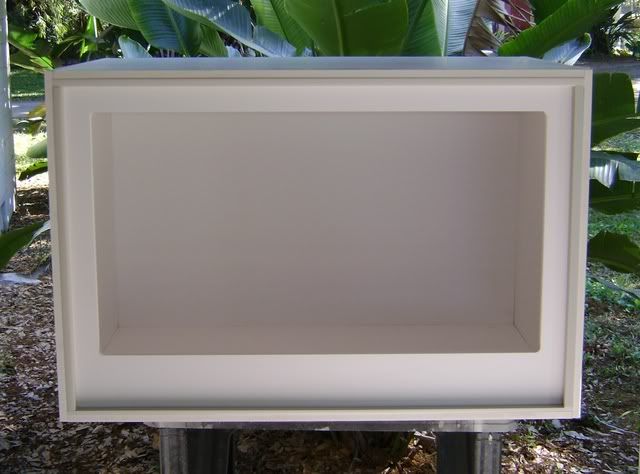
ok, the box is built (it's mocked up to work out the bugs, and get ready for finishing), and it will be an awesome piece of furniture. I can't wait to show pictures!!!!

RHPs are far out of my budget for right now so we're working the heat and floor covering issue out now.

My only option seems to be:
Flexwatt on the inside, small recess and channels for the connectors, probes, and wires to run.

To cover the floor I'm at a loss. I want to allow as much heat transfer as possible to avoid having to install a CHE as well. I can do it, but would rather not.

I'm feeling silicone is the way to go for sealing all edges on the floor.

1. Mylar would work great in the short term but sucks in the long term, once it's creased that's it. plus,heat and shifting reptile weight could pull it around.

plexi would run another $160 or so for 1/4" flooring.

2. PVC vinyl sign material: self adhesive, and paper thin!

3. 1/32 in pvc sheet.

4.linoleum, only ever seen it done poorly, and I don't know how well it works.

What are your opinions? What do you think the best option is to let the flexwatt do it's thing. or any obvious drawbacks to one of these options.

Remember this is being built as a piece of furniture, so I want it to look nice, and I'm thinking the wood will hold heat well.

Best,
Quenton

quentonius May 22, 2012 05:59 AM

sorry, I forgot one option we discussed.

Using a thick coating substance like repti-shield (but not, since it's not available anymore), and just coating directly over the heat tape as well.

anyone ever try this? did it work? if so what products?

Site Tools