Reptile & Amphibian Forums

Welcome to kingsnake.com's message board system. Here you may share and discuss information with others about your favorite reptile and amphibian related topics such as care and feeding, caging requirements, permits and licenses, and more. Launched in 1997, the kingsnake.com message board system is one of the oldest and largest systems on the internet.

Click here to visit Classifieds
Southwestern Center for Herpetological Research
Click for 65% off Shipping with Reptiles 2 You
ALT Jun 09, 2012 01:28 PM

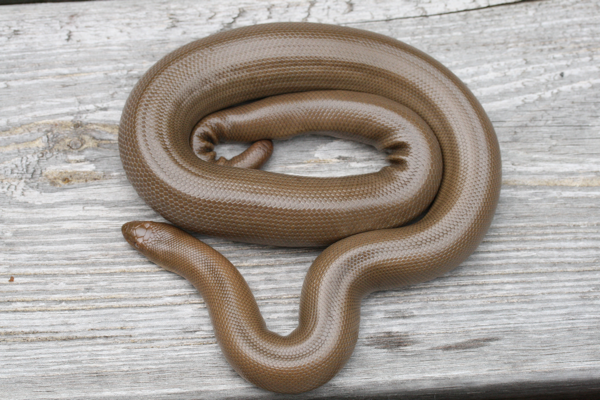
I had a pretty crazy May, and hadn't paid a lot of attention to these guys lately. Stunned by how fat she looks today! And she refused a meal...which NEVER happens. Her last feed was 3 fuzzies about a month ago.

No hibernation. Just cohabitation. I wonder if I'll have little worms this summer...

Replies (6)

mrkent Jun 09, 2012 05:05 PM

It sure looks like a possibility. I have been wondering the same about mine. Her last meal was April 7.


-----
Kent

RichardFHoyer Jun 13, 2012 11:13 AM

ALT:
Your female very well could be gravid as much of her mass is in the lower part of her body suggesting she may have already ovulated and entered the gestation period. Just a wild guess as 'long-range' observations (without being able to handle the specimen) are pretty iffy at best.

Another guess is that she could have originated from the central Sierras. Certainly she is not from the extreme southern Sierras (Southern Kern Plateau / southern Greenhorn Mts.) or further south in S. Calif. She is too large to have originated from those regions which contain a dwarf form of the species.

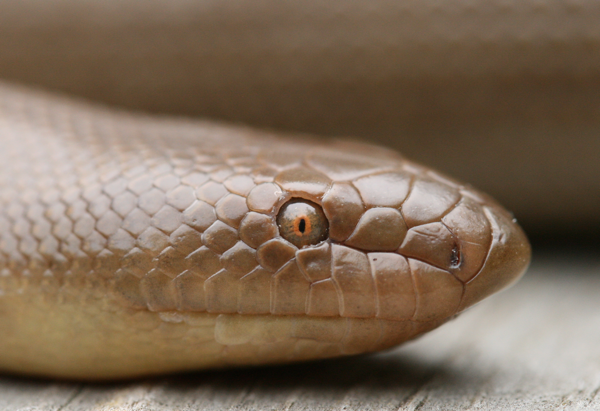
Then with extensive black pigment on her ventrals combined with the basic black eye coloration with bronze ring around the pupil is very similar to what I have observed in boas from the main Sierra Nevada Mts. However, there likely are other regions in the species' distribution with boas that possess the same characteristics of basic black eyes coupled with black mottling on the ventrals.

Fasting during gestation is a common trait for gravid female
rubber boas from some regions. But such fasting during the gestation period is not a hard and fast rule in the species as I have found many exceptions. However, if she continues to refuse offerings of prey, that may well indicate she is gravid and fasting during gestation. Should she produce a litter later in the summer, be sure to post that information.

Richard F. Hoyer

ALT Jun 14, 2012 09:52 AM

Thanks for the information! I will be sure to post if she pops. She's a pretty amazing snake. I purchased her as a baby at a PA breeder expo in October of 2010. She ate like a king snake from day 1, and grew at a ridiculous rate.

RichardFHoyer Jun 15, 2012 11:09 AM

ALT:
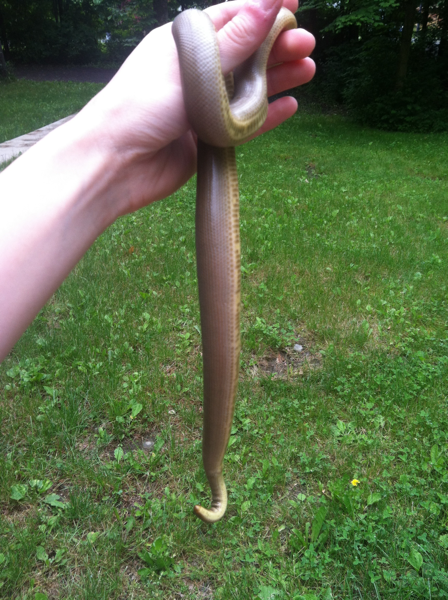
From the photo of your female hanging below your arm suggests she is at least 2 feet in length (if stretched). The minimum age at which the species attained mature status in the wild is likely to be about 5 years and the average time to maturity is likely to be about 7 - 8 years. I once had a captive born female in which I fed year around until she was mature which I believe was at 4 years of age. She produced a litter the next year when 5 years old. So when you mention your female as being pretty amazing, I would agree.

That she began taking lab mice from the get-go is one amazing aspect as that situation is not the norm for the species. Secondly, you mentioned you obtained her when she was a baby. The term 'baby' is imprecise in that it could mean she was a newborn boa as of the year you obtained her (Oct., 2010), or simply she was of juvenile size when you obtained her so could have been born 2 or 3 years earlier and simply was small at the time of purchase. Did you happen to measure the boa when you first obtained her and if so, what was her length at that time. Do you know her current length?

Also, your first message implies you have a male boa as well. What is his length? The best way to measure these boas is to pin the tail down along a yard or meter stick (tape measure) with one hand and grasp the snake just below the head and stretch firmly until the snake relaxes and record its maximum length.

Last, you mention she grew at a ridiculous rate. By chance, did you happen to keep tabs on her growth over time by taking periodic measurements?

Richard F. Hoyer

ALT Jun 15, 2012 01:36 PM

Richard,

I'm kicking myself for not taking measurements/data on my group. I got the males in the fall of 2008 for outreach animals and they behaved more "normally". They were started on f/t lab mice from the breeder, and would eat well through spring and early summer, then fast the rest of the year. The "2010" animal was sold to me as born that summer, and as I said, has always been a stellar feeder. I had to cut her back to once a month or every 6 weeks because I was worried she was getting too fat. I also have a "2011" female, purchased early December last year. She did not take a single meal until April, but once switched on, has fed reliably on thawed lab pinkies. The 2.1 older animals are housed communally, while the juvenile has her own enclosure for now.

If you scroll down the forum, I have 2 other posts about my little group, one from last year around this time and one from January 2012. Those have some size comparison photos and more information.

best,
Amanda

RichardFHoyer Jun 16, 2012 11:35 AM

Amanda:
I reviewed your prior posts and see I did comment about the fact you had received two males from the breeder. Determining the sex of juveniles can sometimes be difficult as the spurs are tiny, un-pigmented, and often hidden.

As for your 2010 female, did she begin to feed that summer? And did you continued to offer prey every month of the year? Or did you put the boa into a brumation situation during the winter months?

I may have over estimated the length of your female but nevertheless, her size is remarkably large for a boa born two years ago. The fact that she has taken on adult type coloration is such a short period of time is also of interest. That is, there is a sharp demarcation between the ventral yellow and dorsal brown where the dorsal scale rows begin. And she shows a considerable degree of ventral black mottling. And her eye color is that of adult as well.

You may note that the eye color of your two males is different from that of your female. Eye coloration of boas from here in W. Oregon varies from yellow to dark greenish-gray but rarely black. As mentioned, the basic black eye color of your female with the bronze halo around the pupil is characteristic of boas found in parts of Calif.

Richard F. Hoyer

Site Tools