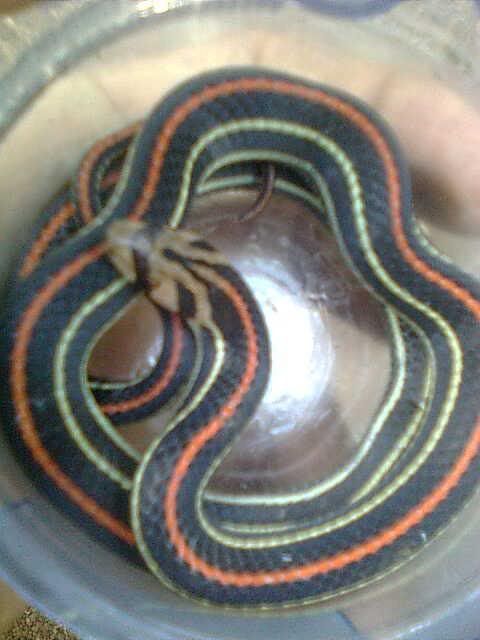
An acquaintance of mine on Facebook lives in Indonesia and is always out catching retics and other snakes... he recently posted this and even he is not sure what he caught. I love the head markings.
Reptile & Amphibian Forums
Welcome to kingsnake.com's message board system. Here you may share and discuss information with others about your favorite reptile and amphibian related topics such as care and feeding, caging requirements, permits and licenses, and more. Launched in 1997, the kingsnake.com message board system is one of the oldest and largest systems on the internet.


what kind is this beauty?
gizzy20001
Jul 01, 2012 12:57 AM
Replies (7)
Greg Longhurst
Jul 01, 2012 11:15 AM
That is the striped kukri snake, Oligodon octolineatus. It is small, reaching perhaps two feet. From what I have found it is harmless. Not sure of its diet.
~~Greg~~
DMong
Jul 01, 2012 04:10 PM
Right you are Greg!..
They are somewhat similar to what Hognose use their enlarged rear teeth for, except they are for puncturing eggs rather than deflating and envonomating toads.
They are so-named due to the curved hind fangs at the back of their mouth. Those fangs evolved to suit Kukri snakes diet of chiefly eggs. As the eggs are swallowed, they would be pierced open by the special fangs. The fangs shape reminds one of the famous Kukri knife used by Nepalese.
Singapore has three types of Kukri snakes: Brown Kukri (Oligodon purpurascens), Striped Kukri (Oligodon octolineatus) and Barred Kukri (Oligodon signatus).
Of the three, Striped Kukri snake is the most common and can inhabit suburban areas.
~cheers, ~Doug
-----
"a snake in the grass is a GOOD thing" 

serpentinespecialties.webs.com
gizzy20001
Jul 01, 2012 08:55 PM
Thanks guys... I forwarded the info to the guy who caught it... I wonder if these ever come on the market and if they can be trained to eat rodents
DMong
Jul 01, 2012 09:40 PM
I am not aware of them ever being available in the hobby, but someone like Tom Crutchfield might know who has imported many strange and obscure types over the years. Also, it might be possible to switch them over with certain scenting techniques, but who knows. I know VERY little about those particular snakes.
Well, at least he will know what it is now anyway..LOL!
cheers, ~Doug
-----
"a snake in the grass is a GOOD thing"
serpentinespecialties.webs.com
Greg Longhurst
Jul 02, 2012 07:07 AM
Interesting stuff, Doug. The site I looked at was extremely limited & did not mention diet, though it did talk about the reason for the name. I had some success years ago keeping a couple of Dasypeltis scabra, the African egg-eaters. I'd climb up under bridges & "borrow" pigeon eggs. Perfect size, & readily available nearly constantly.
~~Greg~~
DMong
Jul 02, 2012 02:48 PM
Yes, that sounds like you were using your "noodle" for a good source of perfect-sized bird eggs!
Good thinking Greg!. I'll keep that in mind too if I ever need them.
~Doug
-----
"a snake in the grass is a GOOD thing"
serpentinespecialties.webs.com
chrish
Jul 02, 2012 10:14 PM
One thing about Kukris is that although they aren't really aggressive, when they do bite they make slashing bites that really lacerate flesh. A Kukri bite bleeds like few other snake bites.
I found a Striped Kukri snake many years ago when I was in Borneo. At the time, there were no books or anything for SE Asia/Indonesia (and certainly no internet) so I always wondered what that gorgeous DOR was. I only figured it out about 3 years ago.
-----
Chris Harrison
San Antonio, Texas
