Reptile & Amphibian Forums

Welcome to kingsnake.com's message board system. Here you may share and discuss information with others about your favorite reptile and amphibian related topics such as care and feeding, caging requirements, permits and licenses, and more. Launched in 1997, the kingsnake.com message board system is one of the oldest and largest systems on the internet.

Click for 65% off Shipping with Reptiles 2 You
Click for ZooMed
Click for 65% off Shipping with Reptiles 2 You

T Negative Albino Texas Ratsnake?

scaledverts Aug 02, 2012 03:27 PM

Anybody got a T negative albino Texas ratsnake? I'm not talking about the more common lavender albino but a true albino. I'm curious if anyone has isolated it from a pink eyed leucistic yet?
-----
Kyle R. Mara

Common sense is genius dressed in its working clothes. - Ralph Waldo Emerson

http://scaledvertebrates.weebly.com/

Replies (20)

DMong Aug 02, 2012 04:21 PM

There are TONS of true T-neg. amel Texas rats out there of several different strains and varieties too. The pink-eyed leucistic Texas rat is nothing more than a leucistic Texas x amel Texas.

~Doug
-----
"a snake in the grass is a GOOD thing"

serpentinespecialties.webs.com

scaledverts Aug 02, 2012 04:24 PM

Thanks Doug,

I figured someone had separated the genes by now. I just NEVER see them. I don't think I have ever seen a t-neg texas that was separate from the leucy gene. I certainly have never seen them for sale (or well at least not since I have been looking at the classifieds ~5-6 years).
-----
Kyle R. Mara

Common sense is genius dressed in its working clothes. - Ralph Waldo Emerson

http://scaledvertebrates.weebly.com/

DMong Aug 02, 2012 04:57 PM

No problem, but I messed up when in my original post when I said that pink-eyed leucy's were nothing more than leucy Texas x amel Texas. I meant to type amel BLACK RAT!!.....that is what the amel composite in them really is. I doubt a true amel lindheimeri really exists in the hobby, but there could possibly be somewhere, who knows. Sorry about not being clear in my original post there..

~Doug
-----
"a snake in the grass is a GOOD thing"

serpentinespecialties.webs.com

scaledverts Aug 02, 2012 05:05 PM

No worries. I have NOW seen pictures of likely true amel texas. But I have not seen one in the hobby for sure!

It's really too bad too, if the snake in that photo IS a pure texas, it looks REALLY cool! If the location is correct of the photo, that puts this snake well out of the range of black ratsnakes.

Image
-----
Kyle R. Mara

Common sense is genius dressed in its working clothes. - Ralph Waldo Emerson

scaledvertebrates.weebly.com/

DMong Aug 02, 2012 05:18 PM

Very true. That would be one of the very few known to be true amel Texas rats. If they are indeed from that locale, there is no question about them being the real deal. That one has a different look too. It is more white in the blotch saddles whereas most Blacks have underlying other colors. Don also has (or at least had) some locale specific leucistic Blacks too. I think I know who else has those if he doesn't. There is a cool axanthic Texas that Don had too, and I know who is also working with those.

~Doug
Image
-----
"a snake in the grass is a GOOD thing"

serpentinespecialties.webs.com

scaledverts Aug 02, 2012 05:38 PM

I looked on Don's website and didn't see anything about the other less common Texas ratsnake morphs. This doesn't mean he isn't working with them, just he doesn't have them listed on his site.

I know a few people that have anery/axanthic, are there two proven genes in Texas ratsnakes where one leaves yellow and one doesn't (e.g. corn snakes)? Along with some of the weird unproven genes (hypo-e, hypo, etc).

I think that I true t-negative albino would be an excellent addition to the growing Texas ratsnake morph market!
-----
Kyle R. Mara

Common sense is genius dressed in its working clothes. - Ralph Waldo Emerson

scaledvertebrates.weebly.com/

DMong Aug 02, 2012 07:27 PM

Yeah, there are a few cool morphs out there. One looks like Don Soderberg's axanthic but only has a few small anomaly flecks of orange/red.

Allen Sheehan got it from Max Peterson and the specific locale is from SW Fannin County, TX. and was caught in Max Peterson’s horse stalls. This seems to basically be an intergrade zone where Texas and Black would blend and might see variations in the area.

I know another one similar was found by Alan Garry and was found in Claiborne Parish, Louisiana.

Here are several cool morphs for you to check out on Allen Sheehan's site if you don't already know about it.

~Doug

LINK

-----
"a snake in the grass is a GOOD thing"

serpentinespecialties.webs.com

scaledverts Aug 02, 2012 09:30 PM

Yeah, I know Allen. He and I exchange emails fairly often regarding Texas rats etc. I have some of his stock too! Can't wait for them to get big enough to breed and produce who knows what.

Also, I emailed Don Soderberg regarding his current stock of Texas rats and it looks like he sold off much of the Texas rats he had. He did confirm that he found an albino Texas ratsnake just north of Austin, TX. He mentioned that he could not quite remember who had got the albino texas though (not that surprising given the time frame since them).

Now, if I can just track it down. I hope the albino bred and kept the genes in the hobby.
-----
Kyle R. Mara

Common sense is genius dressed in its working clothes. - Ralph Waldo Emerson

scaledvertebrates.weebly.com/

DMong Aug 02, 2012 10:20 PM

"Now, if I can just track it down. I hope the albino bred and kept the genes in the hobby"

You just hit the nail square on the head with a huge 16lb. sledge hammer..LOL!

If some hybridizer got it, it is probably long gone now and the genetics is in every known obsoletus complex morph under the sun by now. People can never leave any morph well enough alone. They always have to mix it into every multi-mutt morph combination they can get their hands on..LOL!!

Sad actually.........that's how things disappear forever all the time. It will be the very same way once I produce some "Moonshine" (t-plus?)locality-specific intergrade "greenish" rats hopefully next year. Once they are out there for a very short while, I'm sure some people will mix them into every Black Rat, Yellow Rat, Texas morph known to man-kind too...

Maybe a very dedicated herpetoculturist DID get it from Don though and kept it a genuinely authentic locale. .....I hope anyway.

Good luck with the investigation and locating the bloodline. I'm glad you are doing that...

BTW, cool that you know Allen too. Please tell him hi for me next time you guys talk.

cheers, ~Doug
-----
"a snake in the grass is a GOOD thing"

serpentinespecialties.webs.com

chrish Aug 03, 2012 11:40 AM

I've only caught a few ratsnakes in deep East/Northeast Texas, but of those several have been relatively anerythristic. I don't think it is a case of a simple anerythristic gene in the area but rather a clinal tendency to lose the background color.

This one is from Freestone County, TX.

There is a photo of a wild caught albino from Tarrant County on this website - http://www.uta.edu/biology/herpetology/Texas rat snake.htm
Image
-----
Chris Harrison
San Antonio, Texas

scaledverts Aug 03, 2012 11:51 AM

Interesting,

I also found the photo below of an albino also caught in the same area (Tarrant County). There is a possibility that there is some black rat blood in there too, it is right on the edge of the intergrade zone (at least according to some range maps anyway).


-----
Kyle R. Mara

Common sense is genius dressed in its working clothes. - Ralph Waldo Emerson

scaledvertebrates.weebly.com/

scaledverts Aug 03, 2012 12:56 PM

Sorry Chris,

What I SHOULD HAVE typed is:

Here is the picture of the albino from the website you mentioned!
-----
Kyle R. Mara

Common sense is genius dressed in its working clothes. - Ralph Waldo Emerson

scaledvertebrates.weebly.com/

DMong Aug 03, 2012 03:19 PM

Very nice looking snake and photo Chris,....

However, I cant quite agree with the black and white specimen Allen has being more of a clinal variant at all if when bred to a normal as Don Soderberg did, as well as Allen and others (as Allen Sheehan mentioned here in this same thread and said offspring he himself produced had absolutely ZERO red or yellow pigment whatsoever). When bred to a typical normal, he got ALL typical looking normal hets, then when bred back to the anery/axanthic parent a typical 50-50 ratio of morphs and normals are produced. That is a true recessive gene mode of inheritance. Same thing when the future normal het babies would be bred to each other, a theoretical odds of inheritance of roughly 25% mutants would generally be produced, the rest of the roughly 75% would be very typical and dark in their background color.

This is just like the recessive trait anery Gray-banded kings (L.alterna) morph, or countless other proven recessive anery/axanthic mutations in the hobby mainstream. The anery/axanthic Florida kings would be another perfect example of a very similar phenotype where the background is TOTALLY void of all red, yellow or orange pigment. Also, the couple odd red flecks on the one animal posted (but not the other that were produced) is considered a paradox anomaly as in many other mutations seen in the hobby. Just one example being a snow (amel x anery/axanthic) that displays SOME flecking and/or random patches of red/yellow that would otherwise be impossible to happen in a double homo "snow" mutation were the red/orange is supposed to be COMPLETELY missing, but isn't.

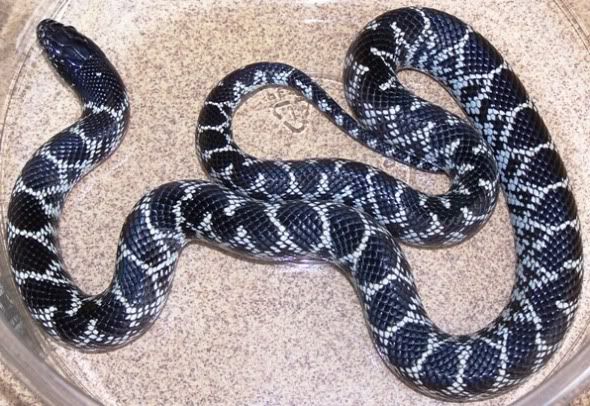
Here is an axanthic Florida king morph. It's identical to the axanthic gene in Soderger's axanthic Texas Rat where it is COMPLETELY void of any red, yellow, or orange (all colors which the pigment cells known as xanthophores are responsible for producing). Recessive axanthic colubrids also tend to have a strong bluish hue to them as well that the Black Rat also has.

In any case, if nothing but typical normals and intermediates where produced when the first generation was bred back to each other, or back to that odd parent, I could then go along with it being a variant that is not recessive, but the color mutation has already been proven to be recessive (lacking all red/yellow/orange) with the exception of the ONE paradox axanthic that was posted with the few odd flecks of color.

cheers, ~Doug
-----
"a snake in the grass is a GOOD thing"

serpentinespecialties.webs.com

DMong Aug 03, 2012 03:20 PM

.
Image
-----
"a snake in the grass is a GOOD thing"

serpentinespecialties.webs.com

DMong Aug 03, 2012 03:50 PM

Again, just another one of many recessively proven axanthics in the hobby with my friend (John Lassiter's) axanthic splendida here. This snake would also normally display yellow pigment (xanthin), but doesn't any at all. And again, it displays the odd bluish hue. With many axanthics, the bluish hue is more pronounced when young and can tend to change into more of a white as the snakes mature and their scales thicken.

~Doug

Image
-----
"a snake in the grass is a GOOD thing"

serpentinespecialties.webs.com

scaledverts Aug 02, 2012 04:31 PM

I would love to get my hands on one or two!
-----
Kyle R. Mara

Common sense is genius dressed in its working clothes. - Ralph Waldo Emerson

http://scaledvertebrates.weebly.com/

DMong Aug 02, 2012 04:48 PM

....that also many amels and leucistics in the hobby mainstream are obviously going to be of mixed Black rat lineage in the hobby anyway since they are very closely related. So it's hard to say for certain. Northern and eastern Texas rats blend and intergrade naturally into the Black rats huge range.

The pink-eyed leucy's no doubt came from amel Black lineage because you cannot tell the real difference meristic-wise between the two white snakes, and definitely not if the two were mixed.

Many of the leucistic Blacks are said to have a more Ivory/beige color to them, but I know for a fact there are countless mixes out there too. Heck, I had a VERY deep ruby eyed leucistic years ago that I bought as a Texas, and an ivory/beige one I bought as a Texas as well. Damned if I know what either of them ever "really" were..LOL! But that is how most are ou there anyway....complete unknowns as whatever someone wants to label them as and whatever someone might have told them as they got them.

To know all this for certain you would have to acquire them from some people that know the origins of locale. There are a few, but not too many. Probably more so for the leucy Blacks.

~Doug
-----
"a snake in the grass is a GOOD thing"

serpentinespecialties.webs.com

AllenSheehan Aug 02, 2012 10:57 PM

What I know of the True T Negative Albino. Don Soderberg did have a strain that he worked with years past as well as a strain of the Anery/Axanthic trait. And like was already mentioned he did sell them off years ago. I bugged the heck out of him years past regarding this. I was able to track down a pair of Anery/Axanthics from this trait several years ago and have been successful in keeping this line pure. This line has zero yellow or red at all. There is a gentleman in the north Texas area that has a very few albino hets of Dons strain that was already pictured. This same individual also has another legitimate T Negative strain that was also wild caught in the central Texas area. These two strains turned out to not be compatible with each other. The strain Don had started years back certainly has something unique to it. I hope to pick up a few hets of these pure strains later this summer if they become available. Why I did not keep a few around when I had the chance many years ago I will never know. I had assumed then they would always be plentiful. And Doug is correct in that most of them probably got muddied up in hybrid projects. Beyond that I have not seen one for many years. I believe Don does still work with specific local Leucistic black rats and Texas rats. His site goes into good detail about those guys. I have the "Paradox Anery" (I stole that name from Doug. LOL) that was caught on Max Petersons land. Between Max and me we should prove or disprove this trait maybe next summer. Anyone out there now of other honest albino Texas rats I would like to hear about it

Allen

scaledverts Aug 02, 2012 11:53 PM

Hey Allen,

TWO non compatible strains...

MAN, I wish I lived in Texas and knew the local breeders!
-----
Kyle R. Mara

Common sense is genius dressed in its working clothes. - Ralph Waldo Emerson

scaledvertebrates.weebly.com/

DMong Aug 03, 2012 12:38 AM

Hi Allen,....glad to see you chime in with all that helpful info my friend. That was great stuff and I saved it along with my other info on them. BTW, that's a really sweet orange hypo there you posted!..

Hope you produce those parodox or anery/axanthics you mentioned too. Those are really special!

~Doug
-----
"a snake in the grass is a GOOD thing"

serpentinespecialties.webs.com

Site Tools