Reptile & Amphibian Forums

Welcome to kingsnake.com's message board system. Here you may share and discuss information with others about your favorite reptile and amphibian related topics such as care and feeding, caging requirements, permits and licenses, and more. Launched in 1997, the kingsnake.com message board system is one of the oldest and largest systems on the internet.

Click for ZooMed
Click here for Dragon Serpents

I Hit Hidden Albino Genes AGAIN

scaledverts Aug 09, 2012 12:57 PM

Hello,

This is the second time this breeding season that snakes have been het for albino but I didn't know it.

This time it was my het leucy Texas Rats.

A little background first:

This pair of Texas rats came from breeding my leucy Texas to a het leucy male (breeder loan from a friend). They are quite nice and light as far as Texas rats go.
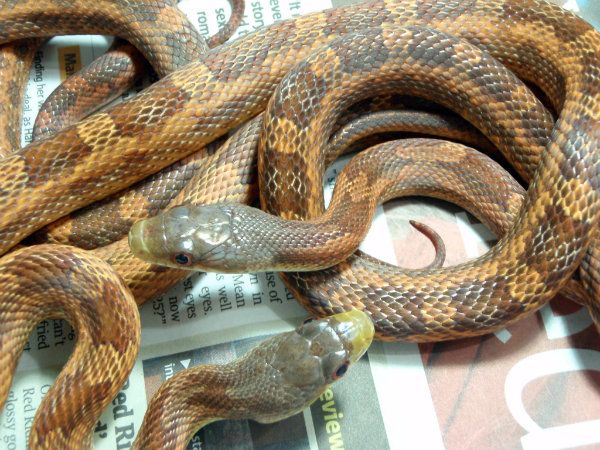
I kept back this pair because they are half siblings to an odd paradox/pied texas rat that popped up in a clutch from a small Florida breeder.

Well I bred them back together and expected to get a few leucy's and some good looking normals. The female gave me 8 good eggs and they incubated for just under 60 days.

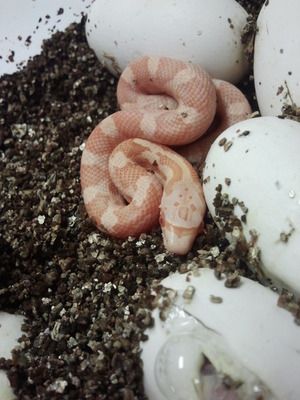
I come home two days ago to find a pink nose sticking out of the egg, the pink nose had pattern on it which meant it was an albino! Needless to say I was perplexed! Neither of the grandparents of these snakes was known to be het albino. None of the clutchmates of the parents were het albino (or any of the other half siblings from the male's other clutches either). As far as I know, the grandparents were true Texas rats. Although it is hard to know for sure with the leucy grandmother.

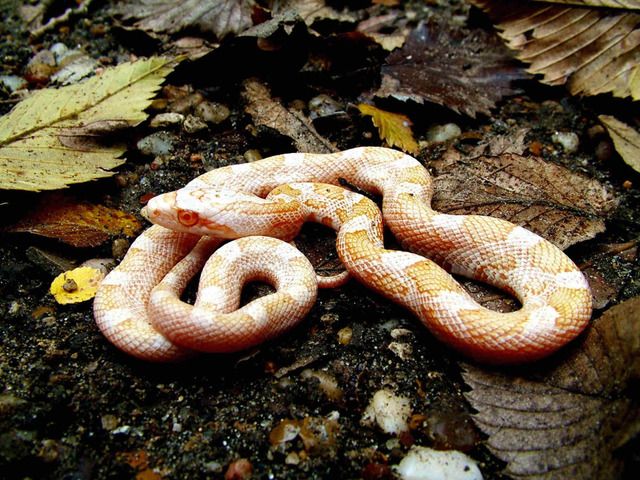
Here's another weird part of it all, so far 5 eggs have pipped and ALL 5 carry the albino gene (at least 2 pink eye leucys and 1 albino, the others are still in the eggs but they are albino too just not sure if leucy or regular albino). The chances that many out of 8 are albino is pretty small 1/4 for each snake basically.

This is also pretty funny to me because of the thread I started below asking about t-negative albino texas rats...I had no idea these were going to hatch when I started the thread below!

Here are some pictures of the one albino that has ventured out of the egg so far and a pic of a wild caught albino texas that was posted in the other thread.

Thoughts/opinions?
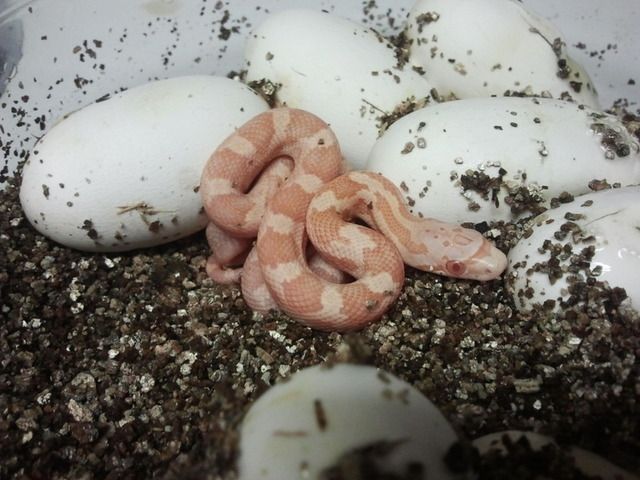
Wildcaught

-----
Kyle R. Mara

Common sense is genius dressed in its working clothes. - Ralph Waldo Emerson

scaledvertebrates.weebly.com/

Replies (14)

DMong Aug 09, 2012 01:26 PM

LOL!!..wow!!. That is pretty crazy stuff there Kyle. That pair of sibs looks like very genuine Texas for sure. Who the heck knows how they got the genetics. That is pretty bizarre about you just asking about them earlier and are now popping some out yourself...

Only in the "Twilight Zone"..LOL!

~Doug
Image
-----
"a snake in the grass is a GOOD thing"

serpentinespecialties.webs.com

DMong Aug 09, 2012 01:50 PM

.....would of course be that the leucy had some distant amel Black rat genetics in it's lineage. It would have to be back a few generations because the het Texas Rat pair you posted look so incredibly textbook authentic in their phenotype.

Since they both have been sold for many years now, there has to be tons of them that have been inadvertently crossed leucy Black x leucy Texas rats over the years. And of course the "pink eyed" Texas leucy's would VERY likely be from the addition of the Black Rat amel gene that has been around for many years,...know what I mean?

~Doug
-----
"a snake in the grass is a GOOD thing"

serpentinespecialties.webs.com

scaledverts Aug 09, 2012 02:39 PM

Yeah Doug,

That's what is going to bug me for a while now! The grandparents of my pair are also classic examples of Texas rats. If the amel gene did come from black rats, it is quite a few generations before the grandparents even!

I guess there is no real way to tell for sure anyway. Without direct lineage paperwork for the grandparetns, it is all just based on phenotype. We'll see what this albino looks like as it grows. Right now it looks pretty much spot on to the juvenile wildcaught. I am curious what the rest of the clutch looks like, I can't wait to get home to check on them!
-----
Kyle R. Mara

Common sense is genius dressed in its working clothes. - Ralph Waldo Emerson

scaledvertebrates.weebly.com/

allensheehan Aug 09, 2012 02:52 PM

I think the best course of action is to just simply ship me the clutch and let me deal with that headache.. LOL

DMong Aug 09, 2012 05:36 PM

Yep, I hear ya man. It seems to be how this hobby works now days. So darn many people in it and so many unknown variables as to what they actually breed to what, or THINK they actually have.

Like you said, I guess all that you can do is to closely scrutinize what is produced later on and if you get any odd surprises that seem a bit out of kilter and look more Black rat (probably easier said than done at this point though, but who knows). That normal het pair sure does look as classic Texas as one could get...

I look forward to future updates on those and what they look like later on.

~Doug
-----
"a snake in the grass is a GOOD thing"

serpentinespecialties.webs.com

FoxTurtle Aug 10, 2012 03:56 PM

A lot of the het (for anything) black rats in the hobby don't look like pure black rats. More a mish-mash of gray/texas/black. I think part of the reason for that is that there are large areas of undetermined and intermediate taxonomy (pre-Burbrink). A lot of black rat snakes in the central part of their range resemble a Texas rat snake more so than a classic black.

Of course, with rat snakes, a lot of people seem to just indiscriminately cross the various subspecies. I don't get it. That's how you make kingsnake food.

So yeah, what I was getting at was that I wouldn't expect a typical hobby-grade albino black rat crossed with a Texas rat to be readily identifiable as a cross.
-----
www.brooksi.com

DMong Aug 10, 2012 10:10 PM

"Of course, with rat snakes, a lot of people seem to just indiscriminately cross the various subspecies"

This would be the far bigger problem more than anything else in today's hobby. And of course I agree with the rest.
-----
"a snake in the grass is a GOOD thing"

serpentinespecialties.webs.com

allensheehan Aug 09, 2012 01:49 PM

I am jealous!!!

Allen

scaledverts Aug 12, 2012 06:31 PM

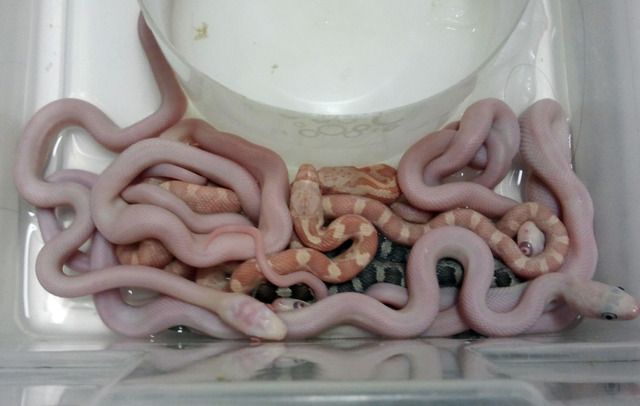
Here is a picture of the clutch. I got 8 total babies (2 albinos, 1 blue eyed leucy, 4 pink eyed leucys, and 1 light colored normal). I think I am going out to play the lotto tonight! Out of double hets I got 4 double homozygous animals...1/16 chance each!

In any case, you can see that some of the pink eyed leucys have some degree of pop-eye to them. This also indicates to me that there is a good chance these are true texas rats. I don't think I have seen it show up in black rats (but I might be wrong).


-----
Kyle R. Mara

Common sense is genius dressed in its working clothes. - Ralph Waldo Emerson

scaledvertebrates.weebly.com/

DMong Aug 14, 2012 01:45 AM

That's very true Kyle. The "bug-eyed" gene is indeed a tandem trait found in the leucistic Texas rats. They could be true linheimeri, but another possibility is that if they were ever crossed with Blacks a while back, some offspring could still express that bug-eyed gene as well as the leucistic and amel gene when the traits align in pairs on the allele. because siblings would be carrying the identical genetic makeup and it is very possible these genes could still line up in pairs to be displayed in homozygous form. It's just impossible to say, but yes, seeing the bug-eyed Texas Rat trait is a good thing to see in this particular case. No doubt what subspecies that came from...

~Doug
-----
"a snake in the grass is a GOOD thing"

serpentinespecialties.webs.com

FoxTurtle Aug 14, 2012 12:45 PM

I've seen bug eyed leucistic black rat snakes too, though. Those may have been from a line that was a Texas cross. Hard to say. Like I've said before, it all seems like a mish mash to me.
-----
www.brooksi.com

DMong Aug 14, 2012 04:02 PM

"Those may have been from a line that was a Texas cross"

BINGO!,......unless the bug-eyed one's you were referring to were wild-caught in a known locale that had nothing to do with linheimeri whatsoever, they have had to have been crossed inadvertently all the time over the years of countless people owning and breeding both types. Hell, I even bought a leucistic "texas" from two different sources to make a pair years ago that were both labeled as "Texas" rats and later on I discovered one had very deep ruby-red pupils. The other was an off-white "ivory" color that is said to be a leucistic "Black" rat characteristic.

Heck yes!, when nobody can tell the difference between the two anyway, simple common sense tells me the cross happens all the time every single breeding year unbeknownst to the breeders. I totally agree, with a few exceptions, the crosses are floating around all over the place being sold as either subspecies.

The way I look at all this is if all these casual hobbyist/breeders can't even tell the difference between the many patterned snakes out there in the hobby, how in god's name could they POSSIBLY tell the difference in the two white snakes?..LOL!!.it just ain't gonna happen, let alone know which are crosses out of all of them out there. I am betting something like 95% wouldn't have a clue which ones they had. I sure didn't either, and the one with deep ruby eyes made me even that much more unsure..

I am wondering if the off-white "ivory" thing isn't simply dreamed up BS too. All it takes is for someone to have some that look more ivory than others and are simple variants that could be in either lecistic ssp.

Anyway, I could never even guess which are true lecistic Blacks and which are true leucistic Texas rats on the best of days, and I know damn well others can't tell either. Just me knowing what most folks know about taxonomy and identification tells me it just can't happen. The ONLY people that know which ones are which, are the few guys that 100% KNOW that theirs originated from one of the few leucistic Black rat locales that were never, ever outcrossed to anyone elses stock not gotten from the same bloodline sources, like maybe Don soderberg's line of leucistic Blacks here. I wish I would have been able to ask him personally, because I was talking to Soderberg just last night for almost two hours. I will remember to ask him about the line he had next time I talk to him though to see what he personally knows about them and where they specifically originated from.

Bottom line is you are totally right about the "mish-mash" thing. I'm very sure a good percentage of them out there are just that, because how could anyone tell otherwise?

~Doug
Image
-----
"a snake in the grass is a GOOD thing"

serpentinespecialties.webs.com

FoxTurtle Aug 15, 2012 09:39 AM

I used to think there was a solid story on leucistic black rats, but I'm not sure now. The main trait I hear of is that they are a lot more tame. A lot more tame is cool! But it's also a very subjective trait. I'd heard that leucistic black rats were also more white than TX rats.

There was apparently a new line of leucistic Texas rat that popped up out of the wild. They were being advertised at $300-$400. Great that it's a new line, but I think that's a bit much to ask for a morph that is already very common in the hobby.
-----
www.brooksi.com

DMong Aug 15, 2012 12:01 PM

Very much agreed on all counts. None of those things are any kind of consistent identifying features between the two leucistic subspecies across the board, even though some of those things can be seen in certain individuals or bloodlines. The so-called "head shape" thing, beige/ivory coloration, temperament, size, nor anything else can identify one from the other with any certainty at all. As we both know, head shape can also vary substantially in many authentic subspecies.

And once again, how on earth could someone look at a leucistic and know if they were not a cross of the two?..LOL! People would have better luck walking along a public beach and tripping over a washed-up pirate chest full of gold...

Bottom line is I'm sure some definitely are one subspecies or the other, and some are undoubtedly crosses of both, but knowing which one's are which is virtually impossible to know.

Then there's the people like this one guy on the hybrid forum a while back that wanted to introduce a Baird's rat x corn to a leucistic "texas" to "bring out the leucistic trait in the F-2's"

HUH???....WTF is that all about????? I can just picture these people staying up nights dreaming this silly crap up?..LOL!!

~Doug
-----
"a snake in the grass is a GOOD thing"

serpentinespecialties.webs.com

Site Tools