Reptile & Amphibian Forums

Welcome to kingsnake.com's message board system. Here you may share and discuss information with others about your favorite reptile and amphibian related topics such as care and feeding, caging requirements, permits and licenses, and more. Launched in 1997, the kingsnake.com message board system is one of the oldest and largest systems on the internet.

Click here for Dragon Serpents
Southwestern Center for Herpetological Research
Click here for Dragon Serpents

What will I get?

bragg1 Oct 01, 2012 12:26 PM

So its been a few years since I have been up and active on breeding/owning snakes. It's great to see how many new morphs of kenyans there are now!
I recently just picked up a pair of Kenyans and am curious to see what I will get out of their pairing. I picked up a Female Stripedxhet anery/Male Normal Het Anery. Like I said it's been awhile and I never played around with these traits. Thanks again for your comments!

-Michael

Replies (13)

eryx4 Oct 02, 2012 10:14 AM

you can get stripe anerys, tiger anerys, stripe 66% het anerys, and tiger 66% het anerys. thanks, scott erycine1@aol.com

chrish Oct 08, 2012 03:38 PM

>>you can get stripe anerys, tiger anerys, stripe 66% het anerys, and tiger 66% het anerys. thanks, scott erycine1@aol.com
>>

I don't think that's right.

I'm not familiar with the term tiger, but I assume a Tiger is a heterozygote for the incompletely dominant striped gene?

If so, since one parent is striped (SS) and the other is normal (NN) the offspring will be 100% tigers (SN) there won't be any striped (SS) babies.

Of those tiger babies,
25% should be anerythristic
50% should be heterozygotes (normal looking)
25% should be normals

Therefore you will only know the genotype of the anerythrystic babies.

I've always had a problem with the concept of an animal being described as "66% het". I know people use it in the hobby but it isn't really correct.

And animal is either heterozygous or it isn't. There is no percentage. An analogy would be to think about a coin flip. It is either heads or tails. Even though the probability of a coin coming up heads is 50%, it makes no sense to describe a coin as "50% heads".

I remember a few years ago a rather heated discussion on the Ball Python forum where someone was proposing the idea that if you were trying to make sure you get a pair of het albinos from 66% hets, it is smarter to buy the whole clutch of "66% het" siblings from one breeder than buy the same number of "66% het" unrelated individuals from different breeders. It was funny to hear people argue for that "logic". (BTW - the answer is no, it makes no difference who you buy them from.)

Chris
-----
Chris Harrison
San Antonio, Texas

scaledverts Oct 08, 2012 08:43 PM

Nope, Scott is correct here.

Stripe is sort of a co-dom gene. It is formed by breeding a rufescens kenyan sand boa to a kenyan sand boa. Therefore, when you breed a stripe to a normal you will typically retain a bit of the rufescens influence which results in the tiger morph.

Also, while yes an animal is either het or not. You cannot predict or possibly know which babies in the clutch will be het and which will not be het. But of the normal looking babies ~66% will be het for anery while ~33% will be normal. So the chances of any one baby being het for anery is ~66%. This only applies to simple recessive traits that do not show some sort of visual heterozygous marker. The coin flip analogy doesn't really fit here as the chances that the anery gene is passed on to the offspring is not 50/50 because both parents have a copy of it. If only 1 parent had a copy of the anery gene then the babies would be 50% het anery. It's all based on punnet squares of simple recessive traits. Technically the 66% referrs to genotype frequencies in the offspring.

Another option is to list all normal looking babies as normal even though 2/3 of them are also carrying the anery gene. Personally, I would rather know that a baby might be carrying the gene as opposed to being surprised by it later on. The only other way to be sure about hets is to raise them up and breed them, and even then statistically it is possible that those that are het anery would not produce any anery babies when bred to a homozygous anery.
-----
Kyle R. Mara

Common sense is genius dressed in its working clothes. - Ralph Waldo Emerson

scaledvertebrates.weebly.com/

chrish Oct 09, 2012 12:21 AM

Nope, Scott is correct here.
Stripe is sort of a co-dom gene. It is formed by breeding a rufescens kenyan sand boa to a kenyan sand boa. Therefore, when you breed a stripe to a normal you will typically retain a bit of the rufescens influence which results in the tiger morph.

Then the striped pattern is a result of incomplete dominance of the dark-backed pattern with the normal pattern. But if there is a "tiger" pattern that is intermediate between the stripe (het) and normal (homozygote) the characterstic is not inherited by simple mendelian allelic patterns. It would have to be polygenic/polyallelic or there would have to be something else happening (epistasis?).

i.e. If RR is dark-backed, and NN is normal, and RN is striped, how do you make a tiger? It can't work this way.

Genes can't be sort of codominant. Codominance is a very specific situation where two different alleles express a product and the heterozygote shows both characteristics of the homozygotes. Incomplete dominance is where the het is intermediate between the two homozygous characters. Neither of those explains this situation.

We as snake breeders are too quick to label something codominant just because it isn't a simple dominant/recessive allele pair. The stripe seems unlikely to be inherited through co/incomplete dominance. In fact, when you look at the larger picture (that the same pattern inheritance seems to occur in miliaris) it gets more potentially complex. The development of a dark stripe on the back which obscures the normal pattern occurs in more than one species of sandboa (depending on your views of Eryx whitakeri, maybe three species). In fact I remember hearing or reading about dark-backed E. jayakari as well somewhere years ago, so maybe four?

There is the possibility that the tigers are just a variant expression of the striped genotype (i.e. some stripes are more complete than others), but in that case striped x striped crosses would produce tigers, and stripes, and normals, and dark-backed snakes. Do they? If not, it isn't incomplete dominance.

Anyone have a decent pedigree we could look at?

The coin flip analogy doesn't really fit here as the chances that the anery gene is passed on to the offspring is not 50/50 because both parents have a copy of it.

I think you missed my point. My point had nothing to do with the actual probability, just the nomenclature.

My analogy was that just because a coin has a 50% probability of turning out heads when flipped doesn't mean that coin should be called a 50% heads coin. But that's what we are doing with these snakes.

The normal looking (non-anery) from this cross offspring have a 66% percent chance of being heterozygous. But no individual can be 66% percent heterozygous, therefore it makes no sense to call an individual a 66% het.

I understand that the name is implying that there is a 2/3 chance that the snake is heterozygous, but that isn't what it actually says and it is also not how some people interpret it. I know because I have had to explain it to them.

My problem isn't the statistics or the genetics, it is the terminology.

Chris
-----
Chris Harrison
San Antonio, Texas

scaledverts Oct 09, 2012 12:58 AM

But here's the problem with some of what you just typed. Stripe is likely NOT a single gene. Polygenic is perhaps closer to what might be going on here but the gradient between stripe and tiger isn't that clear. It is a reproducible trait that is not simple recessive because you create it by basically hybridizing ruf. and kenyan sand boas (depending on which phylogeny you subscribe to). The reason it is "sort of" codom is that typically in breeding a stripe to a normal you will end up with ~50% stripes. However, the farther you get away from the original pure ruf. to kenyan breeding (ie lower percentage of ruf.) the less predictable the offspring become. So the morph behaves like a codom gene but there is more at work here than a single gene. In theory, epistasis could be at work here, but without sequencing and targeted upregulation/downregulation networks we really will never know.

The real question in my mind here is: Are rufescens kenyan sand boas and kenyan sand boas actually separate species or are rufescens sand boas simply a locality specific morph of kenyan sand boas (I think most are gravitating toward the second option). The answer to this question either a) makes this whole discussion a moot point because they are hybrids and the pattern differences are the result this hybridization or b) makes the situation much more complicated to explain.

While I agree that 66% het can lead to some confusion, I'm not sure that there is a better way of stating it. Do you know of a better way? It likely started out as something like normal 66% chance of being heterozygous, and got shorted over time.

I think a big reason people misuse genetic terms is because they do not understand them. Unfortunately, that has become part of the marketing of the reptile world. Now that it has started down this path I'm not sure there is much that can be done about it.
-----
Kyle R. Mara

Common sense is genius dressed in its working clothes. - Ralph Waldo Emerson

scaledvertebrates.weebly.com/

chrish Oct 09, 2012 06:33 PM

The real question in my mind here is: Are rufescens kenyan sand boas and kenyan sand boas actually separate species or are rufescens sand boas simply a locality specific morph of kenyan sand boas (I think most are gravitating toward the second option). The answer to this question either a) makes this whole discussion a moot point because they are hybrids and the pattern differences are the result this hybridization or b) makes the situation much more complicated to explain.

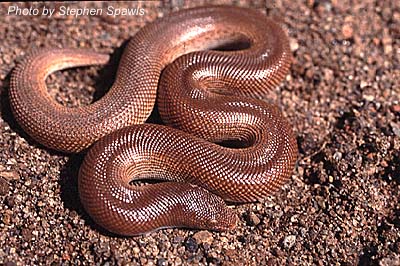
rufescens are just melanistic colubrinus, nothing more. They are restricted to a small region of the species range in northern Kenya and Somalia. I received an email from Steve Spawls along with this photo of a wild caught Ethiopian colubrinus years ago talking about this. Spawls has probably seen as many wild colubrinus as anyone and he indicated that they were simply a melanistic population in the NE part of the range. When Tokar examined the species (sinking loveridgei) he looked at specimens from this region and came to the same conclusion.

And this situation isn't unique to colubrinus/rufescens. You see a similar dark-backed phase in the NE corner of the range of E. miliaris which are sometimes called known by the old name E. nogaiorum in the hobby.

The same is apparently true in some populations of Eryx jayakari.

Melanistic populations of other species of snakes (Natrix, Thamnophis, Vipera, etc.) are well known.

What evidence is there to suggest that they are anything other than melanistic colubrinus?
-----
Chris Harrison
San Antonio, Texas

scaledverts Oct 09, 2012 09:12 PM

What evidence is there to suggest that they are anything other than melanistic colubrinus?

There have been a few genetic studies that have suggested that they are separate species. Really when it comes down to it genetics are where most species descriptions are going these days. Morphology has been shown time and time again to not be an accurate descriptor or phylogeny. However, there have also been conflicting studies that have combined rufescens with kenyan sand boas. If they are simply "range variation" within kenyans, there are some morphological differences other than color such as size (smaller for rufescens than Kenyans typically) that separate the two. This is why any species description has to be based on more than just morphological evidence. As a biologist, I need to see evidence beyond anecdotal accounts before I will make any conclusions. Time and time again phylogenetic relationships based on morphology have been shown to be blatantly wrong. However, there is a fine balance between relying too much on genetics.

Also, stripe is not a black back but a white back. So other species that have black back morphs are not really the same.
-----
Kyle R. Mara

Common sense is genius dressed in its working clothes. - Ralph Waldo Emerson

scaledvertebrates.weebly.com/

bragg1 Oct 11, 2012 01:21 PM

I really appreciate your guys comments on the whole thing. I myself was confused on what I would get, but from the looks of it I will just have to wait and see.

chrish Oct 14, 2012 11:54 PM

There have been a few genetic studies that have suggested that they are separate species.

Are these studies based on snakes (tissue) taken from the wild or from the captive population. If from captives, how many breeder animals came out of east Africa to found that captive population? I suspect there is lot of inbreeding in the captive population and it only represents the genes of a few individuals (at best).

Time and time again phylogenetic relationships based on morphology have been shown to be blatantly wrong.....and even more times when the genetic relationships have confirmed morphometric phylogenies. Of course, those studies don't get as much attention.

I believe strongly in the value of molecular genetics to give us more precision in phylogenetic analyses, but I am always curious about the sample size. In captive rufescens, that sample size may be as few as one or two animals and the captive gene pool has been contaminated with the genetic makeup of animals outside of the rufescens area.

Also, stripe is not a black back but a white back. So other species that have black back morphs are not really the same.

I wasn't referring to the striping. I was referring to the fact that several species of Erycines have populations that show varying amounts of melanism. I'm not saying it is correlated 100%, but I think the parallels are interesting and may speak to the development and inheritance of pattern and melanism in these snakes.

Aren't some rufescens dark-backed and light sided or have there even been enough wild animals looked at to know?
-----
Chris Harrison
San Antonio, Texas

vjl4 Oct 15, 2012 02:51 PM

The problem with using genes to define species is that you have to decide a priori that some % divergence defines a species, rather than reproductive isolation (which will give rise to distinct morphologies). It is entirely unclear what % that should be and there is no natural cutoff. Genes are nice because they can resolve lineage relationships well, but assigning a rank to those relationships isn't any easier with genetic data than with morphological data.

Can-o-worms

Vinny
-----
“There is a grandeur in this view of life, with its several powers, having been originally breathed into a few forms or into one; and that whilst this planet has gone on cycling according to the fixed laws of gravity, from so simple a beginning endless forms most beautiful and most wonderful have been, and are being, evolved.” -C. Darwin, 1859

Natural Selection Reptiles

scaledverts Oct 15, 2012 03:15 PM

Absolutely!

I don't even want to get into cryptic species etc. Speciation itself is sometimes a contentious subject, do you subscribe to the biological species concept, the phylogentic species concept, etc. It gets even more complicated when you consider that "reproductive isolation" comes in many forms. And not all forms of reproductive isolation result in outwardly different morphologies (eg differences in gamete morphology). Unfortunately, detailed morphological descriptions are not performed much anymore. Partially because these sorts of things are harder to get funding for, but also because genetics has become MUCH more common and easier to do.

Also, Chris, I'm fairly sure that the genetic studies were performed on wild populations but I don't have the time to dig up the paper to be 100% sure.

I would say that to most scientists, genetic based phylogenies that match morphological based phylogenies are much less interesting than phylogenies that do not match those predicted by morphology. It usually means that they selective regime that had been assumed to be at work to create the extant morphologies is not actually the selective regime that the organisms faced in their evolutionary history. The one that I am most familiar with is hammerhead sharks (as I have done a bit of work with them). Extant species have heads of varying width (~20% - 50% of their lenth). Morphological based phylogenies predicted that the head progressed from relatively narrow toward increasingly wider as a result of some advantage conferred by the wide head. However, molecular based phylogenies actually show that the pattern of head width evolution is exactly the opposite with wider heads arising first and then head width decreasing through evolutionary history. This has very different implications for the selective pressures that these sharks faced.
-----
Kyle R. Mara

Common sense is genius dressed in its working clothes. - Ralph Waldo Emerson

scaledvertebrates.weebly.com/

vjl4 Oct 15, 2012 03:46 PM

Hell I'm not even a neodarwinian and an evolutionary species concept guy so I think 1) adaptations are rare and even harder to prove and 2) species may not even exist (or perhaps they are like pornography, I can't really define them but will know it when I see it!).

Vinny
-----
“There is a grandeur in this view of life, with its several powers, having been originally breathed into a few forms or into one; and that whilst this planet has gone on cycling according to the fixed laws of gravity, from so simple a beginning endless forms most beautiful and most wonderful have been, and are being, evolved.” -C. Darwin, 1859

Natural Selection Reptiles

chrish Oct 16, 2012 09:07 AM

I would say that to most scientists, genetic based phylogenies that match morphological based phylogenies are much less interesting than phylogenies that do not match those predicted by morphology.

Exactly my point. And beyond that it is hard to publish a study that shows that the moleculer tree is 100% concordant with the morphological tree. That's not "exciting" science and not worth the space in a big journal.
Therefore there is a perception that molecular phylogenetics is throwing all of our morphological phylogenies out the window. That is simply not the case. Clearly there are cases where that has happened, but there are just as many cases I suspect where the phylogenies are concordant.

And we got here from a discussion of striping in sandboas?
-----
Chris Harrison
San Antonio, Texas

Site Tools