Reptile & Amphibian Forums

Welcome to kingsnake.com's message board system. Here you may share and discuss information with others about your favorite reptile and amphibian related topics such as care and feeding, caging requirements, permits and licenses, and more. Launched in 1997, the kingsnake.com message board system is one of the oldest and largest systems on the internet.

Click for 65% off Shipping with Reptiles 2 You
Click for ZooMed
Click here for Dragon Serpents

Brumation questions

gerryg Dec 01, 2012 05:39 PM

As most of you regulars know all my current milks are way down from Central America way and all too young… imo anyway… to be breeding at the moment so brumation has so far not been a topic of interest for me. However I am making inquires into obtaining a pair of snakes from “north of the border” so now seems a good time to ask questions.

First… is brumation necessary for milks whose home range would normally place them under a few feet of snow during the winter months? If it is do the snakes normally start “shutting down” on their own or is it something I will have to initiate?

Second… are there recommended brumation temps for a given ssp’s? Winter temps in the country of origin for the ssp’s I currently have are in the mid 60’s… what would the temps be for ssp’s originating in Nebraska?

Third… are there dangers to it? I’ve read posts in the past where experienced keepers have lost snakes while they were in brumation. If experienced keepers lose animals it seems all but a given there must be dangers. While I would like to breed all the milks I have… which is why I get them in pairs … they are first and foremost pets. Each ssp’s I have is chosen because of some feature about them I like. The fact that each is also rare/hard to come by/uncommon/etc is purely coincidental… I don’t want to lose one of them for any reason.

And lastly… I’ve also read post where keepers place more emphasis on the light cycle rather than lower temps… I’d really like to hear more from those of you that go that route in regards to breeding success..

If you can't tell I'm looking for input on all things having to do with the pro's and con's of brumation... alternate methods etc... appreciate hearing from all of you with experience.

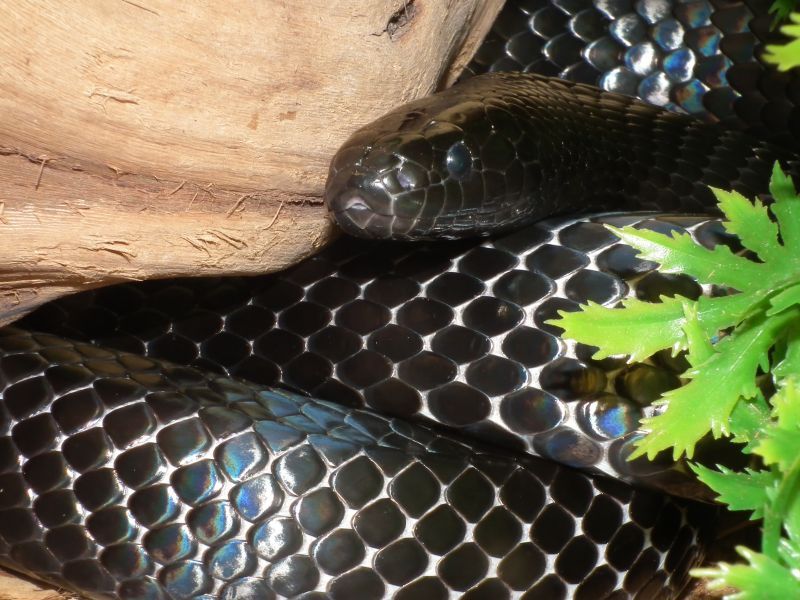
Here's yet another picture of my little darling Jade... when I first looked at this picture I was freaked out... what are all those scars along her infralabials... I took her out of her cage to have a look at what she'd done to herself only to find there were no scars... it took me a few moments to realize the "scars" were little more than a reflection off her infralabials of the skin between her scales... so for those of you needing an excuse to add a BM or two to you collection... how much cooler can you get than a snake that acts as it's own mirror?

Gerry
Replies (4)

tspuckler Dec 02, 2012 07:34 AM

It's not necessary to brumate milks found in the United States, though I've had some that went off feed in the Fall and in those cases you really have no choice. As far as breeding these types, yes I think brumation is advisable.

I don't think brumation temperatures matter all that much, though below 60-65 degrees and above 45 degrees is pretty standard. I would be under the impression that in the wild the temperatures would vary in a hibernaculum.

I've never had a snake die in brumation (I've been cooling snakes in the winter for 25 years). Snakes can die at any time. If the snake is healthy and checked on every week or so, it should be fine. I think inexperienced keepers have a hard time knowing if a snake is healthy. I think keepers with big collections may not check on their snakes enough. I recently checked on my snakes that are in cooling and noticed that a young Rubber Boa has an upper respiratory infection. If I had not checked on the snakes and not known the signs of an URI, then it's likely the snake would have died.

I have a friend who bred Hondurans and for many years that simply used light cycling. It is important to note that in the winter the ambient temperature in the room was cooler than in the summer. He fed his snakes throughout the year. I've heard of Corn Snake breeders that do this as well. While this may work for snakes from warmer climates, I don't think there's been much done to see if it would work for an Eastern Milk or Red Milk....though in my experience these snakes would tend to go off feed and need to be cooled anyway.

Tim

Third Eye Herp
Third Eye Herp

RG Dec 03, 2012 09:21 AM

Like Tim has said, for some species, classic brumation is not required.

I've successfully bred AZ Mt. Kings, California Kings and Corns (many years ago) by turning off their heat, automatic lights and opening the window sometimes at night, to cool them with our Florida winters and it worked perfectly for me.

Years later, I kept heat on with my Hondos and continued to feed them, while reducing the light cycle (not removing it) and I've had good success with that too.

The major advantage with leaving heat on and reducing the light cycle (from Thanksgiving to Valentines Day) is that my Hondos continue to grow over the winter.

The major disadvantage, you never get a break (a complaint from others I've spoken to about it).

The weird thing to me is, the folks that put the snakes down in a dark cool environment always have eggs before me!

-Rusty

SunHerp Dec 02, 2012 12:22 PM

Gerry,

Whether brumation is "necessary" depends on both you and the snakes. Here are some thoughts:
- Many sub-adult and adult temperate traingulum automatically shut down in late summer or early fall. It's a natural process which probably protects them from getting caught with a full gut in an early cold snap (like we both know can happen at northern latitudes!). If the snakes shut down on their own, they really need to be cooled down or they lose condition.

- Breeding is the second factor here. If you want them to breed, they really need to be cooled down (unlike the tropical, Latin American forms). Both sexes seem to need a cold and dark rest period to stimulate the hormones that spur gametogenesis (making sperm and ovulating eggs). Animals which haven't been cooled long enough or cold enough seem to have fertility issues.

Brumation temperatures can be tricky. You want the animals to be cool enough, but not TOO cold. I use a combination of mini-refrigerators and a crawl space that underlies a portion of my house. The crawl space stays below 60 but above 40 degrees (pretty much what I consider the ideal and safe range) all winter. I'm not sure if the temperature fluctuation (certainly doesn't cover that whole spectrum in one week) is helpful or harmful, but I haven't had any problems with it. The dorm fridges are easy to keep at a constant temperature, but there isn't a ton of space in them. The milks typically go in the crawl space, while the Rubber Boas and zonata go in the fridge.

A reduced light cycle is probably important, too, but I keep them dark all winter, so I've never test out HOW reduced a light cycle is necessary. My thoughts are that the snakes (temperate milks) are going to spend the cold months deep underground, and often under several feet of snow. They aren't going to see any daylight.

Hope this helps!

Lampropeltis triangulum - Weld co., CO
Image
-----
_______________________

-Cole

gerryg Dec 02, 2012 05:26 PM

Amazingly enough both replies are/were pretty much what I expected... apparently (in some regards at least) my memories are without fault. Still, I appreciate the confirmation.

Cole... you of course have an e-mail... I, for one, am looking forward to the spring. The best to you and yours!

Gerry

Site Tools