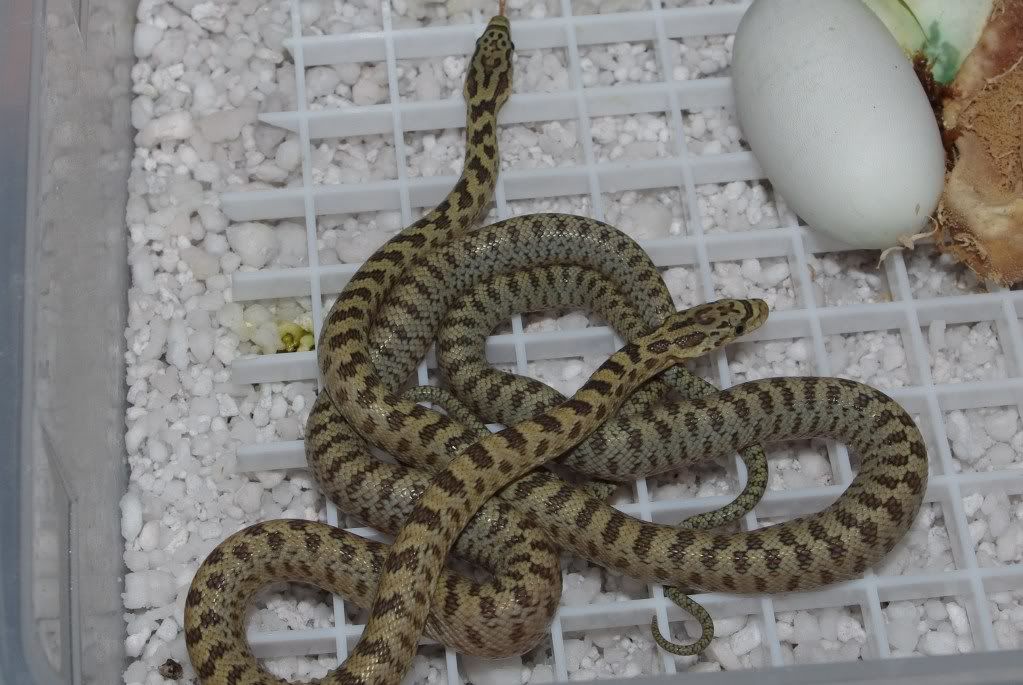
These guys started hatching right on time, around 90 days of incubation. They are Pajarito Mountains Northern Green Rat Snakes...
-----
-Toby Brock
Southwestern Center for Herpetological Research
Welcome to kingsnake.com's message board system. Here you may share and discuss information with others about your favorite reptile and amphibian related topics such as care and feeding, caging requirements, permits and licenses, and more. Launched in 1997, the kingsnake.com message board system is one of the oldest and largest systems on the internet.


These guys started hatching right on time, around 90 days of incubation. They are Pajarito Mountains Northern Green Rat Snakes...
-----
-Toby Brock
Southwestern Center for Herpetological Research
>>These guys started hatching right on time, around 90 days of incubation. They are Pajarito Mountains Northern Green Rat Snakes...
>>
>>
>>-----
>>-Toby Brock
>>Southwestern Center for Herpetological Research
Hey, Toby. How are these hatchlings doing? Did any start feeding yet?
Terry
-----
Conserving reptiles by helping to protect habitat...
www.ratsnakehaven.com
www.scenicsantaritas.org
>>>>These guys started hatching right on time, around 90 days of incubation. They are Pajarito Mountains Northern Green Rat Snakes...
>>>>
>>>>
>>>>-----
>>>>-Toby Brock
>>>>Southwestern Center for Herpetological Research
>>
>>
>>Hey, Toby. How are these hatchlings doing? Did any start feeding yet?
>>
>>Terry
>>-----
>>Conserving reptiles by helping to protect habitat...
>>www.ratsnakehaven.com
>>www.scenicsantaritas.org
Terry, none of these new babies have shed yet (unless they shed last night) and have not fed yet. They are pretty chubby little things, so no worries - lots of time to work with them on it. All of the babies of the previous 2012 intermedia clutches started feeding fairly easily, except for a tiny runt which has been stubborn...
-----
-Toby Brock
Southwestern Center for Herpetological Research
>>>>>>These guys started hatching right on time, around 90 days of incubation. They are Pajarito Mountains Northern Green Rat Snakes...
>>>>>>
>>>>>>
>>>>>>-----
>>>>>>-Toby Brock
>>>>>>Southwestern Center for Herpetological Research
>>>>
>>>>
>>>>Hey, Toby. How are these hatchlings doing? Did any start feeding yet?
>>>>
>>>>Terry
>>>>-----
>>>>Conserving reptiles by helping to protect habitat...
>>>>www.ratsnakehaven.com
>>>>www.scenicsantaritas.org
>>
>>Terry, none of these new babies have shed yet (unless they shed last night) and have not fed yet. They are pretty chubby little things, so no worries - lots of time to work with them on it. All of the babies of the previous 2012 intermedia clutches started feeding fairly easily, except for a tiny runt which has been stubborn...
>>-----
>>-Toby Brock
>>Southwestern Center for Herpetological Research
Yep, these guys can go quite awhile just on their yoke. Hope they do well for you.
TC 
-----
Conserving reptiles by helping to protect habitat...
www.ratsnakehaven.com
www.scenicsantaritas.org
Congrats! Great looking little greens, mine went 91-92. I have my adults down for the winter, can't wait for next year.
-----
Pituophis c. annectans
Senticolis t. intermedia
Pantherophis bairdi
Lampropeltis m. thayeri
Lichanura t. trivirgata
Pseudopus apodus
>>Congrats! Great looking little greens, mine went 91-92. I have my adults down for the winter, can't wait for next year.
>>-----
>>Pituophis c. annectans
>>Senticolis t. intermedia
>>Pantherophis bairdi
>>Lampropeltis m. thayeri
>>Lichanura t. trivirgata
>>Pseudopus apodus
Thanks Ryan!
This is the 7th clutch of intermedia I have hatched. Most of mine have hatched sometime around 90 days (give or take), but have ranged from 80 - 94 days - and some clutches have taken several days for the entire clutch to hatch.
My adult females have double clutched every year so far, even without being reintroduced to males. I did not reintroduce either adult female this year, yet both laid second clutches. There seemingly was lower fertility in these, as some of the "good" eggs went bad (including 3 of 4 from the Santa Ritas female), and both females laid a few slugs before the "good" eggs were laid.
I will start cooling all of my adult snakes this weekend, using a small window unit air conditioner to keep room temps in the 60's. I leave the heat tape on all winter for the green rats per work / articles on them by Cranston (Merker). I am going to leave the heat tape and heat cable on for all of my southern and southwestern U.S. snakes, this year (subocs, meahllmorum, L. g. holbrooki, Keys Corns) - but will cool my rhinos and coxi without heat tape. I cool the green rats for about 2 months, from the end of December / beginning of January through the end of February.
-----
-Toby Brock
Southwestern Center for Herpetological Research
Big congrats again Toby! Any abnormalities in this clutch? They look perfect to me. How close is that mtn. range to the Santa Rita's?
-----
Matt Kauffman
>>Big congrats again Toby! Any abnormalities in this clutch? They look perfect to me. How close is that mtn. range to the Santa Rita's?
>>-----
>>Matt Kauffman
Thanks Matt!
No abnormalities in these three babies - all are perfect!
I am not sure offhand how close / distant those mountain ranges are, but they are separated from each other by enough distance that the populations of intermedia in both do not share gene flow, or at least not very much - and I consider them definitely seperate locales. Here is a map I found which shows the Santa Ritas and Pajaritos. http://www.csupomona.edu/~djmoriarty/az/az_sky_islands.htm
-----
-Toby Brock
Southwestern Center for Herpetological Research
>>>>Big congrats again Toby! Any abnormalities in this clutch? They look perfect to me. How close is that mtn. range to the Santa Rita's?
>>>>-----
>>>>Matt Kauffman
>>
>>Thanks Matt!
>>
>>No abnormalities in these three babies - all are perfect!
>>
>>I am not sure offhand how close / distant those mountain ranges are, but they are separated from each other by enough distance that the populations of intermedia in both do not share gene flow, or at least not very much - and I consider them definitely seperate locales. Here is a map I found which shows the Santa Ritas and Pajaritos. http://www.csupomona.edu/~djmoriarty/az/az_sky_islands.htm
>>-----
>>-Toby Brock
>>Southwestern Center for Herpetological Research
Cool map, Toby, and if you don't mind I'd like to add to the discussion of the location of the ranges. Actually the map leaves out some good info about the areas bt. the ranges. For instance, there are two more ranges bt. the Pajaritos and the Santa Ritas, the Atascosas and the Tumacacoris. The Pajaritos, Atascosas, and Tumacacoris are all connected and it's likely the green rats are in all three ranges, although I haven't seen them from the Tumacacoris, yet.
I'm working on an article for the SWCHR Bulletin this month and this will give me some practice. The Pajaritos are also connected to the Patagonias by a small range called the Cayetano Mtns, but the Santa Cruz River separates them, as well as separating the Patagonias from the Pajaritos. Then the Patagonias are connected to the Santa Ritas by a series of hills and washes, etc. I agree that they are all separate localities, but at some time in the past there has been gene flow bt. all of these ranges.
Green rats are unique in their habitat preferences. For instance, there are no voucher records for the Huachuca Mtns, which are in the midst of the Sky Islands that green rats do inhabit. Question is why? Green rats inhabit the northern Santa Ritas and there is gene flow across to the Empire Mtns, just south of the Rincon Mtns which they do not inhabit. And, yet, the eastern slopes of the Santa Ritas do not seem to be inhabited by green rats. This habitat is grassland. One can surmise from these observations that green rats don't like grasslands or heavily wooded areas, such as in the Huachucas. They also avoid the more northerly mountains which have Rocky Mountain vegetation, rather than Madrean vegetation.
Sorry for getting off topic a bit, but thought you could use this info here. BTW, I do see differences in the appearance of green rats from the Pajaritos as compared to the Santa Ritas.
Happy Holidays....Terry
>>>>>>Big congrats again Toby! Any abnormalities in this clutch? They look perfect to me. How close is that mtn. range to the Santa Rita's?
>>>>>>-----
>>>>>>Matt Kauffman
>>>>
>>>>Thanks Matt!
>>>>
>>>>No abnormalities in these three babies - all are perfect!
>>>>
>>>>I am not sure offhand how close / distant those mountain ranges are, but they are separated from each other by enough distance that the populations of intermedia in both do not share gene flow, or at least not very much - and I consider them definitely seperate locales. Here is a map I found which shows the Santa Ritas and Pajaritos. http://www.csupomona.edu/~djmoriarty/az/az_sky_islands.htm
>>>>-----
>>>>-Toby Brock
>>>>Southwestern Center for Herpetological Research
>>
>>
>>Cool map, Toby, and if you don't mind I'd like to add to the discussion of the location of the ranges. Actually the map leaves out some good info about the areas bt. the ranges. For instance, there are two more ranges bt. the Pajaritos and the Santa Ritas, the Atascosas and the Tumacacoris. The Pajaritos, Atascosas, and Tumacacoris are all connected and it's likely the green rats are in all three ranges, although I haven't seen them from the Tumacacoris, yet.
>>
>>I'm working on an article for the SWCHR Bulletin this month and this will give me some practice. The Pajaritos are also connected to the Patagonias by a small range called the Cayetano Mtns, but the Santa Cruz River separates them, as well as separating the Patagonias from the Pajaritos. Then the Patagonias are connected to the Santa Ritas by a series of hills and washes, etc. I agree that they are all separate localities, but at some time in the past there has been gene flow bt. all of these ranges.
>>
>>Green rats are unique in their habitat preferences. For instance, there are no voucher records for the Huachuca Mtns, which are in the midst of the Sky Islands that green rats do inhabit. Question is why? Green rats inhabit the northern Santa Ritas and there is gene flow across to the Empire Mtns, just south of the Rincon Mtns which they do not inhabit. And, yet, the eastern slopes of the Santa Ritas do not seem to be inhabited by green rats. This habitat is grassland. One can surmise from these observations that green rats don't like grasslands or heavily wooded areas, such as in the Huachucas. They also avoid the more northerly mountains which have Rocky Mountain vegetation, rather than Madrean vegetation.
>>
>>Sorry for getting off topic a bit, but thought you could use this info here. BTW, I do see differences in the appearance of green rats from the Pajaritos as compared to the Santa Ritas.
>>
>>Happy Holidays....Terry
>>
>>
>>
>>
>>
>>
>>
>>-----
>>Ratsnake Haven Webpage
>>Ratsnake Haven Group
Thanks for the info and clarification, Terry. I misspoke somewhat by saying there was little or no gene flow between the Pajaritos and the Ritas. Yes, I agree that there has to have been some flow between those ranges, and the rest as well - at least at one time.
I am very interested in the natural history of green rats, and I appreciate the input.
Also - I am looking forward to your SWCHR Bulletin article very much now!
-----
-Toby Brock
Southwestern Center for Herpetological Research
Help, tips & resources quick links
Manage your user and advertising accounts
Advertising and services purchase quick links
