Reptile & Amphibian Forums

Welcome to kingsnake.com's message board system. Here you may share and discuss information with others about your favorite reptile and amphibian related topics such as care and feeding, caging requirements, permits and licenses, and more. Launched in 1997, the kingsnake.com message board system is one of the oldest and largest systems on the internet.

Click for 65% off Shipping with Reptiles 2 You
Southwestern Center for Herpetological Research
Click here for Dragon Serpents

Musings of a Student/ Why I'm a Milkman

captainjack0000 Jan 09, 2013 06:21 PM

Has anyone given any thought to the idea that there may be differences among the groups of people in the snake keeping society? I have. It seems that there are differences between the Ball Python breeders and keepers, the Corn Snake group, and of the course the Milk lovers. There also seems to be differences between the hot snake keepers and the big snake keepers, though I am less familiar with them.
I regularly visit 3 different forums, one each for milks, corns, and BPS. There appeares to be differences between the general attitudes of the three. I noticed it mostly between corns and pythons because I also was able to visit their off topic forums and get a better sense of other differences between then. More importantly to me is why are there these differences?

Why are certain groups of people drawn to keep pythons over kingsnakes. Are there political differences, or differences in attitudes about nature and the environment or something seemingly unrelated like gun control and why do they exist? Are keepers of big snakes more conservative or liberal than keepers of small snakes? Are current and former members of the armed services more likely to keep some species over other species?

I cannot definitively say there are differences,as I have not run any tests, but it seems to me there are differences. Have any of you had similar experiences?

I say I am a Milkman because I feel most comfortable on this forum of the three. I have found that the folks on this forum are more polite, more engaged in the natural history of the animal and less likely to view the animal as part of a business operation. I'm not saying corn and python keepers are rude, but I am posting this message here because I fear what the reaction would be among the other forums. Which raises another question.

What are the implications of referring to our pets are a "collection". I have read a handful of threads about the quarantine process and many outspoken advocates argue that without such a procedure, their "collection" might suffer. Do any other pet keepers QT other pets? Do fish people QT new fish, or dog keepers? I've only ever heard of the QT process in snake husbandry, and seems like the primary concern is that their stock or overhead might be damaged because of some outside animal. It in some ways, to me, devalues the snake.

It seems weird to me to think of my snakes as colorful objects to be collected. People collect paintings, coins, stamps, and other 'things'. I like snakes, and I want lots of them, but they're not a collection to me. They're living breathing creatures that are my pets. They have personalities! Is there a risk in objectifying snakes? Does doing so limit the ability for a person to appreciate the creature? Is there a cascade of ideas? Are people who view snakes as objects more likely to use a tub and rack system?

And lastly, the division we impose upon milksnakes. Why do we do that? I understand for taxonomic reasons why genetic divisions are important, but are not all milk snakes Lampropeltis triangulum? The subspecies is just a locality? There might be some morphological differences, but does it really matter that much if its a Nelson's or Sinaloan? Or Honduran? Why is there such pressure to have pure stock? Does any of it really matter? An awesome snake is an awesome snake.

Feedback, thoughts, comments, critiques are welcome seeing how this is all conjecture.

Replies (24)

SunHerp Jan 10, 2013 03:52 PM

Has anyone given any thought to the idea that there may be differences among the groups of people in the snake keeping society?

Oh yeah - every time I visit a forum dedicated to another species (or species group).

I have found that the folks on this forum are more polite, more engaged in the natural history of the animal and less likely to view the animal as part of a business operation.

I think you nailed it, right there. The alterna/mexicana-complex and pyromelana/zonata folks are right there with us, though. The keepers of some other species are less likely, for some reason, to be "naturalists", it seems.

What are the implications of referring to our pets are a "collection".

For me? I have a moderately large collection of snakes, most of which are Lampropeltis triangulum. It means that very few of my animals are given names and that I don't don't engage in anthropomorphism. I enjoy my animals immensely and they receive the best care possible. I'm utterly fascinated by their natural history, spend countless dollars and hours observing them in the wild as well as captivity, but they aren't my companions. My family and dogs are companions.

Quarantine

Keepers of many types of animals use quarantine. This certainly includes all herps, fish, birds, small mammals, invertebrates, etc. It's a safety net to prevent the spread of disease from a newly acquired specimen (or group) to the animals already under the keeper’s care. Many infections, whether they be bacterial, viral, fungal, parasitic, or protozoan in nature, can quickly infect and kill established and previously healthy animals. Why would you subject animals you care about to that risk?

And lastly, the division we impose upon milksnakes. Why do we do that? I understand for taxonomic reasons why genetic divisions are important, but are not all milk snakes Lampropeltis triangulum?

All milksnakes are currently classified as Lampropeltis triangulum, but that may not reflect reality. There may, in fact, be more than one distinct lineage masquerading as Lampropeltis triangulum. Additionally, each subspecies has adapted to a unique geographic region and the environmental conditions thereof.

The subspecies is just a locality?

No, it isn’t. A subspecies, as alluded to above, is a genetically and morphologically distinct population within the species which occupies a geographically distinct portion of the species’ range. The subspecies concept simply provides us a way to describe the variation seen across a species’ range. Locality is the place where a specimen is found. For example, this is a Pale Milksnake (Lampropeltis triangulum multistrata) from the locality of Cherry County, Nebraska, USA (my buddy Dell’s photo).

This is a Pale Milksnake (Lampropeltis triangulum multistrata) from the locality of Yellowstone County, Montana.

These animals are the same subspecies, but different localities - that's common. You CANNOT, however, have members of two subspecies at the SAME locality. This is a fundamental principle of the subspecies concept.

There might be some morphological differences, but does it really matter that much if its a Nelson's or Sinaloan? Or Honduran?
They’re very different animals, really. They differ genetically, ecologically, behaviorally, and morphologically. The Honduran Milksnake (Lampropeltis triangulum hondurensis) is adapted to the lowland moist forests along the Caribbean versant of Honduras and Nicaragua. It’s habitat and interspecies relationships (i.e.; ecology) differs significantly from that of the Sinaloa Milksnake (Lampropeltis triangulum sinaloae), which is adapted to the semi-arid thorn scrub and tropical deciduous forests of northwestern Mexico. The selective pressures that have molded them into the beasts we see today are very different. Many milk-heads appreciate those differences and grow to have a great respect for the diversity we see in the species (or several species, as it may turn out there are).

Why is there such pressure to have pure stock? Does any of it really matter?

It so totally does (at least to me and a few others) because of the reasons I listed above. I’m fascinated by the natural history of Lampropeltis triangulum, including its intraspecific diversity, and if I’m going to keep an animal captive, I strive to make sure I preserve that diversity and thus the impetus for me wanting to keep it captive in the first place.

An awesome snake is an awesome snake.

Ok… but “awesome” is subjective and in my eyes, a snake loses ALL of its “awesome” once it’s no longer a product of nature, but of some breeder with no regard for its natural history.

-----
_______________________

-Cole

captainjack0000 Jan 10, 2013 10:07 PM

You CANNOT, however, have members of two subspecies at the SAME locality.

This doesn't make sense to me. It seems like there would be areas where subspecies' ranges overlap, and you might find two different subspecies in one area. Unless there are distinct populations, metapopulations if you will. In that case, I would think separating into species makes sense. Or just recognize they are metapopulations of the same species and the occasional wandered helps keep genetic diversity high in the local pockets of the species.

For example, here in Florida people go wild over the Florida panther. It is considered to be an endangered subspecies of mountain lion/cougar. To me, it just is a southern population of the couger, not much differently than you might find in Appalachia. I feel like, from a practical stand point, maybe time and resources should be devoted to saving endangered species, not endangered subspecies. Maybe I'm just a lumper and not a splitter.

If the geographically different populations are genetically different, then I wonder why the powers that be haven't divided them accordingly. I find the sociology of scientists to be interesting. Like the whole Pluto as a planet issue.

When I was writing the question about this species/subspecies, I was thinking about how some dog breeders have applied so much artifical evolutionary pressure (for lack of a better term) onto certain dog breeds that pure stocks are have inbreeding issues. I didn't want the same to happen to the herp community. Your common dog is Canis lupus familiaris, a subspecies of Canis lupus (which includes other things like wolves). I'd hate to see a certain L.t.(x) valued over some other L.t. and in hundreds (or thousands) of years find that only pure bred L.t.(x) have major deformities or something else wrong with them.If interbreeding is possible, then increasing genetic richness seems more important than maintaining pure stock. Further study would have to be done to see if certain subspecies do cross in the wild. Like for example the "Gulf Hammock Rat Snake" which is a cross between two subspecies of rat snake, the yellow and the gray.

I guess I just don't know enough about milk snakes to give an answer.

Sunherp Jan 10, 2013 11:57 PM

I just spent an hour on a reply (when I should have been doing other things), only to have it disappear on me. This one is going to be much shorter and succinct (which is probably better, anyway). What I've written below is particularly applicable to Lampropeltis triangulum, as that is our topic.

Subspecies aren't a tenable biological entity – they aren't separate, but rather part of the whole. Milksnakes (Lampropeltis triangulum) are perhaps better (more realistically) viewed as a clinal species, which changes across its broad range in response to local environmental conditions. That said, subspecies are very useful in describing the various within the species. Where a particular set of characteristics (morphological and/or genetic) is fairly consistant over a fairly broad geographic area (often coinciding with a major ecological region, like the Great Plains), we recogzine a subspecies to denote that population.

Subspecies DO NOT overlap and I wish field guides would stop describing them that way. Areas of intergradation are actually areas of non-differentiation. The animals are intermediate, both phenotypically and genetically (duh, I know) between the subspecies on either side. As I stated above, I had an eloquently laid-out explanation with good examples, etc., but that's all gone. Sorry. In short, I had described the habitat and range of the Lampropeltis triangulum gentilis (essentially, arid shortgrass prairie) and L. t. syspila (esssentially mesic forest glades and tallgrass prairie). Between them is an area of intermediate and trasitional habitat: The Flint Hills. In the Flint Hills, one finds milksnakes intermediate between gentilis and syspila. On the western flank, they look more like gentilis, while toward the east, they show more syspila traits. Intermediate habitat = Intermediate (intergrade) milksnakes.

As for conservation, the goal is to generally preserve variety. If milksnakes are only in trouble in New Jersey because of over development, does that mean we shouldn't try to preserve them because they're doing well in Kansas or Missouri? Of course not – a shrinking range and loss of habitat is bad for every species. Is the doom of the New Jersey animals going to spell it out for the rest of the species, too? Probably not, but it's not good in any way, shape for form.

All subspecies of a given species are are adjacent to one another "interbreed". If they don't, they're not subspecies, they're species. Period.

Here's a west-central Kansas gentilis, since everyone likes pictures.
Image
-----
_______________________

-Cole

captainjack0000 Jan 11, 2013 05:26 PM

Okay, that makes sense.

In my rat snake example, then, we should value saving the yellow rat as much as the gray. I'll agree to that.

There are something like 24 subspecies of L.t. Does this seem accurate, or would you have higher numbers of subspecies, or different species all together?

It seems hard to imagine that a black milksnake is not taxonomically more distinct than say a Nelson's.

SunHerp Jan 11, 2013 07:04 PM

In my rat snake example, then, we should value saving the yellow rat as much as the gray. I'll agree to that.

Exactly! The diversity is important.

There are something like 24 subspecies of L.t. Does this seem accurate, or would you have higher numbers of subspecies, or different species all together?

Honestly, probably not. One of the greatest criticisms of Williams' work was that he "over-split" and recognized a number of subspecies based on a dozen or less specimens. Frank Blanchard, many years back, was probably closer with his recognition of far fewer forms, including some that he speculated were part of the triangulum group, but gave them species status because he lacked the evidence to include them under that umbrella (polyzona and micropholis are examples).

It seems hard to imagine that a black milksnake is not taxonomically more distinct than say a Nelson's.

I'm not sure if "more" is an appropriate term. The coloration is super plastic in Lampropeltine Colubrids. Genetic analysis shows that L. t. gaigeae is VERY closely related to adjacent subspecies stuarti and micropholis (surprise, surprise), but is virtually indistinguishable, at a molecular level, from the latter. A melanin overwash is a feature of the species of Micrurus that is sympatric with gaigeae.

There are multiple clades (evolutionarily cohesive groups) within the Lampropeltis triangulum group. Whether these should be designated as the "real" subspecies or given full species status is currently being investigated.

Myself, Dell Despain, and Jeff Hardwick with a L. t. syspila

Image
-----
_______________________

-Cole

JGEORGE Jan 11, 2013 06:00 PM

I totally agree with your observations and writings regarding the subspecies in triangulum. How do you feel about the distribution of L. t. elapsoides and L. t. triangulum? The coastal plains milks appear to be intermediates but what about the areas in KY and TN where elapsoides are known along with triangulum? I have not observed L.t.e. in KY myself, and probably never will, but the university I attended had several in the collection (preserved) from various eastern KY counties. I did not observe any collected animals that appeared to be intermediate. Please keep in mind that I'm basing this on my observations of a limited collection. I'd really like to know what kind of observations others have made regarding the overlap in the south eastern US.
If it weren't for the coastal plains it would be very easy to convince me that L.t.e. should be a different species.

SunHerp Jan 11, 2013 07:12 PM

You are really on to something, JGeorge. Lampropeltis elapsoides was recently elevated to species status based on overwhelming genetic evidence in addition to the morphological and ecological evidence. In short, elapsoides doesn't intergrade with triangulum-complex animals anywhere. L. t. "temporalis" is likely a southern clinal variant of nominate triangulum or a post-glacial isolate of syspila, separated from the remainder of the syspila population by a northward expansion and ecological exclusion by L. elapsoides.

My buddy Dell at the Chubby Pickle

Image
-----
_______________________

-Cole

JGEORGE Jan 11, 2013 07:42 PM

That's great to know. Apparently I'm a little behind!

SunHerp Jan 24, 2013 09:12 AM

It's hard to stay current on EVERYTHING, man. I'd be happy to send you some literature on the topic if you'd like.
-----
_______________________

-Cole

cn013 Jan 19, 2013 12:14 PM

Well said, errr typed.

SunHerp Jan 21, 2013 10:36 AM

Give me a shout sometime, man. I'd like to catch up!
-----
_______________________

-Cole

captainjack0000 Jan 10, 2013 10:24 PM

The keepers of some other species are less likely, for some reason, to be "naturalists", it seems.

What sort of divisions have you found besides naturalist and non-naturalist? I know it is usually bad practice to generalize groups of people, but I would be curious to see what other differences arise. Without trying to offend anybody, here is what I have found. (Again, just conjecture).

Corn snakes - many first time snake owners, usually parents with younger kids, or teens who wanted a snake but weren't ready (or allowed) to have something bigger or more difficult to care for. I have found mixed interests, and mixed political views. Usually a general interest in nature/science, but nothing too dedicated.

Ball python - some more advanced folks from the corn snake group, but also a large portion of BP keepers are older, into breeding, and feel like their BP breeding is a business venture. It seems like many BP keepers have conservative political leanings. This might simply be because of the connection BPs have with keepers of larger pythons.

The big python and boa keepers seem individualistic and independent. I say this because most of my experience with them is their complaints about legislation and their right to keep large animals is being taken away from them by the government.

Milkmen (and women) - Most of the folks who have a naturalist approach want animals that are from their particular region or animals whose wild types are striking. There is little interest in the pet trade created genetic variations. Maybe an albino here or there, but not the triple recessive stuff. They migh have a corn or ball in their collection, but might also enjoy a kingsnake, bull snake or hognose snake equally as well. The snakes that are 'natural' so to speak.

Sunherp Jan 11, 2013 12:05 AM

pretty spot-on with my own observations. I notice that milk-heads (and other Lampro-dorks) tend to be much more field-oriented, too. For instance, this forum is chalk full of field herpers (myself included) who just happent to keep nice collections of milks, too. See? Here's four forum members doing what they do best.
Image
-----
_______________________

-Cole

tspuckler Jan 12, 2013 04:45 PM

I've kept and bred Ball Pythons, Corn Snakes and Milk Snakes. I'm not going herping in Africa (too expensive). I have found Corn Snakes in the wild. The thing is with milks is that there are many different subspecies, including one that lives close by me. This makes finding them enjoyable - even in local populations there's variations. The same thing can be said for Corns (and even Ball Pythons) but with Milks, it's the subspecies that make it extra interesting (and challenging).

Finding my first non-Eastern was a thrill. And more thrills await as I seek out milks in different states. So in my view the variety of triangulum subspecies feeds the field herping beast.

Tim

Red Milk from Snake Road (my first non-Eastern)
Third Eye Herp
Third Eye Herp

joecop Jan 10, 2013 10:44 PM

Cole, if I ever need something explained that is very important I am coming to you!!! I totally agree with everything you just said ,but never in a million years could have put it into words like you just did. Damn it, why didn't I stay in school!!

Joe

Sunherp Jan 10, 2013 11:26 PM

You give me too much credit, amigo!

Rumor has it you're in Kansas... could it be true?
-----
_______________________

-Cole

joecop Jan 13, 2013 03:23 PM

No, you are just modest. You heard right my friend, I am in Dorthy's country. Looking forward to spring when I can get out with buddies and find the treasures that await.!!!

Joe

CarlBartlett Jan 11, 2013 09:19 AM

Cole I agree with you on all counts. To me locality is so important that whenever possible I have them right down to the same section of woods. Not always easy with temporalis. The offspring should be a perfect example of of what has evolved from an exact habitat. As natural selection has created. It's as if you're holding the whole process of time in your hands.
I love the beauty of snakes and the hobby but my golden retriever is my companion.

captainjack0000 Jan 11, 2013 05:17 PM

The offspring should be a perfect example of of what has evolved from an exact habitat.

I'm not trying to pick on you specifcally, but your comment speaks to a larger issue, IMO.

How do you define perfect or exact? It sounds like one could argue the intergrades are the perfect one if they're suited to a variety a of habitats. More adaptable if you will.

I know some people will say something like, the ones with nice clean bands, but I feel like all of this is socially contructed. How can one wild animal be any more perfect than another? How can any of us make any claims on how an animal is supposed to look?

CarlBartlett Jan 11, 2013 07:27 PM

It's the habitat that over time has been the force behind the evolution of what is perfectly adapted to survive in the limitations of climate, food , cover and any number of specifics. The term intergrade is just language we use to help in our own limited ability to place the snake in scientific terms. That snake is still the perfect example of habitat specific survival. Any comparisons based on appearance for our approval is strictly subjective and has no meaning to the perfect snake for the habitat.The true beauty of the snake is not always just the cleanest red or whitest white but in its own place in the land that created it. Although we can't help being attracted to the best in terms of beauty. It's only natural.

SunHerp Jan 11, 2013 07:16 PM

from the same cloth, Carl!

Here are a few hard-core Lamro-dorks preparing to do their thing in far eastern Kansas.

Image
-----
_______________________

-Cole

BrandonD Jan 10, 2013 05:02 PM

I concur with COle, There are definately ssp. of milk snakes, there are many branches. Comparing nelsoni to sinaloae is like comparing syspila to temporalis, if you compared L.t.t. to gentilis or andesiana you can clearly see it is more than variation going on. I see you would be a collins man as he to thought of triangulum in that matter. I would say there are the Eastern milks which would include L.t.t, L.t.temporalis, and L.t.syspila, then the western milks which includes L.t.gentilis, L.t.multistrata, L.t.taylori, and L.t.celaenops, then the southern milks which would be L.t.amaura, annulata, and elapsoides (unless it truly is not a triangulum) Im not even going to get into the south american milks just because I don't understand them how I do the north american milks. But I am a milk man, It may be because I can find them in my "back yard", I was fascinated by them when I first saw one. I always liked finding reptiles and amphibians the one thing that took me the longest to find was the milk snake this could be a reason for me to. I only have 6 at the moment, but I bet my collection will more than double this year. I don't see them as coins or things like that. I see them as special pets, my photo collection of ones I found and released is like a coin collection though, this is one hobby you can easily get into over a hundred animals, because there are so many awesome ssp and so many awesome individuals from each ssp and we all have certain looks we deem more idealistic.
Thats my two cents on it and heres a photo of my 2 favorite snakes
this sanderson celaenops the one with the red head

Locality is a big deal
Cheers
Brandon DeCavele
This syspila is my other favorite
Image

DISCERN Jan 12, 2013 01:01 AM

I see very similar similarities of people who are REALLY into bulls, pines, and gophers and those who are really into milksnakes.

I applaud you milkheads!

Really serious collectors of pits are really against hybrids, all for purity, and if possible, all for experiencing pits in the field. From what I have gathered, serious lovers of milks are very similar!

That is why I love this forum!

Those who are really into milks are REALLY into these awesome creatures, and love them like no other. That, to me, is awesome, and shows complete dedication and seeking of knowledge of these fine animals.

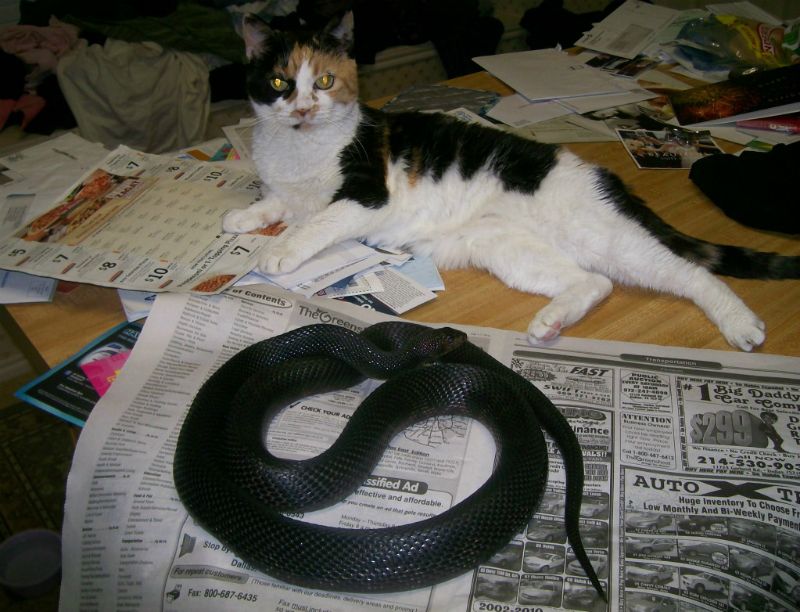
The famous Mammakatt, enjoying relaxing with a locality black pinesnake, over tea and cookies:

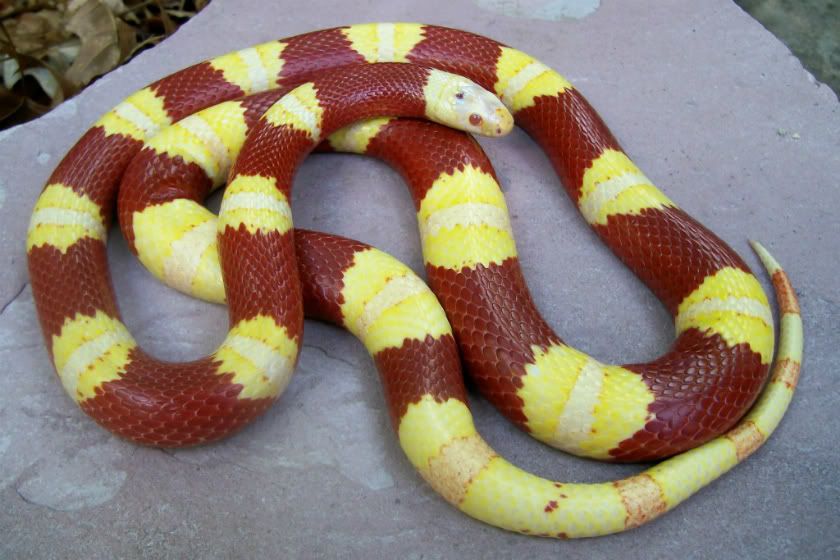
My albino Nelsoni, who will be 14 this year!

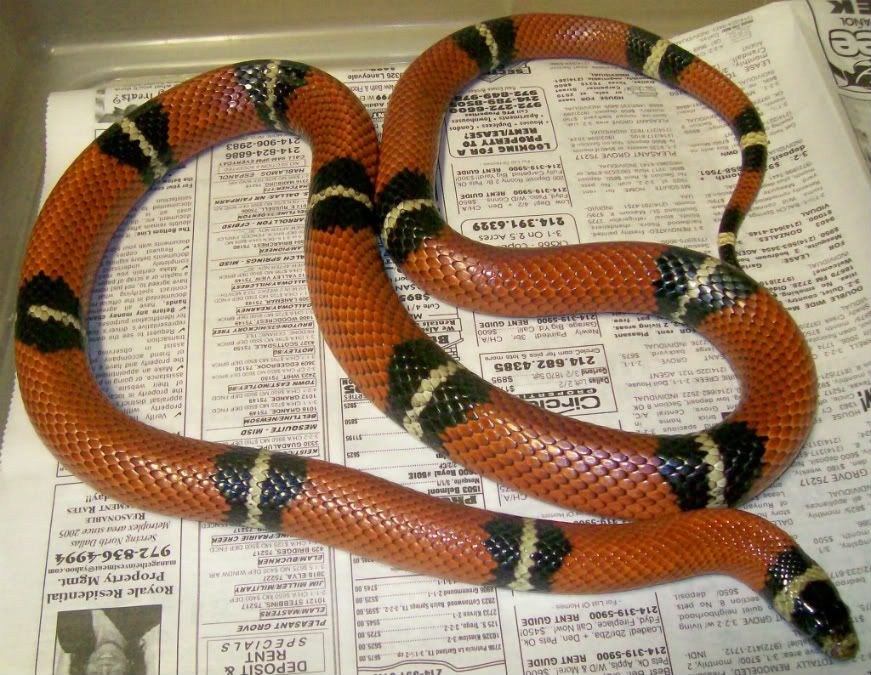
My Sinaloan milksnake, who will be 19 this year!

-----
Genesis 1:1

markg Jan 30, 2013 06:38 PM

The reason ball python keepers focus on morphs only? It is pretty much all they have to go with. Locality data for imported ball pythons is difficult to ascertain, and there are probably few if any recognizable differences among localities.

Having zero locality data means you can't obsess about locality.

Site Tools