Reptile & Amphibian Forums

Welcome to kingsnake.com's message board system. Here you may share and discuss information with others about your favorite reptile and amphibian related topics such as care and feeding, caging requirements, permits and licenses, and more. Launched in 1997, the kingsnake.com message board system is one of the oldest and largest systems on the internet.

Click here to visit Classifieds
https://www.crepnw.com/
Click here for Dragon Serpents

Milk Snake Behavior Question

captainjack0000 Jan 29, 2013 08:36 PM

I came across the video I posted below because I am trying to find an answer to my question.

Why is my milk snake, now after 8 months of being the most shy animal in my house, suddenly more active. Has he just grown up and is no longer afriad? Is he looking for a female? (seem a bit early to me, but I dunno) Does he miss the warm spot that I swear he never used (and why is there a 2-week lag time)?

Details below:

Back on the 15th of this month I bought a new terrarium and took the rheostat I had for my milk snake off to use on the new tank for a new animal. I unplugged the UTH for the milk so as not to have an unregulated UTH. I had no issues with this because since having acquired the milk back in April of last year I have never once observed the snake hiding or resting anywhere near the warm side. He always kept to the cool side of the tank, even for digestion. I would occasionally find fecal deposits on the warm side so I know he moved about at night, but I never, ever found him curled up on the warm side. So I figured my ambient house temps (72F at night, 82F during the day) were within his preferred temperature range. Infact, since having unplugged the UTH I have actually now have found him curled up on what was formerly the warm side.

Every night, I place a cloth cover over his viv to help with the day/night cycles, and I figure it gives him an added sense of security. But, yesterday morning and this morning I uncovered the tanks to find him out and about roaming his tank. This is highly unusual behavior because except for perhaps the first week of ownership I have virtually never seen him out exploring. He knows the layout of his tank and after having been handled he always darted to the cool side hide (now he goes to whatever is closest). On top of this, yesterday, around late afternoon after having returned from work I found him out and about, hiding behind some leaves, casually exploring. It seems as though after he noticed he wasn't alone anymore, my big face peering in on him, he decided to make a run for it, and he head straight away towards the closest hide.

So what is going on? Why is he suddenly active now?

Replies (26)

joecop Jan 29, 2013 10:11 PM

Could be a number of reasons for the sudden onset of movement. The animal could be looking for someplace to brumate (in the mid 50's or so) and does not have the option in the set up that is provided. The animal could be hungry and looking for food. My snakes will move around a bunch for both of the above reasons. As far as the hot spot goes, you seem to have a fairly good gradient, but I can bet that animal uses that hot spot. The snake might not sit there long if the temps are high, but probably does use it. IMO it is a good idea to have it available if the animal is kept up for the winter and EATING. They also use the higher temps to fight off infection, parasites, ect. In short, if your animal is still being fed I would keep the option for the hot spot there.

Joe

DMong Jan 30, 2013 09:47 AM

.
-----
"a snake in the grass is a GOOD thing"

serpentinespecialties.webs.com

captainjack0000 Jan 30, 2013 07:06 PM

I will get a rheostat back back on him this weekend (or right now, wife says we have errands to run).
I had temped with an IR temp gun the warm area to be no more than 88F. I have the UTH still there, I just need to hook a rheostat back up.

Is it a problem not to brumate him? I didn't think it was essential, and I would be curious to know why he is just now, in late January, looking for somewhere. As in why was the onset of his behavior not earlier in the winter.

The food one makes sense. He has been getting smaller prey items. They're big enough I didn't want to want to double down, but small enough they probably don't offer much to him anymore. They're about 13g each, he was 160g at his last weigh in.

joecop Jan 30, 2013 09:32 PM

If he is still eating I would tend to go with the "he is hungry" theory. I know when my snakes are very active and looking to brumate, they do not want to eat either. Get the heat pad back up and running and give the critter more to eat. See if that settles him back down. Is this snake a sub-adult as well?

Joe

captainjack0000 Jan 30, 2013 10:43 PM

I acquired him in April of 2012 and was told he was a late 2011 hatchling. He was 14" or 15" when I got him.

My first weight for him wasn't until August 7th of 2012 and that was 72g.

If he hatched Oct/Nov of 2011, then he's about 15-16 months old, so I would call that sub-adult.

I don't really know though what "late 2011" means. Maybe he's older, maybe he's younger.

joecop Jan 30, 2013 11:05 PM

Not that any advice would change, but what ssp of milk is he? Just curious. I brumate most of my snakes, but will keep hatchlings and sub-adults up for the winter if they continue to feed. This is the time in their lives when they are growing fast and will consume a good amount of food. I would offer at least two appropriate sized meals per feeding. With a good hot spot and properly sized food items, I would feed him every four to five days. If he is searching for food he is obviously hungry. (if that is what is going on here) Just my two cents. Hell, I wish my snakes would continue to feed all winter. (sub adults and hatchlings at least)
Joe

nategodin Jan 31, 2013 08:04 AM

... that would make a huge difference. A black or Andean milksnake kept under those conditions would be trying desperately to get away from that 88 degree hot spot!

joecop Jan 31, 2013 10:51 AM

And in a proper setup could do just that.

Joe

nategodin Jan 31, 2013 11:39 AM

What I was getting at is that for the montane subspecies, having a spot that warm anywhere in the enclosure automatically disqualifies it from being a proper setup, and will lead to excessive restlessness and/or soaking.

DMong Jan 31, 2013 12:40 PM

"having a spot that warm anywhere in the enclosure automatically disqualifies it from being a proper setup, and will lead to excessive restlessness and/or soaking"

I don't honestly think that providing a very small warm spot on the very far end for digestion would be detrimental in any way.... But that is ONLY providing that it can also easily seek optimum cooler temps that those ssp. thrive better in as well. It really comes down to if the enclosure's given size can provide both of these, and that the snake won't have to choose hiding over temps and vise-versa. For instance, a ridiculous example would be a 20 foot long cage. It could even be 20 degree temps on the very far end and 200 degrees on the opposite end. The snake would of course seek a comfortable medium somewhere in between those two extremes for any particular need as it sees fit.

It is definitely seeking something though as you guys already mentioned. Either food or different conditions.

cheers, ~Doug
-----
"a snake in the grass is a GOOD thing"

serpentinespecialties.webs.com

nategodin Jan 31, 2013 01:22 PM

I agree with your last sentence, and that your 20' long cage example is ridiculous.

A better example would be a cage that is 88 degrees on one end, and 68 degrees (room temperature) on the other. Assuming a linear temperature gradient, it would be 78 degrees in the middle. If you have a type of milksnake that avoids temperatures above the mid-70s, then you're wasting over half of the space in the cage. Given that the original poster says that his ambient room temperature is 82 degrees during the day, and that the snake (until recently) always stayed on the cool side, even when digesting a meal, the actual conditions are even less ideal for a montane subspecies than the example I described.

DMong Jan 31, 2013 01:31 PM

I totally missed that the ambient room temps were actually 82 and that there was also supplemental heat ON TOP of that as well. I didn't read all of the responses.

I totally agree that it is simply way too warm for that race!

~Doug
-----
"a snake in the grass is a GOOD thing"

serpentinespecialties.webs.com

joecop Jan 31, 2013 01:33 PM

Well, I would have to agree if the whole cage is getting up to 82 during the day then I would seggest putting the heat pad on a timer so that it comes on at night when the ambient goes down to the low 70's. I did overlook the ambient of 82 deal there. However, if he could get the ambients down to the upper 60's or low 70's AND provide the hot spot I think it would be ideal. Hell, my rubber boas even sit on a hot spot in the high 80's and low 90's at times. But then again, they have a cooler ambient temperature. I know all of my animals benefit from a small hot spot in the their cages, but they do have a lower ambient temp within the cage.

Joe

gerryg Jan 31, 2013 05:22 PM

A supplemental heat source is not needed for any given ssp's of milk snake given the ambient temps are in the low 80's during the day and low 70's at night... and those ambient temps are in fact too high for some ssp's of milks... Yes, no?

I use the data given in the link I've provided to determine what temps I'll keep my milks at... using the average temp as a starting point.

Gerry
Climate Data

captainjack0000 Jan 31, 2013 11:25 PM

I thought I had mentioned my milksnake subspecies. It is a hobby hondo.

He has a UTH in the back right corner of his tank. I did buy a rheostat last night, and that's back in place. I have used my IR temp gun to adjust as needed.

I feel as though my husbandry has been correct at least thus far with 8 months of no problems. So temperature issues asside, I am guessing it is a question of food.

Friday is feeding day so he should happy very soon.

gerryg Feb 01, 2013 04:47 AM

Noah... I think your husbandry has been fine as well.

Since you have the rheostat and the uth back in place my advice would be to dial the uth down and then do as you always do... watch how the hondo responds. If it uses the hot spot dial it up a little more... at some point he may give up using that spot as you've noticed before, when he does simply dial the rheostat back down to the point where he was using the spot. Personally think the ambient temps you have are more than adequate.

As far as feeding... I'm guessing you're doing the once a week schedule since Friday is feeding day. My advice is the same I always give... if your hondo attacks the prey item hard and fast either double up or feed every five days. I don't have a set schedule for feeding... it's always based on how the snakes responded at the last feeding.

Gerry

joecop Feb 01, 2013 01:22 AM

Gerry, that is a cool site!!!!

gerryg Feb 01, 2013 04:55 AM

Yes it is. I've found it very helpful in selecting temps. I was rather amazed at first to find the average temps down in Central America were a good deal lower than I would have guessed. With the exception of my male hondo not one of my milks wants anything to do with spots that are higher than 78-80... the majority prefer things around 73-75.

Gerry

joecop Feb 01, 2013 02:02 PM

I found that pretty interesting myself when ready all the average temps for areas. My LTT sure as heck use their hotspots though!!! LOL... If they ever get a parasite or are fighting an infection they sure will appreciate a hot spot. I have quite a few Zonata, and they will use a hot spot when provided. The temps for these snakes in their natural environment is not high either, however, I have temp gunned the rocks where I have found them basking (exposing part of their bodies really) and have gotten readings well into the 90's when it was only 70 outside. So, some of the temps can be misleading. I used a temp gun on my driveway one day in MD when it was in the 40's outside. The pavement that was exposed to the sun was 80 degrees. Just food for thought.

Joe

Joe_M Feb 01, 2013 05:34 PM

Excellent point Joe. I was thinking the same thing as air temperatures tell us very little about the temps that these snakes choose to utilize for their needs at the time. Ground temps, under cover (tin, wood, rocks, shingles, etc.) temps, and even underground temps explain a lot more what's going on than the air temps with these cold blooded creatures.
-----
Joe

captainjack0000 Feb 01, 2013 07:10 PM

I have had this debate before, the "ambient air temp vs ground temp" debate that is.

Both are important, with perhaps a slight favoring towards surface (or belly heat), at least in terms of keeping them at home.

A snake is going to regulate its temperature, and each species probably has different approaches. There might even be different approaches at different stages of life. A young milk snake may dive for cover in a thick humus layer, and he might be able to move up or down in that layer, at different times of day to regulate temp. If decomposition is in play, say near a rotting log, then that might even provide some heat for the young animal. Compost heaps can give off a lot of heat.

A rattlesnake however might choose to bask in the sun on a pile of leaves, and not bother going under.

I think many people have this notion that the only way a snake regulates its body temperature is using incoming solar rays or hiding in the shade. I would bet that it is WAY more complicated than that.

But what I can tell you, from my climatology class here at UF, is that the air temps you get on these weather maps are probably recorded at about 5 feet off of the ground, and they're in a stevenson screen. It's a box with open slats (google image search for a pic) that allows for the passage of air, but also keeps the sun off of the thermometers and whatever else might be inside. A big reason for this is because air temperature is going to be drastically different than the surface of the intrument. Plus, they need consistency. You don't every cloud coming by throwing off your data collection, so its better to just keep it in the shade all of the time. Why 5ft or so? I bet its convient. Why bend over if you can set it at shoulder height? But this does cause some problems. I've been taught that some places may have a temperature difference of up to 36F in 2m of air closest to the surface. It can be WAY hotter down by your feet than it is by your face. The shortwave radiation coming in from the sun on a clear day can really heat up the ground, but the longwave radiation given off by the earth takes a while to heat up the air above it. Side note, the warmest part of the day (excluding air mass movements and whatnot) is mid afternoon when longwave radiation re-radiating back from the atmosphere is at its peak. (Can anyone tell I'm loving my class because of its utility for herpetoculture?)

Anyway, my point is that air temps are a good start, but surface temps might of more value.

But, the other side of the argument is that snakes may help regulate temperature via breathing. I don't have much evidence for this other than hearsay, but the idea is that the lung in snake is long and passes by some critical organs and blood vessels. A warm surface but cold air may cause problems for the snake because of the exchange of heat from the animal to the air that it exhales. Every new breath in brings in more cold air, chilling the blood and whatever else, and every exhale releases more heat from the animal.

So that argument then says ambient air has to be proper as well.

IMO opinion, both are important because it seems silly to risk being wrong.

captainjack0000 Feb 01, 2013 07:34 PM

My Hondo was very agressive in feeding, so it must have been a food issue. He got a bigger mouse too. A 17g pre-thaw weight mouse Yum!

joecop Feb 01, 2013 09:01 PM

Good news on your hondo!!! I figured that was his issue!!! LOL. Let him eat. I was feeding my hondos a LOT of fuzzies at that stage in their lives. Nice stuff on your studies as well. We can all learn something new from one another here.

Joe

Joe_M Feb 01, 2013 08:09 PM

Very good points,and great info. Although I have yet to find a snake hovering above the ground either 5' or shoulder level in the field
-----
Joe

Joe_M Feb 01, 2013 08:26 PM

Joking of course!!!

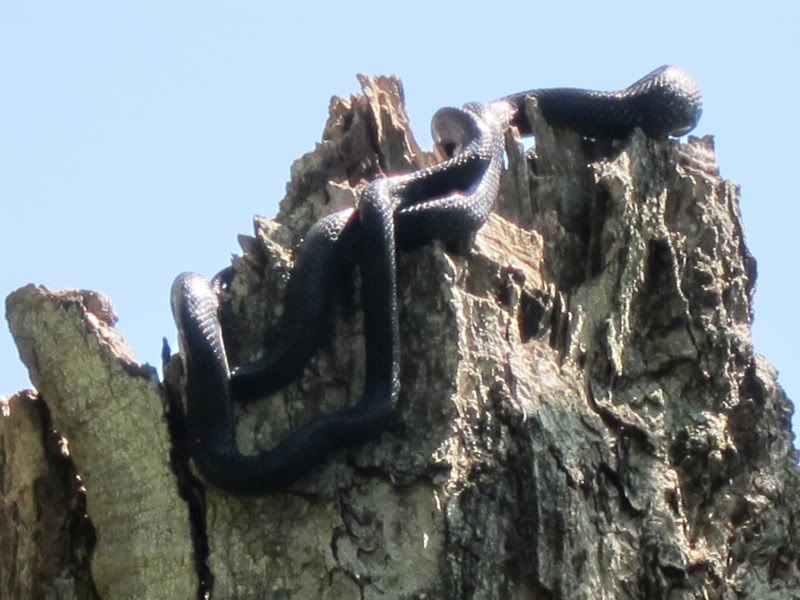
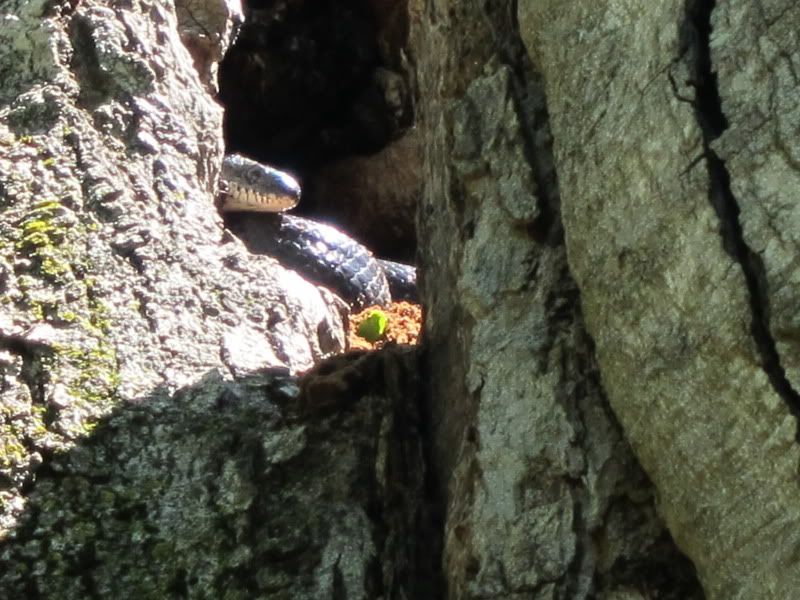
But I have found a few (non milk) snakes up in trees...


-----
Joe

joecop Feb 01, 2013 08:57 PM

Joe, I think those are pics you posted after I posted that giant egg laying site. Nice pics. Most (90 percent plus) of the milks and kings I find are under some sort of surface cover that has been heated by the sun. These objects hold the temperature even after sunset, thus allowing these shy animals to thermoregulate without exposing themselves to danger. No coincidence that most seperated rocks used are not too thick and in the sun, AND have immediate escape routes via rock fissures or rodent burrows. I think these air temps are great examples of ambient air temps for a herp in the given area represented, but they do get, and use, much higher temperatures from objects warmed by the sun.

Joe

Site Tools