Reptile & Amphibian Forums

Welcome to kingsnake.com's message board system. Here you may share and discuss information with others about your favorite reptile and amphibian related topics such as care and feeding, caging requirements, permits and licenses, and more. Launched in 1997, the kingsnake.com message board system is one of the oldest and largest systems on the internet.

Click here to visit Classifieds
https://www.crepnw.com/
Click here for Dragon Serpents

Creative Monitor Cages

Izi Jun 03, 2013 11:05 AM

I have a linoleum'ed wet room set aside for monitors, I am planning on getting a couple of niles. I need to make something to have them be able to go into when guests are over so they can be displayed or just during cleaning time.

Are there any good sites or books that discuss advanced vivarium building techniques?

Monitors will shred mesh, but glass doesn't allow for enough ventilation. My first monitor was kept in a tank with a fan and a pool. After that I used those tanks with the built in vents. Then I had an Iguana in a giant parrot cage for a while and he seemed healthy.

What is the in thing to do for monitors by pros these days? In zoos it always seems to be glass front with a fan, and oppurtunity for bathing. Is this acceptable? Or is glass/acrylic always less than ideal?

Since I also want to do a custom sculpted decorative wall, I would like to find an artist tutorial for custom zoo exhibits so I don't end up using toxic building and sculpting materials.

Replies (24)

Izi Jun 03, 2013 11:07 AM

I know monitors are not meant to be kept in metal cages, btw, because of the burrowing action they try to do with their nose, but maybe there's a rubber coated mesh out there that works that I have not learned about.

FR Jun 03, 2013 12:05 PM

Hi Izi, I think you should learn what is REQUIRED for the monitor first.

I say that because what you have already mentioned, is far from what is needed for keeping healthy monitors.

You already have some very real prejudices that need to be cleared up.

Zoos do not normally address the health of the animals when displaying them. Hmmmmmm this coming from me, who owned a zoo exhibit building company.

Heres the first REAL problem, FANS are not for monitors. They KILL monitors. Fans are to keep the glass clean and without condensation. Moving air, dehydrates reptiles, which is totally against their design.

Rooms do not work out so well for monitors, at least not healthy monitors, the reason is simple, the conditions monitors thrive in, destroys houses. Hot and humid.

The heat it takes for REAL thermoregulation is just to high for most construction methods.

Niles are water monitors, which makes it a bit more difficult.

Enough bad stuff, enough thought there is more.

Your idea is great, the chance of you pulling it off, is not great. Your naive on too many fronts, both monitors and VARANID cage design. Naive means, your not aware. Which also means you can learn.

If I were to recomend the best approach to accomplish your goals, that would be to keep and house a few neonate niles in a normal large cage. If done right, they can grow to 5 or 6 feet in a year, so it does not have to be a long period. During that time, learn about cage materials and the reality of these types of cages.

izi Jun 04, 2013 12:40 PM

Thanks FR,

Wow you owned a zoo building company, that's very cool.

I have read though, that if you wish to keep a nile for its entire life, you have to have a room for it, that it's not possible to keep large adults in a cage. Is this just not true? This is coming from Nile owners so I am not sure what to think, you know.

To be honest, I would MUCH rather have a large cage than set aside an entire room.

Also the fan for the Savannah was mounted outside of the cage, three feet away, and only turned on intermittently, to circulate air. Humidity was 70% in cage at all times, and had deep substrate for burrowing and a pool. I had been told 40% was incorrect for Savs, but I was also told that glass terrariums did not have good air quality so they needed periodic air circulation if you kept them in one. This was in the 90's...I'm sure that I have missed a lot about monitor husbandry since then.

Thanks for taking the time to inform me about all of this. I have never killed a reptile and I don't plan to start

I am lucky enough to live in Olympia, WA, the second most humid city in the US!

Izi Jun 04, 2013 01:45 PM

I think the simplest and most elegant solution, will be to get a shower stall with a bath, and clear sliding glass doors, and mount it on top of a base, so it can be gravity drained with tubing connected to the drain, which is fed through a window and into the garden. Then have part of the tub covered with a rubber treaded plastic or steel platform with a lip they can use to climb in and out. If that is not big enough, then TWO shower stalls. One with glass doors and the back cut out for the front, and the rear attached to the front one, using clamps and a rubber gasket around the edge, for sealing.

Hm, I am not sure at this point the best way to have different basking areas. I would guess...steel brackets, mounted to the sides, with ramps leading to two levels. Would the niles hate that climb or would it be okay?

JME Jun 04, 2013 11:31 PM

Why niles? Are you sure you know what you're getting into? Plan on a 12' x 12' space for a pair. The temp and humidity requirements will destroy a room in your house. I strongly recommend you consider another species.

Izi Jun 04, 2013 11:47 PM

they're horrible monsters that i can expect never to tame or handle safely? LOL.

12 x 12!!!

REALLY!

D:

JME Jun 05, 2013 09:38 AM

Think about it. You have two 6' - 7' lizards that may or may not get along.

FR Jun 05, 2013 11:08 AM

Hi again Izi.

The problem is, your a newbie, and a very avid one, one who is thinking about doing a great job. I want to encourage you, but its hard to get you going in the right direction, without discouraging you.

Many of your concerns, are not whats important. For instance tame or monsters, please, that has not a thing to do with it. I and I am sure JME is not considering that as a problem. At least not between you and the animal. It one bites you, well most likely you made a mistake.

Things like humidity, 70% is nonsense. Period, and it has nothing to do with monitors in boxes or nature.

The problem is dehydration, not hydration. With active diurnal reptiles, they require heat. Such animals as whipsnakes, coachwhips, etc are amoung the snakes that can have this problem. And frankly, no one keeps them because of those same problems. Monitors, are the same, they required heat, to give them heat, you have to add heat, in a way that makes for both The heat that's needed and a huge problem with dehydration. High heat, makes air move. Air moves up, and it takes available water with it. All available water. Which means, its dehydrating everything in the cage. EVERYTHING. Including the reptile.

So with high heat cages, you have to limit air loss. The reason is above, its not actually air loss, its water loss. If you have a water bowl that dries out, you have a reptile that is also drying out. They are NOT designed for that. It causes chronic to fatal kidney damage. to be continued

FR Jun 05, 2013 11:18 AM

Yet monitors, and 99% of all reptiles, shelter in DRY places. Why? because they are not salamanders. It is that simple. They have a protective layer and must be dry and medium humid. A balance of wet, their insides and their protective layer. That must be equal. So after checking tens of thousands of long term shelters in nature, the humidity is aprox 50 to 60%. That is what they DO. They then adjust by temporarily using areas of higher humidity and areas of lower humidity.

In effect, its the same as temps, they need a CHOICE between high and lower humidity.

The key to understanding is this. Their home shelter is THEIR base. That must be a safety zone, just like your home. It must not be too hot, or too cold, or too wet or too dry. Just like your home. That is the first thing all reptiles seek, including monitors.

Most snakes can be tortured and still live, but monitors, they do not play that game, they are more mammal like in that they REQUIRE the ability to perform in a normal way. Again, snakes folks lock in a box and smile. I guess snakes do not need to be happy. Monitors do.

Consider, JME and I, both built dedicated facilities aimed at the keeping and breeding of varanids, including large types. Not a big cage, facilities. Thanks

Izi Jun 05, 2013 01:18 PM

Thanks FR, you're more useful than the internet or books

Okay so what do you think if I connected two airtight shower/bath stalls with duct tubing.

One could house the pool, with varied level perches so they could pick their temperature, then the other could house tunneling substrate at the bottom, with the same configuration of varied level perches ascending. So essentially one of their "rooms" would be wetter than the other, and both would have varied temperature.

Once they got bigger, they could certainly have a 12 x 12 enclosure within a room.

I wonder has anyone experimented with "hamster tube" setups, where a bunch of enclosures are connected together via ducts that the monitors can explore. Although it's possible to set up a room size enclosure in three rooms of this house, that will not damage the house, setups that are not a variation on the cube would be easier to set up for people without the kind of space I have, and may offer a better quality of life for the reptile.

JME - it would be unfortunate if they didn't get along, but in that case, I would just give them separate enclosures. In your experience, have you seen a lot of Niles fighting?

FR Jun 05, 2013 08:45 PM

Hi again, I could tell you what your imagination could make work.

I can help you with what is needed to raise up and produce generations of monitors. Its very simple, unless you let all manner of prejudiced thoughts get in your way. In this case, prejudiced means ideas you think will work, that have no real benefit to what really works.

Like I said, monitors are all reptile and like most reptiles, they are indeed the canary of reptiles. That is, they will detect flaws sooner and let you know about it. Unfortunately, they let you know by being alive and from the outside, healthy one day and being dead the next.(kidney and/or liver failure)(reproductive complications)

They are so tuff, its difficult to tell if an individual has "problems". With snakes, something is wrong, they stop feeding. With monitors, they feed until a day or so PAST when they died. Or it just seems that way.

They are so strong and bullheaded, they just keep going, until its too late. They are strong as bulls, but sensitive to a couple things.

Dehydration, is murder to varanids

Stress is murder to varanids

Egg complications are murder to female varanids, virtually all adult female perish from this in captivity. Its just a matter of when. In most cases, its right off the bat.

These issues are easily addressed, but not the same as with other reptiles.

Izi Jun 05, 2013 09:32 PM

what do I do to get started?

...

izi

Izi Jun 04, 2013 11:54 PM

12x12 - is that last 12 height or width?

I suppose 12wx12l would make an interesting platform floor for the living room.

...

Izi Jun 04, 2013 11:58 PM

SOLID PLASTIC.

Izi Jun 05, 2013 12:36 AM

FR told me to consider another species in response to the limited availability of Varanus griseus, which was logical, since i have to wait like a year anyways, and i need to catch up on what the industry is doing. now I'm told my choice of niles is not good enough. GUYS SHOULD I JUST GIVE UP MONITORS. GO BACK TO LEOPARD GECKOS WHICH IM NOT ATTRACTED TO? OR IGUANAS!! I would rather eat cockroaches than Kale!!! bleh!

Tonight me and my housemate were discussing cooking insects for food since im going to be breeding them anyways. We're all super psyched to try the land shrimp! gross! but im willing to do it for science!

I have the space. I have the money to afford $150 per month feeding, easily. I have the ability to deal with the fact that they want to eat my face at all times.

I just fell in love with monitors, they rock. i want to do it right, so help me. I mean its not the money. I know they cost alot each month.

i dont have any reptiles right now BECAUSE I dont take on responsibilities unless I can take care of them.

I want a monitor local to the middle east. that is really important to me.

Because I am pretty sure the Mushushu was based on the monitor lizard. This is like a [bleep]ing religious thing to me. I would always put them first, like, they are my kids.

i think the whole thing about "their enviroment destroys houses" is just an engineering issue. I have friends who are engineers. It isn't such a big deal. we'll figure it out. Washington State itself, as an enviroment destroys houses. I can build the enclosure outside if need be. To me that would be weird because the monitors should be inside the house, spreading their ferocious energy to the humans.

JME Jun 05, 2013 09:58 AM

No doubt Washington State is tough on houses. Now, turn your house inside out and let me know how it goes. The interior of a home is not made to handle 90F+ temps and 100% humidity. In addition, you're going to have tons of damp earth on what??? Add fecal matter to the mix and you get my point.

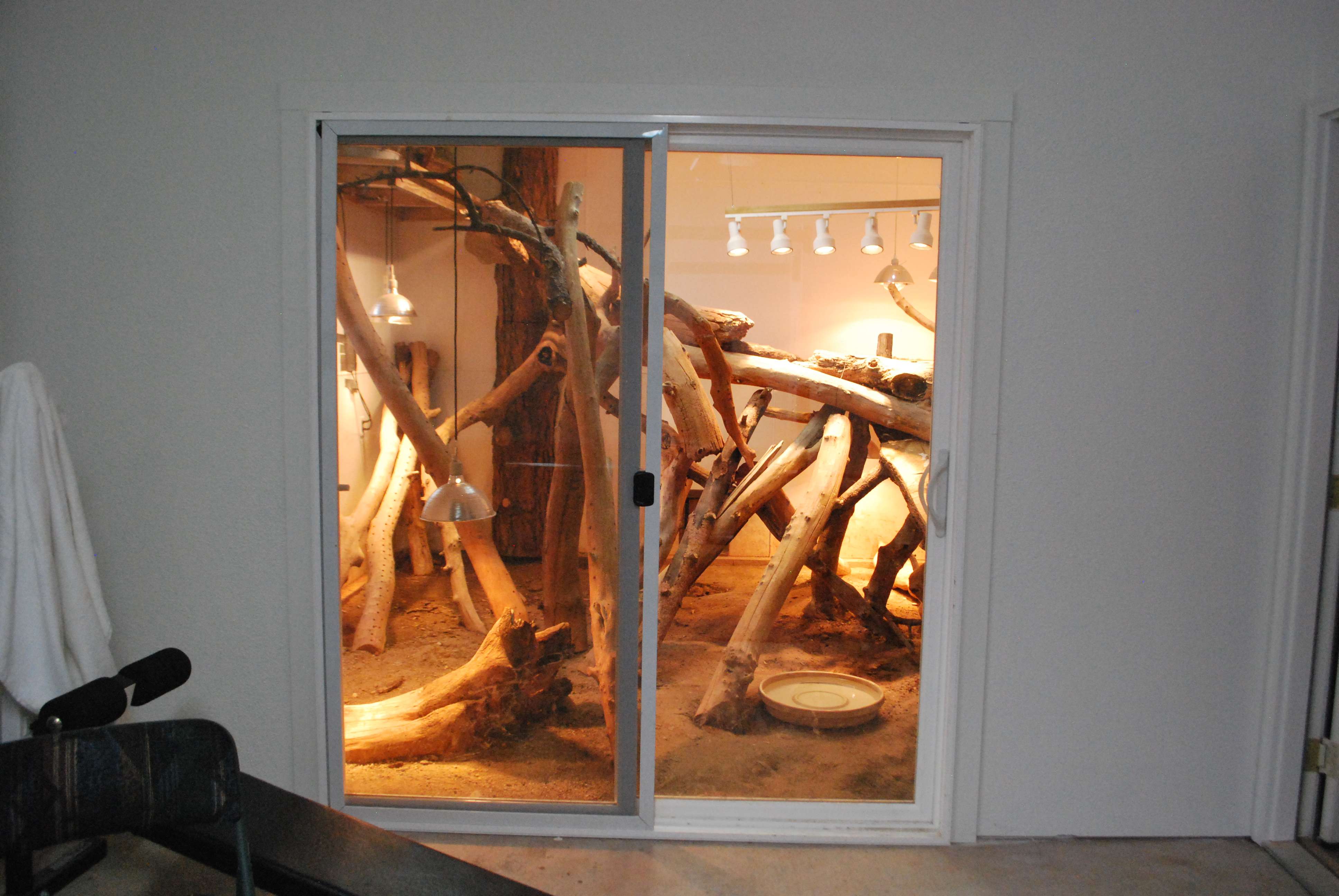
Here's my enclosure. It's approx 15' x 12'. And yes, a mature pair of niles might require something this large. This is NOT in my house! I couldn't imagine something like this in my home. It's a separate building, with an area, that was built specifically for monitors. For example, there's no foundation/ floor in this enclosure. It's dirt all the way to China. Four feet under this dirt is a radiant heating system and wire mesh. This way, I can control the substrate temps. I can also soak the substrate and it has natural drainage. There's no standing water, etc.


Varanus Griseus would be a much better species to house, in my opinion. Problem is, you CAN'T get them. You seem to think it's a simple as driving to someone's home, out of State, who has them. Buying them and driving them back to your place. It's not, you have to be a resident of that State.

So yes, I am trying to talk you out of getting niles. And this is coming from someone who has a few of the larger species. Very few people, and I mean very few, can properly house these for the long term. For others, it's a frustrating experiment that doesn't end well.

Your choice isn't limited niles, griseus, or leopard geckos! There are several monitor species that make better captives. I'm not sure why you're stuck on species from the Middle East and I don't get the religion thing? Have fun eating bugs.

FR Jun 05, 2013 12:04 PM

Izi, the whole direction gets thrown off. One, your choice of niles, hmmmmmmm African, not middle eastern. But none of that is the point.

The point is, your missing whats important to all monitors. it does not matter what kind or where its from.

Heres the problem, in most cases, 90% or more, successful reptile experience with other types, such as geckos, beardeds, or snakes, is a hinderence. The reason is, its far easier to learn something then RELEARN something. From your statements, your going to have to relearn how to keep reptiles. Monitors will teach you what other reptiles REALLY are/need. But other reptiles, will not teach you what monitors are, or need.

What you need is a base education on monitors. You do understand, they are the LEAST successfully kept of all reptiles. Only a couple of species are produced in captivity, and even with those, failure is dominate. Most species like Savs or niles, there is nearly complete failure.

Let me think, hmmmmmmm that hurts, there are tens of thousands of both species in the country, and in the past ten years, you can count the successful reproductive events(minimum level of husbandry) on one or two hands. Then add, those events were mainly one female, one year. Not year after year, or generations.

In my case, I have taken aprox 18 species to six generations or more. With that in mind, both JME and I, are only attempting to get you to head in a direction where you "possibly" could be successful.

What I/we are saying, If you can take a neonate or some small species from hatchling to adult, in say, under 18 months, you will have an understanding of what's needed. Then you take that and expand it to a large cage or room and you and your monitors will be happy. Which is what we want.

continued

FR Jun 05, 2013 12:20 PM

On the otherhand, your choices seem odd, ones an extreme xeric(desert) species, and the other, a water monitor. Both show no(very little)history of captive success. You admit to having ZERO experience. Why would you make those choices????????

You require a species from a particular region, unfortunately, that region only has protected species, due to the hide trade. Bengals(which would be your best choice) desert monitors and The yellow monitor, V.flavecens

Niles venture north to the mouth of the nile river, is that Persia? Cheers

izi Jun 05, 2013 06:02 PM

keeping monitors is odd. you can't milk them you know.

anyways I raised a sav from baby to full 2.5 year adult. (he didn't die, I sold him to a breeder when i turned 17)

bengals are Cites 1 and I can't find any breeders of them so why is that best? Do you mean, the easiest to care for?

I like all monitors. I just feel like I really only have the time to commit to one species, and that is my favorite. I have wanted a big monitor for like 10 years, and V. Griseus is my favorite. There are no monitors I wouldn't be pleased to care for.

FR Jun 06, 2013 10:46 AM

Hi again, Well I keep asking questions because your new and may not have an understanding of varanids. Like your statement of big monitors, You said you want a big monitors, but desert monitors are not big, they are medium sized. 3feet or so, with some males slightly larger.

Bengals get 4 1/2 to over five for some males. Niles, do get very large.

Even Savs can get large, a over 4 foot male is larger in mass then my breeder croc monitor male who 7 1/2 feet long.

All the size talk above is not a given, its a potential. They have the potential to reach those sizes. The reality is, there are no guarantees that they will, and as mentioned, most do not grow up at all, and that's both in captivity and in nature. In nature, the entire world is out to get neonates. In captivity, different people keep monitors, then build and launch rockets. Hmmmmmmmmm in most cases they don't seem able to figure out simple reptiles.

Whats important to them is what is important to you. What would that be?

Izi Jun 06, 2013 11:40 AM

Well, for them to thrive and reach their maximum potential I think is what excites me about keeping herps or any animal really. To allow them to fulfill their natural behaviors which is what makes any species happy

FR Jun 06, 2013 12:19 PM

Well then, your going to be great at this. The next question is how thick is your skin. Because people will attack you more, for being successful, then for being a failure. I know, sounds weird but its true. Which means, the mass of those out there will tell you your wrong, so you will have to do what I did, point to the animals.

Ok, do you want to start off, easy or hard, that is, do you want me to baby you or treat you like an equal????? I think I know the answer, an equal. Which means, I will challenge you to think. Its commonly said, FR, you talk in riddles. Yup, that's true, If your equal, then I require you to think and fill in those riddles, and if you do not understand those riddles, then do not be afraid of asking. And do not be afraid of change.

Are you up to this?

Izi Jun 07, 2013 03:33 AM

yes and yes

FR Jun 08, 2013 09:57 AM

Ok Izi, whats the most important thing for a monitor???

Site Tools