Reptile & Amphibian Forums

Welcome to kingsnake.com's message board system. Here you may share and discuss information with others about your favorite reptile and amphibian related topics such as care and feeding, caging requirements, permits and licenses, and more. Launched in 1997, the kingsnake.com message board system is one of the oldest and largest systems on the internet.

Click here for Dragon Serpents
Click for ZooMed
Click here to visit Classifieds

monitor suitable substrate

monitorguy69 Jul 11, 2013 10:53 AM

hey guys, so i just finished building an 8x4 for my black throat (which is doing a lot better now thanks to everyone that offered me advice which is hard to find through all the bull online), and now i have a little bit of a substrate dilemma. first of all heres some pictures (obviously nothing set up yet, can only see one dome where the basking spot will be)

sorry for such terrible pictures. OSB lined on the inside with FRP, siliconed all openings/gaps, and the black holes are two big rubbermaids in each end to fill with dirt and turn into hides (allowing for digging). my floor would not be able to support thousands of pounds of dirt so thats what i did to problem solve.

the dirt is no problem, will be getting that from my backyard, the problem is mulch. the white areas where the tub doesnt cover, i wanted to fill with mulch, although up here in ontario the only places that sell cypress mulch (within 2 hours of me) have prices that would cost way too just to put a 3 inch layer. any suggestions for what i should do? the only answer im seeing is just having to cover that in dirt too, any input?

also please any criticisms and input on the actual enclosure would be great. thank you!
Replies (21)

monitorguy69 Jul 11, 2013 08:04 PM

decided to just go ahead and fill it all with dirt. hot side is saying 82% humidity with it being about 90 cool side. at the moment 128 - 133 basking spot, ambient is only 80 hot side, and ambient is hovering at 72.2 to 72.7. he is dragging his vent area around this new enclosure, although not seeing much of a "flower" at the moment, maybe due to young age or possibly a female? although he has very large buldges at the base of his tale and the large bumps at right above his nostrils. not nearly enough cover for him right now, will be buying stuff tomorrow, any recommendations for logs or any other functional items? i will get pictures of him as soon as i have an opportunity to do so, without disturbing him.

FR Jul 12, 2013 09:53 AM

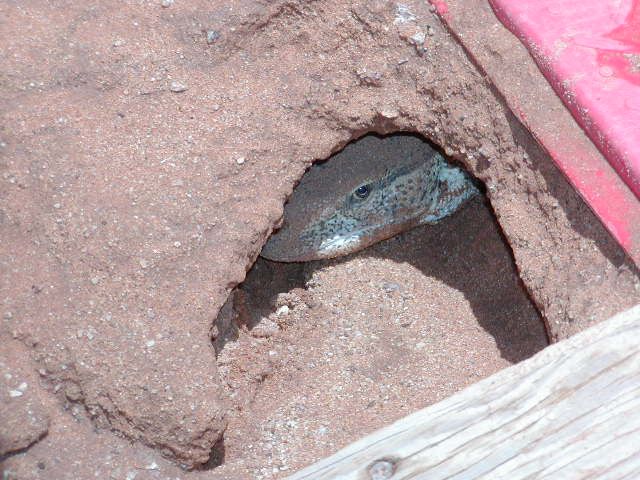
Albigs only use cover temporarily, they LIVE in burrows, your cage does not have the depth to allow that. Most folks would put that cage on top a cattle trough filled with dirt.

Why do you need to know its gender, that cage is not suited for breeding them.

The above is advanced opinion and recommendations.

If you want a "pet shop" opinion, then great cage and good luck.

Do you know those ant farms in the old days, Well albigs live like ants or gophers. They tunnel and burrow and live in those, and occasionally come out of the ground. Just like ants and gophers. You would not keep ants without the ability to burrow, or a gopher, would you?

monitorguy69 Jul 12, 2013 10:33 AM

ok, so the rubbermaids installed in each end of the enclosure is full of 16 inches of packed down dirt, clumps in my hands and breaks apart when i put my finger in it. he has stayed in the cool end since i put him in there, after he "explored", and has also already eaten in this enclosure. i used the rubbermaids instead of a trough due to the terrible availability of them around my area, as soon as i find one i will fit it to the enclosure. i have read that you have bred black throats before? is this true? how much dirt did you supply for them? thanks

monitorguy69 Jul 12, 2013 10:38 AM

sorry for double post, i wanted to ad on to last post. from everything ive gathered, the dirt needs to be deep enough for the monitor to dig deep enough to fit its whole body, so right now my black throat is about 15 inches, so the 16 - 17 inches i am supplying right now is bare minimum and not anywhere near optimal from my understanding, and also a poor amount and i feel like you will be even more blunt about it haha. i am doing my best to attempt to create optimal conditions for the black throat, ive searched intensely for more information but i cannot find any sources that go by your guidelines, other than reading experienced keepers forum entries.

FR Jul 12, 2013 11:57 AM

Its simply common sense. First, your animal is 15 inches long. Its a baby, if you do what you want and take good care of it, and if its a male, in a year, it will be 5 to 7 feet long(with decent care)

THis is the point. You albig should grow 2 1/2 to 5 inches in a month. So in one month, where are we with that amount of dirt? In two months? etc etc.


A adit, is what your providing, an entrance to a burrow, a burrow is many times the length of the animal, any animal. A burrow is something the animal can go into, and stay at the adit/entrance. They use a system of burrows.

Of course we cannot provide that, but we need to provide as much as we can. If your only going to support and entrance, then why do it at all, its of no use. Support something of use. And please, this is only common sense.

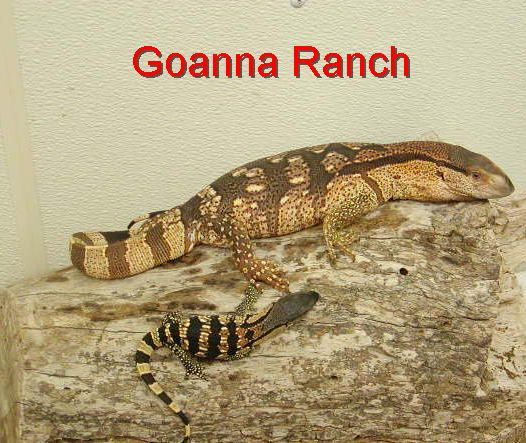
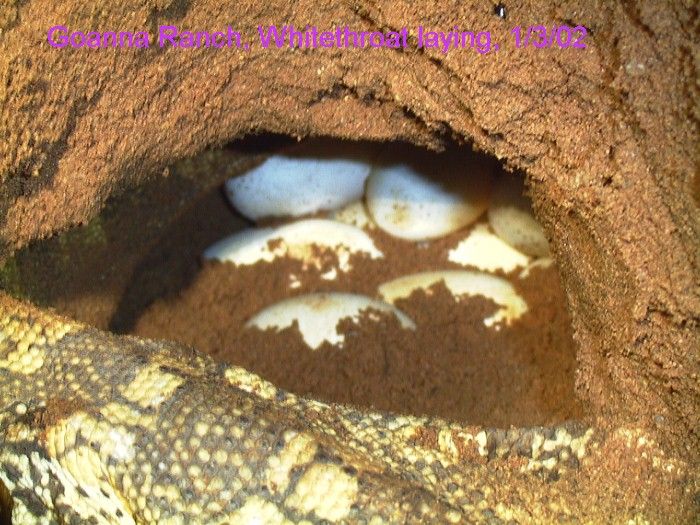
I bred albigs, white throats. And because they are much smaller, topping out at 3 1/2 feet, so about half the size of blackthroats. Which means, I could provide a decent burrow system for adults.

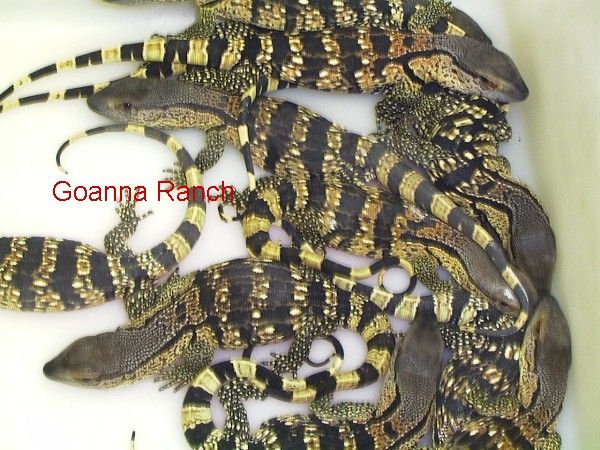
Those neonates are one month apart. They are neonates from a first clutch, and the smaller, the second clutch, which were one month apart.

The last two pics are from indoors in a cattle trough. Most of mine were done outside in larger cages. The larger cages were so much easier on the poor females. Small inside cages, are simply hard on the animals. Again, common sense.

Common sense is by far the most important tool you can use. Simply put, a 7 foot lizard in a 8 foot box, is not using common sense. Best wishes

monitorguy69 Jul 12, 2013 09:24 PM

great, thank you very much for the reply. im trying to find the biggest trough i can now, hopefully i can find atleast 10 ft long, and then ill just go straight ahead and construct a full 10 - 12 ft long cage to properly suit him as an adult (obviously if hes pushing 7 feet or more i will stick to the double body length rule and supply even larger enclosures). thanks again for all these questions you have answered, youre very knowledgeable.

see, the thing is with using common sense, is that a lot of people are afraid to use it with such specialty animals. everything seems to be so scientific and bang on, so i think thats why everyone (me) seems to lack confidence in using common sense. thank you

varanusaurus Jul 13, 2013 12:46 PM

It's not necessarily your fault. Pet stores and the vast majority of herp "enthusiasts" keep all this terrible information circulating.

Your best bet is to forget all that crap, and simply observe the lizard's behaviors. See how it responds to the environment you provide, and make adjustments accordingly.

FR Jul 14, 2013 09:52 AM

Again common sense, what is the double the body length rule??? and what does it apply to? Surely not a seven foot or six foot albig.

Monitors are diurnal active lizards. And your going to give one a box that it can reach the other side, in two steps. Again, that rule is not meant for lizards or any reptile, its meant for people who want to box up an animal and not give it any kind of life.

Let me think, if your six foot tall, would you want to live your life in 12 feet????

Also, you fail to mention what is the most important aspect of monitors. A home. That's what your box should provide at the minimum. So what is a home? whats it like, etc etc?

varanusaurus Jul 14, 2013 12:54 PM

I recently observed the importance of a "home" in a monitor's captive environment.

One of my friends has been working with a single melinus since May, and it exhibited a nervous disposition that goes beyond what I considered typical of most Indo types. Upon disturbance, it would flee at high speeds, slam into the walls, etc., which we expected. What we did not expect was that it would never settle down (hide) in one place. It aimlessly ran from one hiding spot to the next, and remained uneasy for long periods of time. He never once observed it basking or eating.

Although there was a crude structure of many hollows and cork tubes filling up most of its cage, we realized that pretty much all it provided was a range of temps and hiding spots. Hiding spots do not provide long-term security, and are certainly not homes. So what we did was set up a massive, hollowed-out tree stump in the cage, partially buried. Unlike the cork tubes, the stump is very heavy and does not budge when the monitor moves on/within it. The melinus continues to use all the hollows as it does its thing, but it always retires to the stump when its done being out and about. The stump consistently provides security and the same temps/humidity, and has become the lizard's home within its cage. His "typical" Indo monitor now willingly leaves the enclosure to tong feed and explore.

This is a slightly different approach than yours with the deep dirt and albigs, but it's essentially the same concept. Captive monitors need a home they recognize as safe, and can rely on.

FR Jul 14, 2013 03:51 PM

Not different at all, I kept and bred many species and some use hollows, like you used, others dirt, others rock crevices. yet they are all the same, the animal calls it home. NOT the KEEPER.

A funny story, while collecting hollow logs and stumps, I put them in the back on my suburban, I noticed there was more room then I thought, until I looked on the otherside and noticed I popped the big back window out. hahahahahahahahaha Thanks

wldktrptls Jul 14, 2013 02:44 AM

You know, Frank, you have this fr&#%!ng uncanny ability to arrive at conclusions that are, in a way, so fundamentally basic, that i am consistently amazed that i, much less,well..like...every/anybody else, didnt reach the same concept, or that over the decades folks have been keepings these, or ANY burrowing animals, captive, that that way of considering what constitutes at least adequate housing with regard to very nature of what a burrow needs to be hasnt become standard husbandry.
Once again, your insights have forced me to re-evaluate the nature and degree of slow torture i have unknowingly inflicted on a number of monitors in my early days of a box with a light, a water dish and a branch...

Tragically, so many of the imported monitors really dont even stand a chance in captivity in the hands of people who, often with the best of intentions, really have no idea what is involved in these creatures husbandry. And, alas, there you go, again, raising the bar...jolly good show! Jolly good!

guy

tectovaranus Jul 14, 2013 11:37 AM

" i am consistently amazed that i, much less,well..like...every/anybody else, didnt reach the same concept, or that over the decades folks have been keepings these, or ANY burrowing animals, captive, that that way of considering what constitutes at least adequate housing with regard to very nature of what a burrow needs to be hasnt become standard husbandry."

Guy, you should do just the tiniest amount of research into the history of animals in captivity, most of these concepts were originated in the 1960's although this type of info has been around for over a 100 years, granted it's been ignored by many, many people but it's nothing new.
The concept of an enclosure being an animals environment or habitat and that it must have multiple homes within that environment was the lifelong work of Heni Hediger, you know "the father of zoo biology" also called the "father of animals in captivity", he was promoting deep substrates for burrowing animals in the 1950's, published, verifiable accounts.
(Not to mention the FACT that Hediger came up with 99.99% of the husbandry concepts promoted here.)
But then so was Hagenbeck in 1910....oh and Gardner in 1890...hell Gardner recommended "deep sandy loam with a vegetable layer(leaf litter)" for large African lizards (niles? he doesn't say) in 1890, that's EIGHTEEN ninety NOT 1990!!!
I'd recommend reading the book that FR's old boss wrote
"A different Nature" by David Hancocks. He's been the biggest promoter of Hediger's work to ever be involved with animals, it's a great overview of the men who did the real groundbreaking work and how their insights have been ignored by most...you'll learn who REALLY came up with these concepts, not who's copying and parroting them.
Ben

varanusaurus Jul 14, 2013 12:06 PM

Shots fired!

FR Jul 14, 2013 04:02 PM

Its not "know" or applied today by the vast majority of keepers. And that's the truth.

The concept of home and who picks it, is totally lost in modern husbandry. Most buy a hide(whatever that is) and call it a day.

In fact of many herp forums, they(even biologist) state that reptiles brains are not capable of making such decisions. So they keep them in Tupperware.

Ben you seem to want to always fight about crayfish(a worthless fight) when we should be teaming up to help people understand what a home for a reptile is and how to understand when its a home and not a pile of nothing useful. A place a monitor calls home is by far the most important item with varanid husbandry.

David Hancocks was never my boss. What is that about??? He was a director at two zoos that I did contract work for. But not my Boss. I did talk to him a couple times at woodlawn park zoo(not about the work). Not sure I ever spoke to him at the ASDM. Best wishes

tectovaranus Jul 14, 2013 04:38 PM

who said anything about crayfish?
Worthless indeed, results always trump rhetoric.

I'd agree 100% that the knowledge is lost or not known or practiced
by most today and that's a shame.
The "hides" that most offer are worthless, agreed again.
Don't get me started on Tupperware, Tupperware and racks sucked the fun and soul right out of the hobby.
Why would I team up with you Frank? All you've ever done is tell lies about me. Do you feel like teaming up with people who tell lies about you? Didn't think so.

"A place a monitor calls home is by far the most important item with varanid husbandry. "-FR
Excellent quote- dead on the money.

"David Hancocks was never my boss. What is that about???"
Just going off what you said here years ago, I stand corrected.
Ben

FR Jul 14, 2013 08:24 PM

First, tell lies about you. Not hardly, I never talk about you. Only met you once maybe twice, cannot remember. I only repeat what I read or was told or what you posted. That cannot be considered lies, it very well can be mis-information. But lies. How wonderful of you.

About crayfish, that's the only time you chine in and war with me. Results are great, but I got them too and far far far more. But that is not about this conversation.

In this conversation, we totally agree and this is what we should do, not fight about nonsense and water bugs.

Its not about who said what/who in history or any academic literature. As you said, it has failed to trickle down to the keepers of thousands of reptiles and monitors. I have spewed on and on about homes/shelters/security, since 1991. Yet we lose out to the pet product marketers with full page advertising.

I have tried in about 8000000000000000 different ways. And yet, failed.

So what kind of hide(?????????????) do you use? I just don't get it, what in the heck does a hide have to do with any reptile. Best wishes

tectovaranus Jul 14, 2013 08:59 PM

Frank, you know damn good and well what I'm talking about, you told lies about me and my business on this forum, recently.
I won't repeat them, but only you and I know the truth, so between you and I we know who's a liar, nothing else matters on that score.

You brought up crayfish, not me, I've got bigger fish to fry than to waste my time going round and round again with you on that nonsense.

There is something to who said what and when, when someone is taking credit for the work of others.
Maybe the failures have something to do with the lies and dishonesty Frank.

The hide comment was in response to yours and I was agreeing with you.
I use 24-36" of sandy loam and leaflitter, along with natural and artificial logs, branches, vines and tubing for all my varanids.
Ben

wldktrptls Jul 15, 2013 05:08 AM

Ok...sure...i can easily believe that frank may not have been the originator of every single aspect of animal husbandry..however, in the course of my reptile keeping over the decades, it was he that taught me the most in the caring for these creatures, proffering perspectives and systematics previously unbeknownst to me.
Granted, he is no god, nor do i thnk he would choose to be, but he has successfully integrated these knowledges before him, and goes to considerable effort to share that knowledge with others. And the dude can spot a ringneck snake from like a mile away while in a jet watching the inflight movie!
I gather that you two have your differences. Thats between you both. I appreciate your direction in where to seek these ideas in the literature.

guy

PS...you're the guy with the dumerili and the crayfish then? Good work with those guys. I, myself, am rather partial to V. rudicollis.

tectovaranus Jul 15, 2013 09:54 PM

I get that FR introduced you to this type of husbandry and I applaud that, it's great that he is promoting and adding to the data/history.
You stated that gosh, golly, gee, it's a wonder that nobody else came up with this over the years, I simply pointed out that your perception was in error.
But there is a broader reason why I bring up this dangerous lack of history in the story told here.
There is a long and storied history of hardworking men who worked all of their lives to promote these exact concepts, when it is purported that just one man has originated all of these ideas because he is some manner of lone wolf or rebel going against the tide of ignorance it's a bit nauseating when the truth is that he is really just one more in a lineage of neglected visionary's continuing this work.
Again I applaud the work FR has done and I do give credit where due, but if it is ignorance and the stupidity of the "full page advertisers" that we're up against, then isn't it is a horse of a different color to promote ideas with respectable pedigree, a continuation of hard work done over centuries, growing and maturing with each passing generation Vs. this one "odd man out" just happened to figure it out, and now he's sticking his finger in your chest telling you to get with it...lot easier to dismiss one "crackpot" vs 100+ years of knowledge and hard work.
Plus, it's just kind of fun and interesting to learn the history of what we do, at least for me.

Yes, I'm the dumerils dude, I also work with several other species of varanids and have worked on and off with rudicollis for years, will be again soon.
Ben

wldktrptls Jul 16, 2013 01:43 AM

I hear what you're saying(well..i think ido..) of course what we do today is founded upon what others did in the past. However, i'd be willing to bet that what elements/aspects each individual integrates into their method/philosophy/approach to husbandry may be likened to the recombinate nature of DNA, where combinations from the past which proved themselves viable in past contexts are passed forward through generations in time. Slight variances to more significant ones develop and continue until other shifts either incorperate the old, outperform them, or progress along side in differentiating populations. Such are the ways of husbandry.

Alas, the full page-er's have deloped a formidable set of traits what with their care-sheets, critter carpets, and cans of tegu food, their ideal examples of proper housing,only overshadowed by the expertise of their staff..(ok..that last part was largely aimed at the petcos of the world...)

But there are those who know better, and as a whole they(we?) Do what we can to keep the genome of progressively better husbandry still thriving in the gene pool, so to speak...

So..i guess what i m really saying is,not only that Frank is a lucky mutant..but that alot more lizards are doing better as captives because of that lucky mutant who has put forth a lot of work and ongoing effort to disseminate not only the results of his works but the means by which others may attain similar effect with their own animals.

Sure..he's not alone in this mission, hell even Watson had Crick!( just to further the strand) But as far as i know, frank was the one that tied the ackie to the kitestring during the thunderstorm..maybe he didnt invent husbandry, but he certainly has helped alot of people understand it better!
Ok....ok...i ll get off the basking spot...
Ben~i would be interested in hearing about your experiences with v.rudicollis as well as your plans for further..well..."roughing it".. i know...sorry..!

guy

FR Jul 16, 2013 10:07 PM

I see your problem Ben, you seem to add all manner of adjectives and descriptive phrases. I never, nor guy did not add those.
I did what most pioneers do. I applied the right information, at the right time, and in a timely manner. Which means, I did it, when it was needed.
I would think we all know "information" is always available, yet application does not always occur. I went against the grain and I applied it when all and I mean all varaphiles thought I was crazy wrong.
A much simpler analogy, I breed mice. I started with the help of a local mouse breeder(masters in herp, rosy boa field work) After I did it for a few years, he came by and said, oh, I thought of that, and I thought of this too, and that. Then he said, I just didn't put it together and make it work. The point is, I did.
So all this your talking about is silly, I took biology and I credit my teacher for allowing me to think and not memorize. I credit my College Mill and Cabinet teacher for the best lesson ever. He had us create a year long project. Then after we turned it in, he said, good, now make the tools to make your project. That was a great lesson.
So Ben I have to ask, did DeVinci invent paint(egg white) or canvas, or brushes. Did Van Bruwn(sp) invent atoms or the bomb?
I simply applied known information and made it work. All I did was allow animals to do, what they are designed to do. What they have been doing for tens of thousands of years.
I accepted that what they do is normal, and how we keep them is not. So I allowed them to be normal and I did it from looking at the animals, not academic literature. All those things you pointed out resulted in what? did they apply it to varanids and have it WORK? Let me remind you, doing something special is about timing. You sir were simply too late. Best wishes

Site Tools